Artificial Intelligence: The Ultimate Double-Edged Sword
RSA Conference 2024 · West Stage Keynote
Overview
At RSAC 2024, a distinguished panel convened to explore the multifaceted nature of Artificial Intelligence, aptly titled "Artificial Intelligence: The Ultimate Double-Edged Sword." Moderated by Miriam Vogel, President and CEO of Equal AI, the discussion featured Lisa Monaco, the United States Deputy Attorney General, and Dr. Fei-Fei Li, Co-director of the Stanford Institute for Human-Centered AI. The talk delved into the profound implications of AI, examining both its burgeoning threats to cybersecurity, democracy, and public safety, as well as its immense potential to drive scientific discovery, augment human capabilities, and solve complex societal challenges.
Key moments
- 0:50 AI lowers barriers for criminals, supercharges cyber threats
- 2:09 Dr. Li: AI is humanity's latest double-edged sword
- 3:35 DOJ's mission: Protecting democracy from AI interference
- 4:30 DOJ applies existing laws to combat AI threats
- 5:00 Example: Conviction for misinformation, linking to AI's future
- 6:50 Dr. Li: AI fundamentally changes computing, a civilizational moment
Artificial Intelligence: The Ultimate Double-Edged Sword
Speakers: Lisa Monaco, United States Deputy Attorney General; Fei-Fei Li, Co-director of Stanford Institute for Human-Centered AI; Miriam Vogel, President and CEO, Equal AI (Moderator)
Conference: RSAC 2024
YouTube: https://www.youtube.com/watch?v=PxbroG6tEIE
Overview
At RSAC 2024, a distinguished panel convened to explore the multifaceted nature of Artificial Intelligence, aptly titled "Artificial Intelligence: The Ultimate Double-Edged Sword." Moderated by Miriam Vogel, President and CEO of Equal AI, the discussion featured Lisa Monaco, the United States Deputy Attorney General, and Dr. Fei-Fei Li, Co-director of the Stanford Institute for Human-Centered AI. The talk delved into the profound implications of AI, examining both its burgeoning threats to cybersecurity, democracy, and public safety, as well as its immense potential to drive scientific discovery, augment human capabilities, and solve complex societal challenges.
The panel underscored that AI, like any transformative technology throughout history, presents a duality that demands careful navigation. While malicious actors, including nation-states and criminals, are increasingly leveraging AI to lower barriers to entry for cyberattacks, exploit vulnerabilities at unprecedented scale and speed, and spread misinformation, the same technology offers powerful tools for defense, fraud detection, and pattern recognition beyond human capacity. This discussion is particularly timely given the 2024 global election year, with nearly half the world's population voting, making AI-driven foreign interference a critical concern for governments and citizens alike.
The dialogue extended beyond immediate cybersecurity concerns to encompass the broader societal and civilizational shifts AI is precipitating. From its impact on labor landscapes and geopolitics to its potential for enhancing education and environmental protection, the speakers highlighted the urgent need for thoughtful policy, responsible development, and broad collaboration between government, academia, and industry. The panel emphasized that effective governance of AI must prioritize real-world risks such as bias, fairness, and privacy, while harnessing the technology's benefits to ensure they are broadly felt and accessible across society.
Background
▶ Watch: AI lowers barriers for criminals, supercharges cyber threats (0:50)
The advent of Artificial Intelligence marks a pivotal moment in human history, akin to the discovery of fire, the scientific revolution, or the invention of the steam engine and electricity. As Dr. Fei-Fei Li eloquently put it, AI fundamentally changes computing, a technology that is now ubiquitous, from the smallest chip in a light bulb to the complex systems in an airplane. At its core, AI represents a more advanced method of leveraging data and prediction models to enhance computational capabilities, making it a "civilizational moment" with profound implications across every facet of life.
Historically, humanity has always grappled with the dual-use nature of its most powerful innovations. From the first stone axe, capable of both building and destroying, to the transformative yet perilous power of steam, electricity, and even biotechnology, every significant tool has presented both immense opportunities and considerable risks. AI is no exception; it is a double-edged sword that can be wielded for both good and ill. This inherent duality necessitates a proactive and balanced approach to its development and deployment.
The problem AI introduces is not entirely novel in terms of malicious intent, but rather in the scale, speed, and sophistication it enables. Existing societal challenges such as fraud, discrimination, and misinformation are not new; however, AI can "supercharge" these activities, making them more pervasive and harder to detect. Deputy Attorney General Lisa Monaco emphasized this point, stating that "discrimination with AI is still discrimination. Price fixing with AI is still price fixing. Fraud with AI is still fraud." This perspective forms the bedrock of the Department of Justice's (DOJ) approach: rather than starting from scratch with entirely new legal frameworks, they are actively applying existing laws and authorities to AI-enabled crimes.
A concrete example of this approach was highlighted: the conviction of a social media influencer for spreading false information about voting methods (e.g., voting via text message or social media platform). While this case did not directly involve AI, Monaco noted that it requires "not a whole lot of imagination" to foresee how AI could be used to amplify such schemes, creating deepfakes or hyper-realistic misinformation campaigns that could severely undermine democratic processes. This underscores the urgency for both legal enforcement and technological solutions to safeguard critical societal functions against AI-powered threats.
Key Findings
▶ Watch: DOJ's mission: Protecting democracy from AI interference (3:35)
The panel discussion illuminated several critical findings regarding AI's impact, spanning both its disruptive threats and its transformative potential:
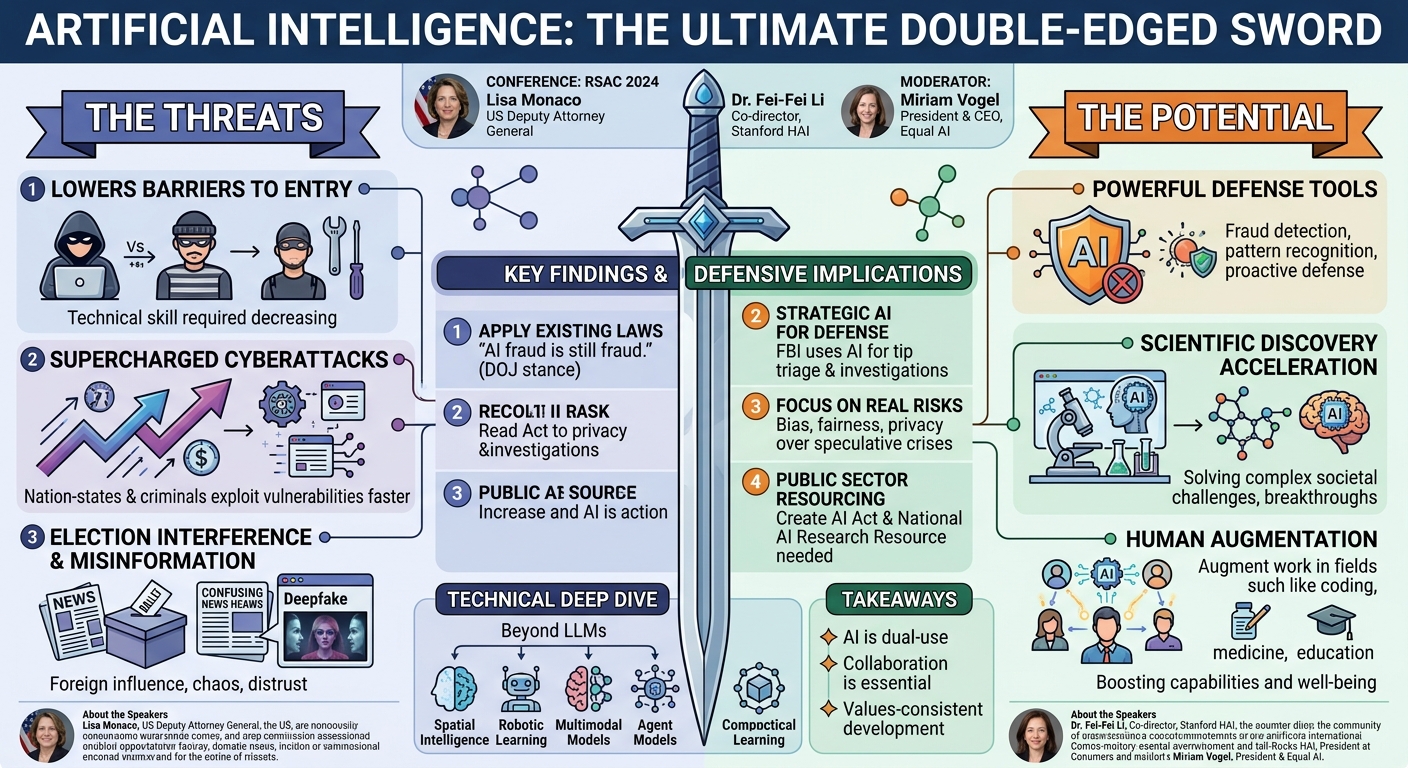
- AI Lowers Barriers and Supercharges Threats: Deputy Attorney General Lisa Monaco highlighted that AI significantly reduces the barrier to entry for criminals of all stripes. It enables malicious actors, including nation-states, to find and exploit vulnerabilities at unprecedented scale and speed. This capability extends to digital authoritarianism, supercharging online harassment, misinformation, disinformation, and the spread of child exploitation material. The threat is not just theoretical; it is actively lowering the technical skill required for sophisticated attacks.
- AI as a Powerful Defensive Tool: Dr. Fei-Fei Li countered the "parade of horribles" by asserting AI's crucial role in cybersecurity solutions. AI is a new computing tool that can fight criminal activities, increase security, detect fraud, and identify patterns at scales unachievable by humans. Its predictive capabilities offer a proactive defense mechanism against evolving threats, demonstrating its potential as a formidable ally for defenders.
- Imminent Election Security Concerns: With 2024 being a monumental election year globally, AI-related foreign interference poses an "acutely aware risk." AI's capacity to disseminate misinformation and disinformation can sow confusion, chaos, and distrust in democratic systems. The DOJ is actively applying existing laws, such as those against knowingly spreading false voting information, to counter these threats, as evidenced by the conviction of a social media influencer for election interference, a scheme easily supercharged by AI.
- Accelerating Scientific Discovery and Human Augmentation: Dr. Li emphasized two profound, often underreported, findings from the annual AI Index Report (now in its seventh edition). Firstly, AI is significantly accelerating scientific discovery, a profound development for civilization's future. Secondly, AI is increasingly augmenting human capabilities across various sectors, from contact center workers to students and creative professionals. While challenges like copyright and intellectual property exist, the trend shows technology enhancing human potential, forming a core aspect of responsible AI use.
- US Leadership in AI Development and Rapid Regulatory Growth: The AI Index Report also revealed that the United States leads China, the EU, and the UK as the primary source of top AI models. This highlights a critical geopolitical dimension to AI development. Concurrently, the total number of AI-related regulations globally grew by a significant 56.3% in the past year alone, indicating a rapid but complex legislative landscape.
- Need for Public Sector Resource Democratization: A key policy finding is the urgent need for public sector resourcing in AI. The Create AI Act, a bipartisan, bicameral bill, aims to establish a National AI Research Resource. This initiative seeks to provide the US public sector with compute and data repositories currently only accessible to a small number of big tech companies, thereby democratizing AI development, discovery, and education.
- Focus on Real Risks Over Existential Speculation: Both Monaco and Li cautioned against an "over-indexing" on speculative existential crises related to AI. While such discussions have their place, they can "suck the oxygen away" from more immediate and tangible societal issues like democracy, fairness, privacy, and job displacement. Overly broad or simplistic legislation (e.g., focusing solely on compute flops) risks inadvertently criminalizing open-source community efforts and consolidating power with large tech companies. The emphasis should remain on applying existing legal frameworks to AI-enabled fraud, misinformation, and discrimination.
Technical Deep Dive
▶ Watch: DOJ applies existing laws to combat AI threats (4:30)
While this panel discussion primarily focused on the policy, societal, and ethical implications of AI rather than a deep dive into specific technical architectures or exploits, it provided crucial insights into the evolving technical landscape and the underlying nature of AI from a visionary perspective.
Dr. Fei-Fei Li, a leading computer vision AI scientist, defined AI as a "more advanced way of using data, using prediction models to change computing." This foundational definition underscores that AI is not a mystical entity but a sophisticated evolution of computational methods. It leverages vast datasets to train models that can identify patterns, make predictions, and generate outputs that mimic human cognitive functions. The pervasiveness of computing, from the smallest embedded chips to large-scale data centers, means AI's influence is equally pervasive.
The current technological zeitgeist, as acknowledged by Dr. Li, has been "hyper-focused on Large Language Models (LLMs)" over the past two years. LLMs, such as those powering generative AI applications, have demonstrated incredible capabilities in understanding, generating, and translating human language. Their power lies in their ability to process and learn from immense textual datasets, enabling them to perform tasks ranging from complex reasoning to creative writing. Dr. Li expressed her personal awe at their capabilities, even as someone deeply entrenched in AI development.
However, Dr. Li also articulated a vision for the "next horizon" of AI development, looking beyond the current LLM-centric focus. She highlighted that human interaction with the world extends far beyond language. Our experiences are inherently spatial, multimodal, and involve interaction with objects and other agents. Therefore, future AI development is anticipated to move strongly into:
- Spatial Intelligence: AI systems that understand and reason about the physical world, including objects, distances, and interactions within a 3D environment. This is crucial for applications in robotics, augmented reality, and intelligent environments.
- Robotic Learning: The development of AI that enables robots to learn from experience, adapt to new situations, and perform complex physical tasks autonomously or semi-autonomously.
- Vision Models: Advanced AI systems that can interpret and understand visual information from images and videos with greater accuracy and nuance, going beyond simple object recognition to contextual understanding.
- Multi-modality Models: AI systems that can integrate and process information from multiple types of data simultaneously, such as combining language, vision, and audio inputs. This closer mimics human perception and understanding, leading to more robust and versatile AI.
- Agent Models: AI systems that can act autonomously or semi-autonomously in environments, making decisions and taking actions to achieve specific goals. This includes intelligent assistants, autonomous vehicles, and sophisticated automated systems.
These advancements represent a shift towards AI that can interact with and comprehend the world in a more holistic and human-like manner. The potential for these technologies is "beyond our imagination," promising to unlock new applications in fields like environmental monitoring, deep ocean exploration, and highly personalized human augmentation. The core technical challenge remains the development of models that are not only powerful but also robust, interpretable, and aligned with human values, ensuring that as AI evolves, it continues to serve and enhance the human condition.
Demo / Proof of Concept
▶ Watch: Example: Conviction for misinformation, linking to AI's future (5:00)
This panel discussion focused on high-level policy, ethical, and strategic considerations of Artificial Intelligence. As such, it did not include any live technical demonstrations or proofs of concept. The speakers conveyed their messages through expert commentary, real-world examples, and forward-looking visions, rather than showcasing specific AI tools or exploits.
Defensive Implications
▶ Watch: Dr. Li: AI fundamentally changes computing, a civilizational moment (6:50)
The discussion provided a robust framework for how defenders—both in government and the private sector—should approach the challenges and opportunities presented by AI. The key defensive implications revolve around leveraging existing authorities, fostering collaboration, investing in public resources, and prioritizing real-world ethical considerations.
- Application of Existing Legal Frameworks: The Department of Justice's stance, articulated by Deputy Attorney General Lisa Monaco, is that "AI fraud is still fraud," and "AI misinformation is still misinformation." This means that existing laws and authorities are immediately applicable to AI-enabled malicious activities. Defenders should understand that the presence of AI does not create a legal vacuum; rather, it often amplifies existing criminal behaviors. This approach empowers law enforcement to act decisively against AI-powered threats, as demonstrated by the conviction for election-related misinformation, a scheme easily supercharged by AI.
- Strategic Use of AI for Defense: AI itself is a powerful defensive tool. The DOJ is actively using AI to:
- Triage and Prioritize Threats: Sifting through over one million tips annually received by the FBI to identify and focus human attention on the most critical reports.
- Investigative Support: Identifying and tracing the source of opioids in complex investigations, and analyzing vast volumes of data and evidence in significant cases, such as the January 6th investigation.
- Pattern Recognition and Fraud Detection: AI's ability to detect patterns and make predictions at scales beyond human capacity is invaluable for identifying and preventing cyber fraud and other criminal activities.
- The Justice AI Initiative: Recognizing the need for informed policy in a rapidly evolving landscape, the DOJ launched Justice AI. This initiative involves a series of convenings designed to gather a full range of perspectives from outside government, including civil society, academia, and scientists. The goal is to avoid insular policy-making and ensure that AI governance is shaped by diverse expertise. Defenders should seek similar collaborative models within their organizations and sectors to stay abreast of AI's implications and contribute to effective, broadly supported strategies.
- Investing in Public Sector AI Resources: Dr. Fei-Fei Li championed the Create AI Act, a bipartisan, bicameral bill aimed at establishing a National AI Research Resource. This initiative would democratize access to critical compute and data repositories, currently monopolized by a few large tech companies, for the US public sector. For defenders, this means advocating for and leveraging public infrastructure that can foster innovation, develop public goods (including talent), and ensure that AI capabilities are not solely concentrated in private hands, thereby strengthening national security and public safety.
- Focus on Responsible AI and Values-Consistent Development: Both speakers stressed the importance of developing and deploying AI "consistent with our values." This involves:
- Addressing Bias and Fairness: Actively putting "guard rails" around existing AI uses to prevent the exacerbation of biases, particularly within the criminal justice system. The President's Executive Order on AI and the forthcoming DOJ report on AI's impact on criminal justice are crucial steps in this direction.
- Prioritizing Real-World Societal Risks: Shifting focus from speculative "existential crises" to tangible, immediate risks concerning democracy, privacy, fairness, and labor. Legislation that "over-indexes" on distant threats can divert attention and resources from pressing issues and potentially harm open-source innovation.
- Proactive Warnings and Transparency: The DOJ's proactive statements warning entities about potential rights violations when using AI underscore the need for transparency and due diligence in AI deployment. Defenders must understand their liabilities and ensure their AI applications are lawful and ethical.
- Building a Diverse Talent Pipeline: Deputy Attorney General Monaco highlighted the critical need for building out a diverse pipeline of talent in science and government. To ensure AI development and use align with societal values, it is essential to have a broad range of perspectives contributing to its design, implementation, and oversight. Defenders should champion diversity and inclusion within their own teams to foster more robust and ethically sound AI solutions.
In essence, defensive strategies against AI threats must be multifaceted, combining robust legal enforcement with strategic technological adoption, collaborative policy development, and an unwavering commitment to ethical principles and broad accessibility.
Key Takeaways
- AI is a Double-Edged Sword: Like all transformative technologies, AI presents both significant threats (supercharging criminal activity, misinformation, vulnerability exploitation) and immense opportunities (scientific discovery, human augmentation, fraud detection, pattern recognition).
- Existing Laws Apply to AI-Enabled Crimes: The Department of Justice emphasizes that AI does not create a legal vacuum; fraud, discrimination, and misinformation enabled by AI are still subject to existing legal frameworks and will be prosecuted.
- Strategic AI Adoption for Defense is Crucial: Government agencies, like the DOJ, are leveraging AI to triage FBI tips, trace illicit substances, and analyze vast datasets in investigations, showcasing its power as a tool for public safety and national security.
- Collaboration and Diverse Perspectives are Essential for AI Governance: Initiatives like Justice AI highlight the need for government to actively engage with civil society, academia, and scientists to develop informed, balanced, and broadly supported AI policies.
- Invest in Public Sector AI Resources: The proposed Create AI Act (National AI Research Resource) is vital for democratizing access to compute and data, ensuring that AI development is not solely confined to a few large tech companies and fostering public good.
- Prioritize Real Societal Risks Over Speculative Existential Threats: While long-term concerns are valid, the immediate focus for policymakers and developers should be on addressing tangible risks such as bias, fairness, privacy, and the impact on democracy and labor, rather than allowing abstract existential worries to overshadow practical governance.
- AI Should Augment Human Agency and Well-being: The ultimate goal of AI development should be to enhance human capabilities, productivity, and overall well-being, ensuring its benefits are broadly accessible and consistent with human values.
About the Speaker(s)
Lisa Monaco serves as the United States Deputy Attorney General. In this capacity, she is deeply involved in addressing the complex challenges posed by Artificial Intelligence, particularly from a criminal and national security perspective. Her extensive background includes serving as Homeland Security and Counterterrorism Advisor to President Obama, a role that often placed her at the forefront of identifying and mitigating significant global threats, earning her the nickname "Dr. Doom." Monaco's focus is on applying existing legal tools to AI-enabled crimes and leading initiatives like Justice AI to ensure informed policy development.
Dr. Fei-Fei Li is the Co-director of the Stanford Institute for Human-Centered AI (HAI) and a leading computer vision AI scientist. She is recognized as one of the "matriarchs of AI," having literally taught AI vision, and is the author of the critically acclaimed book "The World's I See." Dr. Li brings a unique perspective as a mother, caretaker, immigrant, and often the only female in the room, advocating for a human-centered approach to AI. Her work at Stanford HAI emphasizes using AI to better the human condition through policy collaboration, and she is instrumental in publishing the globally recognized AI Index Report. She is also involved in the AI for All initiative.
Miriam Vogel is the President and CEO of Equal AI and served as the moderator for this panel. Her organization is dedicated to reducing bias in AI and promoting responsible AI development. Her work, particularly in the realm of responsible AI, has inspired significant efforts within the field, including contributions to the Stanford AI Index Report. Vogel's role as a moderator underscored her expertise in guiding discussions on the ethical and societal implications of AI, ensuring a balanced exploration of its challenges and opportunities.