Secret to a Healthier Life? Fun!
RSA Conference 2024 · West Stage Keynote
Overview
In a departure from the typical cybersecurity discussions at RSAC 2024, award-winning journalist Catherine Price delivered a compelling and insightful talk titled "Secret to a Healthier Life? Fun!" This presentation explored the often-overlooked yet profoundly impactful concept of fun, moving beyond its dictionary definition to uncover its deeper psychological components and significant benefits for human well-being. Price argued that fun is not merely a superficial amusement but a fundamental ingredient for thriving, with tangible positive effects on energy, resilience, creativity, and overall happiness.
Key moments
- 0:00 Introduction to fun's deeper meaning and joy
- 2:00 Unveiling fun's three ingredients: playfulness, connection, flow
- 3:00 The powerful benefits of fun for our well-being
- 4:00 Don't force fun; cultivate its three ingredients
- 4:27 Practical exercise: starting a 'delight practice'
- 4:55 Live audience participation in the 'delight' exercise
- 5:30 Prioritize fun: a key to a happier, more resilient life
Secret to a Healthier Life? Fun!
Speakers: Catherine Price, Award-winning Journalist
Conference: RSAC 2024
YouTube: https://www.youtube.com/watch?v=hbJghhmCAzY
Overview
In a departure from the typical cybersecurity discussions at RSAC 2024, award-winning journalist Catherine Price delivered a compelling and insightful talk titled "Secret to a Healthier Life? Fun!" This presentation explored the often-overlooked yet profoundly impactful concept of fun, moving beyond its dictionary definition to uncover its deeper psychological components and significant benefits for human well-being. Price argued that fun is not merely a superficial amusement but a fundamental ingredient for thriving, with tangible positive effects on energy, resilience, creativity, and overall happiness.
Price's talk is particularly relevant in high-stress, demanding fields like cybersecurity, where burnout and mental health challenges are prevalent. By deconstructing fun into its core elements of playfulness, connection, and flow, she provided a practical framework for individuals to intentionally cultivate more moments of genuine joy in their lives. The importance of this topic lies in its potential to offer a proactive strategy for personal and professional sustainability, reminding attendees that prioritizing authentic fun can lead to a healthier, more engaged, and more effective existence, ultimately benefiting both individuals and the organizations they serve.
Background
▶ Watch: Introduction to fun's deeper meaning and joy (0:00)
The conventional understanding of fun often relegates it to a trivial pursuit—a fleeting moment of amusement or lighthearted pleasure. Catherine Price challenged this narrow perspective, suggesting that this simplistic definition fails to capture the profound impact and complex nature of what truly constitutes fun. Her research, drawing from numerous personal stories collected globally, revealed a consistent pattern that points to a much deeper, more visceral experience. This deeper understanding is particularly crucial in a modern society characterized by constant demands, digital distractions, and a pervasive sense of busyness, which often push opportunities for genuine fun to the periphery.
Price highlighted that despite its universal appeal, the mechanisms and benefits of fun are rarely consciously explored or prioritized. Society frequently equates productivity with worth, inadvertently creating an environment where activities perceived as "non-essential," like having fun, are undervalued or even seen as a luxury. This cultural backdrop contributes to rising levels of stress, anxiety, and burnout, particularly within high-stakes professions. Price's work emerges as a timely intervention, providing a framework to reclaim and integrate authentic fun back into daily life, positing it not as a mere outcome of well-being, but as a critical catalyst for it. Her approach builds upon existing psychological concepts like Mihaly Csikszentmihalyi's theory of flow, but synthesizes it with other key human experiences to offer a holistic and actionable definition of fun.
Key Findings
▶ Watch: The powerful benefits of fun for our well-being (3:00)
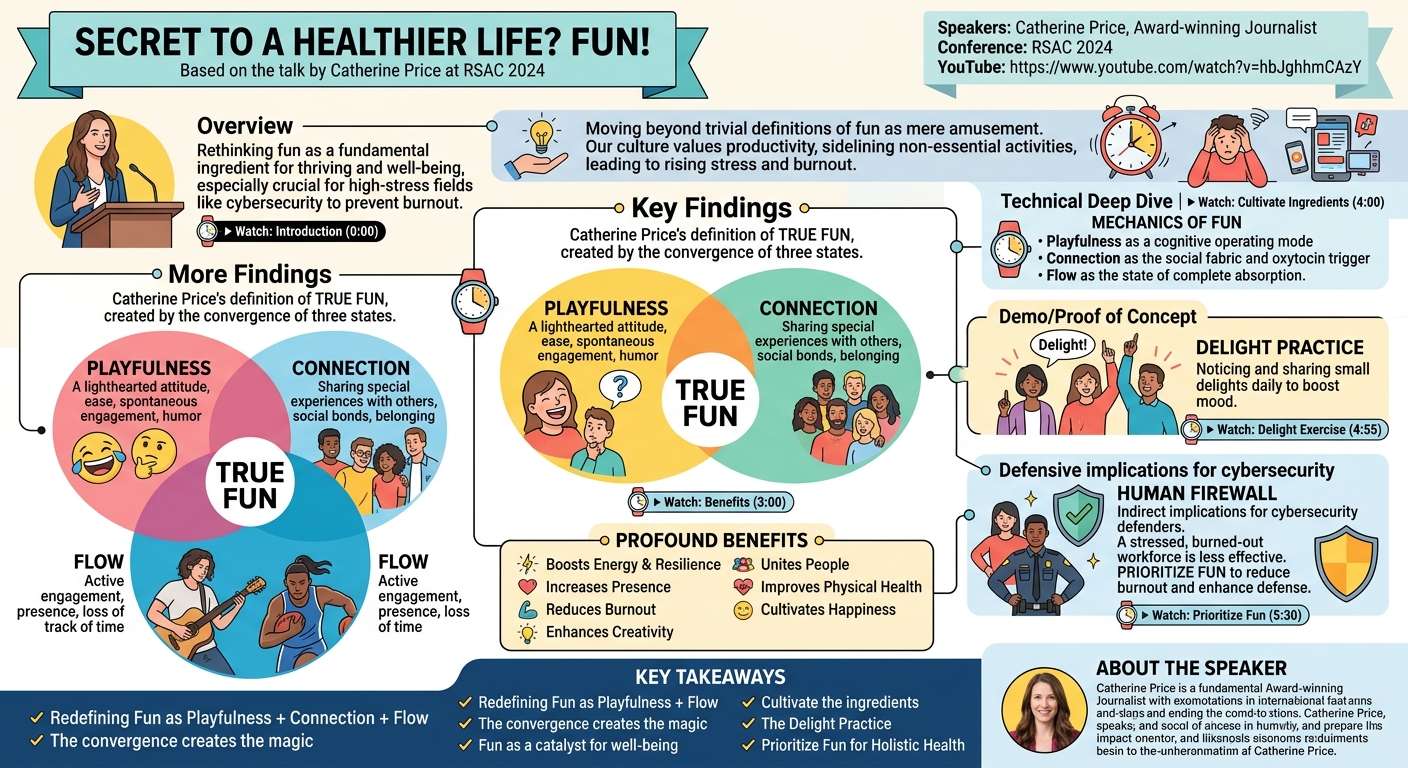
Catherine Price's central contribution is a refined, actionable definition of fun, derived from extensive anecdotal evidence and observation. She identified three consistently recurring states that, when combined, create the experience of what she terms "true fun." These are:
- Playfulness: This is characterized by a lighthearted attitude, a willingness to not take oneself or the world too seriously, and an openness to laughter. Price clarified that this doesn't necessitate acting childish or playing specific games, but rather adopting a disposition of ease and spontaneous engagement. It's about approaching situations with curiosity and a sense of humor.
- Connection: This refers to the feeling of sharing a special experience with others. While some individuals report having fun alone, the overwhelming majority of stories Price collected involved shared moments with another person or a group. This highlights the inherently social dimension of fun, fostering bonds and creating a sense of belonging. Even for introverts, shared experiences are often central to their most memorable fun moments.
- Flow: This state, popularized by psychologist Mihaly Csikszentmihalyi, occurs when an individual is so actively engaged and present in an activity that they lose track of time. Examples include a musician immersed in playing, an athlete in the zone during a game, or a rock climber focused on a challenging ascent. In flow, attention is completely absorbed, leading to a sense of effortless action and deep satisfaction.
Price emphasized that while each of these states is beneficial on its own, the "magic" happens when all three converge simultaneously. This trifecta—playfulness, connection, and flow—is the crucible in which true fun is forged.
Beyond defining fun, Price underscored its profound benefits, asserting that it is not merely a result of human thriving but a fundamental cause. The key benefits identified include:
- Boosts Energy and Resilience: Regular experiences of fun replenish mental and emotional reserves, making individuals more robust in the face of challenges.
- Increases Presence: Fun forces individuals to be fully engaged in the moment, pulling them away from distractions and rumination.
- Reduces Burnout: By providing an antidote to stress and monotony, fun helps prevent and alleviate the exhaustion associated with chronic overwork.
- Enhances Creativity: A playful and relaxed state of mind is conducive to divergent thinking and problem-solving, fostering innovation.
- Unites People: Fun temporarily erases differences and fosters a sense of shared humanity, strengthening social bonds.
- Improves Physical Health: By reducing stress and promoting social connection, fun has positive physiological effects.
- Cultivates Happiness: Price observed that no one ever recounts a fun experience and simultaneously describes feeling miserable, suggesting a direct link between fun and overall happiness. She even posited that the secret to happiness might simply be to have more everyday moments of fun.
These findings collectively present fun as a critical, yet often neglected, component of a healthy and fulfilling life, offering a blueprint for intentionally integrating it into daily routines.
Technical Deep Dive
▶ Watch: Don't force fun; cultivate its three ingredients (4:00)
While Catherine Price's talk does not delve into the technical architectures, protocols, or code typically associated with cybersecurity conferences, it offers a deep dive into the mechanics of a fundamental human experience: fun. From a systems perspective, Price presents fun not as a monolithic concept, but as an emergent property arising from the synergistic interaction of three distinct psychological components: playfulness, connection, and flow. Understanding these "ingredients" is akin to understanding the technical specifications required to build a desired outcome.
Playfulness can be conceptualized as a cognitive and emotional operating mode. It involves a deliberate shift in perspective, moving away from rigidity and seriousness towards an attitude of experimentation, lightheartedness, and humor. This doesn't mean a lack of seriousness for important tasks, but rather the capacity to inject levity and an exploratory mindset into various situations. Psychologically, playfulness reduces the perceived stakes of an activity, lowering inhibitions and fostering an environment conducive to spontaneous engagement. It acts as a mental lubricant, allowing for more fluid and adaptable thought processes. For instance, finding delight in the absurdity of a squirrel outside a window, as Price mentioned, demonstrates this mode in action – it's a conscious choice to engage with the world in a less critical, more appreciative way.
Connection functions as the social fabric of fun. It is the reciprocal interaction and shared experience between individuals that amplifies positive emotions. This component involves an active engagement with another person or group, creating a temporary, shared reality. The "special shared experience" is not merely co-presence but a mutual recognition and appreciation of the moment. From a neurochemical perspective, social connection is known to trigger the release of oxytocin, a hormone associated with bonding and trust, which contributes to feelings of well-being and reduces stress. Price noted that the "vast majority of stories" about fun involve another person, underscoring its role as a critical multiplier for the fun experience, even for introverted individuals who might typically seek solitude. This shared vulnerability and joy strengthen interpersonal relationships, creating a supportive social environment.
Flow, as defined by Csikszentmihalyi, is a state of complete absorption in an activity. It is characterized by intense focus, a loss of self-consciousness, and a distorted sense of time. To achieve flow, an activity must present a clear set of goals and immediate feedback, requiring a balance between the challenge presented and one's skill level. If the challenge is too low, boredom ensues; if too high, anxiety. When this balance is struck, the individual becomes fully immersed, and the activity itself becomes intrinsically rewarding. Price cited examples like a musician playing a piece, an athlete engaged in a game, or a rock climber on a wall. In these scenarios, the cognitive resources are entirely dedicated to the task at hand, effectively silencing internal distractions and external noise. This state provides a deep sense of satisfaction and accomplishment, contributing significantly to the feeling of being "alive."
The "technical" brilliance, in Price's model, lies in the synergy of these three components. When playfulness disarms the internal critic and fosters an open mindset, and connection creates a shared, supportive environment, and flow fully engages the individual's cognitive and physical faculties, the result is an experience exponentially greater than the sum of its parts. This convergence is where "the magic is," producing the visceral sense of lightness, joy, and radiance that defines true fun. It's a robust, self-reinforcing system where each element enhances the others, leading to sustained positive affect and profound personal benefits. The absence or weakness of any one component can diminish or prevent the full experience of fun, much like a critical component failure in a technical system.
Demo / Proof of Concept
▶ Watch: Live audience participation in the 'delight' exercise (4:55)
While Catherine Price's talk did not feature a technical demonstration or a cybersecurity proof of concept, she provided an experiential "demo" designed to immediately put the audience into a "fun mindset" and illustrate the practical application of her principles. This demonstration was the introduction of a delight practice.
The delight practice is a simple yet powerful exercise inspired by poet Ross Gay. It involves intentionally noticing things that bring a small sense of delight throughout one's day. When such a delight is observed, the participant is instructed to raise a finger in the air and verbally exclaim, "Delight!" Price offered examples such as the sight of a pretty cloud, a flower, or even the absurdity of a squirrel outside a kitchen window.
To reinforce this concept and allow the audience to experience it firsthand, Price led a live, interactive practice. She counted to three, prompting the entire audience to collectively raise a finger and shout "Delight!" The shared, slightly silly, and spontaneous nature of this exercise immediately generated a palpable sense of playfulness and connection within the room. Price noted that the collective loud exclamation itself was a delight.
She explained that this seemingly simple act is an evidence-backed exercise known to boost people's moods. Furthermore, its effectiveness is amplified when these delights are shared. She encouraged attendees to continue this practice throughout the day, particularly in moments when they might typically reach for their phones (e.g., waiting in line). Instead, she suggested turning to a nearby person, asking them to share a delight, and then sharing one of their own. This sharing mechanism further leverages the power of connection, transforming an individual observation into a shared, positive micro-experience.
This "demo" served as a practical proof of concept for how individuals can actively cultivate the ingredients of fun—specifically playfulness and connection—in everyday moments, thereby making true fun more likely to occur. It underscored that fostering fun doesn't require grand gestures but can begin with small, intentional shifts in attention and interaction.
Defensive Implications
▶ Watch: Prioritize fun: a key to a happier, more resilient life (5:30)
Catherine Price's talk, "Secret to a Healthier Life? Fun!", does not directly address technical defensive implications related to cybersecurity threats, vulnerabilities, or mitigation strategies. There are no discussions of firewalls, intrusion detection systems, secure coding practices, or threat intelligence. The content is entirely focused on human well-being and the psychological benefits of fun.
However, the insights presented hold significant indirect implications for cybersecurity defenders and the broader security industry. The cybersecurity field is notoriously high-stress, characterized by long hours, constant vigilance against sophisticated adversaries, and the pervasive threat of burnout. Price's message about the critical role of fun in boosting energy, resilience, creativity, and reducing burnout is directly applicable to the human element of defense.
A cybersecurity workforce that is chronically stressed, disengaged, and suffering from burnout is inherently less effective. Burned-out defenders are more prone to errors, less likely to be creative in problem-solving, and may struggle with maintaining the focus required for effective threat detection and incident response. By emphasizing the intentional cultivation of playfulness, connection, and flow, Price offers a proactive strategy for maintaining the mental and emotional health of security professionals.
Organizations and individual defenders can "defend" against burnout and disengagement by prioritizing moments of true fun. This could involve fostering team environments that encourage lighthearted interaction and shared experiences (connection), creating opportunities for deep, focused work that allows for flow states, and promoting a culture where individuals feel comfortable approaching challenges with a sense of playfulness rather than overwhelming gravity. While not a technical defense, promoting well-being through fun can be seen as a crucial "human firewall" against attrition, decreased performance, and the mental health crisis within the industry, ultimately strengthening the human layer of cybersecurity defense.
Key Takeaways
- Redefining Fun: True fun is not mere amusement but a profound feeling characterized by the simultaneous presence of playfulness, connection, and flow.
- The Power of the Trifecta: While playfulness, connection, and flow are individually beneficial, their convergence creates a magical, deeply impactful experience that makes people feel truly alive.
- Fun as a Catalyst for Thriving: Fun is not just a result of well-being but a fundamental cause, boosting energy, resilience, creativity, presence, and happiness while reducing burnout and uniting people.
- Cultivating a Fun Mindset: To have more fun, focus on its ingredients rather than forcing it. Adopt a lighthearted attitude, seek shared experiences, and engage deeply in activities.
- The Delight Practice: An actionable strategy to increase daily joy involves intentionally noticing and verbally acknowledging "delights" in your surroundings, and sharing these observations with others.
- Prioritize Fun for Holistic Health: Despite feeling tired or busy, consciously prioritizing fun is a worthwhile effort that significantly improves personal well-being, making individuals better partners, parents, friends, and ultimately, more effective professionals.
About the Speaker(s)
Catherine Price is an award-winning journalist recognized for her insightful work on technology, attention, and well-being. Her research and writing often delve into the psychological impacts of modern life and offer practical strategies for living more intentionally. Through her extensive collection of stories from people around the world, Price has developed a unique understanding of what constitutes true fun and its vital role in human thriving. Her engaging presentations aim to empower individuals to reclaim joy and presence in their daily lives.