Photographing Nature: Expanding Human Understanding
RSA Conference 2024 · West Stage Keynote
Overview
Doris Mitsch, an accomplished artist, presented a captivating talk at RSAC 2024, delving into the fascinating intersection of art, nature, and human perception. Titled "Photographing Nature: Expanding Human Understanding," Mitsch's presentation explored how unique photographic techniques can reveal the hidden intricacies of the natural world, challenging our anthropocentric view and expanding our understanding of reality. While delivered at a prominent cybersecurity conference, this talk distinguished itself by offering a philosophical and artistic exploration rather than focusing on traditional security topics, serving as a powerful reminder of the diverse ways in which observation and perspective can unveil previously unseen systems, whether in nature or in complex digital environments.
Key moments
- 0:00 Introduction to photo stacking and pandemic inspiration
- 2:00 Photo stacking: capturing animal movement over time
- 3:20 Discovering invisible patterns and nature's efficiencies
- 4:00 The hidden world of sound beyond human hearing
- 5:45 Creatures perceive time and senses differently than us
- 6:00 Starlings' collective intelligence and invisible group decisions
- 7:40 Expanding human understanding of the invisible natural world
Photographing Nature: Expanding Human Understanding
Speakers: Doris Mitsch, Artist
Conference: RSAC 2024
YouTube: https://www.youtube.com/watch?v=b3H3Hk3HDnY
Overview
Doris Mitsch, an accomplished artist, presented a captivating talk at RSAC 2024, delving into the fascinating intersection of art, nature, and human perception. Titled "Photographing Nature: Expanding Human Understanding," Mitsch's presentation explored how unique photographic techniques can reveal the hidden intricacies of the natural world, challenging our anthropocentric view and expanding our understanding of reality. While delivered at a prominent cybersecurity conference, this talk distinguished itself by offering a philosophical and artistic exploration rather than focusing on traditional security topics, serving as a powerful reminder of the diverse ways in which observation and perspective can unveil previously unseen systems, whether in nature or in complex digital environments.
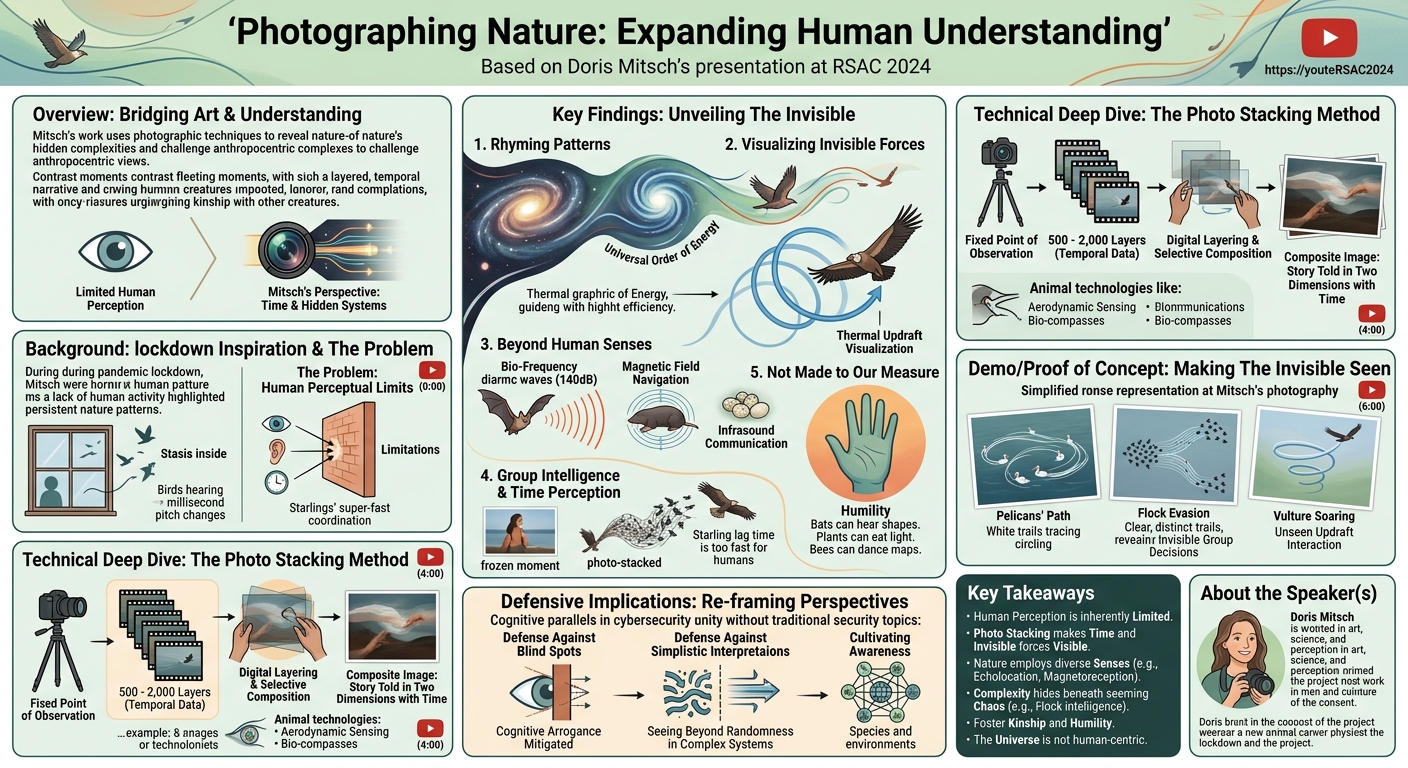
Mitsch's work centers on a technique called photo stacking, which involves layering multiple images taken from a fixed point over time into a single composite. This method transforms fleeting moments into a visual narrative, making the invisible movements and patterns of the natural world visible to the human eye. The talk underscored the profound implications of recognizing that our perception is inherently limited, and that the universe operates on systems and timescales far beyond our immediate grasp, encouraging a sense of kinship and reverence for the "otherness" of fellow creatures and their unique ways of experiencing the world.
The significance of this talk, even within a cybersecurity context, lies in its broader message about perspective, hidden systems, and the limitations of our own sensory and cognitive frameworks. Just as cybersecurity professionals must uncover unseen threats and understand complex, often invisible, network dynamics, Mitsch demonstrates how artists can reveal the invisible architectures of nature. Her work encourages a critical examination of what we assume to be "reality" and champions the value of fresh eyes and innovative methods to perceive the deeper truths that lie beneath the surface of the familiar.
Background
▶ Watch: Introduction to photo stacking and pandemic inspiration (0:00)
The genesis of this photographic series emerged from an unexpected period of forced introspection during the early days of the COVID-19 pandemic lockdown. Confined to her home, Doris Mitsch found herself with an abundance of time to simply observe the world outside her window. This enforced stillness led to a heightened awareness of the persistent, rhythmic movements of local wildlife, such as crows commuting daily and birds of prey making their rounds. This stark contrast between human stasis and nature's ongoing dynamism sparked the inspiration for her project.
Mitsch's chosen technique, photo stacking, while not entirely new, was adapted and refined for this specific observational purpose. She had utilized it previously, but the lockdown period provided a unique opportunity to apply it to the continuous, often imperceptible, movements of animals. The core principle involves capturing numerous photographs—ranging from 500 to 2,000 individual layers per final image—from an unmoving vantage point over an extended duration. These layers are then meticulously combined, allowing Mitsch to experiment with which elements to retain or discard, ultimately constructing a composite image that tells a story across time, rather than freezing a single moment.
The problem Mitsch's work addresses is fundamentally one of human perceptual limitation. Our senses are finely tuned to a specific range of stimuli, and our internal "sense of time" is equally constrained. Consequently, many natural phenomena, from the subtle nuances of animal communication to the rapid, synchronized movements of flocks, remain invisible or incomprehensible to us. For example, we might hear birds singing the same notes, but lack the ability to discern millisecond variations in pitch that convey complex information to other birds. Similarly, the rapid, coordinated decisions of a starling flock occur at speeds too fast for our human perception to process as anything other than chaotic. Mitsch's work provides a visual methodology to bypass these limitations, offering a glimpse into these hidden realms and demonstrating that what we perceive as "empty" or "silent" is often teeming with activity and information beyond our sensory bandwidth.
Key Findings
▶ Watch: Discovering invisible patterns and nature's efficiencies (3:20)
Through her extensive photo stacking project, Doris Mitsch made several profound observations and presented them as key findings that challenge conventional human understanding of the natural world:
- Rhyming Patterns in Nature: By visualizing the flight paths of animals over time, Mitsch highlighted the pervasive presence of repeating, "rhyming patterns" across various natural phenomena. These patterns, evident in the movement of water waves, light, and sound, manifest in grand scales like spiraling galaxies and whirlpools, as well as in the subtle aerial navigation of birds. This suggests a fundamental underlying order or set of principles governing movement and energy transfer in the universe.
- Visualization of Invisible Forces: The photographic technique successfully rendered visible phenomena that are typically imperceptible to humans. A prime example is the visualization of thermal updrafts that hawks and vultures skillfully ride. Mitsch noted that some vultures are so adept at finding even the "tiniest patches of turbulence" that they can soar for hours without flapping their wings, a testament to their sophisticated navigational abilities and the invisible atmospheric structures they exploit.
- Beyond Human Sensory Perception: The talk extensively showcased how many creatures navigate and communicate using senses entirely outside the human range.
- Echolocation: Bats, characterized as either "whisperers" or "shouters," navigate by emitting sounds up to 140 decibels (as loud as a jet engine) at frequencies beyond human hearing. What we perceive as silence is, for bats, a rich soundscape mapping the environment, including the "sound of the shape of a hillside."
- Infrasound/Ultrasound Communication: Sea turtle eggs, once a mystery for their synchronized hatching, are now known to communicate from within their shells. Similarly, mice "sing" to each other at frequencies beyond human range, demonstrating complex social interactions invisible to us.
- Magnetoreception/Vibration Sensing: Mitsch emphasized that many creatures, from European moles to rainbow trout, find their way using wavelengths of vibrations, magnetic fields, or electrical signals—sensory inputs for which human physiology is simply not equipped.
- Differing Perceptions of Time and Group Intelligence: The project revealed how other species experience time differently, leading to what appears to us as inexplicable behavior. Mitsch referenced the work of British ornithologist Edmund Salus in the 1930s, who, observing flocks of starlings moving as "one mind," concluded they must be psychic. Modern understanding, however, reveals that starlings follow each other with a split-second lag time that is too short for human perception. This rapid, decentralized decision-making in flocks, illustrated by the evasive maneuvers of a flock escaping a peregrine falcon, demonstrates a "hidden intelligence" in what appears to us as random or chaotic, highlighting group decisions made at speeds that render them invisible to our slower human sense of time.
- The Universe is Not Made to Our Measure: The overarching finding is a powerful philosophical statement: the universe does not operate solely according to human perception or understanding. It is a reminder that our human-centric view often blinds us to the complex, intelligent systems operating continuously around us. The "empty air" is, for a bat, a detailed map of sound, magnetic fields, electrical signals, and even a "topography of smells" like krill patches and plankton blooms. Mitsch eloquently summarized this by quoting Jared K. Anderson: "Bats can hear shapes. Plants can eat light. Bees can dance maps."
These findings collectively serve as a compelling argument for humility in human perception and a call to expand our understanding by acknowledging and exploring the "otherness" of the living world.
Technical Deep Dive
▶ Watch: The hidden world of sound beyond human hearing (4:00)
The core technical innovation and methodology behind Doris Mitsch's project is her refined application of photo stacking. This technique is fundamentally about aggregating temporal data into a single spatial representation, effectively making time a visible dimension within a two-dimensional image.
The process begins with a fixed point of observation. This is crucial, as any movement of the camera would introduce unwanted parallax and prevent the clean layering of images. From this static position, Mitsch captures a series of multiple images over an extended period. The duration of capture and the interval between shots are not explicitly detailed but are implied to be continuous or semi-continuous to capture the full trajectory of movement. The volume of data is significant, with each final composite image comprising anywhere from 500 to 2,000 individual photographic layers.
Once the images are acquired, the digital processing phase begins. This involves layering these hundreds or thousands of images onto one another. The challenge, and indeed the artistic skill, lies in the selective inclusion and exclusion of specific layers. Mitsch explicitly states that "a lot of that time is spent just experimenting with which layers to keep in the final image and which to leave out." This iterative and experimental approach is critical to shaping the narrative and visual impact of the final composite. Unlike traditional photography, which freezes a single moment, photo stacking creates a story told in two dimensions with layers of the fourth dimension (time). The result is a composite image that traces the path and presence of moving subjects, such as birds in flight or pelicans circling in the water, revealing patterns and movements that would be lost in a single frame.
While Mitsch's primary "technical deep dive" is into the photographic process, the talk also delves into the "technical" mechanisms of animal perception, albeit from a biological and observational standpoint rather than an engineering one.
- Echolocation: For bats, this involves emitting high-frequency sound waves (up to 140 decibels) and interpreting the echoes. The "technicality" here lies in the sophisticated biological sonar system that allows bats to not only detect objects but to construct a detailed spatial map of their environment based on the timing, intensity, and frequency shifts of the returning echoes. This is a highly advanced form of bio-sonar.
- Thermal Updraft Exploitation: Vultures and hawks demonstrate an exquisite "technical" understanding of atmospheric physics. They are able to detect and exploit subtle changes in air temperature and pressure to locate thermal updrafts and patches of turbulence. This is a form of aerodynamic sensing and navigation, allowing them to conserve energy by soaring for hours without flapping.
- Millisecond Auditory Discrimination: Birds, as Mitsch notes, can perceive "millisecond variations in pitch and other complexities" within notes that humans perceive as identical. This points to a highly refined auditory processing capability, enabling complex communication and information exchange at a temporal resolution far beyond our own.
- Magnetoreception and Electroreception: The mention of creatures navigating by "fields of magnetism or electricity" refers to biological systems capable of detecting and interpreting electromagnetic fields. This involves specialized cells or organs that act as biological compasses or sensors for electrical currents in water, representing a "technical" sensing capability that is largely absent in humans.
In essence, Mitsch's work provides a visual "technical deep dive" into the hidden mechanics of nature, both through her photographic process and by highlighting the remarkable sensory technologies evolved by other species.
Demo / Proof of Concept
▶ Watch: Starlings' collective intelligence and invisible group decisions (6:00)
The entirety of Doris Mitsch's talk served as a powerful demonstration and proof of concept for her photo stacking methodology and its ability to reveal the invisible. The visual evidence presented throughout the presentation—the composite photographs themselves—were the primary "demo."
Each image displayed was a direct result of her process, showcasing how the layering of hundreds or thousands of individual frames could render the ethereal and fleeting movements of nature into tangible, visible patterns. For instance, the image of pelicans entering from both sides and circling in the water vividly illustrated how the technique captures a sequence of events, transforming a mere "moment frozen in time" into a "story told in two dimensions." The visual effect was not a blur, but rather a graceful aggregation of trajectories, revealing the intent and coordinated movement of the birds.
Another compelling demonstration was the visualization of a peregrine falcon chasing a flock of birds that split into two evasive directions. This single image, a composite of rapid, synchronized movements, served as a proof of concept for Mitsch's assertion about "group decisions made at speeds that make them invisible to us." Without the photo stacking technique, this complex, split-second maneuver would appear as a chaotic blur or simply be missed by the human eye and conventional photography. The image clearly showed the distinct paths of the two subgroups, making the "hidden intelligence" of the flock's coordinated evasion strikingly apparent.
Furthermore, the photographs of soaring birds of prey, such as hawks and vultures, effectively demonstrated the visualization of otherwise invisible thermal updrafts. While the updrafts themselves are not directly photographed, their presence is inferred and visually represented by the smooth, spiraling, and sustained flight paths of the birds, indicating their effortless navigation of these atmospheric currents. The images served as compelling evidence that these creatures are exploiting unseen environmental structures.
In essence, Mitsch's artistic output was the demonstration. Her photographs were the tangible proof that her unique approach could transcend the limitations of human perception and traditional photography, making visible the "endless ways to look at its familiar sites, like a bird in flight with fresh eyes." The visual impact of these layered images was central to conveying her message about the hidden complexities and beauties of the natural world.
Defensive Implications
▶ Watch: Expanding human understanding of the invisible natural world (7:40)
Given the artistic and philosophical nature of Doris Mitsch's talk, there are no direct defensive implications in the traditional cybersecurity sense, such as strategies for protecting systems, mitigating vulnerabilities, or responding to attacks. The talk does not discuss security protocols, threat intelligence, or incident response.
However, if we interpret "defensive implications" more broadly in a cognitive or philosophical context, the talk offers profound insights relevant to how we "defend" against limited perception and anthropocentric biases.
- Defense Against Perceptual Blind Spots: Mitsch's work acts as a defense against the human tendency to assume our senses provide a complete picture of reality. By demonstrating what lies beyond our hearing, sight, and temporal processing, she encourages a defensive posture against cognitive arrogance—the belief that what we cannot perceive does not exist. This is crucial in any field, including cybersecurity, where unseen threats or subtle anomalies often go undetected due to entrenched assumptions or limited visibility.
- Defense Against Simplistic Interpretations: The examples of starling flocks or synchronized turtle hatching illustrate how apparent randomness or inexplicable synchronicity can be the result of complex, rapid, and often invisible communication and decision-making. This defends against the impulse to dismiss complex natural phenomena as "random" or "chaotic" without understanding the underlying systems. In a cybersecurity context, this translates to looking beyond surface-level observations to understand the intricate, often hidden, logic of an attack or system behavior.
- Cultivating Expanded Awareness: Ultimately, the talk advocates for a "defense" of a more expansive and humble worldview. It encourages individuals to actively seek out and appreciate the "otherness" of living creatures and their unique ways of experiencing the world. This fosters empathy and a deeper connection to the environment, which, while not a direct security measure, can contribute to more holistic problem-solving and a greater appreciation for interconnected systems, whether biological or digital.
In summary, while lacking direct cybersecurity defensive strategies, Mitsch's presentation serves as a powerful reminder to "defend" against narrow-mindedness, perceptual limitations, and the human tendency to oversimplify complex systems, urging us to remain open to the "more in this heaven and earth than is dreamt of in our philosophy."
Key Takeaways
- Human Perception is Limited: Our senses and temporal processing capabilities inherently restrict our understanding of the natural world, leading us to miss vast amounts of information and activity.
- Photo Stacking Reveals Hidden Systems: The technique of layering multiple images over time can make invisible movements, patterns, and forces (like thermal updrafts or rapid group decisions) visible, expanding our understanding.
- Nature Operates on Diverse Sensory Modalities: Many creatures navigate and communicate using senses beyond human capabilities, such as echolocation (bats), magnetoreception (moles, trout), and ultra-fast auditory discrimination (birds, mice).
- Complexity Beneath Apparent Chaos: What appears random or chaotic to humans (e.g., starling flocks) often represents highly intelligent, rapid, and coordinated decision-making occurring at speeds too fast for our perception.
- Cultivate Kinship and Reverence for Otherness: Recognizing the sophisticated and varied ways other species experience and interact with the world fosters a deeper connection to nature and a humility about human centrality.
- The Universe is Not Human-Centric: The talk serves as a reminder that the world operates on systems and measures far beyond our own, encouraging us to look with "fresh eyes" and embrace a broader, more inclusive understanding of reality.
About the Speaker(s)
Doris Mitsch is an artist whose work explores the intersection of art, science, and perception. As highlighted in her talk, her recent project involving photo stacking was initiated during the COVID-19 pandemic lockdown, a period that provided her with "a lot of extra time to spend staring out the window." This time of forced observation and introspection led her to focus on the movements of animals and to develop a new series of photographs designed to reveal the hidden patterns and "hidden intelligence" of the natural world. Mitsch's background in art, combined with her keen observational skills, allows her to translate complex natural phenomena into visually compelling and thought-provoking works.