Winner's Announcement — RSA Conference 2024 Innovation Sandbox
RSA Conference 2024 · Innovation Sandbox
Overview
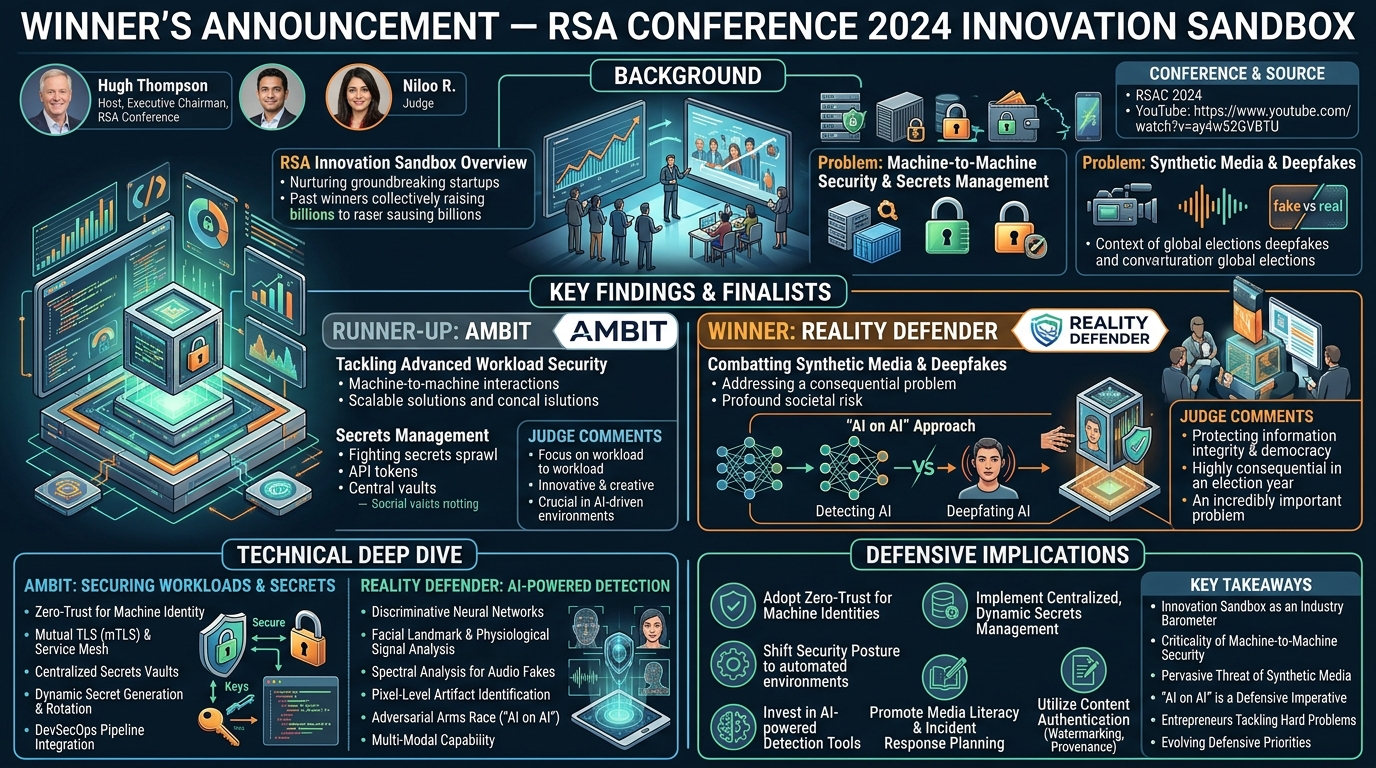
This talk captures the highly anticipated moment of the winner's announcement for the RSA Conference 2024 Innovation Sandbox competition. Far from a traditional technical presentation, this segment serves as a crucial culmination of a rigorous evaluation process, highlighting the cutting-edge of cybersecurity innovation. Hosted by Hugh Thompson, Executive Chairman of RSA Conference, the session reveals the top two finalists—Ambit and Reality Defender—and ultimately crowns the victor, Reality Defender.
Key moments
- 0:00 Welcome, judges return, acknowledging top 10 companies.
- 2:00 Introducing Ambit and Reality Defender, the top two finalists.
- 4:00 Judges describe the challenging and 'spirited' deliberation process.
- 6:15 Judges highlight Ambit's innovative machine-to-machine security solution.
- 8:50 Judges praise Reality Defender's AI-on-AI approach to deepfakes.
- 10:00 The dramatic announcement of the 2024 Innovation Sandbox winner.
Winner's Announcement — RSA Conference 2024 Innovation Sandbox
Speakers: Hugh Thompson (Host, Executive Chairman, RSA Conference), Nazrin R. (Judge, RSA Innovation Sandbox), Niloo R. (Judge, RSA Innovation Sandbox)
Conference: RSAC 2024
YouTube: https://www.youtube.com/watch?v=ay4w52GVBTU
Overview
This talk captures the highly anticipated moment of the winner's announcement for the RSA Conference 2024 Innovation Sandbox competition. Far from a traditional technical presentation, this segment serves as a crucial culmination of a rigorous evaluation process, highlighting the cutting-edge of cybersecurity innovation. Hosted by Hugh Thompson, Executive Chairman of RSA Conference, the session reveals the top two finalists—Ambit and Reality Defender—and ultimately crowns the victor, Reality Defender.
The significance of this event extends beyond a mere award ceremony; it offers a vital pulse check on the most pressing challenges and promising solutions in the cybersecurity landscape, as identified by a panel of expert judges. The brief, yet insightful, commentary from judges Nazrin R. and Niloo R. provides a high-level overview of why these two companies stood out. Their endorsements underscore the critical importance of securing machine-to-machine interactions and managing secrets in an AI-driven world, alongside the urgent need to combat the burgeoning threat of synthetic media and deepfakes. This competition acts as a powerful accelerator for emerging technologies, bringing solutions to the forefront that are poised to shape the future of digital defense.
Background
▶ Watch: Welcome, judges return, acknowledging top 10 companies. (0:00)
The RSA Conference Innovation Sandbox Contest has long been recognized as a premier platform for identifying and nurturing groundbreaking startups in the cybersecurity domain. Established to showcase the industry's most promising new technologies, the contest provides emerging companies with unparalleled visibility and validation from a panel of seasoned industry veterans and venture capitalists. Over its two-decade history, the Innovation Sandbox has launched numerous successful companies, many of which have gone on to achieve significant market impact, with past winners collectively raising billions in venture capital and experiencing successful acquisitions. This pedigree establishes the contest not just as a competition, but as a barometer for future trends and essential defense capabilities.
The problems addressed by the 2024 finalists are emblematic of the evolving threat landscape. Ambit was recognized for tackling machine-to-machine workload security and secrets management. In modern, distributed, and cloud-native architectures, the proliferation of machines, microservices, and automated processes has dramatically increased the surface area for attacks. Traditional perimeter-based security and user-centric authentication models are inadequate when machines need to communicate securely and access sensitive data or services without human intervention. The challenge of managing cryptographic keys, API tokens, database credentials, and other "secrets" across thousands of workloads, often in dynamic environments, has become a major headache for defenders. These secrets are prime targets for attackers, and their compromise can lead to widespread system breaches, data exfiltration, and operational disruption. The judges specifically noted the novelty of Ambit's approach to the "workload to workload" problem, acknowledging that many CISOs are still grappling with "user to machine" security, highlighting a forward-looking perspective.
Reality Defender, the ultimate winner, addressed the rapidly escalating threat of synthetic media and deepfakes. The advent of sophisticated generative AI models has made it remarkably easy to create convincing, yet entirely fabricated, audio, video, and images. This technology, while having legitimate applications, poses an existential risk to trust in digital information, democratic processes, and individual reputations. Misinformation and disinformation campaigns can be amplified exponentially through deepfakes, capable of swaying public opinion, inciting social unrest, or even impacting geopolitical stability. In an era marked by an unprecedented number of global elections—with eight out of ten most populous countries holding elections and half the world's population going to the polls in 2024—the ability to distinguish authentic content from AI-generated fakes becomes not just a cybersecurity issue, but a fundamental societal imperative. The judges emphasized the "consequential problem" of synthetic media, noting the urgent need for solutions that can keep pace with the rapid advancements in AI-driven content generation.
Key Findings
▶ Watch: Judges describe the challenging and 'spirited' deliberation process. (4:00)
The RSA Conference 2024 Innovation Sandbox announcement brought to light two critical areas of cybersecurity innovation and culminated in the recognition of a groundbreaking solution. The primary "findings" from this segment are the identification of Ambit and Reality Defender as the top two companies, and the subsequent declaration of Reality Defender as the overall winner. This outcome reflects the judges' collective assessment of the most pressing problems and the most promising entrepreneurial efforts to solve them.
Ambit was lauded for its innovative approach to workload-to-workload security and secrets management. The judges were particularly impressed by the leadership team's experience and the creative nature of their solution. They highlighted that while many organizations are still focused on securing user-to-machine interactions, Ambit is tackling the more advanced and increasingly prevalent challenge of machine-to-machine communication at scale. This area is deemed especially crucial given the accelerating adoption of AI-based solutions, which inherently rely on extensive machine-to-machine interactions. Furthermore, Ambit’s focus on solving the pervasive problem of "secrets sprawl"—where sensitive credentials and keys are scattered across diverse environments, creating significant headaches for defenders—was seen as a major contribution. The judges' endorsement underscored the growing realization that traditional security paradigms are insufficient for the dynamic, automated, and AI-driven infrastructures of tomorrow.
Reality Defender, ultimately crowned the winner, was recognized for addressing one of the most consequential problems of our time: the proliferation and impact of synthetic media and deepfakes. The judges articulated the profound societal risk posed by AI-generated content, capable of fabricating events and statements, threatening individual reputations, and undermining trust in information. This threat is amplified dramatically in a year marked by numerous critical global elections, where the potential for deepfakes to manipulate public discourse and electoral outcomes is immense. Reality Defender's approach, described as "AI on AI," was highlighted as a necessary and deeply hopeful strategy to combat this rapidly evolving challenge. The judges commended the entrepreneurs for taking on such a hard and incredibly important problem, acknowledging the inherent "cat and mouse" nature of detecting AI-generated content with AI-driven solutions. The unanimous decision to award Reality Defender the top prize underscores the urgent global need for robust, scalable solutions to safeguard truth and trust in the digital age.
Technical Deep Dive
▶ Watch: Judges highlight Ambit's innovative machine-to-machine security solution. (6:15)
The "Winner's Announcement" format of this talk, by its very nature, provides a high-level overview and endorsement of innovative companies rather than a granular technical exposition of their solutions. Consequently, specific details regarding protocols, architectures, or algorithmic implementations from Ambit or Reality Defender were not presented. However, the judges’ commentary offers insights into the problem spaces these companies are addressing, which are themselves highly technical and complex.
For Ambit, the focus on workload-to-workload security implies a deep technical understanding of modern distributed systems. In environments characterized by microservices, containers, and serverless functions, traditional network segmentation and host-based security are often insufficient. Workloads, which can be ephemeral and numerous, require robust identity and access management (IAM) mechanisms that operate at a granular level. This often involves concepts like zero-trust architectures, where no workload is inherently trusted, and every interaction must be authenticated and authorized. Securing these interactions typically involves mutual Transport Layer Security (mTLS), service mesh technologies (e.g., Istio, Linkerd), and API gateways that enforce policies between services. The "machine-to-machine at scale" aspect suggests solutions capable of handling high volumes of automated requests, potentially leveraging hardware security modules (HSMs) or trusted platform modules (TPMs) for secure key storage, and distributed ledger technologies or cryptographic attestation for verifying workload integrity.
The challenge of secrets management that Ambit addresses is also profoundly technical. Secrets—such as API keys, database credentials, cryptographic certificates, and cloud provider access tokens—are the keys to the kingdom. Manually managing these across thousands of workloads is infeasible and error-prone. Modern solutions typically involve centralized secrets vaults (e.g., HashiCorp Vault, AWS Secrets Manager, Azure Key Vault) that securely store, distribute, and rotate secrets. Technical approaches often include dynamic secret generation, where secrets are created on-demand for specific workloads with short lifespans, rather than being static and long-lived. This requires integration with CI/CD pipelines, orchestration platforms (e.g., Kubernetes), and identity providers to ensure that only authorized workloads can retrieve necessary secrets. The judges' emphasis on this being a "major headache for defenders" highlights the operational complexity and the significant security risks associated with inadequate secrets hygiene, such as hardcoded credentials in code repositories or insecure storage in environment variables.
For Reality Defender, the "AI on AI" approach to synthetic media detection points to advanced machine learning and deep learning techniques. Detecting deepfakes is an adversarial problem: as generative AI models improve, so too must detection models. This often involves training discriminative neural networks to identify subtle artifacts or inconsistencies left by generative models, which are often imperceptible to the human eye. Techniques can include analyzing facial landmark inconsistencies, physiological signal anomalies (e.g., irregular blinking patterns, lack of natural micro-expressions), audio spectral analysis for unnatural voice patterns, or pixel-level noise analysis within video frames. The "AI on AI" phrasing suggests an iterative arms race, where Reality Defender's AI models are constantly evolving to counter the latest advancements in deepfake generation. This could involve generative adversarial networks (GANs) where one AI attempts to create fakes and another attempts to detect them, or leveraging transformer models for contextual analysis of content. The criticality of this problem in an election year underscores the need for high accuracy, low latency, and robust resistance to adversarial attacks against the detection mechanisms themselves. While the specific technical architecture remains proprietary, the general approach signifies a sophisticated, multi-modal analysis capability to combat a rapidly advancing threat.
Demo / Proof of Concept
▶ Watch: Judges praise Reality Defender's AI-on-AI approach to deepfakes. (8:50)
This particular segment of the RSA Conference was dedicated solely to the announcement of the Innovation Sandbox finalists and the ultimate winner. As such, it did not include any live technical demonstrations or detailed proof-of-concept presentations from either Ambit or Reality Defender. The companies would have presented their full technical demonstrations and explained their solutions in detail during the earlier rounds of the Innovation Sandbox competition, prior to this final announcement. The judges' comments were based on their prior evaluation of these demonstrations and presentations.
Defensive Implications
▶ Watch: The dramatic announcement of the 2024 Innovation Sandbox winner. (10:00)
The insights gleaned from the RSA Conference Innovation Sandbox announcement, particularly concerning Ambit and Reality Defender, carry profound defensive implications for organizations and society at large. While the talk did not delve into specific defensive strategies, it clearly highlighted two critical areas where defenders must bolster their capabilities.
For the challenges addressed by Ambit—machine-to-machine workload security and secrets management—defenders must fundamentally shift their security posture. The traditional focus on user accounts and network perimeters is no longer sufficient in cloud-native, highly automated environments. Organizations need to adopt a zero-trust security model for their machine identities, ensuring that every service-to-service communication is authenticated, authorized, and continuously verified. This means implementing robust workload identity solutions that can assign and manage identities for ephemeral compute instances, containers, and serverless functions. Defenders should prioritize solutions that enforce least privilege access for machine identities, limiting their permissions to only what is strictly necessary. Furthermore, the pervasive issue of secrets sprawl demands immediate attention. Defenders must move away from static, hardcoded secrets and implement centralized, dynamic secrets management platforms. These platforms should enable automated secret rotation, just-in-time access, and auditability, significantly reducing the attack surface associated with compromised credentials. Integrating these solutions into DevSecOps pipelines is crucial to embed security early in the development lifecycle, preventing secrets from ever reaching insecure locations. The increasing prevalence of AI-based systems further amplifies this need, as AI models and their supporting infrastructure will rely heavily on secure machine-to-machine interactions and robust secrets protection.
Regarding the threat of synthetic media and deepfakes, championed by Reality Defender, the defensive implications are multifaceted and extend beyond traditional cybersecurity to encompass information integrity and societal resilience. Defenders, including security teams, media organizations, and government agencies, must invest in and deploy AI-powered detection and verification tools capable of identifying fabricated content. This requires understanding the evolving techniques used by generative AI and continuously updating detection capabilities. Beyond technology, there's a critical need for media literacy education to equip individuals with the skills to critically evaluate digital content. Organizations need to develop incident response plans for deepfake attacks, outlining procedures for verification, public communication, and damage control in cases of reputation damage or misinformation campaigns. Furthermore, digital provenance and content authentication technologies, such as cryptographic watermarking or blockchain-based verification, will become increasingly important to establish the authenticity of original media. The threat is not just about detecting a fake, but about preserving trust in an increasingly manipulated information ecosystem, making this a collective defensive challenge for technology, policy, and public education.
Key Takeaways
- Innovation Sandbox as an Industry Barometer: The RSA Conference Innovation Sandbox remains a critical platform for identifying and validating the most pressing cybersecurity problems and the most promising entrepreneurial solutions.
- Criticality of Machine-to-Machine Security: The recognition of Ambit highlights the urgent need for organizations to shift focus from user-centric to machine-centric security, particularly for workload-to-workload interactions and scalable secrets management in AI-driven environments.
- Pervasive Threat of Synthetic Media: Reality Defender's win underscores the profound and immediate threat that deepfakes and synthetic media pose to information integrity, democratic processes, and individual trust, especially in a year with numerous global elections.
- "AI on AI" as a Defensive Imperative: The winning solution's approach emphasizes that combating advanced AI-generated threats often requires equally sophisticated AI-driven detection and countermeasure capabilities, signaling an ongoing technological arms race.
- Entrepreneurs Tackling Hard Problems: The competition celebrates the courage and ingenuity of entrepreneurs willing to address complex, high-stakes cybersecurity challenges that have significant societal implications.
- Evolving Defensive Priorities: The judges' insights reveal a clear shift in defensive priorities towards securing highly automated infrastructures and combating sophisticated information manipulation, reflecting the dynamic nature of the cyber threat landscape.
About the Speaker(s)
The "Winner's Announcement" was hosted by Hugh Thompson, who serves as the Executive Chairman of RSA Conference. In this role, he oversees the strategic direction and overall execution of one of the cybersecurity industry's most influential global events. His presence as the host underscores the significance and prestige of the Innovation Sandbox competition.
Providing expert commentary and insights into the judging process were Nazrin R. and Niloo R., who served as judges for the RSA Conference 2024 Innovation Sandbox. As members of the distinguished judging panel, they played a crucial role in evaluating the ten finalist companies, assessing their innovative solutions, market potential, and impact on the cybersecurity landscape. Their perspectives, shared during the announcement, offered valuable rationale behind the selection of the top two companies and the ultimate winner, reflecting their deep expertise and understanding of industry challenges.