Harmonic — RSA Conference 2024 Innovation Sandbox
RSA Conference 2024 · Innovation Sandbox
Overview
Alistair Patterson, co-founder and CEO of Harmonic, delivered an insightful presentation at the RSA Conference 2024 Innovation Sandbox, introducing Harmonic Maestro. The core of his talk centered on the critical challenge of securing sensitive enterprise data in the rapidly evolving landscape of generative artificial intelligence (GenAI). Patterson highlighted that while GenAI applications like ChatGPT have exploded in popularity, offering unprecedented productivity gains, they simultaneously introduce significant data privacy and security risks that traditional data protection mechanisms are ill-equipped to handle.
Key moments
- 0:00 Introduction to Harmonic and GenAI data security problem
- 0:30 Data privacy identified as the #1 barrier to GenAI adoption
- 0:33 Introducing Maestro: Harmonic's human-like data protection AI
- 0:50 Maestro's plain English configuration for defining data protection
- 1:10 Harmonic's unique insight from Digital Shadows team experience
- 1:25 Maestro as a new category leader in enterprise data protection
Harmonic — RSA Conference 2024 Innovation Sandbox
Speakers: Alistair Patterson, Co-founder and CEO, Harmonic
Conference: RSAC 2024
YouTube: https://www.youtube.com/watch?v=lN10MOj4vb4
Overview
Alistair Patterson, co-founder and CEO of Harmonic, delivered an insightful presentation at the RSA Conference 2024 Innovation Sandbox, introducing Harmonic Maestro. The core of his talk centered on the critical challenge of securing sensitive enterprise data in the rapidly evolving landscape of generative artificial intelligence (GenAI). Patterson highlighted that while GenAI applications like ChatGPT have exploded in popularity, offering unprecedented productivity gains, they simultaneously introduce significant data privacy and security risks that traditional data protection mechanisms are ill-equipped to handle.
The presentation underscored that current methods, such as regular expression (regex) matching for personally identifiable information (PII) or manual data labeling, are fundamentally inadequate for the nuanced, contextual data that enterprises truly care about. These legacy approaches fail to protect information like an "investment committee memo," which, while not necessarily containing PII, is profoundly sensitive due to its strategic and proprietary nature. Consequently, data privacy has emerged as the foremost barrier to widespread GenAI adoption across enterprises.
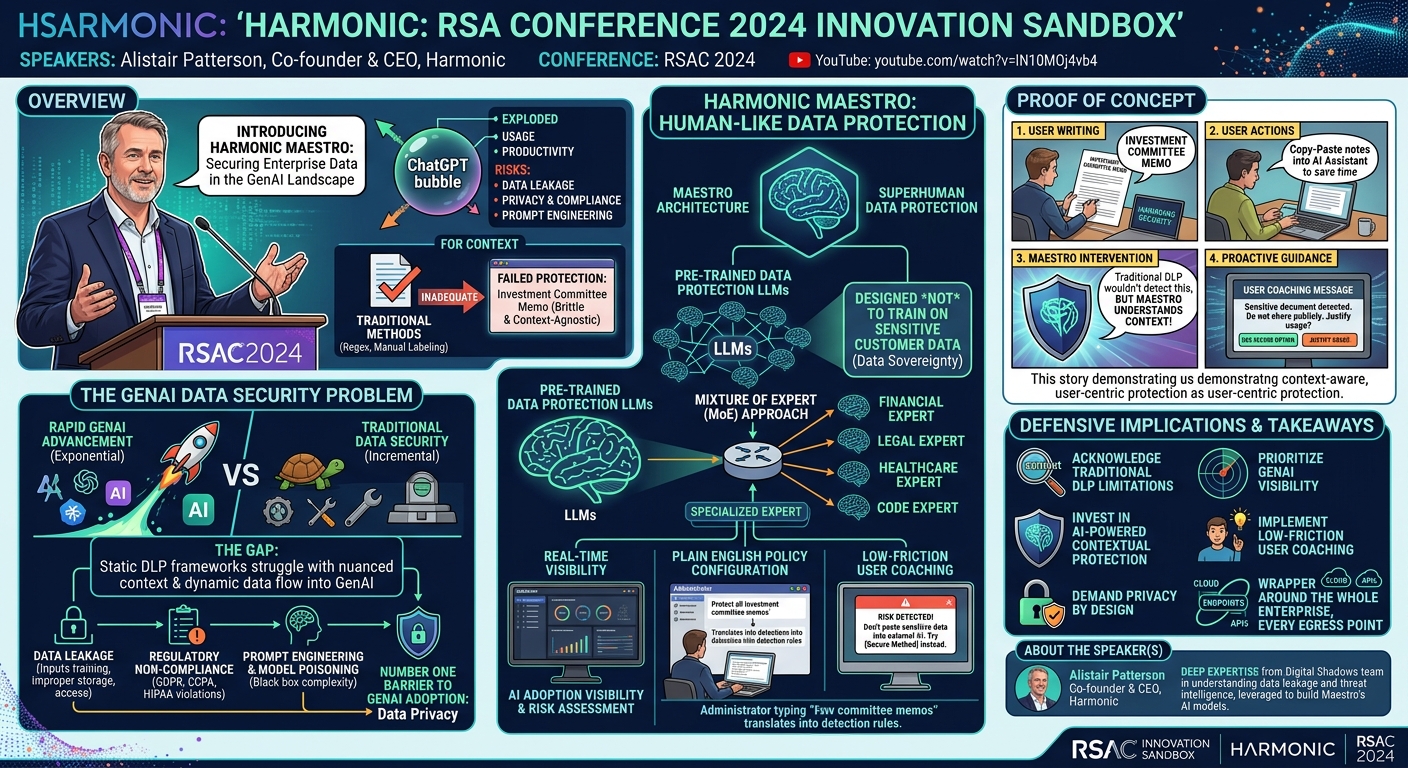
Harmonic Maestro is positioned as a groundbreaking solution designed to overcome these barriers. By leveraging advanced, pre-trained data protection large language models (LLMs) with a mixture of expert approach, Maestro aims to provide "superhuman" data protection capabilities. This system is engineered to understand and protect sensitive information with the same contextual intelligence a human expert would apply, but at an unparalleled scale. The talk emphasized Maestro's ability to offer comprehensive visibility into AI adoption risks, configurable policies in plain English, and a low-friction user coaching mechanism, thereby enabling organizations to harness the power of GenAI securely and compliantly.
Background
▶ Watch: Introduction to Harmonic and GenAI data security problem (0:00)
The advent of generative AI has ushered in a new era of technological capability, promising to revolutionize workflows, accelerate innovation, and enhance productivity across virtually every industry. Tools like ChatGPT have rapidly permeated the enterprise, demonstrating the immense potential of AI to automate tasks, generate content, and analyze complex information. However, this rapid proliferation has also brought to the forefront a constellation of new and exacerbated data security and privacy challenges. The core problem, as articulated by Patterson, is a stark mismatch: while generative AI capabilities have advanced exponentially, data security practices have progressed only incrementally, leaving a significant gap in protection.
Traditional data loss prevention (DLP) and data privacy frameworks were largely designed for a world where data was static, structured, and its sensitivity could often be inferred through simple pattern matching or explicit classification. For instance, identifying PII like social security numbers or credit card details often relies on regex. Similarly, classifying documents as "confidential" might involve manual tagging or keyword searches. These methods, while foundational, are fundamentally brittle and context-agnostic. They struggle profoundly with unstructured data, nuanced business context, and the dynamic nature of information flowing into and out of GenAI systems. An "investment committee memo," for example, might contain no PII but represents highly sensitive intellectual property or strategic financial information. Traditional DLP systems would likely miss such a document unless explicitly configured with highly specific, often brittle, rules.
The integration of GenAI into enterprise operations introduces several acute risks. Foremost among these is the risk of data leakage through inputs. Users, in their pursuit of efficiency, may inadvertently feed sensitive, proprietary, or regulated information into public or insecure GenAI models. These models, depending on their terms of service and underlying architecture, might use this input data for future training, store it insecurely, or make it accessible to unauthorized parties. This creates a direct pathway for sensitive corporate data to exit organizational control, leading to potential intellectual property theft, competitive disadvantage, regulatory non-compliance (e.g., GDPR, CCPA, HIPAA violations), and severe reputational damage.
Furthermore, the very nature of GenAI—its ability to synthesize and generate novel content—presents challenges. It can inadvertently generate or propagate misinformation, or even be prompt engineered to reveal information it was not intended to disclose. The "black box" nature of some LLMs makes it difficult to ascertain how they process and retain information, raising concerns about model poisoning or the potential for models to "memorize" and later regurgitate sensitive training data. This lack of transparency undermines trust and makes compliance auditing exceedingly complex.
Patterson's assertion that data privacy is the "number one barrier to GenAI adoption" highlights a critical strategic dilemma for enterprises. Organizations recognize the transformative potential of GenAI but are paralyzed by the inability to guarantee the security and privacy of their most valuable asset – their data. This paralysis stems from the inadequacy of existing tools to provide the necessary contextual understanding and dynamic protection required for GenAI interactions. The problem is not merely about identifying a specific pattern of characters, but about understanding the meaning, intent, and sensitivity of information within the broader organizational context, a task that has historically demanded human-level intelligence and judgment. Harmonic Maestro aims to bridge this gap by bringing "superhuman data" capabilities to mimic and exceed human contextual understanding in data protection.
Key Findings
▶ Watch: Introducing Maestro: Harmonic's human-like data protection AI (0:33)
While the presentation at the RSA Conference Innovation Sandbox was structured as an introduction to a new product rather than a traditional research talk, it presented several critical insights and proposed solutions that can be considered the "key findings" or core assertions underpinning Harmonic's approach to data protection in the age of generative AI. These findings illuminate the speaker's understanding of the current security landscape and the strategic direction for future data protection.
Firstly, a fundamental finding is the demonstrated inadequacy of traditional data protection methodologies—specifically regex matching for PII and broad data labeling—in the face of complex, contextual, and unstructured data. Patterson explicitly stated that these approaches would fail to protect sensitive, context-dependent information like an "investment committee memo," or "thousands of others like it, that the data that most enterprises care about." This highlights a critical functional gap where legacy systems are blind to the true business sensitivity of information.
Secondly, the presentation underscored that generative AI applications introduce novel and significant data privacy risks that are not effectively addressed by existing security paradigms. The core risk identified is the potential for GenAI models to "train on the sensitive information that's put into them, or hold it insecurely or non-compliantly." This finding points to a systemic vulnerability where the very mechanism that makes GenAI powerful—its ability to learn and process vast amounts of data—becomes a vector for unintentional data exfiltration and compliance breaches.
Thirdly, the talk presented the necessity and feasibility of an AI-driven, context-aware data protection solution as the path forward. Harmonic Maestro's central premise is that an AI system can be developed to mimic and even surpass human intelligence in discerning data sensitivity. Patterson suggested imagining "that you personally had enough time to look at all of the sensitive information that's leaving your business, using all of your smart human context, you would make really good decisions about what is and isn't sensitive, and so can Maestro." This represents a key finding: that advanced AI, specifically LLMs, can be engineered to understand semantic meaning and organizational context, moving beyond superficial pattern matching.
A significant architectural and operational finding related to Maestro is its **reliance on pre-trained data protection LLMs using a mixture of expert approach, specifically designed not to train on sensitive customer data.** This addresses a major privacy concern inherent in many AI solutions. By leveraging pre-trained models, Harmonic asserts it can provide robust protection without ingesting and potentially compromising customer-specific sensitive information, a critical trust-building mechanism for enterprise adoption.
Furthermore, the presentation highlighted the finding that effective data protection for GenAI requires real-time visibility and proactive, low-friction user coaching. Maestro is designed to provide "visibility into AI adoption across the enterprise and associated risks" and to "communicate directly with end users and coach them in the right direction." This finding suggests that a purely enforcement-based, security-team-centric approach is insufficient; instead, empowering and educating end-users in real-time is crucial for fostering a culture of secure GenAI usage and reducing the burden on overloaded security teams.
Finally, Patterson revealed a unique competitive advantage or "unfair advantage" derived from the speaker's prior experience: the finding that deep expertise in understanding leaked sensitive data provides unparalleled insight for building effective AI models. He noted that "20 of our team were with me last time around building Digital Shadows in the threat intelligence space, so we understand what sensitive data that's already leaked out of organizations looks like better than anybody." This demonstrates a crucial insight: real-world knowledge of data breaches and exfiltration patterns is invaluable for training and refining AI models that can accurately identify and protect similar sensitive information before it leaves the organization.
These "findings" collectively articulate a vision for a new category of data protection, one that is intelligent, context-aware, user-centric, and purpose-built to address the unique challenges posed by generative AI.
Technical Deep Dive
▶ Watch: Maestro's plain English configuration for defining data protection (0:50)
The technical underpinnings of Harmonic Maestro, while presented at a high level during the Innovation Sandbox pitch, point towards a sophisticated application of modern AI and security architecture principles. The core assertion is that Maestro can achieve "superhuman data" protection by understanding sensitive information with "smart human context," going far beyond the capabilities of traditional regex-based or manual labeling systems.
At the heart of Maestro are pre-trained data protection LLMs, employing a mixture of expert (MoE) approach. This architectural choice is significant. A Large Language Model (LLM), by its nature, is trained on vast datasets to understand and generate human language. In the context of data protection, a "data protection LLM" would be specifically fine-tuned or designed to identify patterns, entities, relationships, and semantic meanings indicative of sensitive information. This moves beyond simple keyword matching to understanding the context in which data appears. For example, the term "acquisition" might be benign in a news article but highly sensitive in an internal financial report. An LLM can discern this contextual difference.
The "pre-trained" aspect is crucial for enterprise adoption and privacy. It implies that Harmonic has developed or adapted its LLMs using publicly available data, synthetic data, or carefully curated non-sensitive datasets. This allows Maestro to be deployed without requiring customers to feed their proprietary sensitive data into Harmonic's training pipelines, directly addressing a major enterprise concern regarding data sovereignty and privacy. The models arrive "ready-to-use" with a foundational understanding of what constitutes sensitive information across various domains.
The mixture of expert (MoE) approach further refines this. In an MoE architecture, instead of a single monolithic LLM, there are multiple smaller, specialized "expert" models. A "router" or "gating network" determines which expert or combination of experts is best suited to process a given input. For data protection, this could mean:
- One expert specializing in financial documents (e.g., balance sheets, investment memos).
- Another expert for legal contracts (e.g., non-disclosure agreements, patent filings).
- A third for healthcare records (e.g., patient data, medical research).
- Yet another for source code or intellectual property.
When a piece of data (e.g., an email, a document, a chat message) is analyzed, the router directs it to the most relevant expert(s). This approach offers several advantages:
- Specialization: Experts can be highly proficient in their specific domain, leading to more accurate and nuanced detection of sensitivity than a general-purpose model.
- Efficiency: Only the relevant experts are activated for a given task, reducing computational overhead compared to running a single, massive model for all data types.
- Scalability: New experts can be added or existing ones updated without retraining the entire system, allowing for flexible adaptation to evolving threats and data types.
Patterson states that Maestro acts as a "wrapper around the whole enterprise, every egress point." This implies a comprehensive deployment strategy that monitors and intercepts data flows at various points where sensitive information might leave the organization. Such an architecture would likely involve:
- API Gateways/Proxies: Intercepting data sent to external GenAI services (e.g., ChatGPT, Copilot) via API calls or web interfaces.
- Endpoint Agents: Monitoring user activity on workstations, including copy-pasting, file transfers, and interactions with local AI applications.
- Cloud Service Integrations: Direct integrations with cloud storage, collaboration platforms, and SaaS applications to analyze data at rest and in transit.
- Network DLP Sensors: Analyzing network traffic for sensitive data exfiltration.
The goal is to provide visibility into AI adoption across the enterprise and associated risks. This visibility would likely be presented through a centralized dashboard, detailing which users are interacting with which GenAI services, what types of data are being submitted, and what potential risks (e.g., policy violations, sensitive data exposure) are being flagged by Maestro.
A key technical feature is the ability to configure Maestro "in plain English." This suggests a natural language interface for defining data protection policies, moving away from complex regex patterns or rule-based engines. For instance, an administrator could simply type "Protect all investment committee memos" or "Prevent sharing of any client financial data with external AI models." The underlying LLMs would then interpret these natural language instructions and translate them into actionable detection and enforcement rules. This simplifies policy management and makes the system more accessible to security teams who may not be deeply technical in regex or scripting.
Finally, Maestro's capability to "communicate directly with end users and coach them in the right direction" implies an intelligent feedback loop. When a user attempts an action that violates a policy (e.g., pasting sensitive code into a public AI chat), Maestro wouldn't just block it silently or alert the security team. Instead, it would likely present an immediate, contextual notification to the user, explaining why the action is problematic, suggesting alternative secure methods, or requiring justification. This could be delivered via browser extensions, in-app pop-ups, or desktop notifications. This "human-in-the-loop" approach is critical for reducing false positives, educating users, and fostering a security-aware culture without overwhelming security operations centers with alerts.
The combined effect of these technical elements is a system designed for deep contextual understanding, broad enterprise coverage, user-friendly policy management, and proactive risk mitigation, aiming to establish a new benchmark for data protection in the GenAI era.
Demo / Proof of Concept
▶ Watch: Harmonic's unique insight from Digital Shadows team experience (1:10)
While Alistair Patterson's presentation at the RSA Conference Innovation Sandbox did not include a live, interactive product demonstration in the traditional sense, he effectively articulated a compelling hypothetical scenario that served as a narrative proof of concept for Harmonic Maestro's capabilities. This illustrative "demo" highlighted the precise problem Maestro aims to solve and how its unique contextual understanding operates.
The scenario began with a relatable situation: "Imagine you're writing an investment committee memo for the hottest security company you've ever seen. Let's call them Harmonic Security." The speaker then described a common use case for GenAI: "And so you're going to put your your notes into an AI assistant to generate that memo, saves you hours of time. Fantastic." This sets the stage for the productivity benefits of GenAI.
However, Patterson immediately introduced the critical security dilemma: "But there are some new risks with using these AI applications, some of them train on the sensitive information that's put into them, or hold it insecurely or non-compliantly." This succinctly encapsulates the data leakage and privacy concerns that are currently hindering enterprise GenAI adoption.
The core of the "proof of concept" then shifted to how Maestro would intervene. Patterson explicitly stated that traditional methods, like regex for PII or general data labeling, "wouldn't have solved the example I just put up." This reinforces the inadequacy of current tools for nuanced, business-sensitive data.
He then presented Maestro as the solution, emphasizing its ability to understand context: "if you can define something that's important to you, like an investment committee memo, Maestro can protect it." This implies that Maestro, unlike conventional DLP, doesn't just look for keywords or patterns. Instead, it understands the semantic meaning and organizational value of an "investment committee memo" as a whole document type, regardless of its specific content, thereby identifying it as sensitive.
In this narrative, the "demo" effectively showcased:
- The Problem: The ease with which sensitive, high-context business data (like an investment committee memo) can be inadvertently exposed to potentially insecure GenAI models.
- The Failure of Legacy Solutions: Traditional DLP's inability to recognize and protect such context-rich information.
- Maestro's Solution: The system's capacity to comprehend the inherent sensitivity of a document based on its type and context, allowing for protection policies to be defined in "plain English" rather than complex technical rules.
- User-Centric Approach: Although not explicitly demonstrated, the mention of "communicat[ing] directly with end users and coach[ing] them in the right direction" suggests that in a live demo, Maestro would likely intercept the user's attempt to submit the memo, explain the risk, and guide them towards a secure alternative.
While not a live technical walkthrough, this narrative proof of concept served to clearly illustrate the pain point Harmonic aims to alleviate and the intuitive, intelligent nature of its proposed solution, making a strong case for its relevance in the GenAI security landscape.
Defensive Implications
▶ Watch: Maestro as a new category leader in enterprise data protection (1:25)
The insights presented by Alistair Patterson regarding Harmonic Maestro carry significant implications for cybersecurity defenders grappling with the challenges of generative AI. The central message is a call to action for a fundamental shift in data protection strategy, moving beyond reactive, pattern-based approaches to proactive, context-aware intelligence.
Firstly, defenders must acknowledge the inherent limitations of traditional Data Loss Prevention (DLP) and data classification systems when applied to the dynamic and nuanced world of GenAI. Relying solely on regex for PII or static data labels will inevitably lead to critical blind spots, allowing highly sensitive, context-dependent information (like strategic business documents) to slip through the cracks. Security teams need to audit their current DLP capabilities against the new threat vectors introduced by GenAI, recognizing that semantic understanding, not just lexical matching, is paramount.
Secondly, organizations should prioritize solutions that provide comprehensive visibility into GenAI adoption and associated risks across the enterprise. Before robust protection can be implemented, defenders need to understand who is using which GenAI tools, what types of data are being submitted, and where potential policy violations or data exposures are occurring. This visibility is foundational for risk assessment, policy development, and targeted intervention. Security leaders should push for dashboards and reporting that give them a clear picture of their GenAI footprint.
Thirdly, the concept of AI-powered, contextual data protection should be a core consideration for future security investments. Defenders should evaluate solutions that leverage advanced LLMs and machine learning to understand the meaning and sensitivity of data, rather than just its form. Key capabilities to look for include:
- Semantic Understanding: The ability to discern the true nature and sensitivity of unstructured text and documents.
- Contextual Awareness: Understanding data sensitivity based on its origin, destination, user, and prevailing organizational policies.
- Adaptability: Systems that can learn and adapt to new types of sensitive data and evolving GenAI usage patterns.
Fourthly, implementing solutions that facilitate low-friction user coaching and education is crucial. Overburdening security teams with every potential GenAI-related data exposure is unsustainable. Instead, defenders should seek systems that can provide immediate, actionable feedback to end-users at the point of interaction. This empowers users to make secure decisions, reduces the workload on security operations, and fosters a more security-conscious culture around GenAI usage. This might involve in-app prompts, browser extensions, or integrated security agents that guide users in real-time.
Fifthly, security teams must demand solutions that respect data privacy by design, particularly those that utilize AI models without needing to train on sensitive customer data. The "pre-trained LLMs using a mixture of expert approach" described by Harmonic addresses a significant trust barrier. Defenders should scrutinize vendors' data handling practices, ensuring that their sensitive information is not used for model training or stored insecurely. This is a critical due diligence step for any AI-powered security tool.
Finally, defenders need to think broadly about data egress points. As Maestro positions itself as a "wrapper around the whole enterprise, every egress point," this highlights the need for comprehensive coverage. Security strategies for GenAI must extend beyond network perimeters to include cloud services, endpoint interactions, API gateways, and shadow IT usage of AI tools. A fragmented approach will inevitably leave gaps.
In essence, the defensive implication is a call to evolve data protection strategies from a rules-based, reactive stance to an intelligent, proactive, and user-empowering framework that can keep pace with the rapid innovation and inherent risks of generative AI. Organizations that fail to adapt risk significant data breaches, compliance penalties, and a stifled ability to leverage GenAI's transformative potential.
Key Takeaways
- Generative AI introduces profound data privacy risks that traditional data protection methods (like regex or manual labeling) are fundamentally ill-equipped to handle, particularly for nuanced, context-dependent sensitive information.
- Data privacy is the leading barrier to enterprise GenAI adoption, indicating a critical need for innovative security solutions that can match the pace of AI innovation.
- AI-powered solutions are essential for contextual data protection, enabling systems to understand the semantic meaning and business sensitivity of information, mimicking and exceeding human judgment at scale.
- Pre-trained Large Language Models (LLMs) with a Mixture of Expert (MoE) architecture can provide robust data protection without requiring sensitive customer data for training, addressing a key enterprise privacy concern.
- Comprehensive visibility and low-friction user coaching are crucial for managing GenAI risks, empowering users to make secure decisions and reducing the burden on security teams.
- Enterprise data protection must encompass all egress points, acting as a complete "wrapper" to ensure sensitive information does not inadvertently leave the organization through any GenAI interaction.
About the Speaker(s)
Alistair Patterson is the Co-founder and CEO of Harmonic. He brings significant expertise in the cybersecurity domain, particularly in understanding data leakage and threat intelligence. Prior to co-founding Harmonic, Patterson led the development of Digital Shadows, a prominent company in the threat intelligence space. A notable aspect of his current venture is that twenty members of his team from Digital Shadows have joined him at Harmonic, providing a unique and deep understanding of how sensitive data is exfiltrated and what it looks like once leaked. This specialized insight is leveraged to build and refine Harmonic's AI models for data protection.