Dropzone A.I. — RSA Conference 2024 Innovation Sandbox
RSA Conference 2024 · Innovation Sandbox
Overview
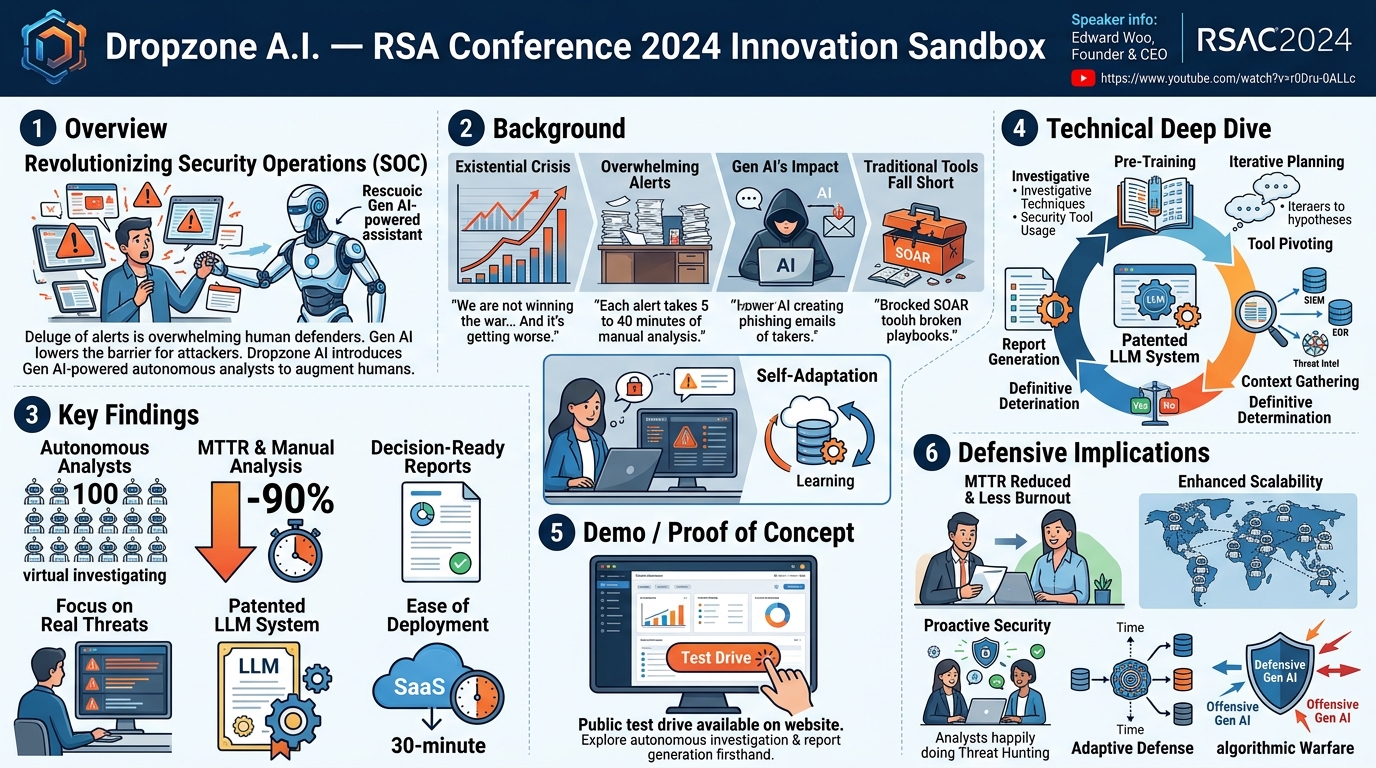
In an era where cyber threats are escalating in sophistication and volume, and the advent of Generative AI (Gen AI) has further lowered the barrier for attackers, security operations centers (SOCs) find themselves at a critical juncture. The talk "Dropzone A.I. — RSA Conference 2024 Innovation Sandbox" by Edward Woo, Founder and CEO of Dropzone AI, addresses this pressing challenge head-on. Woo introduces Dropzone AI's innovative solution: a Gen AI-powered autonomous SOC analyst designed to augment human defenders in the trenches.
Key moments
- 0:00 Gen AI's impact on cyber and Dropzone's mission
- 0:00 Overwhelmed SOCs: How Dropzone AI reduces analysis by 90%
- 0:00 Patented LLM system: Autonomous alert investigation
- 0:00 No playbooks needed: SAS deployment in 30 minutes
- 0:00 Deployed in production, public test drive available
- 0:00 Vision: Defenders reclaim higher ground with AI analysts
Dropzone A.I. — RSA Conference 2024 Innovation Sandbox
Speakers: Edward Woo, Founder and CEO, Dropzone AI
Conference: RSAC 2024
YouTube: https://www.youtube.com/watch?v=r0Dru-0ALLc
Overview
In an era where cyber threats are escalating in sophistication and volume, and the advent of Generative AI (Gen AI) has further lowered the barrier for attackers, security operations centers (SOCs) find themselves at a critical juncture. The talk "Dropzone A.I. — RSA Conference 2024 Innovation Sandbox" by Edward Woo, Founder and CEO of Dropzone AI, addresses this pressing challenge head-on. Woo introduces Dropzone AI's innovative solution: a Gen AI-powered autonomous SOC analyst designed to augment human defenders in the trenches.
The core premise of Dropzone AI is to revolutionize the way security alerts are handled. Traditional SOC environments are plagued by an overwhelming deluge of alerts from various security systems, leading to analyst burnout and delayed response times. Dropzone AI aims to alleviate this burden by leveraging advanced Gen AI to autonomously investigate alerts, thereby significantly reducing manual analysis time and the Mean Time To Respond (MTTR). This transformative approach seeks to empower cyber defenders, allowing them to reclaim the upper hand against an increasingly relentless adversary.
This article delves into the technical underpinnings, operational benefits, and defensive implications of Dropzone AI's solution. It explores how a patented large language model (LLM) system, pre-trained on expert investigative techniques and security tool usage, can deliver decision-ready investigation reports, ultimately enabling security teams to focus on genuine threats and strategic initiatives rather than being mired in alert fatigue.
Background
▶ Watch: Gen AI's impact on cyber and Dropzone's mission (0:00)
The modern cyber landscape presents an existential crisis for security operations. As Edward Woo succinctly puts it, "Cyber defenders have been battling attackers since the dawn of the digital age. But we are not winning the war. And it's getting worse." This grim assessment is underscored by several critical factors that contribute to the overwhelming challenges faced by SOC teams today.
Firstly, the sheer volume and velocity of security alerts have reached unmanageable levels. A typical SOC operates dozens of disparate security systems, including Security Information and Event Management (SIEM), Endpoint Detection and Response (EDR), Intrusion Detection/Prevention Systems (IDS/IPS), cloud security platforms, and more. Each of these systems continuously generates logs and triggers alerts, resulting in "thousands of alerts every day." Manually triaging and investigating these alerts is a monumental task. The speaker highlights that "each alert takes 5 to 40 minutes of manual analysis," a timeframe that quickly compounds into hundreds of hours of labor daily, leading to severe analyst fatigue and an inability to keep pace with incoming threats.
Secondly, the advent of Generative AI (Gen AI) has significantly exacerbated the problem. While Gen AI offers immense potential for defenders, it has also "lowered the bar by making attacks easier." Malicious actors can now leverage sophisticated AI models to craft highly convincing phishing emails, generate polymorphic malware, automate reconnaissance, and develop novel attack vectors with unprecedented speed and scale. This democratization of advanced attack capabilities means that SOCs are not only dealing with more alerts but also with alerts that represent more sophisticated and rapidly evolving threats. The traditional, largely manual, and reactive approach to incident response is simply no longer sustainable against such an adaptive adversary.
Prior work in this domain has largely focused on Security Orchestration, Automation, and Response (SOAR) platforms. While SOAR tools aim to automate repetitive tasks and streamline workflows, they often require extensive upfront investment in developing and maintaining complex playbooks, writing custom code, or engaging in intricate prompt engineering. These requirements can be prohibitive for many organizations, particularly those with smaller teams or less mature security operations. The need for constant updates to playbooks as threats evolve, coupled with the specialized skills required to manage these systems, often prevents SOAR platforms from achieving their full potential in dynamic environments. The problem, therefore, is not just about automation, but about intelligent, adaptive, and autonomous automation that can learn and respond without constant human intervention or rigid pre-defined rules. This gap is precisely what Dropzone AI aims to fill, by offering a solution that is immediately operational and self-adapting, without the burden of playbook creation or custom coding.
Key Findings
▶ Watch: Patented LLM system: Autonomous alert investigation (0:00)
The central revelation from Edward Woo's presentation is the introduction of Dropzone AI's autonomous analysts, a Gen AI-powered solution designed to fundamentally transform security operations. These AI analysts are positioned as a critical intermediary, sitting "between the alerts and the human analysts," autonomously investigating each alert and replicating the investigative techniques of human experts.
The most significant and quantifiable finding is the dramatic improvement in operational efficiency. Dropzone AI claims to deliver "decision-ready investigation reports, reducing manual analysis and MTTR by 90%." This figure is a game-changer for overwhelmed SOCs, indicating a potential shift from a reactive, firefighting mode to a more proactive and strategic posture. By offloading the vast majority of initial alert investigations to AI, human analysts are freed to "focus on only the real threats and critical projects," such as advanced threat hunting, vulnerability management, and strategic security planning, rather than being bogged down by false positives or easily triaged events.
At the heart of Dropzone AI's technological contribution is a patented large language model (LLM) system. This system is not a generic AI but has been specifically "pre-trained on the investigative techniques of common alert types, as well as the usage of security tools." This specialized training is crucial, as it imbues the AI with domain-specific knowledge and the practical skills required to navigate complex security investigations. Unlike conventional automation tools that rely on explicit rules or playbooks, Dropzone AI's LLM system is designed to intelligently plan and execute investigation steps iteratively.
Another key finding relates to the ease of deployment and operationalization. The speaker emphasizes that the technology "does not require any playbooks, code, or chat prompts." This eliminates significant barriers to entry and ongoing maintenance that often plague other automation solutions. Instead, Dropzone AI is delivered as a SaaS (Software as a Service) solution and "can be deployed within 30 minutes." Furthermore, it is designed to "connects to all your existing security systems" and, critically, "self-adapts to your environment." This adaptive capability, combined with its ability to "adjusts its reasoning based on feedback," means the system continuously learns and improves, becoming more effective over time without requiring manual reprogramming.
These findings collectively highlight Dropzone AI's potential to democratize advanced security operations, making sophisticated, AI-driven incident response accessible to "security teams of any size and maturity," from MSSPs (Managed Security Service Providers) to large enterprise SOCs. The public test drive mentioned by Woo further underscores the company's confidence in its out-of-the-box capabilities.
Technical Deep Dive
▶ Watch: No playbooks needed: SAS deployment in 30 minutes (0:00)
The technical core of Dropzone AI's solution is its patented large language model (LLM) system, a sophisticated AI architecture designed specifically for the nuanced and complex domain of cybersecurity investigations. This isn't a general-purpose LLM; its power lies in its specialized training and operational methodology.
The LLM system undergoes extensive pre-training on two critical datasets:
- Investigative techniques of common alert types: This involves feeding the model vast amounts of data related to how expert human analysts approach different categories of security alerts. This includes understanding the indicators of compromise (IoCs), the typical sequence of steps to confirm or deny a threat, the relevant data points to collect, and the logical inferences drawn during an investigation. For example, for a "phishing attempt" alert, the model learns to check email headers, sender reputation, URL authenticity, and potential malware attachments. For a "brute-force login" alert, it learns to examine login patterns, source IP addresses, and user account status.
- Usage of security tools: A critical aspect of a SOC analyst's job is knowing which tools to use for what purpose. The LLM is pre-trained to understand the functionality, input requirements, and output interpretation of various security systems. This could encompass SIEMs for log correlation, EDRs for endpoint forensics, threat intelligence platforms for contextual data, vulnerability scanners for asset context, and more. This training allows the AI to effectively "pivot to the right tool" at the appropriate stage of an investigation.
When a new alert arrives in the SOC, Dropzone AI's system initiates a multi-stage, iterative investigation process:
- Iterative Planning: Unlike rigid, pre-defined playbooks, the LLM system dynamically plans a sequence of investigation steps. This planning is adaptive, meaning the AI doesn't follow a linear path but adjusts its next action based on the information gathered in previous steps. It's akin to a human analyst forming hypotheses and then seeking evidence to prove or disprove them. For instance, if an initial check reveals a suspicious IP, the plan might pivot to querying threat intelligence databases; if a file hash is found, the plan might shift to scanning endpoints for its presence.
- Tool Pivoting: Based on its dynamic plan, the AI determines which security tool is most appropriate for the current investigative step. It then programmatically interacts with that tool, likely through APIs (Application Programming Interfaces), to extract specific data points or execute commands. This could involve querying a SIEM for logs related to a user, initiating an endpoint isolation command via an EDR, or enriching an IP address with geopolitical context from a threat intelligence feed. The system's pre-training on tool usage ensures it knows how to interface with and interpret results from a diverse array of security products.
- Context Gathering: As the investigation progresses, the AI systematically gathers "sufficient context" to build a comprehensive picture of the alert. This context isn't just raw data; it's correlated information from various sources, presented in a structured manner. This could include user activity logs, network traffic data, endpoint process trees, threat intelligence scores, and asset criticality ratings. The goal is to collect all necessary information to make an informed decision about the alert's validity and severity.
- Definitive Determination: Once enough context has been gathered, the LLM system makes a "definitive determination." This is the AI's conclusion regarding the nature of the alert – whether it's a true positive, a false positive, benign activity, or requires further human escalation. This determination is based on the synthesis of all collected evidence, applying its learned investigative logic.
- Report Generation: Finally, the system produces a "decision-ready investigation report." These reports are structured and concise, summarizing the alert, the steps taken during the investigation, the evidence found, and the AI's determination. The aim is for these reports to be immediately actionable by human analysts, providing them with all the necessary information without requiring them to sift through raw logs or manually correlate data.
A significant technical differentiator is the system's self-adaptation capabilities. It "self-adapts to your environment" and "adjusts its reasoning based on feedback." This implies a continuous learning loop where the model refines its understanding of an organization's specific baseline, acceptable behaviors, and unique alert patterns. Feedback from human analysts (e.g., correcting a false positive determination) further trains the model, making it more accurate and relevant over time without the need for manual playbook updates or code changes. This dynamic learning process contrasts sharply with static, rule-based automation, positioning Dropzone AI as a truly intelligent and evolving security assistant.
Demo / Proof of Concept
▶ Watch: Deployed in production, public test drive available (0:00)
While Edward Woo's presentation at the RSA Conference 2024 Innovation Sandbox was primarily a pitch outlining the vision and capabilities of Dropzone AI, the transcript does not contain a detailed, live demonstration or a step-by-step walkthrough of a Proof of Concept during the talk itself. The speaker stated, "Let me show you how it works," which likely refers to the conceptual explanation that followed, rather than an interactive product demo within the confines of the short pitch.
However, Woo did mention a significant avenue for potential users to experience the technology firsthand: "We also have a public test drive on our website where everyone on the internet can try." This suggests that Dropzone AI provides an accessible, public-facing environment where individuals can interact with the AI analyst and observe its capabilities in practice. While the specifics of this test drive were not elaborated upon during the talk, it serves as the practical demonstration component, allowing interested parties to validate the claims made about the autonomous investigation and report generation. This approach aligns with the Innovation Sandbox format, where the focus is often on high-level impact and innovation, with detailed product demonstrations typically reserved for separate engagements or online resources.
Defensive Implications
▶ Watch: Vision: Defenders reclaim higher ground with AI analysts (0:00)
The introduction of Dropzone AI's Gen AI-powered autonomous analysts carries profound implications for defensive cybersecurity strategies and the operational efficacy of SOCs. The technology promises to fundamentally shift the paradigm of incident response, offering a potent countermeasure to the escalating threat landscape.
Firstly, the most immediate impact is a dramatic improvement in Mean Time To Respond (MTTR) and a significant reduction in analyst burnout. By automating up to 90% of manual alert analysis, Dropzone AI frees human analysts from the relentless cycle of triage and investigation of low-priority or false-positive alerts. This allows for faster identification and containment of genuine threats, directly impacting an organization's security posture by minimizing the window of opportunity for attackers. Simultaneously, by removing the repetitive and often tedious tasks, it alleviates the immense pressure on SOC teams, leading to improved job satisfaction and retention among highly skilled cybersecurity professionals.
Secondly, Dropzone AI enables enhanced scalability and coverage. The ability to deploy "100 AI analysts" virtually means that security teams, regardless of their size or maturity, can effectively manage a much larger volume of alerts and cover a broader attack surface without proportionally increasing headcount. This is particularly beneficial for small to medium-sized enterprises (SMEs) and MSSPs, who often struggle with resource constraints but face the same sophisticated threats as larger organizations. The technology democratizes access to advanced incident response capabilities, leveling the playing field against well-resourced adversaries.
Thirdly, the shift from reactive to proactive security operations is a critical defensive implication. When human analysts are no longer overwhelmed by alert queues, they can dedicate their expertise to higher-value activities. This includes threat hunting, proactively searching for novel threats and anomalies that might bypass traditional detection mechanisms; vulnerability management, focusing on systemic weaknesses before they are exploited; security architecture review, ensuring robust defenses are in place; and strategic intelligence gathering, understanding attacker tactics, techniques, and procedures (TTPs) to anticipate future threats. This strategic refocusing transforms the SOC from a cost center into a true value-add for the business.
Furthermore, the self-adapting nature of Dropzone AI's system offers a dynamic defense mechanism. As it learns from an organization's specific environment and feedback, its detection and investigation capabilities become more tailored and accurate. This continuous improvement loop ensures that the defensive tools evolve with the organization's unique threat profile and operational context, reducing false positives and increasing the fidelity of true threat detections over time. This adaptive intelligence is a significant advantage in an environment where attacker TTPs are constantly evolving, particularly with the aid of Gen AI.
Finally, Dropzone AI directly addresses the challenge posed by Gen AI-powered attacks. While Gen AI "has lowered the bar by making attacks easier," Dropzone AI leverages the same technology to "raise the bar" for defenders. By employing sophisticated AI to counter AI-driven threats, it introduces an element of algorithmic warfare, where the speed and scale of defensive actions can match or even exceed that of offensive campaigns. This strategic application of Gen AI in defense represents a potential turning point, offering defenders a viable path to "drive back the attackers and reclaim the higher ground" in the ongoing cyber war.
Key Takeaways
- Gen AI for Autonomous SOC Analysis: Dropzone AI introduces a patented large language model (LLM) system to create autonomous AI analysts that investigate security alerts, aiming to revolutionize traditional, overwhelmed SOC operations.
- Dramatic Efficiency Gains: The solution promises a significant 90% reduction in both manual analysis time per alert and the Mean Time To Respond (MTTR), freeing human analysts to focus on critical threats and strategic projects.
- No Playbooks, Code, or Prompts Required: Unlike traditional SOAR solutions, Dropzone AI's system is designed to be immediately operational, requiring no complex playbooks, custom code, or chat prompts, thanks to its pre-training on investigative techniques and security tool usage.
- Rapid Deployment and Self-Adaptation: Delivered as a SaaS product, it can be deployed within 30 minutes, connects to existing security systems, and continuously self-adapts to the specific environment, adjusting its reasoning based on feedback.
- Empowering Human Defenders: By offloading the vast majority of alert triage and initial investigation, the technology empowers human SOC analysts, improving job satisfaction, enabling proactive threat hunting, and enhancing overall security posture.
- Countering AI-Powered Threats: Dropzone AI leverages Generative AI to combat the increasing ease and sophistication of Gen AI-powered attacks, offering a scalable and intelligent defense mechanism for security teams of any size and maturity.
About the Speaker(s)
Edward Woo is the Founder and CEO of Dropzone AI. He is presented as a seasoned industry expert with a strong background in developing cutting-edge technology solutions. According to the talk, Edward Woo "previously built actual AI/ML and detection products from scratch." This experience highlights his deep understanding of artificial intelligence, machine learning, and their application in creating robust security detection capabilities, providing him with the foundational knowledge necessary to lead Dropzone AI in its mission to augment cyber defenders with autonomous AI analysts.