P0 Security — RSA Conference 2024 Innovation Sandbox
RSA Conference 2024 · Innovation Sandbox
Overview
In an era defined by the rapid expansion of cloud infrastructure and the proliferation of digital identities, securing access remains a paramount challenge for organizations worldwide. Shashwat Segal, Co-founder and CEO of P0 Security, introduced P0 Security at the RSA Conference 2024 Innovation Sandbox, presenting a novel approach to universal access governance. The talk highlighted the critical need for a solution that can effectively manage and secure access for both human and machine identities across complex cloud environments, a problem exacerbated by the rise of AI agents and the limitations of legacy security tools.
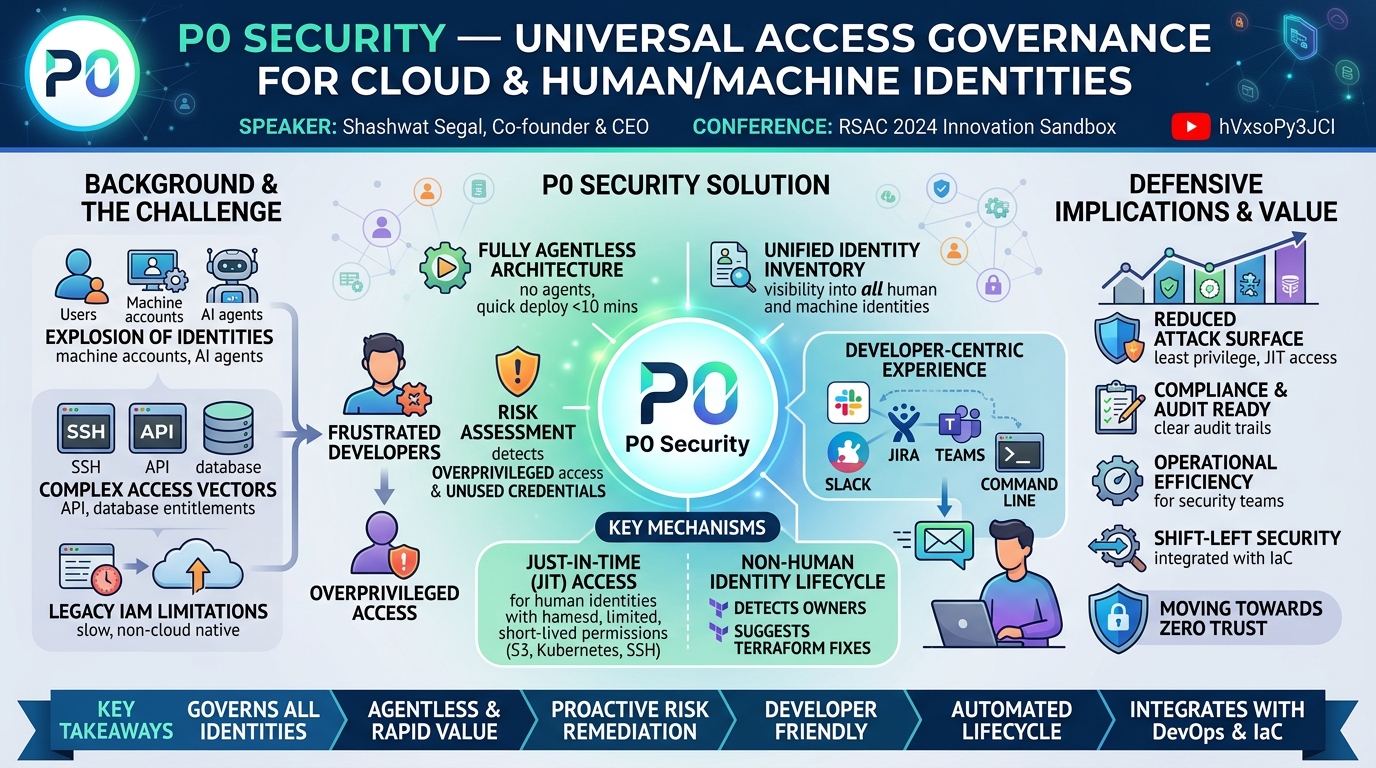
Key moments
- 0:00 Introduction: The pressing challenge of cloud access governance
- 2:00 P0 Security: Universal access governance for all identities
- 2:10 P0's agentless inventory and risk assessment capabilities
- 2:30 Automating just-in-time access for human identities
- 2:58 Simplifying lifecycle management for non-human identities
- 3:18 P0's agentless architecture and developer-centric experience
- 3:40 Tremendous customer traction and industry experience
P0 Security — RSA Conference 2024 Innovation Sandbox
Speakers: Shashwat Segal, Co-founder and CEO of P0 Security
Conference: RSAC 2024
YouTube: https://www.youtube.com/watch?v=hVxsoPy3JCI
Overview
In an era defined by the rapid expansion of cloud infrastructure and the proliferation of digital identities, securing access remains a paramount challenge for organizations worldwide. Shashwat Segal, Co-founder and CEO of P0 Security, introduced P0 Security at the RSA Conference 2024 Innovation Sandbox, presenting a novel approach to universal access governance. The talk highlighted the critical need for a solution that can effectively manage and secure access for both human and machine identities across complex cloud environments, a problem exacerbated by the rise of AI agents and the limitations of legacy security tools.
Segal underscored the significant investment—over $16 billion in 2023—that organizations pour into identity security, yet the governance of cloud access continues to be a major pain point. P0 Security aims to address this by offering an agentless platform designed to inventory identities, assess risks like overprivileged access and unused credentials, and automate lifecycle management without disrupting crucial developer workflows. This approach is particularly relevant as traditional identity and access management (IAM) solutions often struggle with the dynamic, fine-grained access requirements of modern cloud-native architectures and the sheer volume of non-human identities.
The significance of P0 Security's offering lies in its promise to bridge the gap between robust security controls and seamless developer experience. By integrating directly into existing developer tools and workflows such as Slack, Jira, and the command line, P0 seeks to remove the friction often associated with security implementations. This focus on practical usability, combined with an agentless architecture that delivers value within minutes, positions P0 Security as a timely and relevant innovation for organizations grappling with the complexities of cloud identity and access management in an increasingly distributed and automated operational landscape.
Background
▶ Watch: Introduction: The pressing challenge of cloud access governance (0:00)
The landscape of cloud security has undergone a profound transformation, marked by an exponential increase in complexity and attack surface. As Shashwat Segal articulated, organizations collectively spent over $16 billion on identity security in 2023, yet the governance of cloud access persists as one of the most formidable challenges. This paradoxical situation stems from several key factors inherent to modern cloud environments and the evolving nature of digital identities.
Firstly, the explosion of identities is a primary driver of this complexity. Beyond human users, cloud infrastructure is teeming with machine identities—service accounts, compute instances, containers, serverless functions, and now, increasingly, AI agents. Each of these identities requires specific, often granular, access permissions to various cloud resources. Traditional identity management solutions, predominantly built for on-premises environments and human users, struggle to scale and adapt to this dynamic, machine-centric paradigm. The sheer volume and ephemeral nature of many machine identities make manual tracking and governance virtually impossible.
Secondly, the vast number of ways identities can access the cloud compounds the problem. Access is no longer limited to simple user logins. It encompasses direct SSH to virtual machines, database access, API calls, and a myriad of entitlements to a rapidly growing number of cloud services and resources like S3 buckets and Kubernetes clusters. Managing these diverse access vectors, each with its own authentication and authorization mechanisms, creates a fragmented and opaque security posture. Misconfigurations or over-provisioned access in one area can easily become a critical vulnerability.
Thirdly, legacy identity solutions were fundamentally not designed for the cloud's inherent dynamism and scale. They often require extensive setup for fine-grained human access and typically offer poor or non-existent support for machine identities. This architectural mismatch leads to cumbersome deployment, operational overhead, and a failure to provide comprehensive visibility and control across heterogeneous cloud environments. Furthermore, a significant impediment highlighted by Segal is the poor developer experience offered by many security tools. Security teams are often hesitant to implement changes that could disrupt critical developer workflows or, worse, potentially take down a production service. This friction leads to a common dilemma: security measures are either bypassed for expediency or implemented in a way that creates operational bottlenecks, ultimately undermining both security and productivity. The need for solutions that integrate seamlessly into existing development and operations (DevOps) pipelines, without imposing additional burdens on engineers, has become paramount. P0 Security emerges from this context, aiming to provide a solution that not only addresses the technical complexities of cloud identity governance but also solves the critical human-factor and workflow challenges.
Key Findings
▶ Watch: P0's agentless inventory and risk assessment capabilities (2:10)
P0 Security's presentation at RSAC 2024 unveiled a platform designed to tackle the multifaceted challenges of cloud access governance head-on, delivering several key contributions and findings that redefine how organizations can secure their cloud environments. The core finding is the establishment of a universal access governance platform capable of securing all identities—human and machine—without disrupting critical developer workflows. This universality is a significant leap forward, addressing the previously fragmented approach to identity management.
A primary finding is P0's ability to inventory all identities across an organization's cloud footprint. This foundational capability provides unprecedented visibility into who or what has access to what resources. Building upon this inventory, P0 can then assess risks proactively. Segal specifically highlighted the detection of overprivileged access, where an identity has more permissions than it needs, and the identification of unused keys and credentials, which represent dormant attack vectors. These insights are crucial for reducing an organization's attack surface and improving its overall security posture.
Another key contribution is the platform's robust automation for lifecycle management of user access. P0 enables organizations to configure standing access for engineers where appropriate, but more importantly, it facilitates just-in-time (JIT) and short-lived access requests. This allows engineers to request temporary, specific access to resources like S3 buckets, Kubernetes clusters, or SSH access to virtual machines only when needed, significantly reducing the window of opportunity for attackers. This dynamic provisioning and de-provisioning of access is a cornerstone of Zero Trust principles, moving away from static, broad permissions.
For the often-neglected domain of non-human identities, P0 introduces a simplified lifecycle management approach. The platform can detect the human owner responsible for each machine identity, a critical feature for accountability and remediation. Furthermore, P0's ability to suggest fixes in Terraform represents a significant shift-left security capability. By integrating with Infrastructure as Code (IaC) tools, it allows security issues related to access to be identified and remediated at the provisioning stage, rather than post-deployment. These suggested fixes can then be routed to the appropriate human owners via familiar workflows in Jira or Slack, ensuring timely and efficient remediation without manual overhead.
Finally, the "secret sauce" of P0 Security lies in its fully agentless architecture and its developer-centric product experience. The agentless design means rapid deployment—providing value within 10 minutes—without the operational burden of installing and maintaining agents across various cloud instances. Coupled with an intuitive experience that meets developers where they are (Slack, Jira, Teams, command line), P0 overcomes the common friction points that hinder security adoption. These combined findings represent a comprehensive, practical, and developer-friendly solution to a pervasive and complex security challenge.
Technical Deep Dive
▶ Watch: Automating just-in-time access for human identities (2:30)
P0 Security's approach to universal access governance is rooted in several technical principles designed for the scale and dynamism of modern cloud environments. While the talk provided a high-level overview, the described capabilities imply sophisticated underlying mechanisms that leverage cloud-native features and integrate seamlessly into existing DevOps workflows.
The foundational aspect of P0's architecture is its fully agentless design. This means P0 does not require agents to be installed on individual virtual machines, containers, or serverless functions. Instead, agentless systems typically operate by integrating directly with cloud provider APIs (e.g., AWS IAM, Azure AD, Google Cloud IAM), configuration management databases (CMDBs), and security information and event management (SIEM) systems. By leveraging these existing interfaces, P0 can ingest vast amounts of metadata about identities, resources, and access policies. This includes details about IAM roles, users, groups, policies, resource tags, network configurations, and activity logs. The benefits are substantial: rapid deployment (as advertised, "within 10 minutes"), minimal operational overhead, no performance impact on workloads, and broad coverage across heterogeneous cloud services without complex agent management.
Once integrated, P0's core capability is to inventory all identities. This process involves continuous discovery and mapping of human users, service accounts, compute roles, and other machine identities to the resources they can access. This inventory forms a comprehensive graph database or similar structure that models relationships between identities, permissions, and resources. This rich dataset allows P0 to perform risk assessments, specifically identifying overprivileged access and unused keys and credentials.
To detect overprivileged access, P0 likely analyzes effective permissions against actual usage patterns. For instance, if a service role has s3:DeleteObject permissions but has never used them in production, P0 can flag this as potential overprivilege. This often involves techniques like role mining, permission analysis, and activity monitoring. Unused keys and credentials are identified by correlating issued credentials with their last observed usage, flagging those that are dormant and pose a risk if compromised.
For human identity lifecycle management, P0 supports both standing access and just-in-time (JIT) short-lived access. Standing access, while configured through P0, would typically involve assigning roles or permissions that are always active but perhaps constrained by conditional policies. The JIT access mechanism is more technically intricate. When an engineer requests JIT access to a resource (e.g., an S3 bucket or SSH to a VM), P0 likely initiates an approval workflow (potentially via Slack or Jira). Upon approval, P0 dynamically provisions temporary credentials or updates IAM policies for a predefined, short duration. For SSH access, this could involve generating temporary SSH keys and distributing them securely, or integrating with SSH certificate authorities to issue short-lived certificates. For cloud resources, it might mean creating temporary IAM roles or policy attachments that are automatically revoked or expire after the specified time. This approach significantly reduces the attack surface by minimizing the window of opportunity for credential misuse.
The management of non-human identities is another critical technical area. P0's ability to "detect its human owner" for every machine identity likely involves analyzing Infrastructure as Code (IaC) configurations (e.g., Terraform manifests), Git commit history, deployment pipelines, or cloud resource tags. By parsing IaC files, P0 can identify which team or individual provisioned a specific service account or compute instance, thereby linking it to a human owner. This is crucial for accountability and remediation. The platform then takes this a step further by suggesting fixes in Terraform. This implies P0 has an understanding of secure configuration best practices and can generate modified Terraform code (e.g., reducing permissions, adding tags, rotating credentials) that addresses identified vulnerabilities. These suggested fixes are not merely alerts; they are actionable code snippets that can be integrated into a developer's existing GitOps workflow.
Finally, the emphasis on a developer-centric experience through integration with Slack, Jira, Teams, or command line is not merely a UI feature but a deep technical integration strategy. P0 likely provides APIs and webhooks for these platforms, allowing developers to request access, receive notifications, and review suggested fixes directly within their preferred tools. For instance, a developer might type a command in Slack to request S3 access, receive an approval notification in Jira, and then use a P0 CLI tool to assume the temporary role. This integration reduces context switching for developers, making security a seamless part of their workflow rather than an external gate. The mention of the team having built products like Cisco SD-WAN, Splunk APM, and Semgrep further hints at a strong foundation in distributed systems, observability, and static analysis, which are all relevant for building a robust, scalable, and intelligent security platform like P0.
Demo / Proof of Concept
▶ Watch: P0's agentless architecture and developer-centric experience (3:18)
While Shashwat Segal's presentation at the RSA Conference 2024 Innovation Sandbox was a concise pitch rather than a live, step-by-step technical demonstration, the described capabilities provide a clear indication of what a typical P0 Security proof of concept (POC) or demo would showcase. The essence of the Innovation Sandbox is to present a vision and capability, and P0 certainly outlined a compelling one.
A conceptual demo of P0 Security would likely begin by illustrating the ease of deployment, emphasizing the "agentless architecture" and the claim of providing value "within 10 minutes." This would involve connecting P0 to a target cloud environment, such as AWS or Azure, via API keys or roles, and then immediately showing the platform's ability to inventory all identities—both human users and various machine identities like service accounts, EC2 roles, or Kubernetes service accounts.
The next phase of the demo would focus on risk assessment. P0 would likely display a dashboard highlighting instances of overprivileged access, perhaps showing a specific service account with broad * permissions to an S3 bucket, despite only needing read access. It would also demonstrate the detection of unused keys and credentials, pointing out dormant access pathways that could be exploited. This visual representation of identified risks would underscore the immediate value of the platform in uncovering hidden security blind spots.
A key part of the demonstration would undoubtedly be the just-in-time (JIT) access workflow. A developer persona could request temporary SSH access to a specific virtual machine, or temporary write access to a production database. The demo would then show how this request triggers an approval workflow in a familiar tool like Slack or Jira, where a security administrator or team lead could approve it. Upon approval, the developer would be granted the short-lived access, and the demo would highlight how this access automatically expires, demonstrating the reduction of persistent privileges.
Finally, for non-human identities, a demo would illustrate P0's ability to identify the human owner of a particular service account by tracing it back to its Terraform definition. The platform would then present a suggested fix in Terraform code—for example, proposing a more restrictive IAM policy. This fix would then be shown being routed to the responsible developer via a Jira ticket or Slack message, demonstrating the seamless integration into existing development workflows and the "shift-left" security capabilities of the platform. While the actual RSA talk was brief, these elements form the core of P0's value proposition and would be central to any in-depth demonstration of its capabilities.
Defensive Implications
▶ Watch: Tremendous customer traction and industry experience (3:40)
P0 Security's platform offers significant defensive implications for organizations struggling with cloud access governance, moving beyond traditional, reactive security measures to a more proactive and integrated approach. By addressing the complexities of both human and machine identities, P0 empowers security teams to build a more resilient and less vulnerable cloud environment.
Firstly, P0 directly contributes to a substantial reduction in attack surface. By identifying and remediating overprivileged access and unused keys/credentials, organizations can systematically eliminate unnecessary permissions that attackers frequently exploit. This aligns perfectly with the principle of least privilege, ensuring that identities only have the minimum access required to perform their functions. The implementation of just-in-time (JIT) and short-lived access further strengthens this by making access temporary and ephemeral, drastically reducing the window of opportunity for attackers to leverage compromised credentials or persistent standing access. This is a critical shift from a "break-glass" approach to a "build-secure" mindset.
Secondly, the platform significantly enhances compliance and audit readiness. With P0's ability to inventory all identities and their effective permissions, security teams gain comprehensive visibility into their access posture. This detailed record of who has access to what, when, and for how long, provides invaluable data for demonstrating adherence to regulatory requirements such as SOC 2, ISO 27001, HIPAA, or GDPR. The automated lifecycle management and clear audit trails simplify the process of proving that access controls are robust and consistently enforced.
Thirdly, P0's focus on non-human identity management is a game-changer for defending against sophisticated cloud attacks. Machine identities are often overlooked, yet they represent a growing vector for compromise. By automatically detecting human owners for these identities and suggesting fixes in Terraform, P0 enables security teams to integrate security earlier into the development lifecycle (shift-left security). This means vulnerabilities are caught and corrected during infrastructure provisioning via Infrastructure as Code (IaC), rather than after deployment, preventing insecure configurations from reaching production. The integration with Jira and Slack ensures that these remediation actions are routed efficiently to the right individuals, preventing security findings from languishing in unmonitored dashboards.
Furthermore, P0 improves operational efficiency for security teams. By automating routine tasks like access provisioning, de-provisioning, and risk assessment, security personnel can shift their focus from manual, repetitive work to higher-value activities like threat hunting, policy refinement, and strategic planning. The developer-centric approach also fosters better collaboration between security and development teams. When security tools integrate seamlessly into developer workflows, developers are more likely to adopt secure practices, reducing friction and improving the overall security culture. This proactive engagement helps prevent the "security versus speed" dilemma that often plagues organizations.
In essence, P0 Security provides defenders with a powerful toolkit to gain control over the chaotic nature of cloud access. It offers centralized visibility, automated enforcement of least privilege, proactive risk remediation, and a collaborative framework that bridges the gap between security requirements and developer productivity. By securing the proliferation of identities and access vectors, P0 helps organizations move closer to a true Zero Trust architecture in their cloud environments.
Key Takeaways
- Universal Access Governance is Crucial: P0 Security addresses the critical need for a unified platform to govern and secure all identities—human, machine, and emerging AI agents—across complex cloud environments, a challenge legacy solutions fail to meet.
- Agentless Architecture for Rapid Value: The platform's fully agentless design enables quick deployment (within 10 minutes) and immediate value, offering comprehensive identity inventory and risk assessment without operational overhead.
- Proactive Risk Remediation: P0 identifies and helps remediate critical risks such as overprivileged access and unused keys/credentials, significantly reducing an organization's cloud attack surface.
- Developer-Centric Security: By integrating seamlessly into developer workflows via tools like Slack, Jira, Teams, and the command line, P0 reduces friction and encourages the adoption of secure practices without hindering productivity.
- Automated Lifecycle for All Identities: P0 automates just-in-time (JIT) and short-lived access for human users and simplifies non-human identity management by detecting owners and suggesting Terraform-based fixes.
- Shift-Left Security with IaC Integration: The ability to suggest fixes in Terraform and route them via developer workflows allows organizations to embed security earlier in the development pipeline, preventing insecure configurations from reaching production.
About the Speaker(s)
The talk at RSAC 2024 was delivered by Shashwat Segal, who is the Co-founder and CEO of P0 Security. While the transcript does not provide an extensive personal biography, it highlights his significant experience in the security and observability product space. Segal is part of a team that has a strong track record of building "industry defining security and observability products." Specific examples mentioned include contributions to well-known solutions such as Cisco SD-WAN, Splunk APM, and Semgrep. This background suggests a deep understanding of complex enterprise technology, distributed systems, and the intersection of security with operational efficiency, positioning him and his team as seasoned innovators in the cybersecurity landscape.