The Museum of Care: Open-Source Survival Kit Collection
Nika Dubrovsky
39th Chaos Communication Congress (39C3): Power Cycles · Day 3 · Saal Fuse
Overview
This talk, "The Museum of Care: Open-Source Survival Kit Collection," delivered by Nika Dubrovsky and Alistair Parvin at 39C3, presents a radical vision for alternative institutions rooted in open-source principles, community engagement, and a profound critique of contemporary societal structures. Dubrovsky, an artist, writer, and anthropologist, and partner of the late influential anthropologist David Graeber, introduces the Museum of Care and the David Graeber Institute as a living legacy, challenging the extractive and individualistic nature of traditional museums and educational systems. The talk then transitions to Alistair Parvin, founder of Open Systems Lab, who delves into the architectural and systemic design of these alternative spaces, particularly focusing on open-source, modular, and replicable physical infrastructure for learning and cultural exchange.
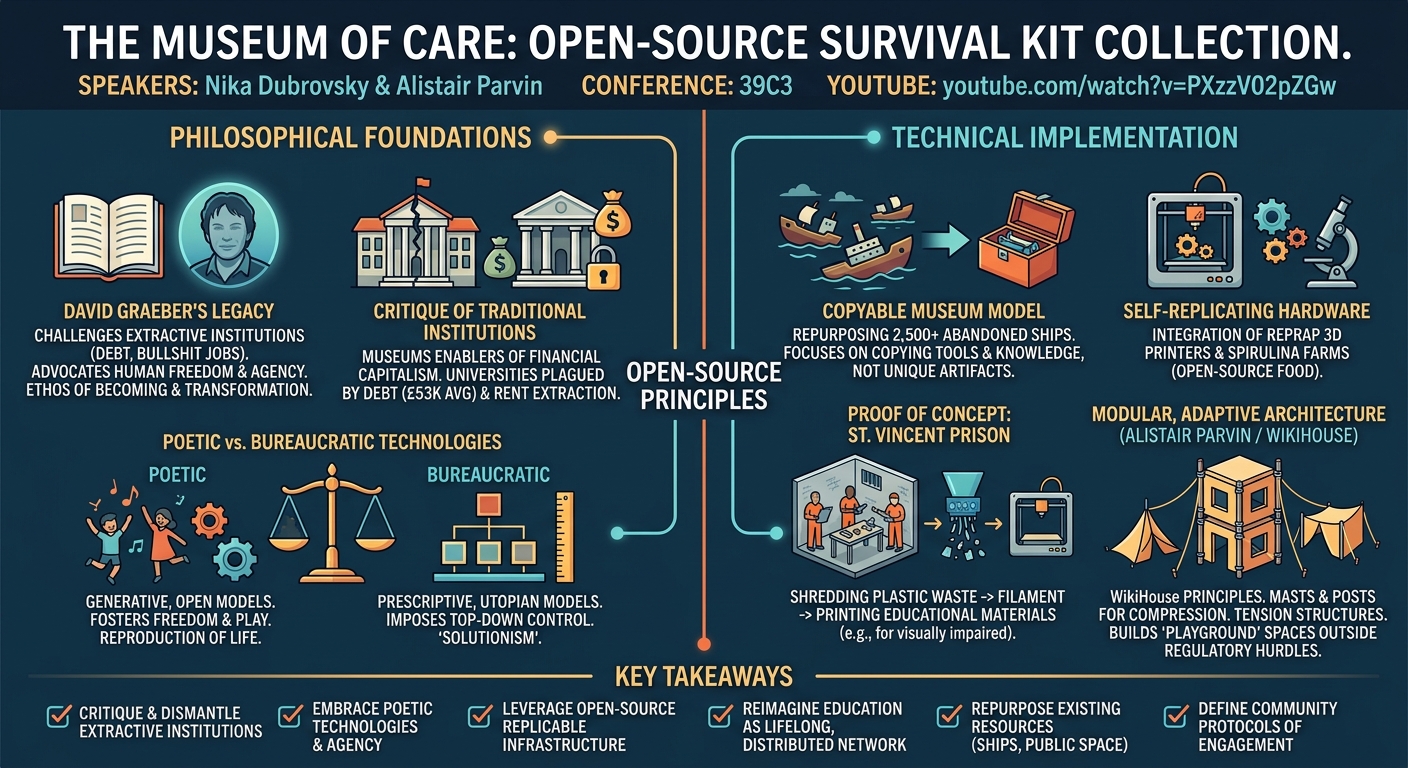
Key moments
- 0:00 Introduction and David Graeber's intellectual legacy
- 1:30 David Graeber's philosophy challenging fixed social systems
- 2:40 The carnival: birth of the Museum of Care
- 4:30 Critiquing contemporary museums, proposing an alternative vision
- 5:40 Abandoned ships: a copyable, open-source museum model
- 7:00 Implementing open-source tools in St. Vincent prison
- 8:40 Distinguishing poetic and bureaucratic technologies for survival
- 10:00 Warning against utopian solutionism and state control
The Museum of Care: Open-Source Survival Kit Collection
Speakers: Nika Dubrovsky
Conference: 39C3
YouTube: https://www.youtube.com/watch?v=PXzzV02pZGw
Overview
This talk, "The Museum of Care: Open-Source Survival Kit Collection," delivered by Nika Dubrovsky and Alistair Parvin at 39C3, presents a radical vision for alternative institutions rooted in open-source principles, community engagement, and a profound critique of contemporary societal structures. Dubrovsky, an artist, writer, and anthropologist, and partner of the late influential anthropologist David Graeber, introduces the Museum of Care and the David Graeber Institute as a living legacy, challenging the extractive and individualistic nature of traditional museums and educational systems. The talk then transitions to Alistair Parvin, founder of Open Systems Lab, who delves into the architectural and systemic design of these alternative spaces, particularly focusing on open-source, modular, and replicable physical infrastructure for learning and cultural exchange.
The core of the presentation revolves around the concept of an "open-source survival kit collection" – not as a top-down NGO initiative, but as a framework for fostering human freedom, play, and the reproduction of life itself. It critiques "bureaucratic technologies" and "solutionism" that attempt to manage humanity from above, advocating instead for "poetic technologies" that empower individuals and communities to actively make and remake their world. This vision extends to re-imagining education, proposing a network of accessible, low-cost, and community-owned learning environments, exemplified by the "playground" metaphor and the use of abandoned ships as copyable museums. The talk provides a compelling argument for dismantling existing, often failing, institutions and building new ones from the ground up, based on principles of openness, collaboration, and shared ownership.
The relevance of this talk extends beyond academic or artistic circles, offering crucial insights for anyone concerned with the future of knowledge, education, and community resilience in an increasingly complex and unequal world. By connecting anthropological theory with practical open-source hardware and architectural design, Dubrovsky and Parvin present a holistic model for creating genuinely emancipatory spaces. Their work matters because it offers tangible, replicable methods for resisting systemic decay and fostering environments where human creativity and collective action can thrive, rather than being stifled by debt, gatekeeping, and commercial interests.
Background
▶ Watch: Introduction and David Graeber's intellectual legacy (0:00)
The genesis of the Museum of Care and the David Graeber Institute is deeply intertwined with the intellectual legacy of David Graeber, whose work profoundly influenced the talk's underlying philosophy. Graeber, a highly influential anthropologist, challenged conventional understandings of society, particularly what he termed the "colonization of the enlightenment." His writings, such as "Debt: The First 5,000 Years" and "Bullshit Jobs," questioned established power structures and advocated for human agency and freedom. Dubrovsky highlights Graeber's critique of structuralists like Lévi-Strauss, who described social life as a system of fixed relationships and codes, leaving little room for subjective human experience. Instead, Graeber, following his teachers Terrence Turner and Lev Vygotsky, emphasized learning and development through social interaction, focusing on how people actively construct and reconstruct their world, a perspective more akin to Noam Chomsky's ideas. This generative approach, prioritizing what people actually do, imagine, and create together, forms the bedrock of the Museum of Care.
The Museum of Care itself was born from a unique response to Graeber's passing: a global carnival in hundreds of locations, from London to New Zealand, Berlin to New York. This carnival, now an annual event, embodies the Bakhtinian idea, which Graeber championed, that humans are "something that is becoming and not fixed." This ethos of transformation and collective celebration directly contrasts with the static, preservative nature of traditional institutions. Dubrovsky and Graeber's collaborative essay collection, "Another Art World," further articulates their critique of contemporary museums, viewing them as integral to financial capitalism. These institutions, they argue, produce and reproduce value systems that prioritize individual artistic achievement or specific cultures over others, creating knowledge reproduction systems that ideally need to be replaced or dismantled.
A central conceptual framework introduced by Graeber and elaborated in the talk is the distinction between poetic technologies and bureaucratic technologies. Poetic technologies are those that build on generative, open models, emphasizing play, freedom, and the reproduction of human life. They arise from a belief in people's capacity to figure things out together and create their own solutions. In contrast, bureaucratic technologies stem from a worldview of absolute certainty, presuming that a select few have already figured out how things should work and how to "save humanity." This "solutionism," often seen in technoptimist visions, is likened to utopian thinking, which Graeber critically examined. Dubrovsky cites Thomas More's "Utopia" and Tommaso Campanella's "City of the Sun" (published 1602) as historical examples, noting Campanella's chilling depiction of a society where the state arranges marriages, determines sexual partners, holds wives and children in common, and expels "weaker or less intelligent children." This cautionary tale serves as a stark warning against top-down, prescriptive systems, a critique that Dubrovsky extends to contemporary figures like Peter Thiel and Alex Karp, who also attempt to design systems for universal happiness and safety.
Alistair Parvin expands this critique to the realm of higher education, highlighting its profound crisis. He notes the corrupted functions of education, which have largely devolved into a "form of labor market supply," rather than fostering knowledge development or individual hope. The current infrastructure is characterized by rising costs and diminishing marginal value, leading to a "slow decline or potential collapse" of many institutions. Parvin uses Terry Pratchett's analogy for religion – where the god dies but the priesthood and rituals continue – to describe the decay of universities: once "fantastic ideas" for knowledge-rich institutions, they now often operate as hollow shells. The UK university system serves as a stark example: students graduate with an average of £53,000 in debt, and a significant portion of university income, particularly by 2028, is extracted by landlords, making them almost double what universities earn from further education. This system of entrenchment, capture, and rent extraction is deemed unsustainable, signaling an impending break.
Key Findings
▶ Watch: The carnival: birth of the Museum of Care (2:40)
The talk presents several key findings that challenge conventional approaches to cultural institutions, education, and societal organization, while offering actionable alternatives:
- Systemic Decay of Traditional Institutions: Both Nika Dubrovsky and Alistair Parvin argue that established institutions like museums and universities are in a state of advanced decay. Museums are seen as enablers of financial capitalism, perpetuating individualistic value systems and preventing the reproduction of culture. Universities, particularly in the UK, are characterized by exorbitant costs, crippling student debt (averaging £53,000 upon graduation), declining educational value, and significant rent extraction by private landlords, indicating a fundamental shift away from their original emancipatory purpose.
- The Power of Poetic Technologies: David Graeber's concept of poetic technologies is central. These are generative, open models that prioritize human freedom, play, and the active reproduction of life over abstract cultural reproduction or top-down management. They stand in stark contrast to bureaucratic technologies, which are prescriptive, utopian, and often lead to oppressive outcomes, as exemplified by Campanella's "City of the Sun." The talk emphasizes that true survival kits must include freedom and play, not just food and shelter.
- Open-Source as a Model for Institutional Design: The core contribution is the application of open-source principles to the creation of new institutions. This includes:
- Copyable Museums: The idea of using abandoned ships (2,500 in maritime databases) as modular, replicable museum spaces that anyone can copy, rather than focusing on unique, preserved artifacts.
- Self-Replicating Hardware: Integration of RepRap 3D printers and open-source food systems like spirulina farms into these spaces, empowering communities to produce their own tools and resources.
- Modular, Adaptive Architecture: Alistair Parvin's work on WikiHouse and the proposed "playground" structures demonstrate how simple, modular, and adaptable designs using masts and posts for compression and tension structures can create flexible, low-cost learning environments that bypass complex regulatory and financial hurdles.
- Education as a Lifelong, Distributed Network: The talk advocates for a radical rethinking of education, moving away from time-boxed, debt-driven models towards lifelong, episodic, low-risk, and experimental learning. This involves creating a network of educational spaces—metaphorically and literally "playgrounds"—that are multigenerational, located in public spaces, and open to continuous development, potentially in places like Zanzibar or Nairobi.
- The Importance of Protocols in Open Systems: While emphasizing openness and permissionless access, the speakers acknowledge the necessity of protocols of engagement for these new spaces. These "software" aspects—like basic rules of respect, commitment to processes, and whether work outputs are public goods—are crucial for fostering productive and equitable communities, preventing the emergence of "cruddy behaviors" often found in declining traditional institutions.
Technical Deep Dive
▶ Watch: Abandoned ships: a copyable, open-source museum model (5:40)
The technical deep dive of this talk focuses not on traditional cybersecurity exploits, but on the architecture and systems design of alternative, open-source institutions. The "survival kit collection" concept is intrinsically technical in its application of open-source hardware and replicable infrastructure.
A primary technical innovation proposed by Nika Dubrovsky is the repurposing of abandoned ships as "museums of care." There are an estimated 2,500 such ships in maritime foundation databases, representing a significant source of "buildings with rooms and doors" that are currently toxic waste polluting the oceans. The technical principle here is reproducibility and copyability. Unlike traditional museums that focus on unique, preserved artifacts and prevent copying, these ship-museums would host collections of open-source tools and knowledge that anyone could replicate and take with them. This includes practical items like self-replicating RepRap 3D printers and spirulina cultivation systems for open-source food production. This approach directly counters the intellectual property and scarcity models prevalent in traditional cultural institutions.
A tangible application of this concept is the project in a prison in St. Vincent. Here, a 3D printer was installed, alongside a plastic shredding machine. This setup addresses two technical problems simultaneously: the abundance of plastic trash in Caribbean islands and the need for educational materials. Inmates can shred plastic waste, transforming it into filament for the 3D printer, and then produce useful items, such as educational materials for blind people. This demonstrates a closed-loop system for waste management and resource creation, utilizing open-source hardware in a non-commercial, learning-focused environment.
Alistair Parvin, from Open Systems Lab, extends this open-source philosophy to physical structures, drawing on his work with WikiHouse. WikiHouse is an open-source modular building system designed for zero-carbon construction. Parvin's expertise lies in designing systems that are simple to build, modular, and can respond to varying budgets and activity levels, effectively making buildings behave "more like software." This includes sharing cutting files for digital fabrication machines, allowing for precise, replicable construction.
For the "playground" concept—a metaphor and literal proposal for new educational spaces—Parvin outlines specific design principles:
- Modularity and Adaptability: Structures must be simple to build and modular, allowing them to grow or shrink based on available funds and activity. This avoids large upfront costs and makes the infrastructure resilient and responsive.
- Shareability as Code: Beyond digital fabrication files, the "code" can also be simpler, such as the topologies of rope knots, which almost anyone has access to and can replicate. This emphasizes universal accessibility to the building "instructions."
- Compression and Tension Structures: The design leverages masts and posts to handle the difficult compression loads in buildings. Connected to these, tension structures (like tents, shades, or more developed temporary enclosures) create adaptive and agile spaces. This approach allows for the creation of seating areas or even temporary homes with a high percentage of the benefits of institutional buildings, while intentionally sitting outside the complex financial and regulatory systems normally associated with construction. By treating these structures "more like art or more like playground," they sidestep bureaucratic complexity.
The proposed educational spaces, whether in Zanzibar or Nairobi, envision a practical application of these principles. The visual assembly concept—where people draw and redraw together—would be housed within these adaptable physical structures, fostering collaborative learning and knowledge creation in a physically and conceptually open environment. The "software" aspect also includes the protocols of engagement for these permissionless but conditional spaces, such as expectations of respect, commitment to processes, and the public good nature of work outputs. This dual focus on open-source hardware and open-source social protocols forms the technical blueprint for the "future university" envisioned by the speakers.
Demo / Proof of Concept
▶ Watch: Implementing open-source tools in St. Vincent prison (7:00)
While the talk did not feature a live, interactive technical demonstration in the traditional sense of a security conference, it presented several conceptual proofs of concept and early-stage project implementations that exemplify the "open-source survival kit collection" philosophy.
One significant conceptual proof of concept is the idea of abandoned ships as copyable museums. Dubrovsky highlights the existence of 2,500 abandoned ships globally, which she describes as "buildings with rooms and doors." The "demo" here is the idea itself: a museum model that explicitly encourages copying and reproduction of useful knowledge and tools, rather than preserving unique artifacts. This directly contrasts with the prohibitive nature of traditional museums. The vision includes equipping these ships with RepRap 3D printers and spirulina farms, allowing for the on-site creation and replication of open-source tools and food.
A more concrete, though still early-stage, project is the prison initiative in St. Vincent. This serves as a working example of the survival kit in action. In this non-commercial space, a 3D printer and a plastic shredding machine have been installed. The inmates are actively engaged in shredding plastic trash from the island, converting it into material for the 3D printer, and then printing educational materials, specifically for blind people. This demonstrates a practical, replicable system for waste management, resource generation, and skill development, all powered by open-source hardware in a real-world, community-benefiting context. A spirulina farm is also being built there.
Alistair Parvin's contribution details the design principles for the "playground" educational spaces, which serve as a design-level proof of concept. He describes how WikiHouse's modular, open-source building systems can be adapted to create flexible learning environments. The proposed architecture utilizes simple masts and posts for structural support, combined with tension structures (like tents or temporary enclosures) for adaptable spaces. The "demo" here is the design methodology itself: how to create low-cost, rapidly deployable, and community-buildable infrastructure that can bypass traditional regulatory and financial hurdles. The concept of "sharing as code"—whether through digital cutting files or simple rope knot topologies—is a demonstration of how design knowledge can be openly distributed and replicated.
Finally, the talk mentions the proposed visual assembly playground in Nairobi's central library. This project, still in its planning stages, involves a huge sticker for collaborative drawing and a physical playground to be built in front of the library. This illustrates the integration of the "visual assembly" concept (collaborative drawing for non-native speakers or diverse groups) with the physical, open-source playground architecture, serving as a future proof of concept for a network of distributed, community-driven educational nodes. While not a live demonstration in the conventional sense, these examples and design frameworks collectively serve as compelling evidence for the feasibility and potential impact of the "open-source survival kit collection."
Defensive Implications
▶ Watch: Warning against utopian solutionism and state control (10:00)
The defensive implications of this talk, while not pertaining to traditional cybersecurity vulnerabilities, are profound for the "defense" of human agency, accessible knowledge, and resilient communities against the systemic "attacks" of institutional decay, financial extraction, and bureaucratic control.
- Defend Against Institutional Decay and Rent Extraction: Defenders must recognize that established institutions (universities, museums) can become extractive rather than empowering. The talk highlights how the UK university system, for example, burdens students with immense debt (£53,000 average) while private landlords extract significant profits. The "defense" is to actively disengage from and build alternatives to these systems. This involves understanding the mechanisms of rent-seeking and institutional capture to avoid replicating them in new structures.
- Embrace Poetic Technologies over Bureaucratic Control: A core defensive strategy is to prioritize poetic technologies – those that foster play, freedom, and human flourishing – over bureaucratic technologies that impose top-down, "solutionist" models. Defenders should be wary of utopian visions that promise universal happiness through centralized control, as these often lead to oppression (e.g., Campanella's "City of the Sun"). The defense lies in decentralized, community-driven approaches that empower individuals to shape their own environments and learning paths.
- Build Resilient, Open-Source Infrastructure: To counter the fragility and inaccessibility of existing physical and informational infrastructure, defenders should adopt open-source principles for building new spaces.
- Open-Source Hardware: Utilize tools like RepRap 3D printers and plastic shredding machines to create closed-loop systems for resource generation and waste management, reducing dependence on external, often exploitative, supply chains.
- Modular, Adaptive Architecture: Employ design principles from WikiHouse for creating low-cost, modular, and easily replicable physical structures. Using masts and posts with tension structures allows for adaptive spaces that can be built by communities, circumventing complex and costly regulatory hurdles of traditional construction. This defends against the high entry barriers and fixed costs of conventional buildings.
- Foster Decentralized, Lifelong Learning Networks: The talk advocates for a defense against the "labor market supply" model of education by creating permissionless but conditional learning spaces. This means building networks of "playgrounds" that offer lifelong, episodic, and low-risk educational opportunities. The "conditions" (e.g., respect, commitment, public good outputs) are crucial protocols for maintaining a healthy, productive community, defending against the "cruddy behaviors" that can emerge in unmoderated or poorly structured environments.
- Reclaim Public and Underutilized Spaces: Defend against the privatization and underutilization of resources by repurposing spaces like abandoned ships for cultural and educational purposes. Similarly, leveraging existing shared spaces in cities or creating temporary, adaptive structures in public areas can bypass the need for expensive, purpose-built "white elephant" university buildings. This strategy defends against financial barriers and promotes accessibility.
In essence, the defensive implications call for a paradigm shift: instead of patching up failing systems, the strategy is to strategically withdraw from them and collectively build new, more robust, equitable, and human-centric alternatives using open-source methodologies and a deep understanding of human social dynamics.
Key Takeaways
- Critique and Dismantle Extractive Institutions: Traditional museums and universities are often extractive, debt-laden, and perpetuate individualistic values, serving financial capitalism rather than human flourishing. Recognizing this decay is the first step towards building alternatives.
- Embrace "Poetic Technologies": Prioritize generative, open models that foster human freedom, play, and the active reproduction of life. Reject "bureaucratic technologies" and "solutionism" that impose top-down, utopian visions that stifle agency.
- Leverage Open-Source for Replicable Infrastructure: Utilize open-source hardware (e.g., RepRap 3D printers, plastic shredders) and modular architectural designs (e.g., WikiHouse principles for masts, posts, and tension structures) to create low-cost, adaptable, and easily reproducible physical spaces for learning and cultural exchange.
- Reimagine Education as a Lifelong, Distributed Network: Shift from time-boxed, debt-driven education to a model of lifelong, episodic, low-risk learning within a network of community-owned "playground" spaces, fostering collaboration and experimentation.
- Repurpose Existing Resources and Spaces: Actively seek out and repurpose underutilized resources like abandoned ships for "copyable museums" or existing shared public spaces for educational "playgrounds," bypassing the high costs and regulatory hurdles of new construction.
- Define and Uphold Community Protocols: While promoting openness, establish clear "protocols of engagement" (e.g., respect, commitment, public good outputs) as the "software" for new institutions, ensuring productive and equitable participation within permissionless yet conditional environments.
About the Speaker(s)
Nika Dubrovsky is an artist, writer, and anthropologist, deeply engaged with the intersection of art, activism, and social theory. She was the partner and close collaborator of the late influential anthropologist David Graeber. Following Graeber's death, she co-founded the Museum of Care and the David Graeber Institute, initiatives dedicated to exploring and implementing alternative institutional models based on open-source principles, community, and human agency. Her work, including the co-authored essay collection "Another Art World," critically examines the role of contemporary museums and advocates for cultural institutions that prioritize the reproduction of life over abstract culture. Dubrovsky is a key figure in translating Graeber's theoretical insights into practical, community-driven projects, such as the prison initiative in St. Vincent and the proposed educational spaces in East Africa.
Alistair Parvin is a designer and the founder of Open Systems Lab, a non-profit organization focused on the design of systems, particularly in architecture and property. Originally trained as an architect, Parvin has become a prominent voice in the open-source hardware and modular building movement. He is widely known for his work on WikiHouse, an open-source modular building system for zero-carbon buildings that allows communities to design, download, and digitally fabricate their own homes and structures. His expertise lies in developing replicable, low-cost, and adaptive architectural solutions that challenge traditional, extractive property and construction systems. In the context of this talk, Parvin applies his knowledge of open-source design to envision the physical infrastructure for the Museum of Care's alternative educational "playgrounds."
All talks from 39th Chaos Communication Congress (39C3): Power Cycles