Keynote: Fireside Chat with Moxie Marlinspike
Unknown
Black Hat USA 2024 · Day 1 · Briefing
Overview
This Black Hat USA keynote, framed as a "Fireside Chat" with legendary privacy advocate and Signal founder Moxie Marlinspike, began with a compelling and thought-provoking "pitch" delivered by Marlinspike himself, following an introduction by Black Hat founder Jeff Moss. While the anticipated chat format was set to follow, Marlinspike's opening remarks served as the core message of the session, challenging conventional wisdom in software development and highlighting the unique, indispensable role of the information security community. The talk centered on the pervasive and often detrimental impact of black box abstractions in modern engineering, arguing that they stifle genuine understanding and create fertile ground for vulnerabilities.
Key moments
- 0:00 Welcome to Black Hat and day two keynote
- 1:00 Introduction of Black Hat scholarship program
- 2:06 Jeff Moss's advice on networking and asking questions
- 6:08 Jeff Moss introduces keynote speaker Moxie Marlinspike, Signal founder
- 9:10 Moxie Marlinspike takes stage for Fireside Chat
- 9:55 Moxie's opening pitch: magic, Harry Potter, and school
Keynote: Fireside Chat with Moxie Marlinspike
Speakers: Jeff Moss, Founder of Black Hat; Moxie Marlinspike, Founder of Signal
Conference: Black Hat USA
YouTube: https://www.youtube.com/watch?v=MAJP-fAf8MI
Overview
This Black Hat USA keynote, framed as a "Fireside Chat" with legendary privacy advocate and Signal founder Moxie Marlinspike, began with a compelling and thought-provoking "pitch" delivered by Marlinspike himself, following an introduction by Black Hat founder Jeff Moss. While the anticipated chat format was set to follow, Marlinspike's opening remarks served as the core message of the session, challenging conventional wisdom in software development and highlighting the unique, indispensable role of the information security community. The talk centered on the pervasive and often detrimental impact of black box abstractions in modern engineering, arguing that they stifle genuine understanding and create fertile ground for vulnerabilities.
Marlinspike posited that as the broader tech world increasingly relies on opaque, high-level tools and services, the deep understanding of how software truly functions at its foundational layers is diminishing. In contrast, he asserted that security professionals are uniquely positioned—and indeed, compelled—to deconstruct these abstractions, exposing their "leaky interfaces" and "unexpected outcomes" to identify exploitable flaws. This keynote was not a technical deep dive into specific exploits but rather a philosophical call to action, urging the security community to recognize and embrace its critical function as the inheritors of true engineering insight in an increasingly abstracted world.
Background
▶ Watch: Welcome to Black Hat and day two keynote (0:00)
The evolution of software development over the past several decades has been characterized by a relentless drive towards abstraction. From assembly language to high-level programming languages, and from bare-metal servers to sophisticated cloud platforms and containerized environments, each layer of abstraction aims to simplify complexity, improve developer productivity, and accelerate innovation. While these advancements have undeniably propelled technological progress, Moxie Marlinspike's keynote critically examines their less celebrated side effect: a growing disconnect between engineers and the fundamental workings of the systems they build.
Marlinspike argues that this trend has led to a systematic "undermining of our ability to create good engineers." By onboarding individuals into teams and systems composed entirely of black box abstractions, where the inner workings are intentionally hidden or deemed irrelevant, the natural curiosity and desire to understand "how things work" can be stifled. He likens this phenomenon to a poorly designed educational system, recounting a personal anecdote about a middle school handbells class so devoid of genuine musical exploration that it seemed designed to "destroy any child's natural desire or curiosity to learn about music." This analogy underscores his concern that modern engineering practices inadvertently create a similar disengagement from the core principles of computing.
Historically, engineers were required to possess a deep understanding of hardware, operating systems, and network protocols to build robust applications. The security implications of every design choice were often more apparent. However, with the proliferation of managed services, serverless architectures, and complex frameworks, much of this underlying machinery is now obscured. This creates a paradigm where developers can build functional systems without truly grasping the intricate interactions, dependencies, and potential failure points beneath the surface. For the security community, this landscape presents both a challenge and a unique opportunity. Black Hat founder Jeff Moss also prefaced the talk by emphasizing the conference's commitment to community, knowledge sharing, and the reality that "nobody knows it all" in information security, highlighting the need for continuous learning and diverse perspectives—a sentiment that resonates with Marlinspike's call for deeper understanding.
Key Findings
▶ Watch: Jeff Moss's advice on networking and asking questions (2:06)
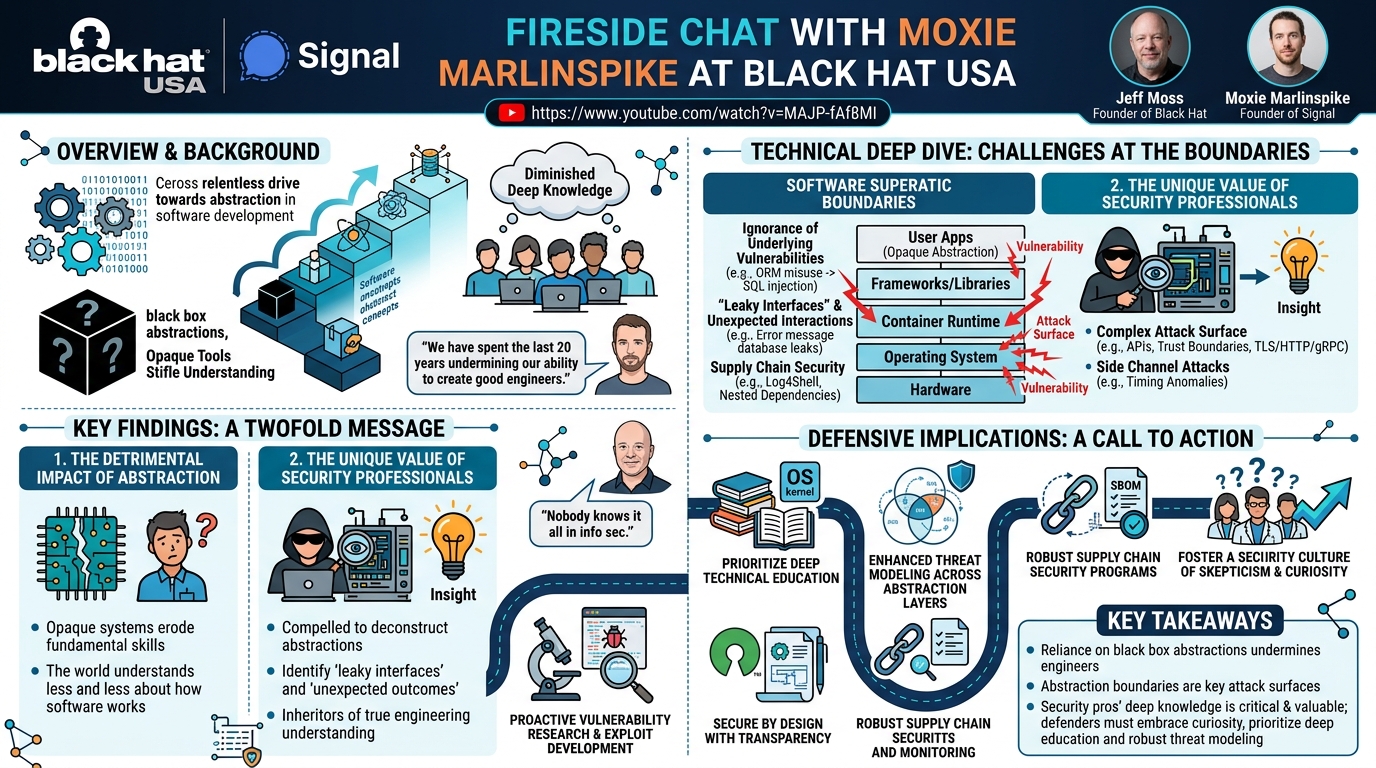
Moxie Marlinspike's keynote delivered a singular, profound finding: the widespread adoption of black box abstractions in software engineering, while intended to simplify development, is inadvertently eroding fundamental engineering skills and creating systemic vulnerabilities. He asserted that the industry has spent the last two decades "undermining our ability to create good engineers" by immersing them in environments where the underlying mechanics are intentionally obscured. This leads to a situation where the broader world "understands less and less about how software works."
However, Marlinspike also presented a crucial counterpoint and a call to recognition for the security community. He argued that the very nature of information security work forces professionals to operate in direct opposition to this trend. Security researchers, by necessity, must "look for the ways that these interfaces do not stack cleanly on top of each other, look for the ways that these things are leaky." Their daily work involves dissecting complex systems, peering inside the "black boxes," and identifying the "unexpected outcomes that are oftentimes exploitable" when these abstractions fail or interact in unforeseen ways.
Therefore, the key finding is twofold:
- The Detrimental Impact of Abstraction: Over-reliance on opaque abstractions hinders the development of engineers with a deep, holistic understanding of software systems. This creates a systemic knowledge gap that can obscure the root causes of vulnerabilities.
- The Unique Value of Security Professionals: The security community, through its investigative and adversarial mindset, is uniquely positioned to bridge this knowledge gap. By actively seeking out the flaws and inconsistencies at the boundaries of these abstractions, security professionals maintain and advance the critical understanding of how software truly functions. Marlinspike concluded this observation with a powerful statement: "without knowing it, I think you, the people in this room, have actually inherited the earth," implying that the deep technical understanding required for security is becoming the most valuable and rare form of engineering insight.
Technical Deep Dive
▶ Watch: Jeff Moss introduces keynote speaker Moxie Marlinspike, Signal founder (6:08)
While Moxie Marlinspike's keynote was more philosophical than a traditional technical briefing, his central concept of black box abstractions carries profound technical implications for understanding system security. In software engineering, an abstraction hides complex implementation details behind a simpler interface. Examples range from high-level programming languages (like Python or JavaScript) that abstract away memory management and processor instructions, to operating systems that abstract hardware interactions, to cloud services (like AWS Lambda or Azure Functions) that abstract away server infrastructure.
Marlinspike's argument is that when engineers are exclusively trained and operate within these black boxes, they lose sight of the underlying mechanisms. This can lead to several security pitfalls:
- Ignorance of Underlying Vulnerabilities: Developers might inadvertently introduce vulnerabilities by misusing or misunderstanding the security implications of an abstracted component. For instance, relying on a cloud provider's default security settings without understanding the granular permissions or network configurations can expose sensitive data. A developer might use a web framework's ORM (Object-Relational Mapper) without understanding SQL injection risks, assuming the abstraction handles all sanitization.
- "Leaky Interfaces" and Unexpected Interactions: The core of Marlinspike's technical observation is the existence of "leaky interfaces." These occur when an abstraction, despite its design, exposes underlying details or allows unexpected interactions that can be exploited. For example, a web API designed to abstract backend database operations might still leak error messages containing sensitive database schema information. A containerization platform (e.g., Docker, Kubernetes) abstracts the underlying host OS, but misconfigurations or vulnerabilities in the container runtime or orchestration layer can lead to container escape or privilege escalation on the host. These "leaks" are often found at the boundaries between different layers of abstraction, where assumptions about isolation or integrity break down.
- Complex Attack Surface: While abstractions aim to simplify, they often introduce new layers of complexity and potential attack surface when viewed from a security perspective. Each API, library, and service interaction represents a potential point of failure or compromise. Security professionals must understand the trust boundaries and communication protocols (e.g., HTTP, TLS, gRPC) that operate across these abstracted layers to identify weaknesses.
- Supply Chain Security: Modern software development heavily relies on third-party libraries and components, which are themselves black boxes to many developers. A vulnerability (e.g., a zero-day exploit or misconfiguration) within one of these nested abstractions can propagate throughout an entire application or system, as seen in incidents like Log4Shell (CVE-2021-44228). Security teams must go beyond merely trusting these components and scrutinize their dependencies, configurations, and behavior.
- Side Channel Attacks and Timing Anomalies: In highly abstracted environments, seemingly innocuous operations can sometimes reveal sensitive information through side channels. For example, the timing of an API response might inadvertently disclose information about data existence or processing paths, even if the data itself is never directly exposed. Understanding these subtle interactions requires a deep grasp of how the underlying hardware and software execute operations, which is precisely what black box abstractions obscure.
Marlinspike's message implies that true security competence requires a willingness to "peel back the layers" of abstraction, to understand not just what a component does, but how it does it, and what assumptions it makes about its environment. This involves delving into areas like operating system internals, network stack implementations, memory management, and cryptographic primitives—knowledge that is increasingly specialized but critically important for identifying and mitigating sophisticated threats. The security community's role is to challenge the illusion of simplicity that abstractions create and expose the underlying reality, where vulnerabilities often reside.
Demo / Proof of Concept
▶ Watch: Moxie Marlinspike takes stage for Fireside Chat (9:10)
The keynote delivered by Moxie Marlinspike was a conceptual and philosophical address rather than a technical presentation featuring demonstrations or proof-of-concept exploits. Marlinspike's intention was to articulate a core observation about the state of modern software engineering and the unique position of the security community, rather than to showcase specific vulnerabilities or tools. Therefore, no live demo or technical proof of concept was presented during this talk.
Defensive Implications
▶ Watch: Moxie's opening pitch: magic, Harry Potter, and school (9:55)
Moxie Marlinspike's critique of black box abstractions offers critical insights for cybersecurity defenders, urging a shift in mindset and strategy to counter the inherent risks of opaque systems. His message is not merely a lament but a call to action for the security community to leverage its unique perspective to build more resilient defenses.
- Prioritize Deep Technical Education and Training: Defenders must actively resist the trend of shallow understanding. This means investing in training that goes beyond high-level concepts and encourages a deep dive into operating system internals, network protocols, memory management, and the actual implementation details of commonly used frameworks and libraries. Security teams should strive to understand the entire technology stack, from hardware to application logic, rather than just the abstracted interfaces. This includes fostering a culture of curiosity where engineers are encouraged to ask "how does this really work?"
- Enhanced Threat Modeling Across Abstraction Layers: Traditional threat modeling often focuses on application logic or network perimeters. Marlinspike's insights demand an expansion of this process to explicitly consider the interactions and potential "leaks" between different layers of abstraction. Defenders should ask:
- What assumptions does this abstraction make about the layer below it?
- Where do these abstractions interact, and what data or control flows across these boundaries?
- What happens if an abstraction fails or is bypassed?
- Are there any side channels or unexpected behaviors at the interface points that could be exploited?
This requires a holistic view, considering not just the application code but also the underlying cloud infrastructure, container runtimes, APIs, and third-party dependencies.
- Proactive Vulnerability Research and Exploit Development: Security professionals, by their nature, are already engaged in breaking down abstractions to find weaknesses. Organizations should actively support and fund internal teams or external researchers who perform this type of work, focusing on critical components and widely used abstractions. This includes fuzzing, reverse engineering, and detailed code audits of both proprietary and open-source components that form the foundation of their systems. Understanding how exploits work at a fundamental level is crucial for building effective defenses.
- Secure by Design with Transparency: When designing new systems or selecting technologies, prioritize those that offer transparency or allow for deeper inspection. While abstractions are necessary, choose solutions where the underlying mechanisms are well-documented, auditable, or open-source. For proprietary systems, demand greater visibility into their internal workings and security posture from vendors. This also extends to internal development, encouraging teams to document design choices and assumptions made at each layer of abstraction.
- Robust Supply Chain Security Programs: Given the reliance on numerous third-party and open-source components (often "black boxes" themselves), defenders must implement comprehensive supply chain security measures. This goes beyond basic vulnerability scanning to include:
- Software Bill of Materials (SBOM) generation and analysis to understand dependencies.
- Vetting of third-party components for known vulnerabilities, security practices, and potential "leaky" behaviors.
- Runtime monitoring to detect unusual activity that might indicate a compromise within an abstracted component.
- Segmenting and isolating components to limit the blast radius of a compromise in one black box.
- Foster a Security Culture of Skepticism and Curiosity: Marlinspike's talk highlights the importance of a mindset. Defenders should cultivate a healthy skepticism towards any "magic" or "it just works" assurances from abstracted systems. Instead, they should foster a culture of curiosity that encourages questioning, investigation, and a drive to understand the true nature of how systems function, including their inherent limitations and potential failure modes. This intellectual rigor is the ultimate defense against threats that exploit the hidden complexities of modern software.
By embracing Marlinspike's perspective, defenders can move beyond simply patching known vulnerabilities to proactively identifying and mitigating risks that arise from the very architecture of modern software, ensuring that the security community truly "inherits the earth" by understanding it deeply.
Key Takeaways
- The increasing reliance on black box abstractions in software development undermines engineers' ability to understand underlying system mechanics.
- This trend creates "leaky interfaces" and "unexpected outcomes" at the boundaries of abstractions, which are often the source of exploitable vulnerabilities.
- Security professionals are uniquely positioned to counter this trend, as their work inherently requires deconstructing abstractions and understanding how software truly functions.
- The security community's deep technical knowledge is becoming increasingly critical and valuable in an industry that often prioritizes abstraction over fundamental understanding.
- Defenders should prioritize deep technical education, rigorous threat modeling that accounts for abstraction layers, and a culture of skepticism and curiosity to identify and mitigate risks.
- Understanding the true nature of software, beyond its abstracted interfaces, is essential for building robust and secure systems.
About the Speaker(s)
Moxie Marlinspike is a renowned figure in the cybersecurity and privacy communities, best known as the founder of Signal, an end-to-end encrypted messaging service. His work has significantly influenced the development of secure communication protocols and privacy-enhancing technologies. Prior to Signal, Marlinspike was involved in projects like Red Phone, an encrypted voice application, which ultimately laid foundational work for Signal. He is recognized for his deep technical expertise and his outspoken advocacy for user privacy and security in the digital age.
Jeff Moss is the founder of the Black Hat and DEF CON computer security conferences, two of the most influential and respected events in the global cybersecurity calendar. As the founder of Black Hat, he serves as the host and often introduces keynote speakers, guiding the conference's mission to bring together diverse communities and foster knowledge sharing within the information security industry.