Main Stage: Let Me Tell You a Story: Technology and the 4 Vs
Unknown
Black Hat USA 2024 · Day 1 · Briefing
Overview
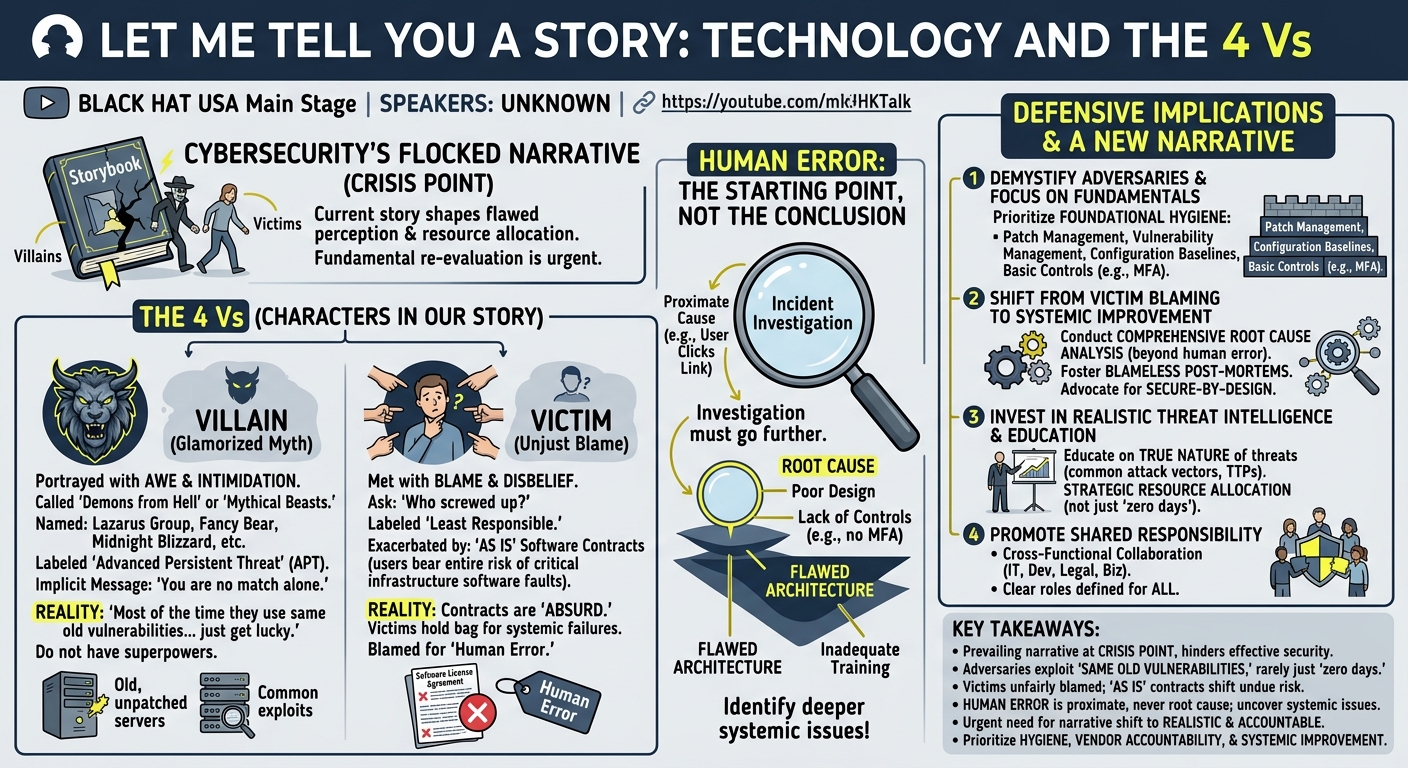
This Black Hat USA talk, "Let Me Tell You a Story: Technology and the 4 Vs," delivered by an unnamed speaker, presents a compelling and critical examination of the prevailing narrative within the cybersecurity industry. The presentation argues that the story we collectively tell ourselves about cybersecurity—how we characterize threats, victims, and the underlying causes of breaches—is fundamentally flawed and has reached a "crisis point." It challenges the industry to rethink its perceptions and move beyond simplistic, often counterproductive, frameworks.
Key moments
- 0:00 Introduction: Storytelling and cybersecurity's crisis point
- 1:55 Characterizing cybersecurity villains: myths vs. reality
- 3:30 Debunking the myth of villains' 'superpowers'
- 4:05 Introducing the 'Victims' and misplaced blame
- 5:10 Critiquing 'at your own risk' software agreements
- 5:55 Human error: starting point, not conclusion of investigation
Main Stage: Let Me Tell You a Story: Technology and the 4 Vs
Speakers: Unknown
Conference: Black Hat USA
YouTube: https://www.youtube.com/watch?v=itpZnfqu9eQ
Overview
This Black Hat USA talk, "Let Me Tell You a Story: Technology and the 4 Vs," delivered by an unnamed speaker, presents a compelling and critical examination of the prevailing narrative within the cybersecurity industry. The presentation argues that the story we collectively tell ourselves about cybersecurity—how we characterize threats, victims, and the underlying causes of breaches—is fundamentally flawed and has reached a "crisis point." It challenges the industry to rethink its perceptions and move beyond simplistic, often counterproductive, frameworks.
The speaker introduces the concept of "the 4 Vs" as central characters in this cybersecurity narrative, though only explicitly details "Villains" and "Victims" within the provided transcript. The talk critiques the glamorization of adversaries and the unjust blaming of victims, highlighting how these distorted perspectives hinder effective security practices and systemic improvement. By deconstructing these established archetypes, the presentation aims to inspire a shift towards a more realistic, responsible, and ultimately more effective approach to cybersecurity.
This article delves into the speaker's arguments, exploring the problematic portrayal of threats and the implications for both offensive and defensive strategies. It emphasizes the need for a foundational change in how the industry communicates, investigates incidents, and assigns responsibility, moving beyond the superficial to address the root causes of our persistent security challenges.
Background
▶ Watch: Introduction: Storytelling and cybersecurity's crisis point (0:00)
The cybersecurity landscape has evolved dramatically over decades, yet the fundamental "story" we tell about it, according to the speaker, remains deeply entrenched and problematic. This talk posits that the industry has collectively fallen into a narrative trap, one that shapes perceptions, influences resource allocation, and ultimately impacts our ability to secure digital infrastructure effectively. The speaker highlights two primary character archetypes that exemplify this flawed narrative: the Villains and the Victims.
The portrayal of Villains in cybersecurity is often one of awe and intimidation. Adversaries are frequently depicted as "hooded strangers operating mysteriously in the shadows," "demons from hell," or "mythical beasts." They are given powerful, almost charismatic names such as Lazarus Group, Nemesis Kitten, Fancy Bear, Midnight Blizzard, Wizard Spider, and Volt Typhoon. This nomenclature, the speaker argues, implies a level of sophistication and power that borders on the superhuman, fostering a sense of helplessness among potential targets. They are frequently labeled as Advanced Persistent Threats (APTs), employing "sophisticated exploits" or the dreaded "zero day." The underlying message, the speaker suggests, is often "You, you're mortal. You are no match for these powerful villains alone." This glamorization, however, obscures a crucial reality: while some adversaries do invest in novel exploits, "most of the time they are using the same old vulnerabilities. And sometimes they just get lucky." The speaker firmly states that these villains "do not have superpowers and we should not treat them like they do." This romanticized view of adversaries distracts from the more mundane, yet pervasive, reality of common attack vectors and unpatched systems.
In stark contrast to the glamorized villains, the Victims are often met with blame and disbelief. When a company is breached, the immediate reaction is frequently "who screwed up?" The responsibility for security is, paradoxically, often laid at the feet of those who are "probably the least responsible character in this story." This victim-blaming culture is exacerbated by legal and contractual language prevalent in the software industry. The speaker points to ubiquitous clauses that state users bear "the entire risk of using the services," often provided "on an as is basis with all faults and as available." This contractual indemnity, the speaker argues, is an absurdity that would be unacceptable in any other critical industry, like automotive or aviation. The consequence is that users—the victims—are left holding the bag for systemic failures, while vendors often face limited liability for the security of the software underpinning "our daily lives" and "critical infrastructure."
A significant aspect of this victim-blaming narrative revolves around human error. While human error is undeniably a factor in many security incidents, the speaker emphatically states that it "can only ever be the starting point for an investigation, never its conclusion. It is the proximate cause, not the root cause." This distinction is critical; by stopping at human error, organizations fail to uncover the deeper systemic issues—such as inadequate training, poor tooling, flawed architecture, or insufficient security controls—that enable such errors to have catastrophic consequences. This flawed investigative approach perpetuates a cycle of blame without addressing the underlying vulnerabilities in systems and processes. The speaker's critique of these two archetypes—the over-glamorized villain and the unfairly blamed victim—forms the bedrock of the argument that the current story of cybersecurity is in crisis, demanding a fundamental re-evaluation of how the industry perceives and responds to threats.
Key Findings
▶ Watch: Debunking the myth of villains' 'superpowers' (3:30)
The central finding of this talk is that the prevailing narrative in cybersecurity, characterized by the speaker as "a story at its crisis point," is fundamentally flawed and detrimental to effective security. This crisis stems from a distorted perception of adversaries and an unjust assignment of blame to victims, which collectively obscure the true nature of security challenges and hinder progress.
The speaker's key findings can be summarized as follows:
- Glamorization of Adversaries is Counterproductive: The industry's tendency to portray threat actors like Lazarus Group or Volt Typhoon as omnipotent, using terms like Advanced Persistent Threats (APTs) and focusing excessively on zero-day exploits, is a form of counterproductive glamorization. This narrative fosters a sense of helplessness and misdirects resources. The reality, as highlighted, is that "most of the time they are using the same old vulnerabilities," and often succeed through basic opportunistic attacks rather than mythical superpowers. This finding implies that a significant portion of security effort should be directed towards foundational hygiene rather than an exclusive focus on highly sophisticated, rare threats.
- Unjust Blame on Victims Masks Systemic Failures: A critical finding is the pervasive culture of victim-blaming, where responsibility for security breaches is often placed on the breached entity or individual. This is particularly egregious given the widespread "as-is" clauses in software licenses that absolve vendors of liability. The speaker argues that this practice allows software providers to externalize risk, forcing users to bear "the entire risk" for products that underpin critical infrastructure. This finding underscores a systemic failure within the software supply chain and legal frameworks, where accountability is skewed.
- Human Error as Proximate, Not Root Cause: The talk critically distinguishes between proximate cause and root cause in incident investigations, asserting that human error should only ever be the starting point, not the conclusion. By stopping at human error, investigations fail to uncover deeper systemic issues, such as poor design, inadequate training, or insufficient controls, that allowed the error to materialize into a breach. This finding challenges the superficiality of many post-mortem analyses, advocating for a more thorough, systemic approach to understanding incident origins.
- The Need for a Narrative Shift: Ultimately, the speaker's overarching finding is the urgent need for a fundamental shift in the cybersecurity narrative. The current story, with its mythical villains and blamed victims, is not serving the industry well. It perpetuates a cycle of fear, misdirection, and unaccountability. A new narrative is required that acknowledges the reality of threats, assigns responsibility appropriately, and focuses on systemic improvements rather than individual fault. This shift is crucial for moving cybersecurity beyond its "crisis point" and towards more effective, sustainable solutions.
Technical Deep Dive
▶ Watch: Introducing the 'Victims' and misplaced blame (4:05)
This talk is not a traditional technical deep dive into specific vulnerabilities, exploits, or architectural designs. Instead, it offers a meta-technical analysis of the pervasive narrative within the cybersecurity domain, examining how technical concepts and actors are framed and the implications of this framing. While specific code or protocols are not discussed, the speaker critically analyzes the language and perception of technical elements that shape industry discourse.
The speaker highlights several key technical terms and concepts that are often misused or exaggerated within the prevailing narrative:
- Advanced Persistent Threats (APTs): The term APT is frequently invoked to describe sophisticated adversaries. While genuine APTs exist, the speaker argues that the label is often applied broadly, contributing to the glamorization of threat actors. The implication is that any successful breach must be the work of an APT, leading to an overestimation of adversary capabilities and a neglect of more common, less sophisticated attack vectors. The speaker specifically calls out group names like Lazarus Group, Nemesis Kitten, Fancy Bear, Midnight Blizzard, Wizard Spider, and Volt Typhoon as examples of how these entities are given powerful, almost mythical monikers, further cementing their APT status in the public consciousness.
- Sophisticated Exploits and Zero Days: The talk directly challenges the emphasis on sophisticated exploits and zero-day vulnerabilities. While these are real and dangerous, the speaker asserts that "most of the time they [adversaries] are using the same old vulnerabilities." This implies that a significant portion of successful attacks leverage well-known, often patched, vulnerabilities that exist due to poor patch management, misconfigurations, or outdated software. The disproportionate focus on zero days can lead to a "chasing ghosts" mentality, diverting resources from fundamental security hygiene, such as regular patching, vulnerability management, and basic network segmentation, which would mitigate the majority of threats. The speaker implicitly critiques the industry's obsession with novel attacks over the persistent, mundane risks.
- Human Error and Root Cause Analysis: From a technical operations perspective, the speaker's distinction between proximate cause and root cause is critically important. In incident response, identifying the immediate trigger (e.g., a user clicking a malicious link, an administrator misconfiguring a firewall) is the proximate cause or human error. However, a true technical deep dive into an incident requires going further:
- Why did the user click the link? Was it due to ineffective security awareness training, a highly sophisticated phishing campaign that bypassed email filters, or a lack of multi-factor authentication that would have contained the initial compromise?
- Why was the firewall misconfigured? Was it due to complex configuration interfaces, insufficient automation, lack of peer review for changes, or an absence of automated compliance checks?
- What systemic controls failed? Did endpoint detection and response (EDR) miss the initial compromise? Was network segmentation inadequate? Were logging and monitoring sufficient to detect anomalous activity post-compromise?
The speaker's argument pushes for a technical deep dive that extends beyond the immediate human action to analyze the underlying technical architectures, security controls, operational processes, and design decisions that created the conditions for the incident. This involves understanding the interplay of software vulnerabilities, network configurations, identity and access management systems, and the efficacy of defensive tools. It's about moving from "who screwed up" to "what in our technical ecosystem allowed this to happen?" This analytical shift is crucial for implementing meaningful, long-term technical improvements.
- Software Liability and "As-Is" Basis: While not a technical concept in itself, the legal framework of "as-is" software delivery directly impacts the technical quality and security posture of products. The speaker highlights that accepting software "with all faults and as available" and bearing "the entire risk of using the services" means that vendors have less incentive to invest in secure-by-design principles, robust threat modeling, rigorous code review, and comprehensive security testing. This contractual arrangement effectively externalizes the technical debt and security risks onto the end-user. From a technical perspective, this leads to a proliferation of insecure software underpinning critical infrastructure, where the onus is on the defender to secure inherently flawed products, rather than on the developer to produce secure ones. This directly affects the technical baseline of security across all industries.
In summary, while the talk avoids delving into specific exploit mechanics, it provides a critical framework for understanding how technical terms and operational realities are interpreted and communicated within the cybersecurity narrative. It advocates for a more grounded, realistic, and accountability-driven approach to technical security, moving away from hyperbolic portrayals and towards a focus on fundamental, systemic improvements.
Demo / Proof of Concept
▶ Watch: Critiquing 'at your own risk' software agreements (5:10)
This presentation did not feature a live technical demonstration or a proof of concept. Its focus was on a narrative critique of the cybersecurity industry rather than illustrating a specific vulnerability or defensive technique. The speaker utilized rhetorical arguments and illustrative anecdotes to convey the core message about the flawed story of cybersecurity.
Defensive Implications
▶ Watch: Human error: starting point, not conclusion of investigation (5:55)
The insights from this talk carry significant defensive implications, urging a fundamental re-evaluation of strategies, resource allocation, and organizational culture. Defenders should leverage this critical perspective to enhance their resilience and effectiveness.
- Demystify Adversaries and Focus on Fundamentals: Defenders must resist the urge to glamorize threat actors. Instead of viewing groups like Midnight Blizzard or Wizard Spider as invincible, focus on the reality that "most of the time they are using the same old vulnerabilities." This means prioritizing foundational security hygiene:
- Patch Management: Implement rigorous and timely patching programs for all operating systems, applications, and network devices. This directly counters the reliance on "same old vulnerabilities."
- Vulnerability Management: Regularly scan and assess systems for known vulnerabilities, prioritizing remediation based on risk.
- Configuration Management: Ensure secure default configurations and enforce configuration baselines to prevent common misconfigurations that adversaries exploit.
- Basic Controls: Strengthen essential controls like multi-factor authentication (MFA), network segmentation, and robust access controls, as these often mitigate even "sophisticated exploits."
- Shift from Victim Blaming to Systemic Improvement: Cybersecurity teams should lead the charge in moving away from a victim-blaming culture. When incidents occur, the focus must shift from "who screwed up" to "what systemic failures allowed this to happen?" This requires:
- Comprehensive Root Cause Analysis: Conduct thorough investigations that go beyond identifying human error as the proximate cause. Delve into underlying technical, process, and cultural factors. For example, if a phishing attack succeeds, investigate the efficacy of security awareness training, email filtering technologies, endpoint detection capabilities, and the availability of secondary controls like MFA.
- Blameless Post-Mortems: Foster an environment where individuals feel safe to report errors without fear of reprisal, enabling honest and effective learning from incidents.
- Advocacy for Secure-by-Design: Engage with software vendors and internal development teams to advocate for secure-by-design principles. Push back against "as-is" clauses and demand greater responsibility for security from product developers.
- Invest in Realistic Threat Intelligence and Education: Educate leadership and employees about the true nature of threats. Counter the narrative of mythical adversaries by presenting realistic threat intelligence that highlights common attack vectors, TTPs (Tactics, Techniques, and Procedures), and the prevalence of known vulnerabilities. This helps in:
- Strategic Resource Allocation: Ensure that security budgets are allocated effectively to address the most probable and impactful threats, rather than solely chasing hypothetical "zero days."
- Effective Security Awareness: Tailor security awareness programs to address real-world threats and common human behaviors that adversaries exploit, rather than fear-mongering about abstract dangers.
- Promote Shared Responsibility and Accountability: While pushing for vendor accountability, defenders also need to foster a culture of shared responsibility internally. This means:
- Cross-Functional Collaboration: Engage with IT operations, software development, legal, and business units to integrate security into every stage of the organizational lifecycle.
- Clear Roles and Responsibilities: Define clear security roles and responsibilities across the organization, ensuring that security is not solely the burden of the security team.
- Metrics Beyond Compliance: Move beyond mere compliance checkboxes to measure the actual effectiveness of security controls and the reduction of real-world risk.
By adopting these defensive implications, organizations can move beyond the "crisis point" narrative and build more resilient, accountable, and effective cybersecurity programs that address the underlying systemic issues rather than superficial symptoms.
Key Takeaways
- The prevailing narrative in cybersecurity, which often glamorizes adversaries and blames victims, is at a "crisis point" and hinders effective security.
- Adversaries, despite powerful names like Lazarus Group or Volt Typhoon, frequently exploit "the same old vulnerabilities" rather than relying exclusively on sophisticated exploits or zero days.
- Victims are unfairly blamed for breaches, with contractual "as-is" clauses in software shifting undue risk onto users for products underpinning critical infrastructure.
- Human error should always be considered a proximate cause, not a root cause, in incident investigations; deeper systemic failures must be identified and addressed.
- The industry needs a fundamental shift in perception and communication to move towards a more realistic, responsible, and effective approach to cybersecurity.
- Defenders should prioritize foundational security hygiene, advocate for vendor accountability, and foster a culture of systemic improvement and shared responsibility over individual blame.
About the Speaker(s)
The speaker for this presentation was not identified in the provided metadata or transcript. The talk was delivered by an unnamed individual on the Main Stage at Black Hat USA, offering a critical analysis of the cybersecurity industry's narrative.