Locknote: Conclusions & Key Takeaways from Black Hat USA 2024
Unknown
Black Hat USA 2024 · Day 1 · Briefing
Overview
This article delves into the "Locknote" session from Black Hat USA 2024, a unique panel discussion featuring members of the conference's review board. These individuals, responsible for curating the hundreds of talk submissions, offer a high-level perspective on the prevailing themes and critical security challenges highlighted at the conference. The session, moderated by an unnamed host, primarily focuses on the profound implications of increasing abstraction in modern technology, a concept central to the conference's Day Two keynote delivered by Moxie.
Key moments
- 0:00 Introduction to the Locknote Session
- 2:00 Introducing the Black Hat Review Board Panelists
- 2:50 Initial Reactions to Keynote's Abstraction Theme
- 4:08 The Dangers of Unknowable, Interconnected Systems
- 7:40 Emphasizing Understanding What's Underneath Abstractions
Locknote: Conclusions & Key Takeaways from Black Hat USA 2024
Speakers: Window Snyder (Thistle Technologies), Nathan Hamiel (Kudelski Security), Ellen Kuolcheck (Google), Joss Wetzels
Conference: Black Hat USA
YouTube: https://www.youtube.com/watch?v=zbNU7kRw3tg
Overview
This article delves into the "Locknote" session from Black Hat USA 2024, a unique panel discussion featuring members of the conference's review board. These individuals, responsible for curating the hundreds of talk submissions, offer a high-level perspective on the prevailing themes and critical security challenges highlighted at the conference. The session, moderated by an unnamed host, primarily focuses on the profound implications of increasing abstraction in modern technology, a concept central to the conference's Day Two keynote delivered by Moxie.
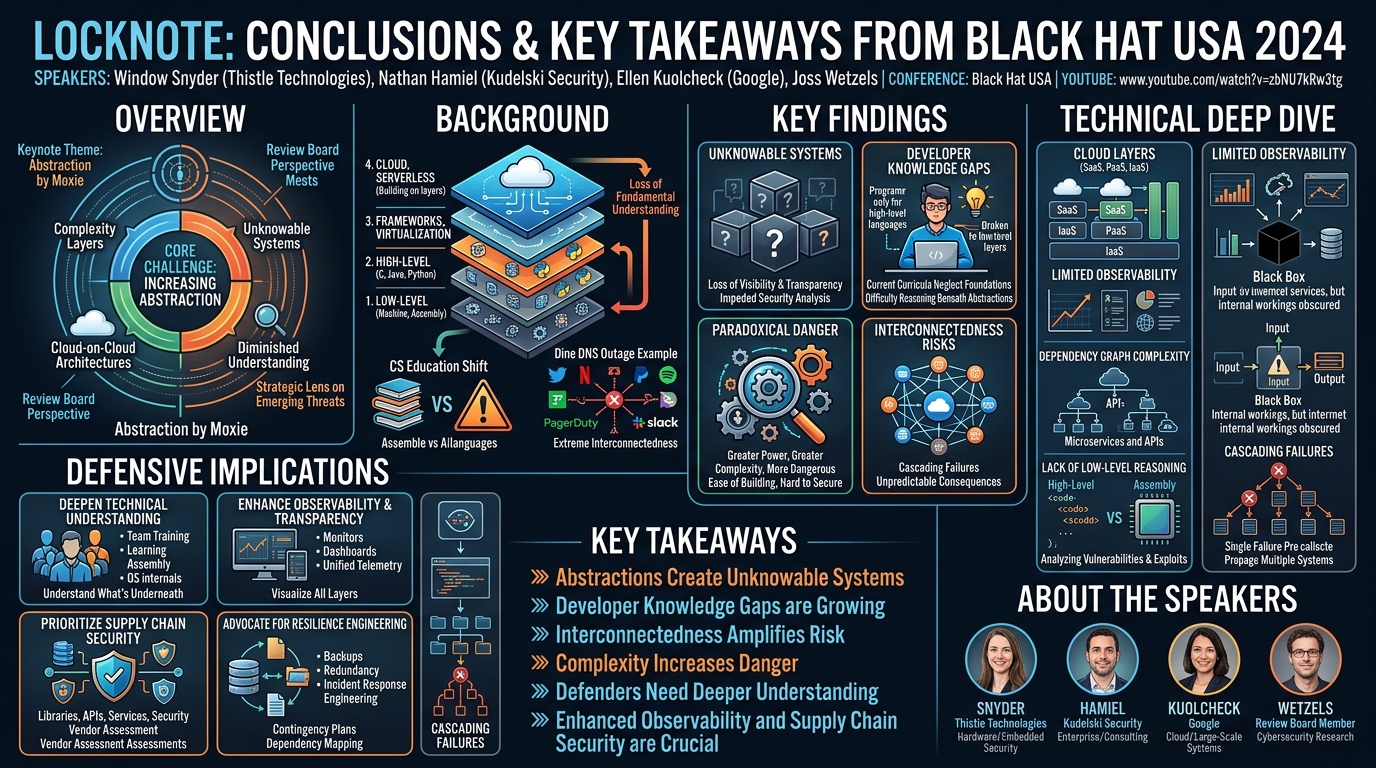
The panel's discussion underscores a growing concern within the cybersecurity community: as software and infrastructure become increasingly layered and complex, the fundamental understanding of underlying systems diminishes. This trend, exemplified by the proliferation of cloud-on-cloud architectures and the shift in computer science education away from low-level programming, creates "unknowable systems" that pose significant risks. The locknote serves as a crucial reflection on the state of the industry, challenging attendees to consider the long-term security ramifications of these architectural choices and educational gaps.
The importance of this talk lies in its ability to synthesize the broader narrative of Black Hat USA 2024, moving beyond individual vulnerabilities to address systemic issues. By highlighting the dangers of opaque systems and extreme interconnectedness, the panel provides a strategic lens through which to view the myriad technical presentations and emerging threats. It implores the security community to re-evaluate foundational principles and foster a deeper understanding of the technological stack, advocating for a more holistic approach to securing an increasingly abstract digital landscape.
Background
▶ Watch: Introduction to the Locknote Session (0:00)
The evolution of computing has been characterized by a relentless drive towards higher levels of abstraction. From machine code to assembly, then to high-level languages like C, Java, and Python, and now to sophisticated frameworks, virtualized environments, and serverless architectures, each layer is designed to simplify development and increase productivity. This progression allows developers to build complex applications without needing to understand the intricate operations of the hardware or operating system beneath. However, this convenience comes at a cost, creating what the panel describes as a "potential gap" in fundamental understanding.
Historically, computer science education placed a strong emphasis on low-level concepts, including assembly language and computer architecture. These subjects were considered critical for a comprehensive understanding of how software interacts with hardware, enabling engineers to reason about system behavior, performance, and security at a granular level. The shift towards teaching primarily high-level languages means that many modern developers are proficient in building applications but lack the foundational knowledge to diagnose issues or identify vulnerabilities that stem from deeper layers of the stack. This gap is exacerbated in the context of modern cloud computing, where entire infrastructures are built on layers of virtualized services. The panel notes the phenomenon of "building an infrastructure on a cloud, on a cloud, on a cloud," where the ultimate physical and logical underpinnings become increasingly obscured.
This multi-layered abstraction leads to systems that are not only complex but also highly interconnected and interdependent. A pertinent example cited by the panel is the Dine (Dyn) DNS outage of October 2016. This incident, caused by a massive distributed denial-of-service (DDoS) attack, demonstrated how a single point of failure in a critical internet infrastructure service could cascade, disrupting major platforms like Twitter, Netflix, PayPal, and Spotify. Even organizations not directly subscribed to Dyn's services were impacted because their own critical dependencies (e.g., PagerDuty for incident response, Slack for internal communication) relied on Dyn. This event underscored the fragility introduced by widespread interconnectedness and the challenge of understanding the full dependency graph of modern enterprise systems. The panel's discussion frames these historical events and educational trends as crucial context for understanding the "unknowable systems" that are becoming the new normal.
Key Findings
▶ Watch: Introducing the Black Hat Review Board Panelists (2:00)
The central "findings" presented by the Black Hat review board panel are not discoveries of specific vulnerabilities but rather critical observations and concerns about the overarching trends shaping the cybersecurity landscape. These insights, primarily inspired by Moxie's keynote, coalesce around the theme of abstraction and its inherent security implications.
One primary finding is the increasing prevalence of unknowable systems. As layers of abstraction accumulate—from high-level programming languages to multi-cloud deployments—engineers and security professionals lose visibility and understanding of the fundamental operations. The panel expressed a significant worry that "at some point you reach these completely unknowable systems," where the intricate interplay of components, especially in decades-old projects or complex cloud environments, becomes opaque even to those who built them. This lack of transparency impedes effective security analysis, incident response, and proactive threat modeling.
Another key finding relates to the "potential gap" in developer knowledge. The panel observed that current computer science curricula often prioritize high-level languages, neglecting foundational subjects like assembly language and computer architecture. This educational shift produces engineers who are adept at leveraging abstractions but struggle to "reason about how to do something different" or understand "what's underneath" when problems arise. This gap is particularly concerning in security, where a deep understanding of low-level system behavior is often crucial for identifying and mitigating sophisticated attacks.
Furthermore, the panel highlighted the paradoxical nature of abstraction: while it enables "fewer developers to do so much more" and build "more powerful" systems, it simultaneously makes these systems "so much more complex and so much more, well, dangerous." The ease of building upon existing, often proprietary, black-box services in the cloud creates a dense web of interconnectedness and interdependence. The panel cited the Dine outage as a stark example, illustrating how a single failure point in a widely used service can trigger widespread disruptions across seemingly unrelated systems. This degree of interconnectedness means that security incidents can have far-reaching, unpredictable consequences, making it challenging to isolate and remediate issues effectively.
In essence, the panel's key findings converge on the idea that while abstraction is a powerful enabler of technological progress, its unchecked proliferation, coupled with a decline in foundational technical education, is creating a generation of systems that are inherently difficult to secure, understand, and manage, leading to an environment ripe for cascading failures and novel attack vectors.
Technical Deep Dive
▶ Watch: Initial Reactions to Keynote's Abstraction Theme (2:50)
The technical implications discussed by the panel revolve around the fundamental architectural shifts driven by abstraction and interconnectedness. While the session itself did not present new technical findings or code, it critically analyzed the technical consequences of these industry trends.
At its core, the concept of abstraction in software engineering involves hiding complex implementation details behind simpler interfaces. For example, a high-level language function abstracts away the underlying assembly instructions and CPU operations. In modern cloud computing, this extends to Infrastructure as a Service (IaaS), Platform as a Service (PaaS), and Software as a Service (SaaS) layers. An application running on a serverless platform (PaaS) might rely on a container orchestration service (PaaS), which in turn runs on virtual machines (IaaS), all hosted on physical hardware managed by a cloud provider. Each of these layers represents a significant abstraction, reducing the operational burden but simultaneously obscuring the full execution path and potential points of failure or compromise.
The panel's concern about "unknowable systems" stems from this multi-layered architecture. From a technical perspective, an unknowable system is one where:
- Observability is Limited: The ability to monitor, log, and trace operations across all layers of abstraction is incomplete, making it difficult to understand system behavior, diagnose performance issues, or detect anomalies. Proprietary cloud services often present a "black box" where internal workings are not exposed.
- Dependency Graph Complexity: Modern applications often integrate dozens, if not hundreds, of third-party libraries, APIs, and microservices. Mapping out the full technical dependency graph, including transitive dependencies, becomes an overwhelming task. This complexity makes it difficult to predict the blast radius of a vulnerability in a single component.
- Lack of Low-Level Reasoning: The panel highlighted the diminishing emphasis on assembly language and computer architecture in university curricula. Technically, this means that a new generation of developers may lack the skills to analyze memory corruption vulnerabilities, understand processor-level exploits, or optimize code for hardware-specific security features. Without this foundational knowledge, reasoning about the security of critical system components or even advanced debugging becomes significantly harder.
- Cascading Failures: The Dine outage serves as a prime technical example of how extreme interconnectedness can lead to widespread failure. DNS (Domain Name System) is a critical component of internet infrastructure, resolving human-readable domain names into IP addresses. A disruption at a major DNS provider means that services depending on it become unreachable, even if their own servers are operational. The technical implication is that a failure in one foundational service (e.g., DNS, a core cloud identity service, or a critical networking component) can propagate through the entire dependency chain, impacting diverse applications and services. This is not just a service outage but a breakdown of the complex distributed system that is the internet.
Technically, addressing these challenges requires a shift towards greater transparency, even within abstract layers. This could involve observable APIs, standardized telemetry, and supply chain security practices that extend to every component, virtualized or otherwise. It also necessitates a renewed focus on system-level understanding among engineers, bridging the gap between high-level application logic and the underlying hardware and operating system mechanisms. Without this, the security community will continue to grapple with systems whose vulnerabilities are buried deep within layers of abstraction, making them exceedingly difficult to detect, prevent, or recover from.
Demo / Proof of Concept
▶ Watch: The Dangers of Unknowable, Interconnected Systems (4:08)
As a locknote session, which serves as a panel discussion reflecting on the broader themes and takeaways from the Black Hat USA conference, this talk did not feature a live demonstration or a proof of concept. The format was an analytical conversation among the review board members, focusing on high-level industry trends and the implications of the keynote address, rather than showcasing specific technical exploits or defensive tools.
Defensive Implications
▶ Watch: Emphasizing Understanding What's Underneath Abstractions (7:40)
The concerns raised by the Black Hat review board panel about increasing abstraction and interconnectedness have profound defensive implications, urging a re-evaluation of current security strategies. Defenders must adapt to a landscape dominated by "unknowable systems" and the "potential gap" in foundational knowledge.
Firstly, organizations must invest in deepening technical understanding within their security teams. While high-level security frameworks and tools are essential, a robust defense requires individuals who can "understand what's underneath" the layers of abstraction. This means fostering skills in low-level systems, including assembly language, operating system internals, and cloud architecture. Training programs should aim to bridge the gap identified in academic curricula, ensuring security professionals can reason about vulnerabilities at every layer, from the application down to the infrastructure.
Secondly, a critical defensive strategy involves enhancing observability and transparency across complex, abstracted environments. Since systems can become "unknowable," defenders must implement comprehensive logging, monitoring, and tracing solutions that provide visibility into multi-cloud and multi-layer architectures. This includes leveraging tools that can aggregate telemetry from various cloud services, containers, and applications to create a unified view of system behavior. The goal is to detect anomalies and understand the flow of data and execution, even when the underlying mechanisms are proprietary or highly abstracted.
Thirdly, organizations need to prioritize supply chain security for all components, not just open-source libraries. In an interconnected world where a single failure can cascade, understanding and managing the security posture of every third-party service, API, and cloud dependency is paramount. This includes rigorous vendor assessments, continuous monitoring of third-party risk, and implementing strong controls around data ingress and egress to and from external services. The Dine outage serves as a stark reminder that even seemingly peripheral dependencies can become critical points of failure.
Finally, defenders should advocate for resilience engineering principles. Recognizing that failures and breaches are inevitable in such complex systems, the focus must shift towards building systems that can withstand and recover from adverse events. This involves designing for redundancy, implementing robust backup and recovery strategies, and developing comprehensive incident response plans that account for cascading failures across interconnected services. Organizations should also conduct regular dependency mapping to identify critical external services and develop contingency plans for their disruption. By proactively addressing the challenges posed by abstraction and interconnectedness, defenders can build more secure and resilient environments.
Key Takeaways
- Abstractions Create Unknowable Systems: The relentless drive towards higher levels of abstraction in software and cloud infrastructure leads to systems whose underlying mechanics and interdependencies become opaque, posing significant security challenges.
- Developer Knowledge Gaps are Growing: Modern computer science education often neglects low-level topics like assembly language and computer architecture, creating a "potential gap" in developers' ability to understand and secure fundamental system operations.
- Interconnectedness Amplifies Risk: Highly interconnected systems, especially in cloud environments, mean that a single point of failure or compromise can trigger widespread, cascading disruptions across numerous services and organizations, as exemplified by the Dine DNS outage.
- Complexity Increases Danger: While abstraction enables greater productivity, it also makes systems "more powerful and so much more complex and so much more, well, dangerous," increasing the attack surface and the difficulty of comprehensive security.
- Defenders Need Deeper Understanding: To counter these trends, security professionals must invest in developing a deeper understanding of underlying technical layers, moving beyond high-level abstractions to reason about security at a fundamental level.
- Enhanced Observability and Supply Chain Security are Crucial: Organizations must prioritize comprehensive observability across all layers of abstraction and implement robust supply chain security practices to manage risks from third-party and interconnected services.
About the Speaker(s)
The Locknote session featured a panel of distinguished members from the Black Hat USA review board, reflecting their unique position in curating the conference's content. While the host remained unnamed, the panel included:
- Window Snyder: Associated with Thistle Technologies. Her participation suggests expertise in hardware security, embedded systems, or IoT, given Thistle Technologies' focus on securing firmware and connected devices.
- Nathan Hamiel: Represents Kudelski Security. As part of the review board, his insights likely stem from extensive experience in enterprise security, consulting, and various aspects of cybersecurity defense and offense.
- Ellen Kuolcheck: Affiliated with Google. Her presence indicates a strong background in cloud security, large-scale systems, or potentially AI/machine learning security, given Google's extensive work in these areas.
- Joss Wetzels: His affiliation was not specified in the provided transcript, but he was identified as a member of the review board. His role on the panel suggests a significant background in cybersecurity research or practice.
Collectively, these individuals represent a diverse range of expertise across the cybersecurity domain, allowing them to offer a comprehensive perspective on the key trends and challenges observed at Black Hat USA 2024. Their role as review board members grants them a unique vantage point to identify emerging threats and critical areas of research within the industry.