Project Zero: Ten Years of 'Make 0-Day Hard'
Unknown
Black Hat USA 2024 · Day 1 · Briefing
Overview
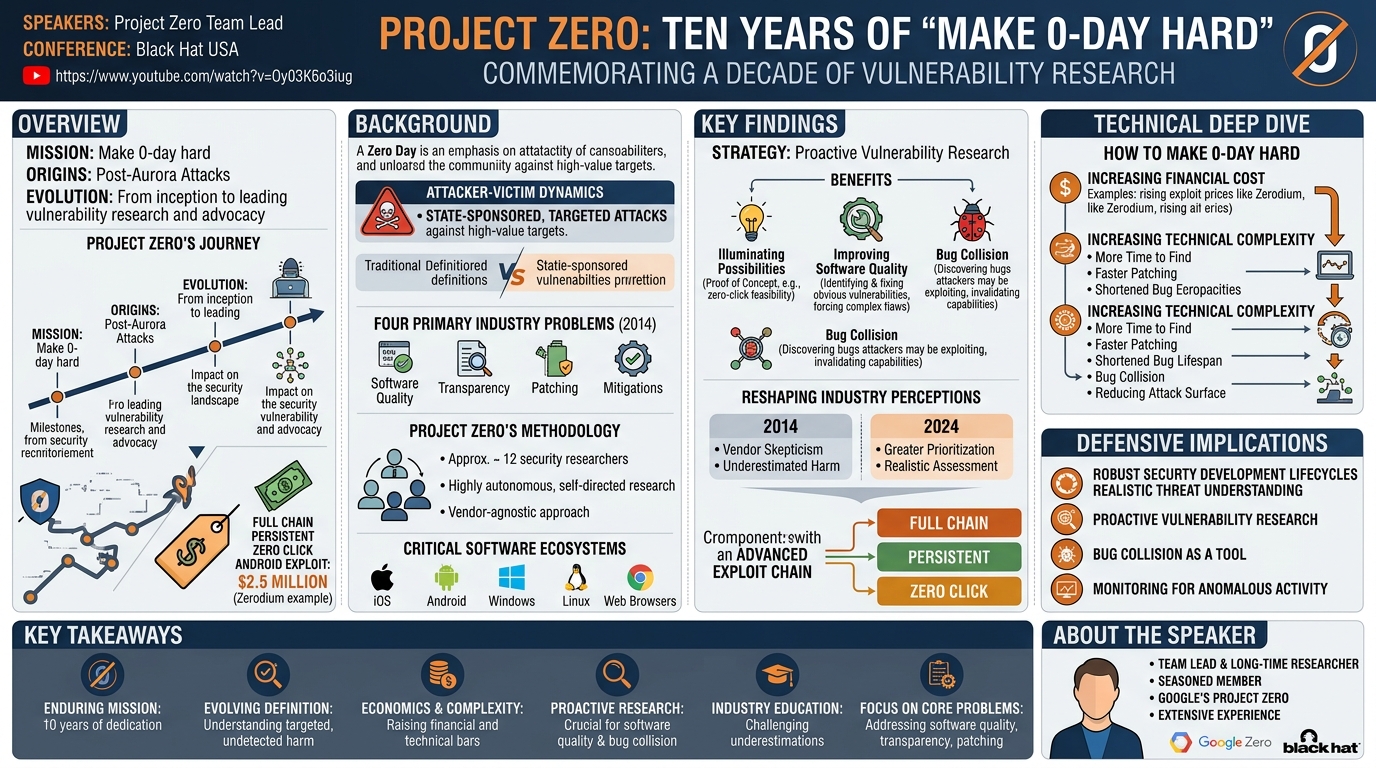
This talk commemorates the 10th anniversary of Google's Project Zero, a dedicated security research team established with the singular mission to "make 0-day hard." Presented by a Project Zero team lead and long-time security researcher, the session delves into the team's origins, evolving strategies, and profound impact on the security landscape over the past decade. The speaker recounts Project Zero's journey from its inception following high-profile incidents like the Aurora attacks, which highlighted the devastating potential of targeted Zero Day exploits, to its current role as a leading force in vulnerability research and industry advocacy.
Key moments
- 0:00 Project Zero's 10-year journey and 'make 0-day hard' mission
- 1:45 Understanding Project Zero's definition of a 'Zero Day'
- 3:40 The financial cost of 0-days: Zerodium price example
- 4:45 Increasing technical complexity to make 0-days harder
- 6:00 Project Zero's unique structure and operational independence
- 7:00 Addressing the fundamental problem of software quality
- 8:40 How vulnerability research improves software quality directly
Project Zero: Ten Years of 'Make 0-Day Hard'
Speakers: Project Zero Team Lead
Conference: Black Hat USA
YouTube: https://www.youtube.com/watch?v=Oy03K6o3iug
Overview
This talk commemorates the 10th anniversary of Google's Project Zero, a dedicated security research team established with the singular mission to "make 0-day hard." Presented by a Project Zero team lead and long-time security researcher, the session delves into the team's origins, evolving strategies, and profound impact on the security landscape over the past decade. The speaker recounts Project Zero's journey from its inception following high-profile incidents like the Aurora attacks, which highlighted the devastating potential of targeted Zero Day exploits, to its current role as a leading force in vulnerability research and industry advocacy.
The talk provides a critical re-evaluation of what a Zero Day truly represents, emphasizing the often state-sponsored, targeted nature of these attacks against specific high-value individuals such as politicians, activists, and academics. It highlights how these compromises extend beyond individual harm, impacting organizations and society at large. Project Zero's work is not merely about patching vulnerabilities but about fundamentally shifting the economics and technical difficulty for attackers, ultimately aiming to create a world where such targeted attacks are exceedingly rare and prohibitively expensive. This mission is vendor-agnostic, focusing on the software most targeted by sophisticated adversaries, regardless of its origin.
Background
▶ Watch: Project Zero's 10-year journey and 'make 0-day hard' mission (0:00)
Project Zero was founded in 2014, a response to a growing recognition of the severe, often unseen, impact of Zero Day vulnerabilities. The speaker critiques the common definition of a Zero Day as "a vulnerability an attacker knows about, but defenders don't," finding it insufficient. Instead, Project Zero defines a Zero Day through the lens of attacker-victim dynamics: a sophisticated attacker, typically state-sponsored or a totalitarian government, identifies a vulnerability in software used by a specific high-value target (e.g., politicians, journalists, activists). They then exploit this vulnerability to compromise the victim's device, often for extended periods—sometimes years—before the issue is detected and remediated by defenders. This focus on targeted attacks against end users (as opposed to businesses) and a vendor-agnostic approach are foundational to Project Zero’s methodology.
The core mission, "make 0-day hard," is multifaceted and continuously evolving. Initially, this meant making Zero Day capabilities more expensive for attackers. The speaker illustrates this with a reference to exploit brokerage firms like Zerodium, which publicly advertises prices for various exploits. For example, a Full Chain Persistent Zero Click exploit for Android, which grants persistent access to all Android devices without victim interaction, is valued by Zerodium at $2.5 million. This financial cost, while not reflecting the cost per victim, represents the significant investment an attacker might make. Project Zero aims to drive these prices even higher, effectively pricing out some adversaries.
Beyond financial cost, "making 0-day hard" also entails increasing the technical complexity of finding and exploiting these vulnerabilities. This includes prolonging the time required for attackers to discover a vulnerability, fostering bug collision where multiple entities (including Project Zero) find the same bug, shortening the lifespan of actively exploited bugs, and reducing the overall attack surface of critical software. The overarching goal is to ensure that any Zero Day capability an attacker develops requires more time and effort, is less reliable, and remains effective for a shorter duration.
In its early days, Project Zero identified four primary industry problems contributing to the prevalence of Zero Days: software quality, transparency, patching, and mitigations. Software quality was a significant concern, with many applications containing easily exploitable vulnerabilities due to a lack of robust security programs. Transparency was also lacking, as many vendors underestimated the harm caused by Zero Days, often prioritizing more visible threats like phishing. There was a general scarcity of technical information about how Zero Day vulnerabilities actually worked, leading software makers to hold "strange disconnected ideas" about the problem's scope and potential solutions. Vendors frequently overestimated the resources required for a working exploit and doubted the feasibility of advanced attack vectors, such as zero-click exploits or those without visual indicators. While patching and mitigations were identified as problems, the speaker did not elaborate on these specific issues within the provided transcript segment.
Project Zero is structured to address these challenges. Comprising approximately 12 security researchers from diverse backgrounds (government, academia, product security, bug bounties), the team operates with a high degree of autonomy. Its members specialize in areas where Zero Days are most prevalent, including iOS, Android, Windows, Linux, and web browsers. This self-directed approach allows researchers the freedom to pursue critical research areas and publish their findings, a novel concept in 2014 when few other teams operated with such a broad, business-independent mandate.
Key Findings
▶ Watch: The financial cost of 0-days: Zerodium price example (3:40)
Project Zero's primary strategy for improving software quality and making Zero Days harder is through proactive vulnerability research. The team actively seeks out vulnerabilities in the same critical software that attackers target, reporting them responsibly to vendors for remediation. This approach yields several key benefits. Firstly, it provides undeniable proof of concept, illuminating "what is possible" in terms of exploitation. By demonstrating working exploits, Project Zero effectively counters vendor skepticism regarding the feasibility or complexity of certain attack types, such as zero-click exploits. This empirical evidence helps vendors understand the true scope of the threat and the technical capabilities of sophisticated adversaries.
Secondly, this direct engagement significantly improves software quality by systematically identifying and fixing obvious vulnerabilities. By removing the "low-hanging fruit," Project Zero forces attackers to invest more time and resources into discovering more complex and subtle flaws, thereby increasing the technical difficulty of exploitation. This process also fosters bug collision, where Project Zero researchers discover and report a vulnerability that an attacker might already be actively exploiting. When such a bug is fixed, the attacker's capability is invalidated, forcing them to develop new exploits, which aligns with the mission of making Zero Days less reliable and shorter-lived. The speaker notes that there is increasing evidence that such bug collisions are indeed occurring.
Over its ten-year tenure, Project Zero has successfully challenged and reshaped industry perceptions regarding Zero Days. In 2014, many software makers lacked a deep understanding of the harm caused by these attacks and often underestimated the technical prowess required to develop and deploy effective exploits. Through continuous research, public disclosure, and direct engagement, Project Zero has helped to educate the industry, leading to a greater prioritization of vulnerability reduction efforts and a more realistic assessment of attacker capabilities. This shift in understanding is a critical, albeit often unquantifiable, finding from Project Zero's decade of work, demonstrating the power of focused, independent security research.
Technical Deep Dive
▶ Watch: Increasing technical complexity to make 0-days harder (4:45)
While the talk primarily focuses on the strategic and philosophical aspects of Project Zero's mission, it inherently touches upon the technical underpinnings of making Zero Days harder. The team's expertise spans critical software ecosystems, including iOS, Android, Windows, Linux, and web browsers, indicating a comprehensive approach to targeting the most prevalent attack surfaces. This broad scope ensures that Project Zero's research addresses vulnerabilities across the diverse technologies that end-users rely upon and that state-sponsored attackers frequently target.
A key technical indicator of the Zero Day market's sophistication and the challenge Project Zero faces is the pricing structure observed in the exploit market. The speaker explicitly mentions Zerodium, a prominent exploit broker, and its advertised prices. For instance, a Full Chain Persistent Zero Click exploit for Android commands a staggering $2.5 million. This specific exploit type highlights several technical complexities:
- Full Chain: Implies a sequence of vulnerabilities chained together to achieve full system compromise, often bypassing multiple security layers (e.g., a sandbox escape followed by a privilege escalation).
- Persistent: The exploit maintains access even after a device reboot, indicating deep system compromise and the ability to establish persistence mechanisms.
- Zero Click: The most technically challenging aspect, meaning the exploit requires no interaction from the victim. This often involves vulnerabilities in network stacks, messaging apps, or other services that process untrusted input automatically, allowing for remote code execution without user consent.
The speaker's vision of making Zero Days "technically complex" translates into several concrete technical objectives. Project Zero's research aims to make it take attackers more time to find a vulnerability by systematically patching known bug classes and improving overall code quality. By engaging in bug collision, they strive to ensure that multiple researchers discover the same vulnerability, ideally leading to its swift remediation before widespread exploitation. Furthermore, their work contributes to shortening the lifespan of bugs by ensuring rapid patching cycles once a vulnerability is identified. Finally, by proactively addressing fundamental design flaws and advocating for stronger security architectures, Project Zero seeks to reduce the number of new attack surfaces that emerge in software, thereby limiting future opportunities for sophisticated adversaries. This continuous cycle of finding, reporting, and advocating for fixes directly impacts the technical landscape, making the development and deployment of Zero Day exploits increasingly arduous.
Demo / Proof of Concept
▶ Watch: Addressing the fundamental problem of software quality (7:00)
This particular conference talk focused on the 10-year journey, mission, and strategic impact of Project Zero. As such, it did not include a live demonstration or a detailed technical proof of concept for any specific vulnerability. The discussion remained at a higher, strategic level, emphasizing the team's overall approach rather than showcasing individual exploit development.
Defensive Implications
▶ Watch: How vulnerability research improves software quality directly (8:40)
The insights shared by Project Zero's team lead offer critical guidance for security defenders across all sectors. Firstly, the emphasis on software quality underscores the paramount importance of robust security development lifecycles. Organizations must prioritize reducing the number of exploitable vulnerabilities in their codebases, moving beyond reactive patching to proactive secure design and rigorous testing. This involves investing in comprehensive security programs that embed vulnerability reduction as a core objective, rather than an afterthought.
Secondly, defenders must cultivate a realistic understanding of Zero Day threats. The talk highlights that vendors initially underestimated the harm and technical capabilities of these attacks, particularly sophisticated vectors like zero-click exploits. Security teams should not dismiss the possibility of advanced, targeted attacks, even against niche software or specific user groups. This requires staying informed about the latest attacker techniques, understanding the economics of the exploit market (e.g., Zerodium prices), and recognizing that well-resourced adversaries can and will leverage highly effective, stealthy exploits.
Furthermore, the concept of bug collision suggests that proactive vulnerability research, whether conducted internally or through engagement with external researchers and bug bounty programs, is a powerful defensive tool. By discovering and reporting vulnerabilities before attackers can widely exploit them, organizations can effectively disarm adversaries and force them to re-invest in new exploit development. This also implies the importance of rapid patching and deployment mechanisms to minimize the window of opportunity for attackers once a vulnerability is disclosed.
Finally, the talk's focus on targeted attacks against end users (e.g., politicians, activists) should prompt organizations to consider the security posture of their most vulnerable personnel. Implementing strong endpoint security, robust monitoring for anomalous activity, and continuous security awareness training are crucial. Defenders should also advocate for broader industry changes that reduce attack surfaces and improve fundamental security architectures, aligning with Project Zero's long-term vision of making Zero Days prohibitively difficult to achieve.
Key Takeaways
- Project Zero's Enduring Mission: For 10 years, Project Zero has been dedicated to making Zero Day exploitation "hard," specifically targeting sophisticated, state-sponsored attacks against individual end-users.
- The Evolving Definition of Zero Day: A Zero Day is best understood as a vulnerability exploited by an attacker against a specific target, often remaining undetected for extended periods, causing harm beyond the individual victim.
- Economics and Technical Complexity: "Making 0-day hard" involves increasing both the financial cost (e.g., $2.5 million for an Android Full Chain Persistent Zero Click exploit) and the technical effort required for attackers to develop and deploy exploits.
- Proactive Vulnerability Research is Key: Project Zero's strategy of finding and reporting vulnerabilities in widely used software directly improves software quality, illuminates attacker capabilities, and leads to "bug collision," disarming active threats.
- Industry Education and Transparency: The team has played a crucial role in educating the industry about the true harm and technical feasibility of Zero Days, challenging initial underestimations of attacker prowess and the impact of vulnerabilities.
- Focus on Core Problems: Addressing fundamental issues like poor software quality, lack of transparency regarding Zero Day impact, and slow patching cycles are essential for a more secure ecosystem.
About the Speaker(s)
The speaker for this Black Hat USA talk is a seasoned member of Google's Project Zero team. They have been involved with the team for the majority of its 10-year history, starting as a security researcher and now serving as a team lead. Their extensive experience within Project Zero provides a unique perspective on the evolution of Zero Day threats and the strategies employed to combat them. The speaker's name was not specified in the transcript.