ACE Up the Sleeve: Hacking Into Apple's New USB-C Controller
Unknown
Black Hat USA 2024 · Day 1 · Briefing
Overview
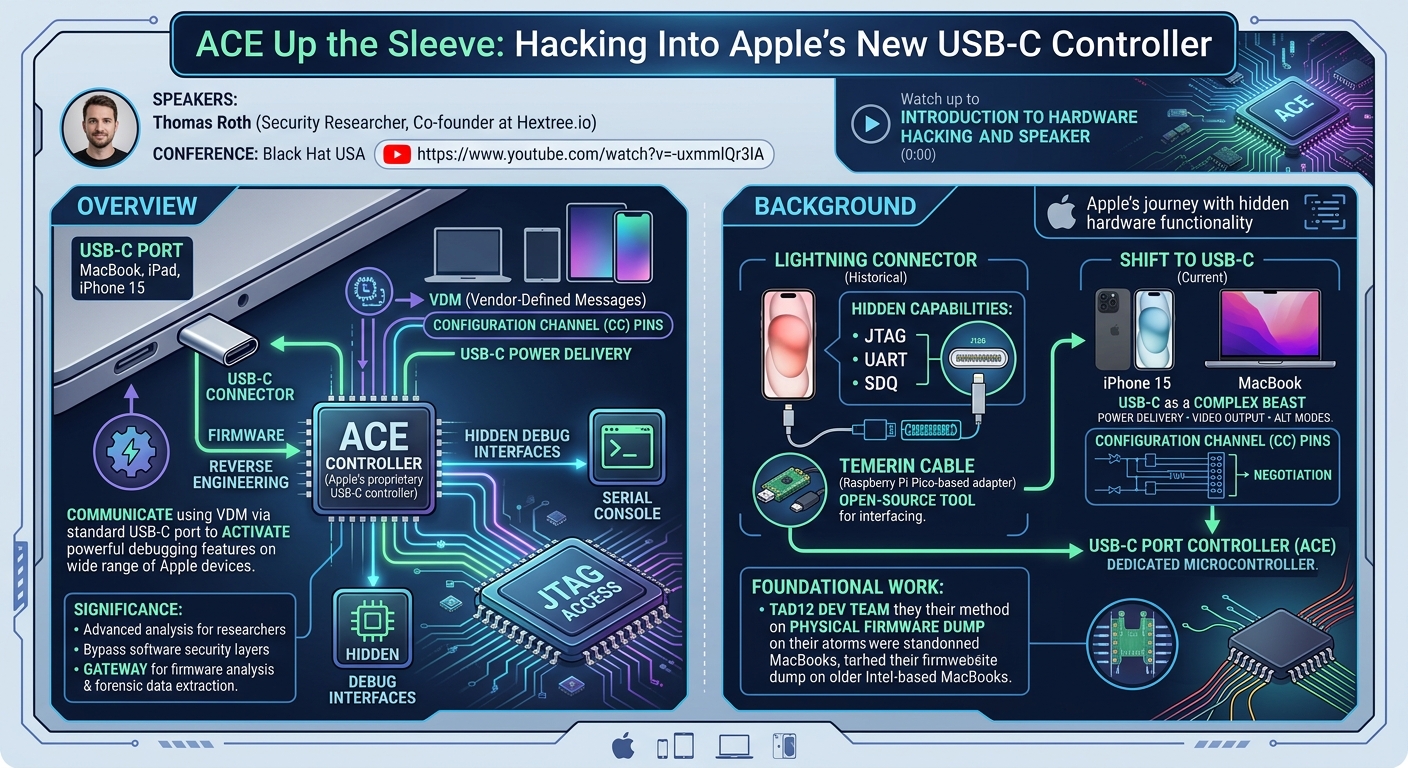
This talk, "ACE Up the Sleeve," presented by Thomas Roth (aka StaxMushing), delves into the intricate world of Apple's proprietary USB-C controller, codenamed "Ace." The presentation unveils a significant hardware security discovery: the presence of hidden debug and control interfaces accessible through the ubiquitous USB-C port on a wide range of Apple devices, including MacBooks, iPads, and the latest iPhone 15. This research builds upon previous work on Apple's Lightning connector, demonstrating a continuity of hidden diagnostic capabilities, now adapted for the USB-C era.
Key moments
- 0:00 Introduction to hardware hacking and speaker
- 0:50 Backstory: Lightning connector capabilities & Temerin cable
- 2:00 Apple's USB-C transition and new research challenge
- 3:00 Introducing ACE: Apple's USB-C port controller
- 3:50 Discovery of VDM and enabling serial console
- 4:50 JTAG and other protocols via USB-C on engineering devices
- 5:45 Tools for sending Vendor-Defined Messages (VDM)
ACE Up the Sleeve: Hacking Into Apple's New USB-C Controller
Speakers: Thomas Roth, Security Researcher, Co-founder at Hextree.io
Conference: Black Hat USA
YouTube: https://www.youtube.com/watch?v=-uxmmlQr3lA
Overview
This talk, "ACE Up the Sleeve," presented by Thomas Roth (aka StaxMushing), delves into the intricate world of Apple's proprietary USB-C controller, codenamed "Ace." The presentation unveils a significant hardware security discovery: the presence of hidden debug and control interfaces accessible through the ubiquitous USB-C port on a wide range of Apple devices, including MacBooks, iPads, and the latest iPhone 15. This research builds upon previous work on Apple's Lightning connector, demonstrating a continuity of hidden diagnostic capabilities, now adapted for the USB-C era.
The core of Roth's research revolves around the ability to communicate with the Ace controller using Vendor-Defined Messages (VDM), a mechanism within the USB-C Power Delivery specification that allows manufacturers to implement proprietary commands. By reverse engineering the firmware of these controllers, Roth and his collaborators uncovered commands that can activate powerful debugging features like a serial console and even JTAG access over the standard USB-C port. This discovery holds profound implications for hardware security, enabling advanced analysis for researchers, but also raising concerns for device integrity and data security.
The significance of this work cannot be overstated. As Apple transitions its entire product line, including the iPhone 15, to USB-C, understanding the underlying hardware and firmware interactions becomes paramount. The ability to leverage the USB-C port for low-level access to the System-on-a-Chip (SoC) bypasses many software-based security layers, offering a potential gateway for deep system introspection, firmware analysis, and even forensic data extraction. This talk serves as a critical exploration into the often-overlooked security surface area presented by sophisticated peripheral controllers in modern computing devices.
Background
▶ Watch: Introduction to hardware hacking and speaker (0:00)
Apple's journey with proprietary connectors and their hidden functionalities forms a crucial backdrop for this research. Historically, the Lightning connector on iPhones and iPads was more than just a charging and data transfer port. As Roth highlighted in his previous work, Lightning secretly supported advanced protocols like JTAG, UART, and SDQ, which are invaluable for hardware debugging and low-level system interaction. This led to the development of open-source tools like the Temerin cable, a Raspberry Pi Pico-based adapter that allowed researchers to interface with these hidden Lightning capabilities, effectively turning a standard connector into a powerful diagnostic tool.
The recent shift by Apple to USB-C for the iPhone 15, aligning with European regulations and standardizing its port across its device ecosystem, initially seemed to deprecate these specialized hardware hacking avenues. However, USB-C itself is a far more complex and versatile standard than its predecessors. It's not merely about data transfer; it's a "complex beast" that handles power negotiation, video output, and various alternate modes. Central to this complexity are the Configuration Channel (CC) pins, which are responsible for negotiating power delivery (PD) roles and determining the capabilities of connected devices. This negotiation is managed by a dedicated microcontroller within the host device, which Apple refers to as the USB-C port controller, or more commonly within its firmware, Ace.
The foundational work for understanding Ace controllers was laid by the TAD12 dev team on older Intel-based MacBooks. This team undertook the arduous task of physically dumping the firmware from these Ace 2 controllers, often involving intricate soldering and debugger connections. Following the firmware dump, they performed extensive reverse engineering, meticulously analyzing the proprietary protocols and commands embedded within. Their efforts revealed that these controllers, though seemingly mundane, harbored a wealth of "secrets," including custom commands that could unlock alternative functionalities on the USB-C port. This prior research provided the critical insight that Vendor-Defined Messages (VDM), a feature of the USB-C Power Delivery specification, could be used to send these proprietary commands, opening a door to deeper system access that standard USB communication channels would not permit.
Key Findings
▶ Watch: Apple's USB-C transition and new research challenge (2:00)
The research presented by Thomas Roth builds directly upon the foundational work concerning Apple's Ace USB-C controllers, revealing several critical findings that extend the scope of hardware-level access to modern Apple devices. The primary discovery revolves around the exploitation of Vendor-Defined Messages (VDM) to interact with the Ace controller in a proprietary manner, bypassing standard USB communication protocols.
One of the most significant findings is the ability to send custom, manufacturer-specific commands to the Ace microcontroller. The reverse engineering efforts, initially by the TAD12 dev team and further explored by Roth, uncovered that a specific VDM command, hex 10, can be used to query the Ace controller for a list of all supported actions or commands. This capability is akin to an attacker gaining access to an API endpoint that lists all available functions, providing a roadmap for further exploitation.
Among the numerous actions supported by the Ace controller, a particularly potent discovery was action 306. This command, when sent via VDM, has the capability to reconfigure some of the sideband use pins on the USB-C connector to function as a serial console. A serial console provides low-level text-based access to the operating system or firmware, often used for debugging, monitoring boot processes, and interacting with the system even before the main operating system has fully loaded. Gaining serial console access through a standard external port is a powerful bypass of typical security measures.
The research also identified different generations of the Ace controller. The older Intel-based MacBooks utilized Ace 2, which was the subject of the initial firmware dumping and reverse engineering efforts. Newer Apple devices, including the latest M3-powered Macs and the iPhone 15, integrate an updated version known as Ace 3. The fact that similar functionalities and proprietary protocols persist across these versions suggests a consistent architectural approach by Apple, making the findings relevant to a broad spectrum of current-generation devices.
Furthermore, the talk highlighted the extensive connections between the main System-on-a-Chip (SoC) and the Ace controller. Beyond standard USB and Thunderbolt data paths, critical debug interfaces such as a serial console and, notably, JTAG are connected. The speaker explicitly stated that on "engineering devices," it is possible to JTAG the main CPU of the computer directly via the USB-C port. JTAG (Joint Test Action Group) is an industry-standard interface primarily used for debugging, in-circuit emulation, and boundary-scan testing of integrated circuits. Access to JTAG provides deep, intrusive control over a device's hardware, allowing for memory inspection, register manipulation, and even code execution at the lowest levels. The mention of SPMI (System Power Management Interface) being found on iPhones further underscores the deep integration and control the Ace controller has over critical system functions.
Technical Deep Dive
▶ Watch: Introducing ACE: Apple's USB-C port controller (3:00)
The technical foundation of this research lies in the sophisticated design of the USB-C Power Delivery (PD) specification and its implementation within Apple's hardware. USB-C PD is not just about delivering power; it's a complex protocol that enables connected devices to negotiate power roles, current levels, and even alternative modes for data transfer (like DisplayPort or Thunderbolt). This negotiation occurs over dedicated Configuration Channel (CC) pins within the USB-C connector. These pins are always active when a device is connected, facilitating the initial handshake and ongoing communication between the host and the connected peripheral.
At the heart of Apple's implementation is the Ace controller, a specialized microcontroller embedded within the device, typically located in close proximity to the USB-C ports. This controller is responsible for managing all aspects of USB-C communication, including PD negotiation, role swapping, and handling Alternate Modes. Crucially, like any microcontroller, Ace runs its own dedicated firmware. The security implications of this firmware are profound, as vulnerabilities or hidden features within it can compromise the entire system.
The initial breakthrough by the TAD12 dev team involved physically accessing and dumping this firmware from Ace 2 controllers on Intel MacBooks. This process typically requires specialized hardware tools, micro-soldering skills, and an understanding of the controller's memory architecture to extract the executable code. Once the firmware was obtained, the team embarked on a rigorous reverse engineering process using disassemblers and debuggers. This involved analyzing the compiled machine code to understand the controller's internal logic, identify functions, and reconstruct the communication protocols it uses. This meticulous analysis revealed the existence of Vendor-Defined Messages (VDM), a specific type of USB-C PD message designed to allow manufacturers to implement proprietary commands and functionalities that are not part of the standard USB-C specification.
The reverse engineering efforts uncovered a proprietary command structure within these VDMs. For instance, sending the command hex 10 through a VDM allows an external device to request a list of all supported actions from the Ace controller. This is a critical step for any attacker or researcher, as it provides an enumerated inventory of potential functionalities that can be triggered. Among these, the action identified as 306 proved to be particularly significant. When this VDM command is sent, the Ace controller reconfigures its GPIO (General Purpose Input/Output) pins, specifically those used for sideband communication, to output a serial console. This effectively turns a standard USB-C port into a direct serial debugging interface, providing verbose output during boot-up, kernel panic logs, and a command-line interface to the underlying system.
The architecture of Apple devices further emphasizes the importance of the Ace controller. It acts as a bridge between the host System-on-a-Chip (SoC) and the external USB-C world. This connection is not limited to just USB data and Thunderbolt; it also includes critical debug interfaces like the serial console and, on engineering devices, JTAG. JTAG is a powerful debugging interface that provides direct, low-level access to the CPU's internal registers, memory, and instruction execution. Its presence, even if restricted to engineering units, highlights the deep diagnostic capabilities routed through the USB-C port. The mention of SPMI (System Power Management Interface) on iPhones further illustrates Ace's control over vital power management functions, adding another layer of potential interaction.
A key challenge in exploiting these findings is the inability to send VDM commands using standard USB libraries like libUSB, as VDM operates at a lower level within the USB-C PD protocol stack. To overcome this, specific tools were developed. The Mac VDM tool leverages a unique feature of some MacBook Pro models, where the back-left USB-C port can act as a debug interface, allowing one MacBook to send VDM commands to another. For more general hardware interaction, Mark Zier and Yi developed the Central Scrutinizer, a dedicated hardware adapter designed to generate and send precise USB-C PD VDM commands, thereby enabling access to the serial console and other debug features for tasks like kernel development. These specialized tools are essential for interacting with the Ace controller's hidden capabilities.
Demo / Proof of Concept
▶ Watch: JTAG and other protocols via USB-C on engineering devices (4:50)
While the provided transcript primarily focuses on the discovery and technical mechanisms rather than a live, detailed demonstration, the speaker clearly outlines the potential for a proof of concept based on the uncovered functionalities. The core of any demonstration would involve leveraging the Vendor-Defined Messages (VDM) to activate the hidden debug interfaces of the Ace controller.
A primary proof of concept would be to demonstrate the activation of the serial console via USB-C. This would typically involve using one of the specialized tools mentioned, such as the Central Scrutinizer hardware adapter or the Mac VDM tool. The process would entail connecting the tool to the target Apple device's USB-C port. The tool would then send the specific VDM command, including the action 306, to the Ace controller. Upon successful execution of this command, the sideband use pins of the USB-C port would be reconfigured to output serial data. A standard serial terminal application on a connected computer would then be used to display the output, which could include boot logs, kernel messages, or even a low-level command prompt if the device's firmware allows it. This demonstration would visually confirm the ability to gain low-level diagnostic access through a seemingly standard port.
Furthermore, on "engineering devices," a more advanced proof of concept would involve demonstrating JTAG access to the main CPU through USB-C. This would require an appropriate JTAG debugger connected to the reconfigured USB-C port. The demonstration would show the debugger successfully connecting to the CPU, allowing for operations like pausing execution, inspecting registers, reading and writing memory, and potentially stepping through code. While the transcript doesn't detail a live JTAG demo, the established capability through Ace's firmware and the VDM protocol lays the groundwork for such an advanced proof of concept. The speaker's emphasis on the existence of these interfaces on engineering devices suggests that while not universally enabled on retail hardware, the underlying hardware and firmware support exists. The talk primarily serves to reveal these hidden capabilities and the methods to interact with them, providing the blueprint for future hands-on demonstrations.
Defensive Implications
▶ Watch: Tools for sending Vendor-Defined Messages (VDM) (5:45)
The discoveries regarding Apple's Ace USB-C controllers carry significant defensive implications for Apple, device users, and enterprise security. The ability to access hidden debug interfaces such as a serial console and JTAG through a standard external port represents a bypass of many traditional software-based security layers, moving the attack surface to the hardware and firmware level.
Firstly, the presence of these powerful diagnostic interfaces, even if intended for internal development or manufacturing, poses a substantial risk if they are not adequately secured or disabled on production devices. An attacker with physical access to a device could potentially leverage these VDM-activated functionalities to gain deep introspection into the system. This could include dumping firmware, extracting cryptographic keys, bypassing lock screens, or even injecting malicious code at a very low level, potentially leading to persistent compromise that survives OS reinstallation.
Secondly, the findings highlight the critical importance of firmware security on peripheral controllers. The Ace controller, while seemingly a minor component, holds immense power over the system's debug capabilities. Any vulnerabilities within its firmware, or the improper configuration of its VDM-controlled actions, could be exploited. Apple's reliance on proprietary protocols and the complexity of USB-C PD mean that independent security researchers face a high barrier to entry for auditing these components, making it challenging to proactively identify and mitigate risks.
Defenders, including Apple itself, should consider several measures. Apple needs to ensure that these advanced debug functionalities are robustly disabled or cryptographically protected on all production devices. This could involve secure boot mechanisms that verify the Ace firmware's integrity, or cryptographic challenges for VDM commands that would prevent unauthorized access. Furthermore, a thorough audit of all Vendor-Defined Messages and their corresponding actions is necessary to identify any unintended exposure.
For users and organizations, these findings underscore the importance of physical security for Apple devices. While these hacks often require specialized tools and expertise, they demonstrate that physical access can lead to compromises far deeper than typical software exploits. Enterprises handling sensitive data on MacBooks or iPhones should be aware that their USB-C ports, under specific conditions, could become a vector for advanced persistent threats or data exfiltration. This might necessitate stricter physical access controls, tamper-evident seals, or even specialized USB-C port protectors in high-security environments. Finally, the research emphasizes that security cannot solely focus on the main CPU and OS; peripheral controllers and their firmware are increasingly becoming critical components in the overall security posture of modern devices.
Key Takeaways
- Apple's USB-C controllers (Ace) expose powerful, hidden debug interfaces. These controllers, found in MacBooks, iPads, and the iPhone 15, manage USB-C functionality and contain proprietary diagnostic capabilities.
- Vendor-Defined Messages (VDM) are the key protocol for accessing these hidden features. VDM allows custom, manufacturer-specific commands to be sent to the Ace controller, bypassing standard USB communication.
- Serial console access is achievable via USB-C. Through a specific VDM command (
306), the USB-C sideband pins can be reconfigured to provide a low-level serial console, offering deep system insight and debugging capabilities. - JTAG access to the main CPU is possible on engineering devices. The research indicates that the USB-C port on development hardware can provide JTAG access, enabling intrusive hardware debugging and control over the SoC.
- Specialized tools are required to interact with Ace controllers. Standard USB libraries cannot send VDMs, necessitating tools like the Mac VDM tool and the Central Scrutinizer hardware adapter.
- This research builds upon extensive prior work. The initial firmware dumping and reverse engineering of Ace 2 controllers by the TAD12 dev team laid the crucial groundwork for these discoveries.
About the Speaker(s)
Thomas Roth, also known by his online handle StaxMushing, is a prominent security researcher with a dedicated focus on hardware and firmware security. His work consistently explores the often-overlooked vulnerabilities and hidden functionalities within embedded systems and proprietary hardware. Thomas is also a co-founder of Hextree.io, an organization committed to teaching hardware hacking and other security disciplines. He is an active member of the security community, sharing his research and insights on platforms like Twitter (@GidraNinja) and YouTube. His contributions often involve reverse engineering complex hardware components to uncover their deepest secrets, as exemplified by his work on the Lightning connector and now Apple's USB-C controllers.