Arbitrary Data Manipulation and Leakage with CPU Zero-Day Bugs on RISC-V
Unknown
Black Hat USA 2024 · Day 1 · Briefing
Overview
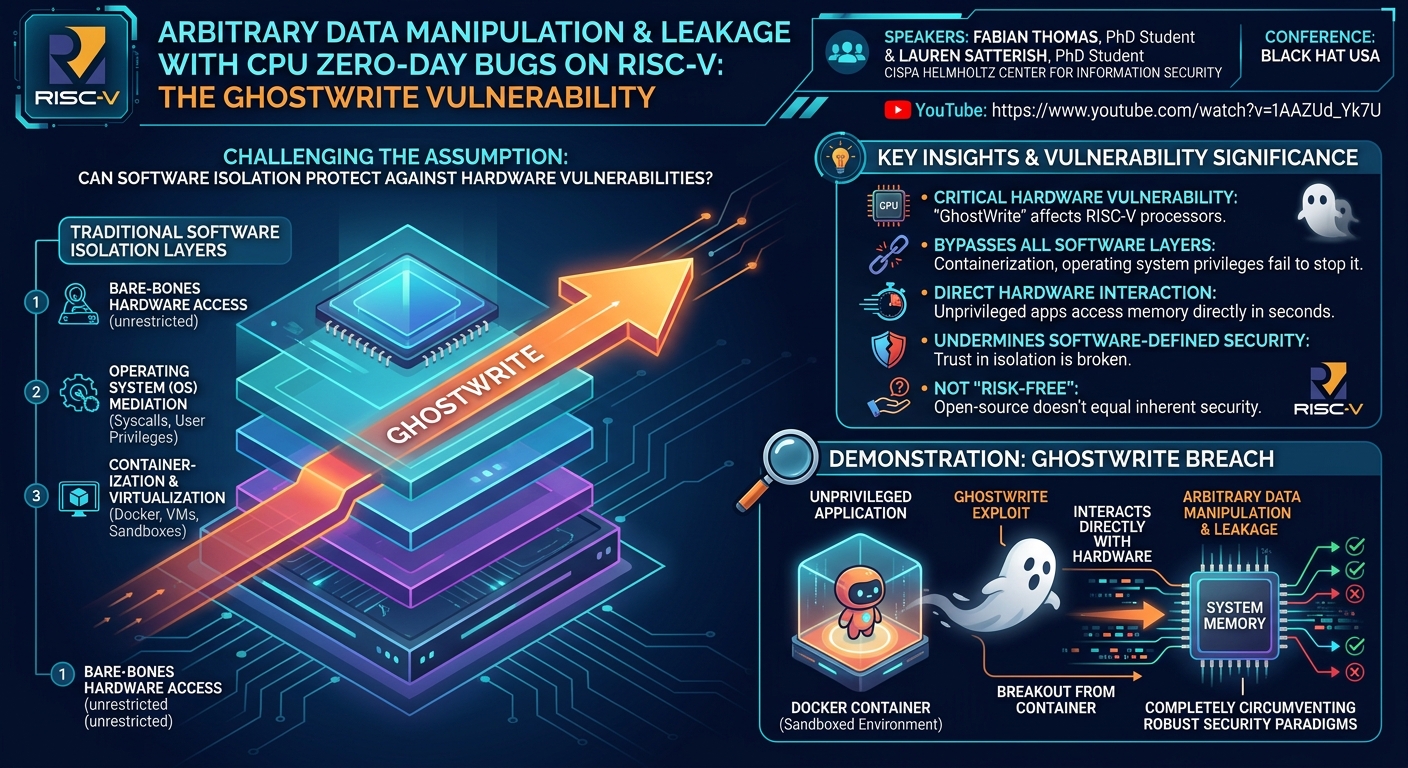
This talk, presented by Fabian Thomas and Lauren Satterish, PhD students from the CISPA Helmholtz Center for Information Security, unveils a critical hardware vulnerability dubbed GhostWrite that affects RISC-V processors. The researchers make the audacious claim of achieving arbitrary data manipulation and leakage by exploiting CPU zero-day bugs, effectively bypassing all layers of software-based isolation. This presentation challenges the prevailing assumption that modern software sandboxing techniques, including operating system privilege levels and containerization, can sufficiently protect against sophisticated attacks originating from compromised user-space applications.
Key moments
- 0:00 Introduction and the bold 'RISC-V zero-day' claim
- 0:50 Overview of software isolation: OS, privilege levels, users
- 2:00 Final challenge: breaking out of a container sandbox
- 2:20 Live demo: bypassing all software isolation instantly
- 2:50 Speakers' introduction and hardware vulnerability research focus
- 3:45 Vulnerability revealed: 'GhostRight' bypasses all software security
- 3:55 GhostRight's fundamental approach: circumventing all software layers
Arbitrary Data Manipulation and Leakage with CPU Zero-Day Bugs on RISC-V
Speakers: Fabian Thomas, PhD Student, CISPA Helmholtz Center for Information Security; Lauren Satterish, PhD Student, CISPA Helmholtz Center for Information Security
Conference: Black Hat USA
YouTube: https://www.youtube.com/watch?v=1AAZUd_Yk7U
Overview
This talk, presented by Fabian Thomas and Lauren Satterish, PhD students from the CISPA Helmholtz Center for Information Security, unveils a critical hardware vulnerability dubbed GhostWrite that affects RISC-V processors. The researchers make the audacious claim of achieving arbitrary data manipulation and leakage by exploiting CPU zero-day bugs, effectively bypassing all layers of software-based isolation. This presentation challenges the prevailing assumption that modern software sandboxing techniques, including operating system privilege levels and containerization, can sufficiently protect against sophisticated attacks originating from compromised user-space applications.
The significance of GhostWrite lies in its ability to completely circumvent the robust security paradigms built upon software isolation. In a compelling demonstration, the researchers illustrate how an unprivileged application, confined within a containerized environment (like Docker), can break out and interact directly with hardware within seconds. This capability fundamentally undermines the trust placed in software-defined security boundaries, particularly in the context of the rapidly expanding RISC-V ecosystem, which is often touted for its openness and perceived simplicity, sometimes leading to an assumption of inherent security or "risk-free" design. The talk serves as a stark reminder that hardware-level vulnerabilities can render even the most advanced software defenses ineffective.
Background
▶ Watch: Introduction and the bold 'RISC-V zero-day' claim (0:00)
Modern computing systems rely on a multi-layered approach to security, with software isolation forming the bedrock of protection against malicious applications and privilege escalation. The typical journey of an application from bare hardware to a highly isolated, sandboxed environment involves several stages, each adding a layer of defense:
- Bare-bones Hardware Access: Initially, an application running directly on hardware has unrestricted access to all system resources. This is the least secure configuration and is rarely encountered in production environments where multiple applications or users coexist.
- Operating System (OS) Mediation: Introducing an operating system like Linux immediately establishes a crucial security boundary. Applications can no longer directly interact with hardware; instead, they must make requests to the OS via syscalls. The OS operates in a privileged mode (e.g., kernel mode), while user applications run in an unprivileged mode. This mechanism prevents user applications from directly manipulating critical hardware components or memory regions.
- User Privilege Levels: Within an operating system, different users are assigned varying levels of permissions. An unprivileged user, for instance, would be denied requests to interact with sensitive hardware components, whereas a privileged administrator (root) could execute such commands. This further restricts the attack surface for compromised user applications.
- Containerization and Virtualization: The most advanced layer of software isolation involves technologies like containers (e.g., Docker) or virtual machines. These solutions create highly isolated environments where applications are confined, often with their own filesystem, network stack, and process space, and are deliberately prevented from "seeing" or directly interacting with the underlying hardware. Breaking out of such an environment typically requires a complex exploit chain: first, an exploit for the container runtime itself to escape the container, followed by a privilege escalation exploit (e.g., a Linux root exploit) to gain administrative control over the host operating system. Only then could the attacker potentially interact with the hardware via the now-compromised OS kernel.
The researchers explicitly frame their work against this backdrop of layered software security. They highlight that for a traditional software exploitation expert, achieving hardware interaction from an unprivileged, containerized application involves overcoming multiple significant obstacles, each requiring a separate zero-day vulnerability. The prevailing assumption is that such a multi-stage exploit chain is incredibly difficult to achieve in practice, making highly isolated environments relatively secure. The "GhostWrite" vulnerability directly challenges this assumption by demonstrating a hardware-level exploit that bypasses this entire edifice of software isolation, rendering the complex exploit chain unnecessary. The talk effectively positions hardware vulnerabilities as a critical and often overlooked threat vector that can nullify years of advancements in software security engineering.
Key Findings
▶ Watch: Final challenge: breaking out of a container sandbox (2:00)
The central and most impactful finding presented in this talk is the discovery and successful exploitation of GhostWrite, a CPU zero-day vulnerability specifically targeting RISC-V architectures. This vulnerability enables arbitrary data manipulation and leakage from an unprivileged software context, completely circumventing all established software-based security boundaries.
The key findings can be summarized as follows:
- Bypass of All Software Isolation Layers: GhostWrite demonstrates that a hardware vulnerability can effectively ignore and bypass the entire stack of software-based security mechanisms. This includes operating system privilege levels, memory protection units (MPUs/MMUs), and even advanced containerization solutions like Docker. The exploit negates the need for traditional software exploit chains that require multiple vulnerabilities (e.g., container escape + privilege escalation) to achieve system-level control or hardware interaction.
- Arbitrary Data Manipulation and Leakage: The exploit grants the attacker capabilities that are typically reserved for highly privileged software or direct hardware access. This includes the ability to read and write arbitrary data within the system's memory, potentially leading to critical information disclosure (e.g., sensitive keys, user data) or system corruption. While the specific data targeted in the demo was not explicitly stated beyond "interacting with the LED panel," the claim of "arbitrary data manipulation and leakage" implies a far broader and more dangerous scope.
- Immediate Impact ("Within Seconds"): The demonstration vividly showcased the speed and efficacy of the exploit. The speaker claimed and then proved that they could break out of a highly isolated sandbox "within seconds," highlighting that GhostWrite is not a theoretical or impractical attack but a highly efficient one. This rapid execution capability makes it a potent threat for real-world systems.
- Hardware Vulnerability, Software Exploitation: The research emphasizes that these are hardware vulnerabilities exploitable from software. This distinction is crucial, as it means attackers don't need physical access to the device or specialized hardware tools. A malicious application running in user space, even with minimal privileges, can trigger these underlying CPU flaws.
- RISC-V Specificity: The vulnerability is identified within the RISC-V architecture. This is particularly significant given RISC-V's growing adoption in embedded systems, IoT devices, and even data centers, often with a perception of enhanced security due to its open-source nature and simplified instruction set architecture (ISA). GhostWrite challenges this perception, highlighting that even modern, open-source ISAs are susceptible to fundamental hardware design flaws.
- Prior Work Context: The speakers mention their previous discovery, CashWarp, indicating a consistent research focus on uncovering such hardware-software interaction vulnerabilities. This positions GhostWrite as part of a broader body of work exploring the security implications of hardware design.
In essence, GhostWrite represents a paradigm shift in understanding the attack surface of modern computing. It underscores that even with the most rigorous software security practices, a single, well-crafted hardware exploit can completely undermine system integrity and confidentiality.
Technical Deep Dive
▶ Watch: Live demo: bypassing all software isolation instantly (2:20)
The talk primarily focuses on demonstrating the impact of the GhostWrite vulnerability rather than delving into its intricate technical specifics within the provided transcript. The speakers explicitly state that their "hardware exploit" allows them to "just go around all your isolations and software." While the precise mechanisms of GhostWrite itself are not detailed, we can infer its nature and discuss the general category of CPU zero-day bugs that enable such a bypass, particularly on RISC-V.
Nature of CPU Zero-Day Bugs and RISC-V:
CPU zero-day bugs are fundamental flaws in the processor's design or implementation that can lead to unintended behavior. These bugs often involve complex interactions between different CPU components, such as the instruction pipeline, caches, memory management unit (MMU), or privilege enforcement mechanisms. On RISC-V, a modular and extensible Instruction Set Architecture (ISA), these issues can arise from:
- Microarchitectural Flaws: Similar to speculative execution vulnerabilities (e.g., Spectre, Meltdown), these bugs exploit microarchitectural optimizations that inadvertently leak information or allow unauthorized operations. While RISC-V is a newer ISA, it employs similar performance-enhancing features that could introduce such side channels.
- Memory Management Unit (MMU) Bypass: The MMU is critical for enforcing memory protection and privilege levels. A flaw in the MMU's translation logic, its interaction with caches, or its privilege checking could allow an unprivileged process to access or modify memory regions it should not be able to. This is a common vector for privilege escalation in software, but a hardware bug in the MMU itself would be far more pervasive.
- Privilege Level Enforcement Issues: RISC-V defines distinct privilege levels (Machine, Supervisor, User). A CPU bug could potentially allow an instruction intended for a higher privilege level to execute from a lower one, or to bypass checks that restrict access to control and status registers (CSRs) critical for system operation.
- Instruction Set Implementation Bugs: Despite the simplicity of the RISC-V ISA, the actual hardware implementation can be complex. Bugs in how specific instructions are decoded, executed, or how they interact with other parts of the CPU (e.g., load/store units, branch predictors) could lead to exploitable conditions. An "off by one" error, mentioned humorously in the demo setup, could theoretically exist in a hardware counter or address calculation, leading to out-of-bounds access.
- Cache Coherence and Consistency Issues: Flaws in how the CPU maintains cache coherence across multiple cores or how it ensures memory consistency could be leveraged. For instance, a cache-related bug might allow an attacker to observe or manipulate data that should be protected by the MMU, as seen in previous research like CashWarp (mentioned by the speakers as their prior work).
How GhostWrite Bypasses Software Isolation:
The core impact of GhostWrite is its ability to directly circumvent the layers of software security. If GhostWrite is a CPU zero-day bug, it means it operates below the layer of the operating system and its security mechanisms.
- Operating System and Privilege Levels: An unprivileged user application makes a syscall to request hardware interaction. The OS kernel, running in a higher privilege level, would normally validate this request against the user's permissions and memory access rights. A hardware bug like GhostWrite could allow the unprivileged application to directly trigger a hardware behavior that bypasses the OS's validation entirely, or it could manipulate the state of the CPU in such a way that the OS thinks the operation is legitimate or that the unprivileged application is privileged.
- Memory Protection Units (MPU/MMU): These units enforce memory access policies (read, write, execute) based on virtual addresses and privilege levels. A hardware flaw could lead to an incorrect address translation, a bypass of permission checks, or a side-channel attack that allows an unprivileged process to read or write to protected memory regions (e.g., kernel memory, other processes' memory, sensitive hardware registers) without the MMU detecting it. This would directly enable "arbitrary data manipulation and leakage."
- Containerization (e.g., Docker): Containers rely on kernel features like namespaces and cgroups to isolate processes. However, they still share the same underlying OS kernel and hardware. If a CPU bug allows an unprivileged process to directly manipulate hardware or bypass MMU protections, then the container's isolation, being purely software-defined at the kernel level, becomes irrelevant. The exploit effectively jumps over the kernel, directly addressing the underlying hardware vulnerability. The demo explicitly showed a breakout from a containerized environment, proving this point.
While the specific technical primitives of GhostWrite (e.g., exact instruction sequences, specific microarchitectural components involved, precise timing requirements) are not detailed in this introductory segment of the talk, its demonstrated capability points to a deep-seated flaw in the RISC-V processor's fundamental security guarantees. This suggests an issue that lies at the heart of how the CPU enforces privilege and memory protection, making it a critical vulnerability for the entire RISC-V ecosystem. The "arbitrary data manipulation and leakage" claim implies a powerful primitive that could be used for complete system compromise.
Demo / Proof of Concept
▶ Watch: Vulnerability revealed: 'GhostRight' bypasses all software security (3:45)
The talk features a compelling and theatrical demonstration that serves as the primary proof of concept for the GhostWrite vulnerability. The setup involves a dialogue between two personas: one representing a skeptical security expert focused on software-based isolation, and the other (Fabian Thomas) representing the hardware exploitation researcher.
The demo environment is structured to be maximally secure from a software perspective:
- Bare Hardware: Initially, direct hardware access is acknowledged as easy but immediately rejected for the demonstration's challenge.
- Operating System & Privilege: An OS is introduced, enforcing syscalls and privilege levels, with the attacker as an unprivileged user.
- User Permissions: The attacker is further restricted as an unprivileged user, denied any direct hardware interaction by the OS.
- Containerization (Docker): The ultimate challenge involves placing the attacker's application within a container, explicitly stated to be "additional isolation" where the application "can't really even see the hardware anymore." The skeptical persona expresses high confidence that breaking out would require a container exploit followed by a Linux privilege escalation to root—a "nice zero day" chain.
Fabian Thomas, playing the role of the attacker, accepts this challenge. During the live demonstration, he is shown to be running an application that is "stuck" or "scuffed up." With a seemingly minor adjustment, a humorous "off by one" comment, he "fixes" the code. Immediately after this "fix," the application successfully breaks out of its highly isolated containerized environment and interacts with the hardware. The target hardware interaction is implied to be with an "advertisement panel" (referred to as "risk free" and "risk five" at the beginning of the talk), likely represented by an LED panel or similar visual indicator.
The key aspects of the demonstration are:
- Live Exploitation: The exploit was demonstrated live, adding significant credibility to the claims.
- Immediate Impact: The breakout was instantaneous, occurring "within second," underscoring the efficiency and practicality of the GhostWrite vulnerability.
- Complete Bypass: The demo visually confirmed that GhostWrite completely bypassed all layers of software isolation—operating system, privilege separation, and containerization (specifically mentioning Docker). The unprivileged application, without requiring any software-based exploits for the container or OS, directly manipulated the hardware.
- Arbitrary Control: While the specific hardware interaction was simple (turning on lights or manipulating a display), the implication is that this direct hardware access provides arbitrary control, supporting the claim of "arbitrary data manipulation and leakage."
The demonstration served as a powerful proof of concept, transforming the abstract concept of a CPU zero-day into a tangible and immediate threat. It effectively communicated that even the most robust software security measures are rendered ineffective when faced with fundamental hardware vulnerabilities like GhostWrite.
Defensive Implications
▶ Watch: GhostRight's fundamental approach: circumventing all software layers (3:55)
The discovery and demonstration of GhostWrite carry profound defensive implications for the entire computing ecosystem, particularly for systems utilizing RISC-V processors. This vulnerability highlights a critical blind spot in traditional security models and necessitates a shift in defensive strategies.
- Inadequacy of Software-Only Isolation: The most immediate implication is that relying solely on software-based isolation mechanisms—such as operating system privilege levels, memory protection units, process sandboxing, or containerization (e.g., Docker)—is insufficient to guarantee security against hardware-level CPU vulnerabilities. Defenders must recognize that these layers, while effective against software bugs, can be completely bypassed by fundamental flaws in the underlying hardware.
- Re-evaluation of RISC-V Security Posture: RISC-V's open-source nature and simplified instruction set have often been perceived as advantages for security, promoting transparency and reducing complexity. However, GhostWrite demonstrates that even modern, open-source ISAs are not immune to deep-seated hardware design or implementation flaws. Organizations deploying RISC-V in critical infrastructure, IoT devices, or cloud environments must re-evaluate their security assumptions and consider the potential for hardware-level attacks. The "risk-free" perception needs to be actively challenged.
- Need for Hardware-Aware Security Audits: Security professionals and system architects must expand their threat models to explicitly include hardware vulnerabilities. This requires investing in expertise for hardware security analysis, including microarchitectural review, formal verification of CPU designs, and robust post-silicon validation. Traditional penetration testing and vulnerability assessments, which primarily focus on software, will miss these critical hardware flaws.
- Supply Chain Security for CPUs: The presence of CPU zero-days like GhostWrite underscores the importance of a secure hardware supply chain. Organizations need assurances from their CPU vendors regarding the rigor of their design, verification, and testing processes. This includes transparency about potential hardware bugs and timely provision of microcode updates or silicon revisions.
- Microcode Updates and Firmware Patches: For CPUs where such vulnerabilities are discovered, the primary mitigation often comes in the form of microcode updates or firmware patches. These updates, provided by the CPU vendor, can modify the CPU's internal behavior to mitigate the flaw. Defenders must ensure robust mechanisms are in place for rapid deployment of such patches across their entire infrastructure, recognizing that these are as critical as operating system or application security updates.
- Secure Enclaves and Trusted Execution Environments (TEEs): Technologies like Intel SGX, ARM TrustZone, or RISC-V's proposed TEE extensions aim to create hardware-enforced secure environments. If a vulnerability like GhostWrite can bypass even hardware-level privilege enforcement, it raises serious questions about the robustness of these TEEs. Further research would be needed to determine if GhostWrite or similar vulnerabilities could compromise such enclaves, which are designed to protect sensitive data even from a compromised OS.
- Impact on Cloud and Multi-Tenant Environments: In cloud computing, tenants rely heavily on the hypervisor and underlying hardware to provide strong isolation from other tenants and the cloud provider. A CPU zero-day that allows arbitrary data leakage or manipulation could potentially enable cross-tenant attacks or give a malicious tenant access to hypervisor memory, posing a catastrophic risk to cloud security and data privacy.
- Proactive Research and Collaboration: The work by CISPA highlights the critical role of academic and independent security research in uncovering these deep-seated vulnerabilities. Fostering collaboration between researchers, CPU designers, and system integrators is essential to identify and mitigate such flaws before they can be exploited in the wild.
In conclusion, GhostWrite serves as a potent wake-up call, emphasizing that security is only as strong as its weakest link, which can often reside deep within the hardware. Defenders must adopt a more holistic security approach that integrates hardware-level considerations into every aspect of design, deployment, and operational security.
Key Takeaways
- Hardware vulnerabilities bypass all software isolation: GhostWrite, a CPU zero-day bug on RISC-V, demonstrates that even advanced software-based security layers (OS, privilege levels, containers like Docker) are insufficient against fundamental hardware flaws.
- Arbitrary data manipulation and leakage possible: The vulnerability grants an unprivileged attacker the ability to read and write arbitrary data, leading to critical information disclosure or system compromise.
- RISC-V is not inherently "risk-free": Despite its open-source and modular design, the RISC-V architecture is susceptible to deep-seated hardware bugs that challenge its perception of inherent security.
- Immediate and practical threat: The live demonstration showed an unprivileged application breaking out of a highly isolated containerized environment and interacting with hardware "within seconds," proving the exploit's efficacy.
- Shift in defensive strategy required: Security professionals must expand their threat models to include CPU-level vulnerabilities and invest in hardware-aware security audits and rapid deployment of microcode/firmware updates.
- CISPA research highlights hardware-software interaction flaws: This work, building on prior discoveries like CashWarp, underscores the ongoing importance of research into vulnerabilities at the intersection of hardware and software.
About the Speaker(s)
The talk was presented by Fabian Thomas and Lauren Satterish, both PhD students at the CISPA Helmholtz Center for Information Security in Germany. They are part of a research group led by Michael Schwarz, a prominent figure in hardware security research. Their primary research focus is on identifying and exploiting hardware vulnerabilities that can be triggered and leveraged from software. This work includes uncovering microarchitectural flaws and other fundamental CPU bugs. Their previous discovery, CashWarp, is also mentioned, indicating a consistent track record in this specialized area of computer security. As PhD students at CISPA, they contribute to a leading institute dedicated to advancing computer security research.