Bugs of Yore: A Bug Hunting Journey on VMware's Hypervisor
Unknown
Black Hat USA 2024 · Day 1 · Briefing
Overview
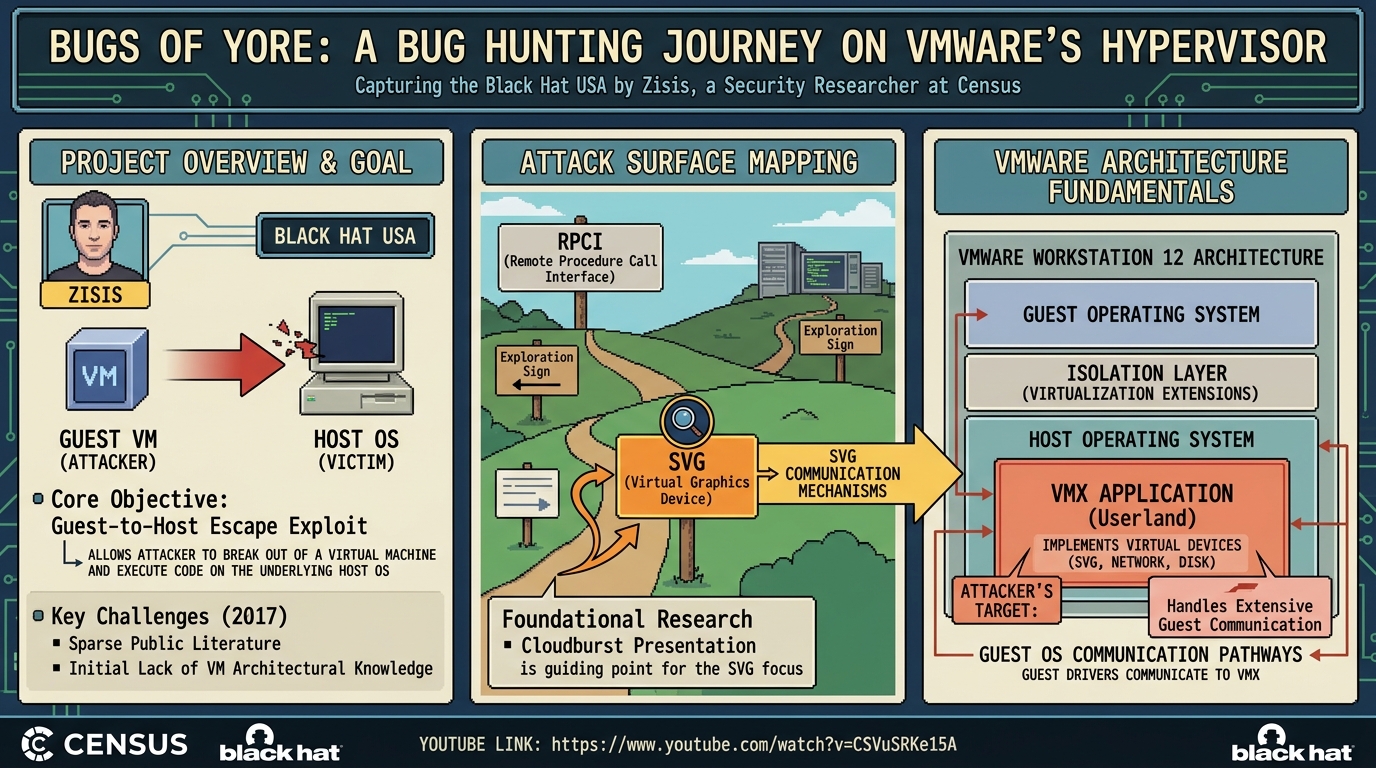
This talk, "Bugs of Yore: A Bug Hunting Journey on VMware's Hypervisor," delivered by Zisis from Census at Black Hat USA, chronicles the speaker's initial foray into VMware exploitation, specifically targeting VMware Workstation 12. The core objective was to develop a guest-to-host escape exploit, a critical vulnerability that allows an attacker to break out of a virtual machine and execute code on the underlying host operating system. The presentation details the speaker's methodical approach to mapping the complex attack surface of VMware, highlighting the challenges faced in 2017 due to the scarcity of public research on the topic.
Key moments
- 0:00 Speaker intro, project goal, and initial research approach
- 2:00 VMware's three major components and VMX as attack surface
- 4:00 SVG device communication via shared memory (FIFO) and resources
- 4:30 Internals of SVG command processing, header, and dispatch table
Bugs of Yore: A Bug Hunting Journey on VMware's Hypervisor
Speakers: Zisis, Security Researcher, Census
Conference: Black Hat USA
YouTube: https://www.youtube.com/watch?v=CSVuSRKe15A
Overview
This talk, "Bugs of Yore: A Bug Hunting Journey on VMware's Hypervisor," delivered by Zisis from Census at Black Hat USA, chronicles the speaker's initial foray into VMware exploitation, specifically targeting VMware Workstation 12. The core objective was to develop a guest-to-host escape exploit, a critical vulnerability that allows an attacker to break out of a virtual machine and execute code on the underlying host operating system. The presentation details the speaker's methodical approach to mapping the complex attack surface of VMware, highlighting the challenges faced in 2017 due to the scarcity of public research on the topic.
Zisis, an experienced exploit developer with a background in low-level security, embarked on this journey with a disadvantage: a lack of familiarity with the intricate workings of virtual machines. This talk is therefore not merely a disclosure of vulnerabilities, but a narrative of discovery, outlining the foundational steps required to understand and ultimately exploit a sophisticated virtualization platform. It underscores the importance of deep architectural understanding and the systematic identification of communication channels between the guest and host environments as prerequisites for successful hypervisor exploitation.
The talk primarily focuses on the SVG (Virtual Graphics Device) as the chosen attack vector, providing an in-depth look at its role within the VMware architecture and its communication mechanisms. By dissecting the internal workings of the SVG device and the VMX application—the userland component responsible for virtual device implementation—Zisis illuminates the critical interaction points that become targets for attackers. This presentation serves as a valuable resource for aspiring exploit developers and security researchers seeking to understand the initial phases of hypervisor bug hunting and the unique challenges presented by virtualized environments.
Background
▶ Watch: Speaker intro, project goal, and initial research approach (0:00)
In 2017, the landscape of public literature regarding VMware exploitation was notably sparse. While Zisis possessed considerable experience in exploit development and low-level programming, he acknowledged a significant gap in his knowledge concerning the fundamental operations of virtual machines. This personal challenge set the stage for a meticulous research effort aimed at understanding VMware's architecture from an attacker's perspective. The initial goal was clear: achieve a guest-to-host escape on VMware Workstation 12.
To begin, Zisis undertook the crucial task of mapping VMware's attack surface. His research led him to a pivotal resource: the "Cloudburst" presentation at Black Hat, which represented the first publicly documented attempt at SVG (Virtual Graphics Device) exploitation. While the RPCI (Remote Procedure Call Interface) was also identified as another potential attack surface, Zisis ultimately decided to concentrate his efforts on the SVG device due to the insights gleaned from the Cloudburst research.
Understanding the fundamental architecture of VMware is paramount for identifying exploitation opportunities. Zisis outlined three major components:
- VMX Application: This is a userland application residing on the host operating system. Critically, the VMX application is responsible for implementing all the virtual devices, such as the virtual graphics device (SVG), virtual network adapters, and virtual hard disks. From an attacker's standpoint, the VMX application is the primary target. Its role in handling extensive communication from within the guest operating system means it processes a vast amount of guest-supplied input, making it a fertile ground for discovering vulnerabilities that could lead to a guest-to-host escape.
- Kernel Driver: Operating within the host operating system's kernel, this driver acts as an intermediary. Its function is to facilitate communication between the userland VMX application and the hypervisor, ensuring the smooth operation of virtualized hardware and services.
- Hypervisor: The third major component, the hypervisor's core responsibility is to manage and pass execution between the host and guest operating systems. It forms the foundation of the virtualization layer, orchestrating the allocation of resources and maintaining isolation between virtual machines.
These three components collaborate synergistically to ensure the proper execution of the virtual machine. For an attacker, the VMX application presents the most direct and accessible avenue for interaction from the guest, making it the focal point for sending malicious input in pursuit of a bug.
The SVG device itself is the virtual graphics device provided by VMware. Its communication channel between the SVG implementation within the VMX application and the guest operating system is facilitated by SVG FIFOs (First-In, First-Out buffers). These are shared memory regions that allow for efficient data exchange. Zisis noted the existence of a highly informative paper published by the original authors of the SVG device, which comprehensively describes its internals. Furthermore, these authors also released mini operating systems specifically designed for internal SVG testing. Zisis utilized these resources, downloading and compiling the mini operating systems, and running them to gain a practical understanding of how the virtual graphics device functions. This hands-on approach was instrumental in demystifying the complex interactions and command structures of the SVG device.
Within the VMX application, a dedicated SVG thread continuously polls these shared memory mappings (the SVG FIFOs). This polling mechanism allows the SVG thread to retrieve commands that are sent by the guest user. A key function identified in this process is process SVG FIFO process FIFO, which is responsible for retrieving commands from the guest operating system. Once a command is retrieved, it then calls a function named dispatch handler. All SVG commands are structured with an SVG command header at their beginning. This header contains a crucial field: the index. This index field serves to indicate the specific command that was requested by the guest operating system. The dispatch handler then utilizes this index field to consult a dispatch table, which maps the index to the appropriate handler function on the host side, thereby servicing the guest's request. This command dispatch mechanism is a critical area for bug hunting, as incorrect handling of the index or the subsequent command parameters can lead to vulnerabilities.
Key Findings
▶ Watch: VMware's three major components and VMX as attack surface (2:00)
The talk, "Bugs of Yore: A Bug Hunting Journey on VMware's Hypervisor," primarily details the speaker's methodological journey and initial understanding of the VMware attack surface, rather than disclosing specific, novel vulnerabilities or detailed exploitation techniques. While Zisis states his eventual success in finding "my first bugs" and "ultimately managed to find some exploitation primitives," the core content of this presentation focuses on the foundational research and architectural understanding that enabled these discoveries.
The most significant finding presented is the detailed mapping and analysis of the SVG (Virtual Graphics Device) as a primary attack surface for guest-to-host escape exploits in VMware Workstation 12. Zisis systematically broke down the complex interaction between the guest and host through the SVG device, identifying key components and communication channels. This includes:
- Identification of the VMX application as the primary target: Zisis's analysis confirmed that the userland VMX process, responsible for implementing virtual devices, is the most accessible and vulnerable component from a guest operating system perspective. This finding guides attackers to focus their efforts on this specific process.
- Detailed understanding of SVG FIFO communication: The talk highlights the critical role of SVG FIFOs (shared memory buffers) as the conduit for guest-to-host communication for graphics commands. This shared memory mechanism is inherently sensitive and requires robust handling to prevent memory corruption or information leaks.
- Dissection of the SVG command dispatch mechanism: Zisis meticulously explained how SVG commands are processed: a dedicated SVG thread in VMX polls the FIFOs, the
process SVG FIFO process FIFOfunction retrieves commands, and thedispatch handleruses anindexfrom the SVG command header to call the correct function via a dispatch table. This process flow is a prime area for identifying vulnerabilities such as out-of-bounds reads/writes if theindexis not properly validated, or logic bugs in the individual command handlers. - Leveraging existing resources for initial research: A crucial finding in Zisis's journey was the effectiveness of using publicly available research, such as the "Cloudburst" presentation, and even internal development tools like the SVG authors' paper and mini operating systems, to jumpstart complex vulnerability research. This demonstrates a practical approach to overcoming the scarcity of public documentation.
In essence, the key findings revolve around a comprehensive understanding of the SVG device's architecture and its communication protocol, which is a prerequisite for any successful bug hunting endeavor in this domain. While specific CVEs or exploit chains are not detailed, the talk provides the essential roadmap and mental model required to uncover such vulnerabilities.
Technical Deep Dive
▶ Watch: SVG device communication via shared memory (FIFO) and resources (4:00)
The technical core of Zisis's presentation lies in the architectural breakdown of VMware and, more specifically, the intricate mechanics of the SVG (Virtual Graphics Device). Understanding these components is paramount for identifying and exploiting vulnerabilities that can lead to a guest-to-host escape.
At a high level, VMware's virtualization environment is composed of three interacting layers:
- The VMX Application: This is a critical userland process running on the host operating system. Its primary function is to emulate and manage all the virtual devices presented to the guest, including the virtual network adapter, virtual hard disk, and crucially, the SVG device. From an attacker's perspective, the VMX application is the most attractive target. Because it directly processes input from the guest OS to manage these virtual devices, it exposes a large and complex attack surface. Bugs within the VMX application's device emulation logic can be leveraged to compromise the host.
- The Kernel Driver: Residing within the host operating system's kernel, this driver acts as a secure intermediary. It mediates interactions between the userland VMX application and the hypervisor, ensuring that privileged operations and resource allocations are handled correctly and securely. While not the primary focus for guest-to-host escapes via virtual devices, its role in managing memory and execution flow is foundational.
- The Hypervisor: This is the lowest and most privileged layer, responsible for abstracting the physical hardware and managing the execution of both the host and guest operating systems. Its main duty is to efficiently pass control and resources between the host and guests, maintaining isolation.
Zisis's focus on the SVG device necessitated a deep dive into its communication protocol. The interaction between the guest OS and the SVG device implemented in the VMX application occurs through SVG FIFOs (First-In, First-Out buffers). These are shared memory regions, mapped into both the guest and host address spaces, allowing for high-performance, asynchronous communication. The efficiency of shared memory, however, comes with security implications; any mismanaged access or boundary checks can lead to critical vulnerabilities.
Within the VMX application, a dedicated SVG thread is responsible for continuously monitoring these SVG FIFO shared memory mappings. This thread actively polls the FIFO to detect and retrieve commands sent by the guest. The command processing pipeline proceeds as follows:
- Command Retrieval: The
process SVG FIFO process FIFOfunction within the VMX application is tasked with reading commands from the SVG FIFO. This function is the initial entry point for guest-supplied data into the host-side SVG processing logic. - Dispatch Mechanism: Once a command is retrieved, the
process SVG FIFO process FIFOfunction invokes adispatch handler. This handler is central to routing guest requests to the appropriate processing logic on the host. - SVG Command Structure: Every SVG command begins with an SVG command header. A critical component of this header is the
indexfield. Thisindexis a numerical value that uniquely identifies the specific command being requested by the guest. - Dispatch Table Lookup: The
dispatch handleruses theindexvalue from the SVG command header to perform a lookup in a dispatch table. This table is essentially an array of function pointers, where eachindexcorresponds to a specific handler function designed to service that particular SVG command. When a match is found, the appropriate handler function on the host side is called to process the guest's request.
This command dispatch mechanism is a fertile ground for vulnerabilities. If the index field is not properly validated (e.g., bounds checking to ensure it falls within the legitimate range of the dispatch table), an attacker could supply an out-of-bounds index. This could lead to an arbitrary memory read or write at an attacker-controlled offset relative to the dispatch table, potentially corrupting critical data structures or even diverting execution flow. Furthermore, even if the index is valid, individual command handlers themselves can contain logic flaws, buffer overflows, integer overflows, or use-after-free vulnerabilities when processing the parameters provided by the guest within the command data. The complexity of graphics commands, involving various data types, sizes, and operations on virtualized memory, makes these handlers particularly susceptible to subtle bugs. The speaker's journey likely involved reverse engineering these handlers to understand their input requirements and identify potential misuse cases.
Demo / Proof of Concept
▶ Watch: Internals of SVG command processing, header, and dispatch table (4:30)
The provided transcript for "Bugs of Yore: A Bug Hunting Journey on VMware's Hypervisor" does not include any description or mention of a live demonstration or a detailed proof of concept. The speaker focuses on the methodological journey, the architectural understanding, and the initial steps taken to map the attack surface of VMware's SVG device. While Zisis states his goal was to develop an exploit and that he "managed to find my first bugs" and "ultimately managed to find some exploitation primitives," the presentation does not delve into the specifics of a working exploit or a live demonstration of a guest-to-host escape.
Defensive Implications
The insights shared by Zisis regarding the attack surface of VMware's virtual devices, particularly the SVG (Virtual Graphics Device), carry significant defensive implications for organizations utilizing VMware products. Understanding how attackers approach these complex systems is crucial for developing robust defense strategies.
- Patch Management is Paramount: The VMX application, being a userland process that handles extensive guest input, is a prime target for attackers seeking guest-to-host escapes. Vulnerabilities in components like the SVG device can be critical. Therefore, applying security patches and updates for VMware products (e.g., VMware Workstation, ESXi, Fusion) promptly and consistently is the single most effective defensive measure. These patches often address specific vulnerabilities in virtual device handlers or the VMX process itself.
- Minimize Attack Surface: Organizations should adopt a principle of least privilege for virtual devices. If a virtual machine does not require specific virtual hardware (e.g., 3D graphics acceleration, specific network adapters, or USB devices), these components should be disabled. Reducing the number of active virtual devices directly reduces the attack surface available to a malicious guest, diminishing the likelihood of a successful escape attempt.
- Input Validation is Critical: The talk highlighted the SVG FIFO as a shared memory channel for guest-supplied commands, processed by functions like
process SVG FIFO process FIFOand dispatched via anindexin the SVG command header to a dispatch table. This entire chain relies heavily on robust input validation. Defenders should understand that any uncheckedindexvalues, malformed command structures, or improper length checks in command parameters can lead to memory corruption or control flow hijack. While this is primarily a developer's responsibility within VMware, knowing this helps defenders appreciate the complexity and potential fragility of these interfaces. - Monitor VMX Process Integrity: As the VMX application is the primary target, any anomalous behavior originating from or affecting this process on the host machine could indicate an ongoing attack. Advanced endpoint detection and response (EDR) solutions should focus on monitoring the VMX process for unexpected memory access patterns, unsanctioned child processes, or unusual network activity that deviates from its normal operational baseline.
- Understand Hypervisor Architecture: Zisis's breakdown of the VMX, kernel driver, and hypervisor components provides a mental model for defenders. While the hypervisor aims for strong isolation, vulnerabilities in the userland VMX or the kernel driver can undermine this. Security teams should have a foundational understanding of these layers to better assess the impact and scope of reported vulnerabilities.
- Review Configuration Hardening Guides: VMware provides extensive security hardening guides for its products. These guides often include recommendations for disabling unnecessary features, configuring logging, and restricting network access. Adhering to these best practices can significantly increase the resilience of virtualized environments against the types of attacks described.
In summary, defending against guest-to-host escapes requires a multi-faceted approach, combining diligent patching, attack surface reduction, and vigilant monitoring, all informed by a technical understanding of how virtual device interfaces can be exploited.
Key Takeaways
- Guest-to-host escapes target virtual devices: The primary attack surface for breaking out of a virtual machine and compromising the host often lies within the virtual device implementations, such as the SVG (Virtual Graphics Device).
- The VMX application is a critical attack vector: The VMX application, a userland process on the host, is responsible for emulating virtual devices and processing guest input, making it a prime target for exploit developers.
- Shared memory (SVG FIFO) is a sensitive communication channel: Mechanisms like SVG FIFOs, which use shared memory for guest-to-host communication, are highly efficient but require rigorous security controls to prevent memory corruption and other vulnerabilities.
- Command dispatch mechanisms are fertile ground for bugs: The process of retrieving guest commands (
process SVG FIFO process FIFO), identifying them via anindexin the SVG command header, and dispatching them through a dispatch table to specific handlers, presents numerous opportunities for input validation errors and logic bugs. - Architectural understanding is foundational for exploitation: A deep dive into the VMware architecture, including the roles of the VMX application, kernel driver, and hypervisor, is essential for identifying potential weak points and developing effective exploit strategies.
- Leverage existing research for complex targets: When public literature is scarce, utilizing prior work (e.g., "Cloudburst" for SVG exploitation) and internal development resources (like vendor papers and testing mini-OSes) can significantly accelerate the bug hunting process.
About the Speaker(s)
Zisis is a security researcher hailing from Greece, working with Census. He is an experienced developer and exploit developer with a strong background in low-level security. Zisis is known within the security community for his past presentations and contributions related to VMware exploitation. In this talk, he shares his personal journey and methodology for approaching VMware bug hunting, demonstrating how he navigated the complexities of virtualization to identify potential attack surfaces and exploit primitives, specifically focusing on the virtual graphics device.