From HAL to HALT: Thwarting Skynet's Siblings in the GenAI Coding Era
Unknown
Black Hat USA 2024 · Day 1 · Briefing
Overview
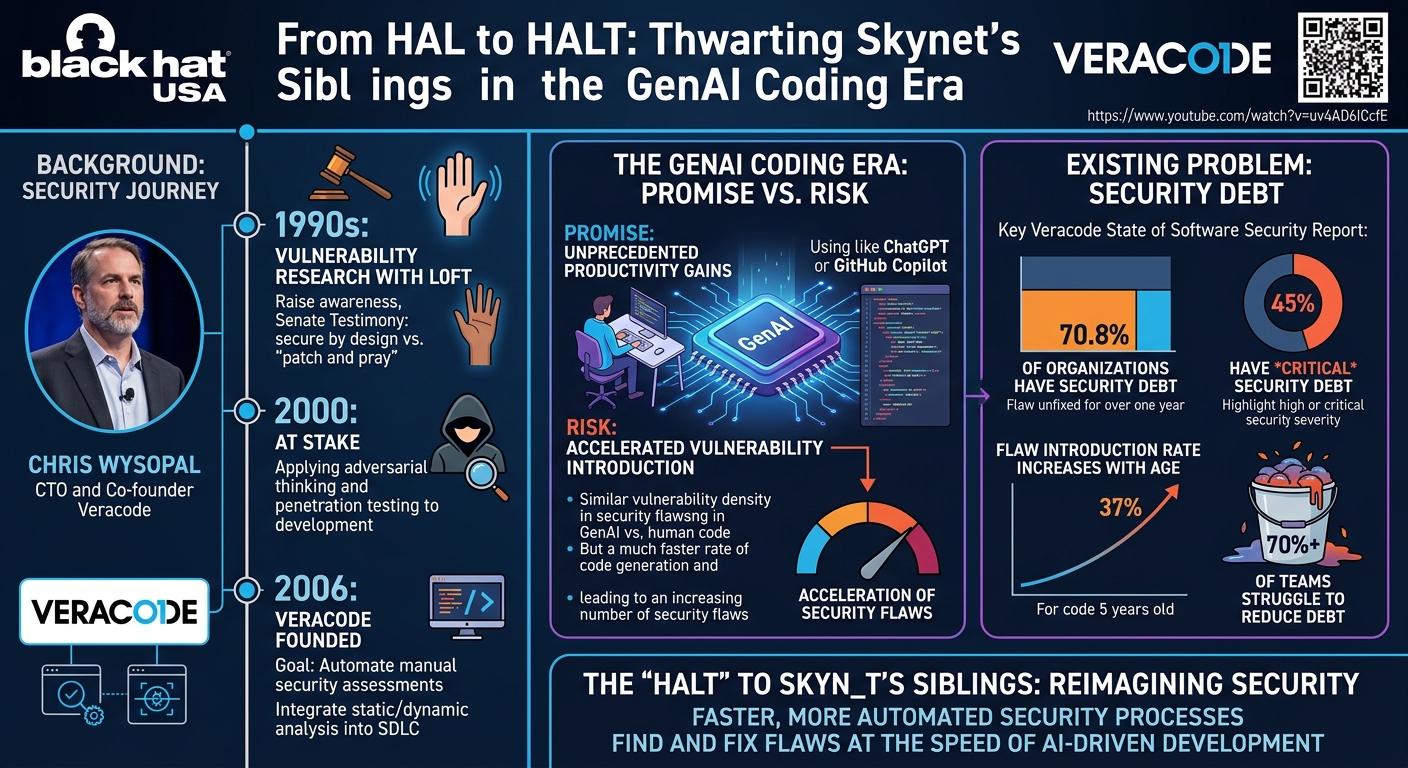
In his Black Hat USA talk, "From HAL to HALT: Thwarting Skynet's Siblings in the GenAI Coding Era," Chris Wysopal, CTO and co-founder of Veracode, addressed the profound impact of generative AI (GenAI) on the software development lifecycle (SDLC) and, critically, on software security. Drawing on his decades of experience—from a pioneering vulnerability researcher in the 1990s to a leader in automated application security—Wysopal highlighted a looming challenge: while GenAI promises unprecedented developer productivity gains, it simultaneously exacerbates existing software security problems by accelerating the introduction of vulnerabilities.
Key moments
- 0:00 Introduction to talk and speaker's security journey
- 2:00 Professional security's origin: breaking into products
- 4:20 Defining and understanding the concept of security debt
- 4:50 Alarming statistics on organizations with critical security debt
- 6:00 Generative AI's rise and impact on development
- 6:40 Common and emerging uses of GenAI by developers
- 8:05 AI's emerging role in debugging and fixing vulnerabilities
From HAL to HALT: Thwarting Skynet's Siblings in the GenAI Coding Era
Speakers: Chris Wysopal, CTO and Co-founder, Veracode
Conference: Black Hat USA
YouTube: https://www.youtube.com/watch?v=uv4AD6ICcfE
Overview
In his Black Hat USA talk, "From HAL to HALT: Thwarting Skynet's Siblings in the GenAI Coding Era," Chris Wysopal, CTO and co-founder of Veracode, addressed the profound impact of generative AI (GenAI) on the software development lifecycle (SDLC) and, critically, on software security. Drawing on his decades of experience—from a pioneering vulnerability researcher in the 1990s to a leader in automated application security—Wysopal highlighted a looming challenge: while GenAI promises unprecedented developer productivity gains, it simultaneously exacerbates existing software security problems by accelerating the introduction of vulnerabilities.
The core of Wysopal's message is that the increased velocity of code generation, driven by tools like ChatGPT and GitHub Copilot, means a faster accumulation of security flaws. He argues that the "vulnerability density" of GenAI-generated code is comparable to human-written code, but its speed of production magnifies the problem. The talk explores how organizations, already grappling with significant security debt, must adapt their strategies to keep pace with this new wave of development, emphasizing the urgent need for faster, more automated security processes to find and fix flaws at the speed of AI-driven development.
Background
▶ Watch: Introduction to talk and speaker's security journey (0:00)
Chris Wysopal's journey in cybersecurity provides a crucial historical lens through which to understand the contemporary challenges posed by generative AI. Beginning his career as a vulnerability researcher in the 1990s with the legendary hacker collective Loft, Wysopal was at the forefront of raising awareness about the inherent insecurity of software. He recounts testifying before the Senate, advocating for the then-radical idea that software should be secure by design, rather than relying on a "patch and pray" approach where vulnerabilities were only addressed after discovery in the wild. Developers, he observed, were often untrained in secure coding practices, leading to a systemic problem of insecure applications.
This early advocacy laid the groundwork for a professionalization of security. Wysopal co-founded At Stake in 2000, where the Loft research team continued their work, shifting from pure offensive research to applying adversarial thinking and penetration testing to the software development process. This marked a pivotal change, integrating offensive security methodologies into the creation of software—a practice that is now standard. In 2006, Wysopal co-founded Veracode with Christian Ryu, driven by the vision to automate the manual, consultant-driven security assessments performed at At Stake. The goal was to make static analysis, dynamic analysis, and other security testing methods an integrated, automated part of the SDLC.
Despite nearly two decades of progress in automated security, Wysopal highlighted a persistent, widespread issue: security debt. Drawing from Veracode's annual "State of Software Security Report," he defined security debt as a logged flaw (found by analysis, meeting policy criteria for fixing) that remains unfixed for over a year. Veracode's data revealed a concerning trend: 70.8% of organizations contend with security debt, and a staggering 45% of those possess critical security debt—high or critical severity vulnerabilities left unaddressed for more than a year. The rate of new flaw introduction also increases with software age, rising from around 20-22% in new code to 37% after five years. Alarmingly, only about 20% of application development teams effectively manage or reduce their security debt, meaning the vast majority are allowing their software's risk posture to increase over time. This pre-existing, systemic accumulation of vulnerabilities forms the critical backdrop against which the advent of generative AI must be evaluated.
Key Findings
▶ Watch: Defining and understanding the concept of security debt (4:20)
The central finding of Wysopal's talk is that while generative AI (GenAI) tools like ChatGPT, GitHub Copilot, and Code Whisperer offer transformative productivity gains for developers, they do not inherently improve the security posture of the generated code. Instead, they amplify the existing problem of accumulating vulnerabilities by accelerating the rate at which code—and thus flaws—are introduced into software.
Wysopal cited reports indicating developer productivity increases of up to 50% when utilizing GenAI. This significant boost is a powerful incentive, leading to rapid adoption: data suggests that up to 40% of development teams are already experimenting with or actively using GenAI in their development environments. Developers are leveraging GenAI for a variety of tasks beyond mere code generation, including:
- Code Review: Assisting in understanding existing codebases.
- Bug Fixing: Generating potential solutions for identified defects.
- Language Translation: Converting code between different programming languages, such as DARPA's initiative to translate C code into Rust for enhanced safety.
- Testing Code: Generating test cases to improve coverage and identify issues.
- Documentation: Automating the creation of comprehensive and up-to-date project documentation.
- Debugging: Analyzing log files and providing insights to identify root causes of bugs.
- Functional and Non-functional Testing: Aiding in the creation and execution of various test types.
However, Wysopal underscored that the code produced by GenAI exhibits a "security defect or vulnerability density" comparable to conventionally written code. This means that while developers can write code 50% faster, they are also introducing vulnerabilities 50% faster. This creates a critical imbalance: organizations are already struggling to address their existing security debt, with only 20% of teams effectively managing it. The influx of GenAI-generated code, without a parallel acceleration in security remediation, will inevitably lead to an even more rapid accumulation of critical vulnerabilities. The key finding, therefore, is that the industry is facing a new imperative: to match the speed of AI-driven code generation with an equally fast and automated process for finding and fixing security flaws.
Technical Deep Dive
▶ Watch: Alarming statistics on organizations with critical security debt (4:50)
The technical implications of generative AI in the software development lifecycle are multifaceted, extending beyond just the initial code generation. Wysopal's talk highlighted several areas where GenAI is being integrated, each with its own set of security considerations.
At its core, GenAI's impact stems from its ability to rapidly generate code. These models are typically trained on vast corpora of publicly available code, which, by its very nature, contains a significant number of security vulnerabilities. When developers use tools like ChatGPT, GitHub Copilot, or Code Whisperer to auto-complete functions, generate entire modules, or even translate complex logic, the output may inherit these insecure patterns. For instance, a prompt asking for a common web application function (e.g., user authentication, data processing) might yield code that is susceptible to SQL injection, Cross-Site Scripting (XSS), or insecure deserialization if the training data contained such examples and the prompt didn't explicitly demand secure alternatives. The lack of inherent security context in many prompts, or the model's inability to fully grasp complex security requirements, means that "secure code" is not a default output.
Beyond raw code generation, GenAI is finding applications across the SDLC that indirectly or directly touch upon security:
- Code Review: Developers are using GenAI to help understand legacy codebases or to review newly written code. While this can expedite comprehension and identify logical bugs, GenAI's ability to spot subtle security flaws, especially those requiring deep contextual understanding or architectural awareness, is still evolving. A model might flag a syntax error but miss a potential privilege escalation vulnerability stemming from an insecure design pattern.
- Bug Fixing: GenAI can suggest fixes for identified bugs. If these bugs are security vulnerabilities, a GenAI-proposed patch could be a double-edged sword. It might provide a quick fix, but without proper validation, it could introduce new, perhaps more subtle, security issues or fail to address the root cause of the original vulnerability. For example, a model might suggest sanitizing a single input field but overlook other injection points or a broader architectural flaw.
- Language Translation: Wysopal mentioned DARPA's initiative to translate C code into Rust. This is a significant security endeavor because Rust, with its strong memory safety guarantees, can eliminate entire classes of vulnerabilities prevalent in C/C++ (e.g., buffer overflows, use-after-free). However, the security of the translated code is entirely dependent on the fidelity and security-awareness of the translation model. An inaccurate translation could introduce new logic flaws or fail to correctly port security-critical constructs, inadvertently creating new attack surfaces.
- Testing Code: GenAI can generate test cases, potentially increasing code coverage. While this is beneficial for functional correctness, the generated tests may not inherently focus on security edge cases or adversarial inputs. Specialized fuzzing techniques or security-focused unit tests are often required to uncover vulnerabilities, and GenAI's ability to create these effectively is an active area of research.
- Debugging and Log Analysis: GenAI can sift through vast quantities of log data to help pinpoint the root cause of bugs. This can indirectly aid security by accelerating the identification of anomalous behavior or system failures that might be indicative of a security incident or vulnerability exploitation. However, the interpretation of security-specific alerts still often requires human expertise.
The fundamental challenge highlighted by Wysopal is that the speed of GenAI-powered development outpaces traditional security remediation efforts. Current application security programs, even those leveraging automated Static Application Security Testing (SAST) and Dynamic Application Security Testing (DAST), are struggling with the backlog of existing security debt. The influx of GenAI-generated code means that new vulnerabilities are being introduced at an unprecedented rate, overwhelming existing manual review and remediation capacities. This necessitates a fundamental shift towards an even more integrated, intelligent, and automated security pipeline that can analyze, identify, and even suggest fixes for vulnerabilities at the speed of GenAI. The vision is to use AI not just to create code, but also to secure it, transforming the current "flaw accumulation problem" into an "automated remediation opportunity."
Demo / Proof of Concept
▶ Watch: Common and emerging uses of GenAI by developers (6:40)
The transcript for Chris Wysopal's Black Hat USA talk, "From HAL to HALT: Thwarting Skynet's Siblings in the GenAI Coding Era," does not describe any specific live demonstration or proof of concept. The presentation focused primarily on conceptual discussions, data analysis from Veracode's reports, and strategic implications of generative AI on software security.
Defensive Implications
▶ Watch: AI's emerging role in debugging and fixing vulnerabilities (8:05)
The advent of generative AI in software development presents a critical juncture for defensive security strategies. Chris Wysopal's talk underscores that the fundamental defensive posture must evolve to match the velocity of AI-driven code generation. The core implication is the urgent need for heightened automation and integration of security throughout the SDLC.
Firstly, the most significant defensive implication is the imperative to automate the finding and fixing process of security vulnerabilities. With GenAI accelerating code creation by up to 50%, traditional manual security reviews and slow remediation cycles are simply unsustainable. Defenders must embrace comprehensive, continuous Application Security Testing (AST) solutions, including:
- Static Application Security Testing (SAST): Tools that analyze source code, bytecode, or binary code to identify security vulnerabilities without executing the program. These tools need to be deeply integrated into the Continuous Integration/Continuous Delivery (CI/CD) pipeline, scanning code as it's generated and committed, providing immediate feedback to developers. The speed of SAST is crucial here, as it can catch flaws early in the development process, before they propagate.
- Dynamic Application Security Testing (DAST): Tools that analyze running applications to find vulnerabilities. DAST can complement SAST by identifying runtime issues, configuration flaws, and vulnerabilities that might only manifest during execution. Automated DAST scans should be part of deployment pipelines.
- Software Composition Analysis (SCA): Given that GenAI often draws from vast codebases, the use of open-source components is likely to remain high. SCA tools are essential to identify known vulnerabilities in third-party libraries and frameworks, ensuring that the generated code doesn't inadvertently introduce supply chain risks.
Secondly, Wysopal highlighted the potential, albeit limited, benefit of including security considerations in prompts for generative AI. While he notes this might only "work a little bit," it represents a foundational defensive layer. Developers should be educated on how to craft security-aware prompts that explicitly instruct the AI to generate secure code. Examples include:
- "Generate a Python function for user input validation that prevents SQL injection and XSS."
- "Create a secure API endpoint for data submission, ensuring proper authentication, authorization, and input sanitization."
- "Write a Rust module for parsing untrusted data, focusing on memory safety and error handling to prevent buffer overflows."
This shifts some of the security burden onto the AI itself, encouraging it to draw from secure coding patterns in its training data. However, this approach should always be coupled with robust automated scanning and human review, as GenAI's interpretation of "secure" might not always align with best practices or specific application requirements.
Thirdly, the widespread issue of security debt becomes even more critical. GenAI's ability to assist in remediating security vulnerabilities is an emerging use case that defenders should actively explore. If GenAI can be effectively leveraged to suggest or even implement fixes for identified flaws, it could significantly reduce the backlog of security debt. This would involve feeding vulnerability reports from SAST/DAST tools into GenAI models and tasking them with generating patches, which would then require human review and testing before deployment. This could transform security teams from solely identifying problems to also rapidly prototyping and implementing solutions.
Finally, the talk implicitly reinforces the need for continuous security education for developers. Even with GenAI assisting, developers remain ultimately responsible for the code they ship. Understanding secure coding principles, how GenAI models work, their limitations, and how to effectively audit GenAI-generated code for security flaws will be paramount. The increased velocity of code changes necessitates a culture where security is ingrained from the very first prompt, not merely an afterthought. By integrating automated tools, promoting secure prompting, and exploring AI-driven remediation, organizations can hope to "HALT" the unchecked accumulation of vulnerabilities in the GenAI coding era.
Key Takeaways
- Generative AI Accelerates Vulnerability Introduction: While GenAI significantly boosts developer productivity (up to 50%), it does not inherently produce more secure code. The "vulnerability density" remains similar, meaning flaws are introduced at a faster rate, exacerbating existing security challenges.
- Widespread Security Debt is a Pre-existing Problem: Most organizations (70.8%) already struggle with security debt, with 45% facing critical, unaddressed vulnerabilities for over a year. GenAI's rapid code generation will compound this issue if not addressed proactively.
- Automation is the Only Viable Solution: To counter the increased velocity of code and flaw introduction, security processes—finding and fixing vulnerabilities—must become equally automated and integrated into the development pipeline.
- Security-Aware Prompting is a First Step: Including explicit security considerations in GenAI prompts can help guide the model toward generating more secure code, though this alone is not a comprehensive solution.
- GenAI Offers Remediation Potential: Beyond generating code, GenAI has emerging uses in code review, debugging, and potentially, in actively remediating existing security vulnerabilities, which could help tackle security debt.
- The Future is Fast and Secure (or Insecure): Organizations must embrace GenAI for its productivity gains but simultaneously invest in advanced, automated security tools and practices to prevent a rapid accumulation of critical security debt.
About the Speaker(s)
Chris Wysopal is the CTO and co-founder of Veracode, a leading provider of application security solutions. With a career spanning several decades, Wysopal is a highly respected figure in the cybersecurity community. He began his journey as a vulnerability researcher in the 1990s as part of the legendary hacker collective Loft, famously testifying before the U.S. Senate to advocate for secure software development. He later co-founded At Stake in 2000, professionalizing offensive security research into practical application security services. In 2006, he co-founded Veracode with Christian Ryu, pioneering the automation of application security testing. Wysopal gave his first Black Hat talk in 2006, focusing on finding backdoors with static analysis, a topic he noted remains relevant today. His work has consistently focused on shifting security left in the software development lifecycle and making secure coding practices standard.