From Weapon to Target: Quantum Computers Paradox
Unknown
Black Hat USA 2024 · Day 1 · Briefing
Overview
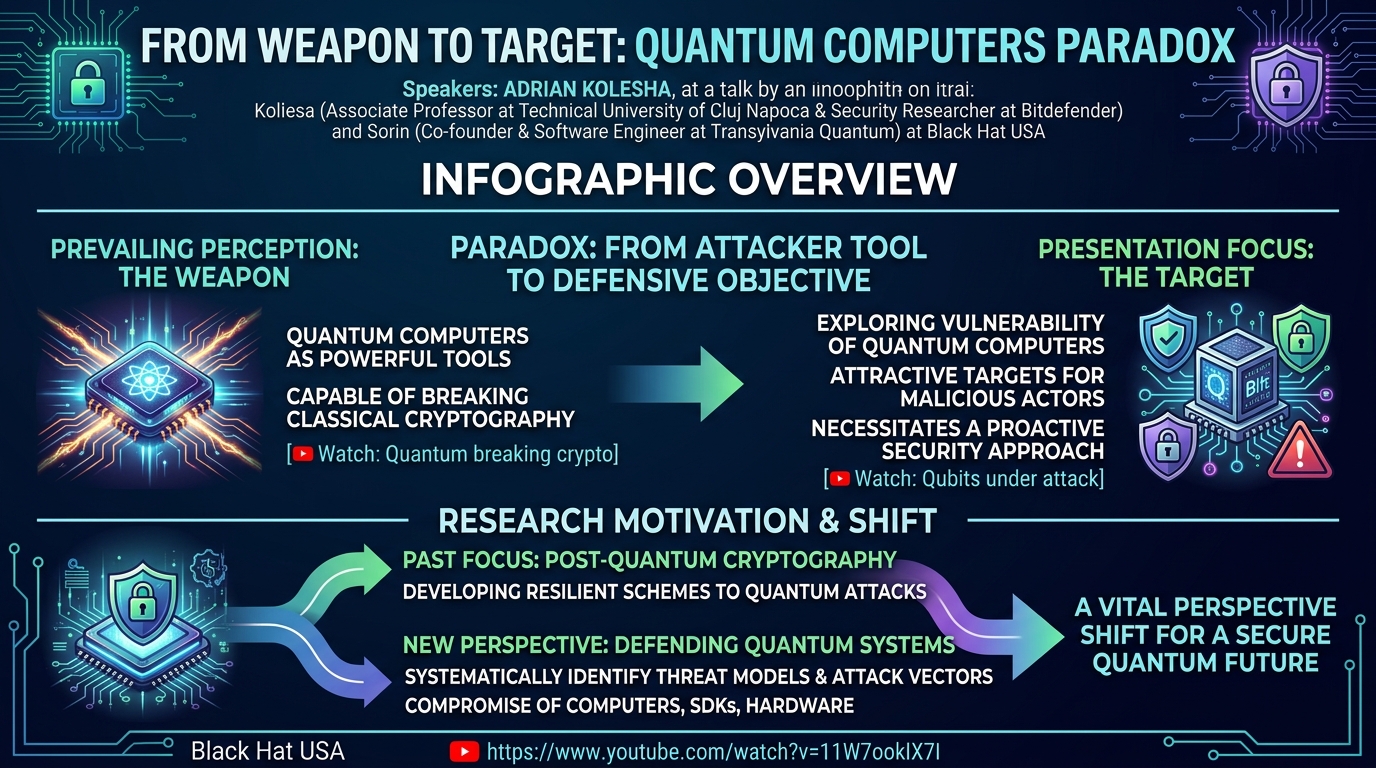
This talk, "From Weapon to Target: Quantum Computers Paradox," challenges the prevailing perception of quantum computers solely as powerful tools capable of breaking classical cryptography. Presented by Adrian Kolesha from the Technical University of Cluj Napoca and Bitdefender, alongside Sorin, co-founder of Transylvania Quantum, the presentation pivots to explore the often-ignored vulnerability of quantum computers themselves. The speakers argue that as these revolutionary machines mature, they become attractive targets for malicious actors, necessitating a proactive approach to their security.
Key moments
- 0:00 Introduction: Quantum computers as targets, not just weapons
- 0:50 Speakers introduce themselves and affiliations
- 2:30 Explaining the fundamental need for quantum computers
- 3:40 Key quantum effects: uncertainty, complex probabilities, measurement
- 5:00 Research methodology: identifying attack vectors and PoCs
- 6:05 Attacking quantum computers: a totally new topic
- 6:30 Limited prior research on multi-user quantum circuit execution
From Weapon to Target: Quantum Computers Paradox
Speakers: Adrian Kolesha, Associate Professor at Technical University of Cluj Napoca & Security Researcher at Bitdefender; Sorin, Co-founder of Transylvania Quantum & Software Engineering at Transylvania Quantum
Conference: Black Hat USA
YouTube: https://www.youtube.com/watch?v=11W7ooklX7I
Overview
This talk, "From Weapon to Target: Quantum Computers Paradox," challenges the prevailing perception of quantum computers solely as powerful tools capable of breaking classical cryptography. Presented by Adrian Kolesha from the Technical University of Cluj Napoca and Bitdefender, alongside Sorin, co-founder of Transylvania Quantum, the presentation pivots to explore the often-ignored vulnerability of quantum computers themselves. The speakers argue that as these revolutionary machines mature, they become attractive targets for malicious actors, necessitating a proactive approach to their security.
The core motivation behind this research, conducted by Bitdefender and Transylvania Quantum, is to systematically identify potential threat models and attack vectors targeting quantum computing infrastructure. While much academic and industry focus has been on post-quantum cryptography—developing new cryptographic schemes resilient to quantum attacks—Kolesha and Sorin highlight the critical need to understand how quantum computers, their software development kits (SDKs), and the underlying hardware could be compromised. This perspective shift is vital for building a secure quantum future, moving beyond simply defending against quantum threats to actively defending quantum systems.
Background
▶ Watch: Introduction: Quantum computers as targets, not just weapons (0:00)
The journey into understanding quantum computers as potential targets begins with a foundational grasp of what they are and why they exist. Classical computers, while incredibly powerful for precise calculations and simulations in many domains (like predicting celestial movements or weather patterns), hit fundamental limits when attempting to model complex quantum systems, such as molecules in chemistry or molecular physics. The inability to simulate even medium-sized molecules, like caffeine, stems from the inherent quantum effects that govern their behavior.
The idea for quantum computers emerged in the 1980s as a novel way to simulate nature at the molecular level, leveraging these very quantum effects. Sorin elucidates three key quantum phenomena that make quantum computation both powerful and profoundly different from classical computing:
- The Uncertainty Principle: A cornerstone of quantum mechanics, this principle dictates that certain pairs of properties of a quantum system (like position and momentum) cannot be simultaneously known with arbitrary precision. If one property is measured and learned, knowledge about its complementary property is lost. This introduces an inherent uncertainty that quantum computers must contend with, fundamentally operating with probabilities rather than deterministic states.
- Complex Probabilities (often simplified as "Negative Probabilities"): Unlike classical probability, which always yields positive values, quantum mechanics often involves complex probability amplitudes. These amplitudes can interfere with each other, leading to phenomena not observed in classical physics. As Sorin explains, a positive probability for an event can interact with a "negative probability" for the same event, causing them to cancel each other out and result in a zero probability. This quantum interference is a powerful computational resource but also introduces counter-intuitive behavior.
- Measurement Update (Wave Function Collapse): Before measurement, a quantum system exists in a superposition of states, meaning it can simultaneously hold multiple possible values for a given property, each with an associated probability. However, the act of measurement forces the system to collapse into a single, definite state. Once a property is measured, the probability for that specific measured value becomes 100%, and all other possibilities vanish. This irreversible process fundamentally alters the quantum system and is a crucial aspect of extracting results from a quantum computation.
These principles define the unique operational paradigm of quantum computers, setting them apart from their classical counterparts. Understanding these foundational concepts is not just a matter of physics but also a prerequisite for appreciating the unique security challenges they present.
Key Findings
▶ Watch: Explaining the fundamental need for quantum computers (2:30)
The research presented by Adrian Kolesha and Sorin identifies a significant gap in existing cybersecurity discourse concerning quantum computing: the overwhelming focus on quantum computers as weapons against classical cryptography, to the neglect of their potential as targets. Their primary finding from an initial literature review was that prior academic and industry efforts to secure quantum computers predominantly addressed a specific, and currently uncommon, operational scenario.
Specifically, early research into quantum computer attacks centered on environments where multiple users' quantum circuits might execute concurrently on a single quantum chip. This scenario, envisioned as a way to optimize resource utilization by shortening queues, would mean that the quantum chip's state could be shared or influenced by different users' computations. Such an environment naturally opens up "a kind of worms in terms of security," as Sorin notes, implying potential for side-channel attacks, information leakage, or interference between co-executing circuits.
However, the speakers emphasize that this multi-user co-execution model is "not in use today" for the majority of current quantum computing services. This highlights that while valuable, much of the existing security research might not directly address the most prevalent threat landscape for contemporary quantum computing platforms, which often isolate user jobs or run them sequentially. Consequently, the researchers from Bitdefender and Transylvania Quantum embarked on their own investigation to identify broader threat models and attack vectors relevant to how quantum computers are accessed and used today, including popular quantum software development kits (SDKs) and quantum providers that offer free access to their hardware. While the talk outlines their investigative approach and the areas of focus (SDKs, providers), the specific vulnerabilities discovered, detailed attack methodologies, or identified threat models are not elaborated within the provided transcript. The emphasis is on the identification of this research gap and the initiation of their work to fill it.
Technical Deep Dive
▶ Watch: Key quantum effects: uncertainty, complex probabilities, measurement (3:40)
The technical deep dive into quantum computer security, as framed by the speakers, starts with the very definition of quantum computation. Quantum computers are "machines that do math using quantum effects," fundamentally differing from classical machines that rely on bits representing 0s or 1s. Instead, quantum computers utilize qubits, which can exist in a superposition of both 0 and 1 simultaneously, and can also be entangled with other qubits, creating correlations that classical computers cannot efficiently simulate.
The core quantum effects detailed by Sorin—the uncertainty principle, complex probabilities, and measurement update—are not merely theoretical curiosities but the operational bedrock of these machines.
- The uncertainty principle implies that an attacker cannot simultaneously gain full knowledge of all properties of a quantum system. This could have implications for forensic analysis or real-time monitoring of quantum states during an attack. Any attempt to observe certain properties will inevitably disturb others, potentially altering or destroying evidence of an intrusion.
- Complex probabilities, which allow for destructive interference (positive and negative probabilities canceling out), are what enable quantum algorithms like Shor's algorithm (for factoring large numbers) and Grover's algorithm (for searching unstructured databases) to achieve their exponential speedups over classical counterparts. From a security perspective, manipulating these probabilities through malicious quantum circuits could potentially lead to incorrect computational results, denial-of-service, or information leakage if an attacker can subtly alter the interference patterns.
- The measurement update, or collapse of the wave function, is the point at which quantum information becomes classical information. This is where the probabilistic outcome of a quantum computation is observed. An attacker targeting the measurement process could potentially influence the outcome, introduce noise, or even extract partial information before full collapse, if not properly secured.
The speakers highlight their investigation into "popular quantum software development kits" and "popular quantum providers." This suggests that their technical analysis would encompass the entire stack, from the high-level programming interfaces (SDKs like Qiskit, Cirq, PennyLane) down to the cloud-based quantum hardware access layers. Potential attack vectors in this context could include:
- Software vulnerabilities in the SDKs themselves, allowing for malicious code injection into quantum circuits or control flow.
- API abuse against quantum cloud platforms, potentially leading to unauthorized resource access, denial of service by flooding quantum processors, or data manipulation.
- Supply chain attacks targeting quantum programming libraries or compilers.
- Side-channel attacks against the classical control systems that manage the quantum hardware (e.g., timing attacks, power analysis, electromagnetic emissions from the classical components or cryogenics).
- Quantum-specific attacks that exploit the unique properties of qubits, such as manipulating control pulses, inducing decoherence prematurely, or exploiting cross-talk between qubits to inject errors or extract information. While the transcript does not delve into these specific attack techniques, the mention of "all possible attack vectors" implies such considerations.
The transcript, however, does not provide concrete examples of code, specific protocols analyzed, or detailed architectural vulnerabilities discovered during their investigation. It largely sets the stage for the types of technical areas that would need to be explored to fully understand quantum computer security.
Demo / Proof of Concept
▶ Watch: Attacking quantum computers: a totally new topic (6:05)
The speakers stated their intention to "try to develop some proof of concept attacks" as part of their research. However, the provided transcript does not describe any specific demonstration or proof of concept attack that was performed or presented during the talk. The details of any developed PoCs, how they worked, or what vulnerabilities they exploited are not included in the transcript.
Defensive Implications
▶ Watch: Limited prior research on multi-user quantum circuit execution (6:30)
While the talk primarily focuses on identifying the need to consider quantum computers as targets and outlining areas of investigation, the transcript does not delve into specific defensive implications or mitigation strategies derived from their findings. The absence of detailed attack descriptions means that concrete recommendations for defenders are not articulated.
However, the overarching implication for defenders is clear: the security posture of quantum computing systems must evolve beyond mere post-quantum cryptography. Security teams and quantum platform providers must proactively develop threat models that encompass the quantum computer itself, its software stack, and its physical infrastructure. This includes:
- Securing quantum software development kits (SDKs): Ensuring code integrity, preventing malicious circuit injection, and hardening the compilation and execution pipelines.
- Hardening quantum cloud platforms: Implementing robust authentication, authorization, and access control mechanisms for quantum hardware resources. Monitoring for unusual resource consumption or anomalous quantum circuit behavior.
- Protecting the quantum hardware: Considering physical security, environmental controls (cryogenics, vacuum systems), and the classical control electronics that interface with the qubits.
- Developing quantum-aware intrusion detection systems: Systems capable of identifying deviations in quantum state, gate fidelity, or measurement outcomes that could indicate an attack.
- Establishing incident response procedures for quantum computing environments, which will require specialized expertise due to the unique nature of quantum data and operations.
The talk serves as a call to action, urging the security community to shift its focus and begin designing and implementing defensive measures for an entirely new class of computing infrastructure.
Key Takeaways
- Quantum computers should be viewed not only as powerful weapons against classical cryptography but also as potential targets for cyberattacks.
- Existing research on quantum computer security has largely focused on multi-user co-execution scenarios, which are not currently prevalent in production quantum systems.
- Understanding the fundamental quantum effects—such as the uncertainty principle, complex probabilities, and measurement update—is crucial for comprehending the unique security challenges of quantum computing.
- Researchers are actively investigating threat models and potential attack vectors against popular quantum software development kits (SDKs) and quantum providers.
- Proactive security measures and dedicated threat modeling are essential for the nascent quantum computing industry to ensure the integrity, confidentiality, and availability of quantum systems.
About the Speaker(s)
Adrian Kolesha is an Associate Professor at the Technical University of Cluj Napoca and also serves as a Security Researcher at Bitdefender. His work focuses on the intersection of cybersecurity and emerging technologies, including quantum computing.
Sorin is a Co-founder of Transylvania Quantum and works in Software Engineering at the same company. He is introduced as the "quantum expert" of the duo, providing foundational insights into the workings and underlying physics of quantum computers. Both speakers hail from Cluj Napoca, Romania.