Laser Beams & Light Streams: Building Affordable Light-Based Hardware Security Tooling
Unknown
Black Hat USA 2024 · Day 1 · Briefing
Overview
This talk, titled "Laser Beams & Light Streams: Building Affordable Light-Based Hardware Security Tooling," introduces Project Lorem, an ambitious initiative aimed at democratizing hardware security research. Presented by Sam Beaumont (Panther) and Larry Trowel (Patch), the research focuses on developing low-cost, high-precision tools that leverage light for hardware analysis and attack. The significance of this work lies in its potential to lower the barrier to entry for advanced hardware security studies, enabling a broader range of researchers and organizations to investigate and mitigate physical vulnerabilities in integrated circuits.
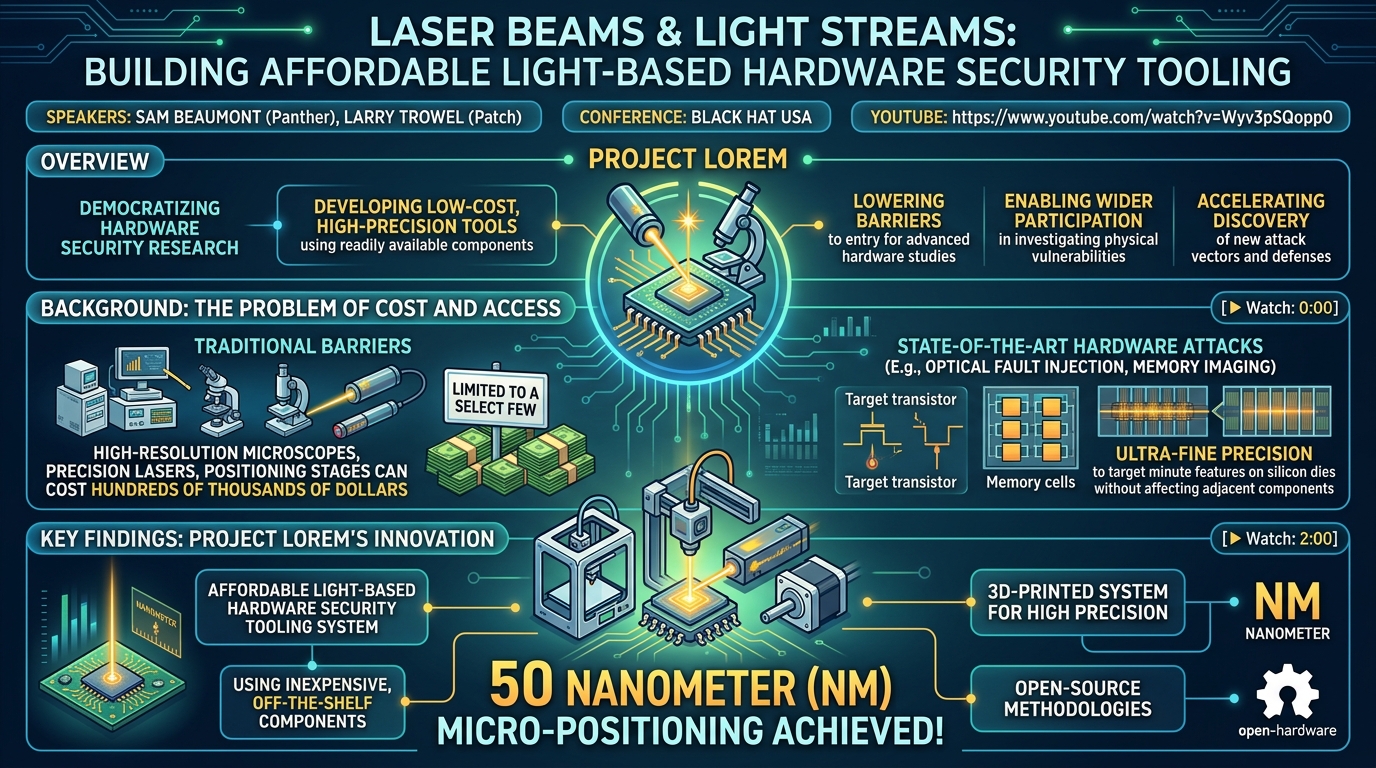
Key moments
- 0:00 Humorous introduction and 'five thesis in a trench coat' talk overview
- 2:00 The humorous origin and acronym of 'Project Lorem'
- 2:30 Speaker Sam (Panther) introduction and her 'noun problem'
- 3:00 Speaker Larry (Patch) introduction and his acronym challenges
- 4:00 Introduction of team members and 3D printed micro-positioning system
Laser Beams & Light Streams: Building Affordable Light-Based Hardware Security Tooling
Speakers: Sam Beaumont (Panther), Larry Trowel (Patch)
Conference: Black Hat USA
YouTube: https://www.youtube.com/watch?v=Wyv3pSQopp0
Overview
This talk, titled "Laser Beams & Light Streams: Building Affordable Light-Based Hardware Security Tooling," introduces Project Lorem, an ambitious initiative aimed at democratizing hardware security research. Presented by Sam Beaumont (Panther) and Larry Trowel (Patch), the research focuses on developing low-cost, high-precision tools that leverage light for hardware analysis and attack. The significance of this work lies in its potential to lower the barrier to entry for advanced hardware security studies, enabling a broader range of researchers and organizations to investigate and mitigate physical vulnerabilities in integrated circuits.
The core premise revolves around making sophisticated optical hardware attacks, typically reserved for well-funded laboratories with expensive equipment, accessible through innovative, cost-effective engineering. The speakers highlight the creation of a 3D-printed system capable of achieving remarkable precision using readily available components. This approach challenges the notion that cutting-edge hardware security research inherently demands exorbitant investment, paving the way for wider participation and potentially accelerating the discovery of new attack vectors and defensive strategies. While the full depth of the five theses described by the speakers as being "in a trench coat" could not be fully captured in the provided transcript, the foundational concept of affordable, light-based tooling is clearly established.
Background
▶ Watch: Humorous introduction and 'five thesis in a trench coat' talk overview (0:00)
The field of hardware security has traditionally been characterized by significant barriers to entry, primarily due to the high cost of specialized equipment required for detailed physical analysis and attack. Techniques such as optical fault injection (OFI) and memory imaging often necessitate high-resolution microscopes, precision laser systems, and sophisticated positioning stages, which can cost hundreds of thousands of dollars. This financial hurdle limits advanced hardware security research to a select few academic institutions, large corporations, and government labs, creating a disparity in the global capability to identify and address fundamental hardware vulnerabilities.
The problem exists because the targets of these attacks, typically individual transistors or memory cells on a silicon die, are incredibly small, often in the nanometer scale. Achieving the precision required to direct a laser beam or image a specific area without affecting adjacent components demands extremely fine mechanical control and optical resolution. Prior work has demonstrated the power of these attacks, revealing vulnerabilities ranging from bypassing secure boot mechanisms to extracting cryptographic keys. However, the solutions available have largely remained within the domain of proprietary, expensive tools. Project Lorem directly confronts this challenge by proposing an alternative: building comparable capabilities using open-source methodologies and inexpensive, off-the-shelf components, thereby making these powerful research techniques more widely available.
Key Findings
▶ Watch: The humorous origin and acronym of 'Project Lorem' (2:00)
The central and most significant finding presented by Project Lorem is the successful development of an affordable light-based hardware security tooling system capable of achieving 50 nanometer (nm) micro-positioning. This precision is a critical enabler for various hardware attacks, as it allows for the accurate targeting of minute features on integrated circuits. The speakers emphasize that this level of control was achieved through the innovative combination of a 3D printed system, utilizing the inherent flexibility of PLA plastic, and commercially available stepper motors.
This demonstrates that the precision traditionally associated with high-cost, specialized optical benches can be replicated with significantly reduced expenditure and more accessible manufacturing techniques. While the transcript does not detail specific vulnerabilities or the outcomes of particular attacks, the mention of "imaging and injection" techniques implies the system's intended capabilities for both optical memory analysis and fault injection. The ability to build such a precise system affordably represents a substantial contribution to the hardware security community, effectively lowering the financial and technical barriers for conducting advanced physical attacks and research.
Technical Deep Dive
▶ Watch: Speaker Sam (Panther) introduction and her 'noun problem' (2:30)
The technical ingenuity of Project Lorem lies in its ability to achieve high-precision optical manipulation using readily available and cost-effective components. The core of the system is a 3D printed mechanical stage, primarily constructed from PLA (polylactic acid) plastic. While PLA is a common and inexpensive material for 3D printing, its selection here is strategic. The speakers note that the "beauty of PLA or plastic is that it bends." This inherent flexibility, often seen as a limitation in high-precision applications, is ingeniously harnessed. When combined with carefully controlled stepper motors, this flexibility contributes to the system's ability to achieve extremely fine movements.
The synergy between the flexible PLA structure and the precise, incremental movements of stepper motors creates a 50 nanometer position micro-positioning system. This level of precision is crucial for light-based hardware attacks. For instance, in optical fault injection, a laser beam must be directed with extreme accuracy to a specific transistor or gate within a complex integrated circuit to induce a transient error. Similarly, for memory imaging, precise optical alignment is necessary to capture data from individual memory cells without interference. The speakers mention Chas Becht as a "circuitry wizard" who was instrumental in building parts of the hardware, suggesting a sophisticated electronic control system is in place to manage the stepper motors and potentially the light source, though specific details on the control electronics, firmware, or software architecture are not elaborated in the transcript. The light source itself, central to "Laser Oscillation for Retrieving Electronic Memory (LOREM)," is not explicitly detailed but would logically involve a precisely focused and controllable laser or LED array, synchronized with the positioning system for effective "imaging and injection" operations. The overall architecture represents a paradigm shift, proving that high-end optical manipulation for hardware security is not solely the domain of expensive, custom-machined components.
Demo / Proof of Concept
▶ Watch: Speaker Larry (Patch) introduction and his acronym challenges (3:00)
While the talk's title and the foundational research clearly point towards practical applications of their tooling, the provided transcript does not include any specific details regarding a live demonstration or a detailed proof of concept. The speakers mention that Chas Becht was "instrumental in actually building part of the hardware that's here tonight," suggesting a functional prototype was present at the conference. However, the transcript does not describe what was demonstrated, how it worked in practice, or any specific results achieved through the "imaging and injection" capabilities. Therefore, while a physical system was likely available, the specifics of its operation or a public demonstration are not documented in the provided text.
Defensive Implications
▶ Watch: Introduction of team members and 3D printed micro-positioning system (4:00)
The advent of affordable, high-precision light-based hardware security tooling like Project Lorem carries significant implications for defenders and the broader cybersecurity landscape. Primarily, it signals a democratization of advanced hardware attacks, meaning the capability to perform optical fault injection or memory imaging is no longer confined to state-level actors or highly-resourced research labs. This expands the threat surface, as more individuals and organizations, including potentially malicious actors, could gain access to such powerful analytical and attack methods.
For chip designers and manufacturers, this necessitates a heightened focus on physical security and resilience at the silicon level. Traditional security measures often concentrate on software vulnerabilities or logical design flaws. However, with accessible tools capable of 50nm precision, designers must consider countermeasures against optical attacks. This could involve incorporating light-sensitive sensors on chip to detect anomalous light exposure, employing opaque passivation layers or metal shielding over sensitive areas, or developing circuit designs inherently resilient to fault injection. The ability to perform "imaging and injection" with inexpensive tools also underscores the importance of secure supply chain practices, as it makes physical tampering and analysis more feasible at various stages of hardware production and deployment. Ultimately, Project Lorem's work emphasizes that hardware security is a multi-layered challenge that extends beyond the digital realm, demanding proactive physical protections against increasingly accessible sophisticated attacks.
Key Takeaways
- Democratization of Hardware Security: Project Lorem demonstrates that advanced light-based hardware security tooling can be built affordably, lowering the barrier to entry for researchers and potentially increasing the number of actors capable of performing physical attacks.
- High Precision from Low-Cost Components: A 3D printed system made of PLA plastic, combined with standard stepper motors, can achieve a remarkable 50 nanometer (nm) micro-positioning capability, critical for targeting minuscule features on integrated circuits.
- Feasibility of Light-Based Attacks: The project validates the concept of using "Laser Oscillation for Retrieving Electronic Memory" (LOREM) for sophisticated hardware "imaging and injection" attacks without requiring exorbitant investments.
- Enhanced Focus on Physical Security: The availability of such tools highlights the urgent need for chip designers to prioritize physical countermeasures against optical fault injection and memory analysis, beyond traditional logical and software security.
- Innovation in Tooling Development: Project Lorem exemplifies how creative engineering and the clever use of readily available materials can disrupt expensive, specialized fields, fostering innovation in security research.
About the Speaker(s)
The talk was delivered by Sam Beaumont, who goes by the moniker "Panther," and Larry Trowel, known as "Patch." Sam is described as being perpetually tired and is known among friends as "the woman who never sleeps." She admits to having a significant challenge with nouns, often forgetting names and common objects. Larry, or Patch, identifies as dyslexic, struggling particularly with acronyms. He also possesses a unique navigation style, which his team affectionately refers to as the "Hand of God navigation system," where he intuitively finds his way by following others.
They have known each other for a considerable time, and their collaborative research project, born from a long-standing joke, was named "Project Lorem" (later expanded to Laser Oscillation for Retrieving Electronic Memory). Two other individuals were acknowledged as integral to the project's success: Chas Becht, hailed as a "circuitry wizard" instrumental in building the hardware, and Kurtis Shelton, also recognized for his crucial contributions. Specific professional titles or company affiliations for the speakers or their collaborators were not provided in the transcript.