Main Stage: From the Office of the CISO: Smarter, Faster, Stronger Security in the Age of AI
Unknown
Black Hat USA 2024 · Day 1 · Briefing
Overview
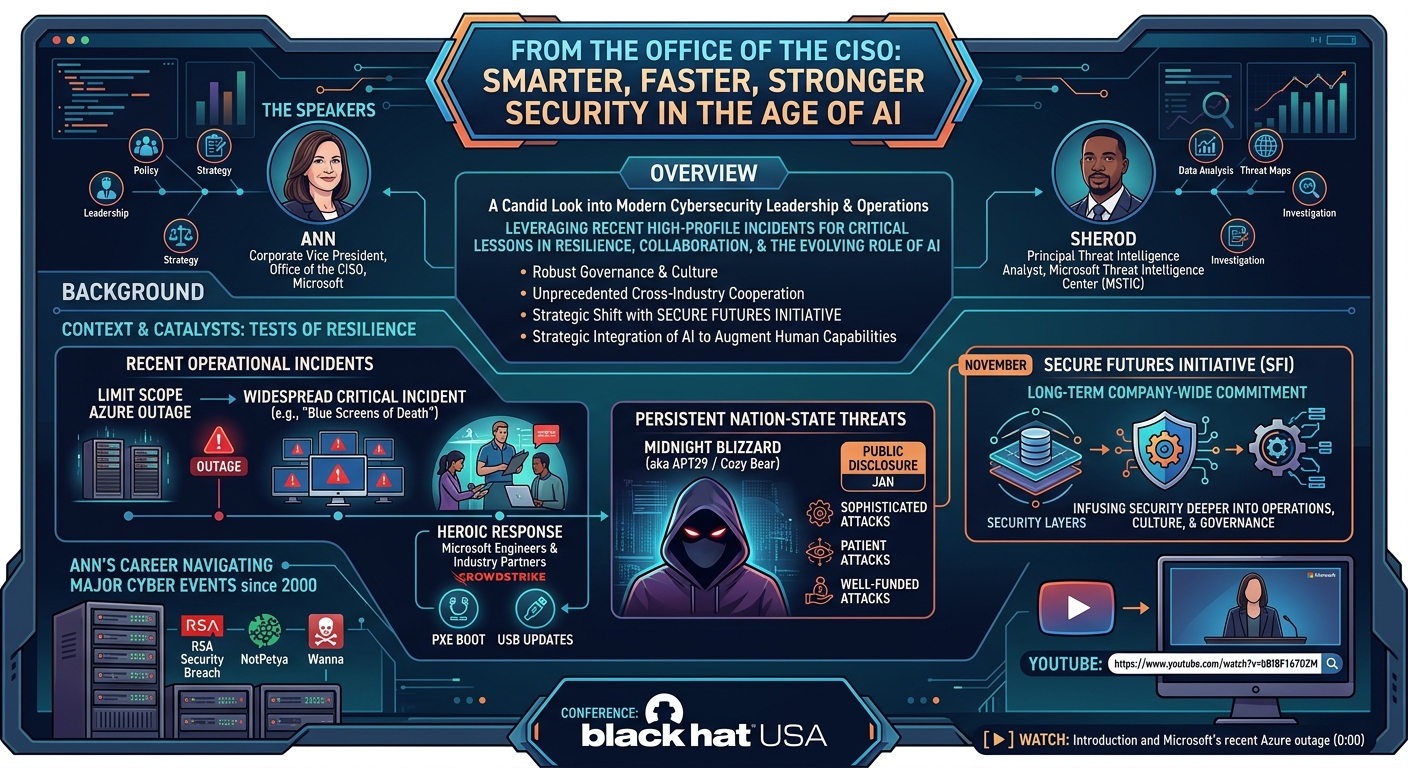
This Black Hat USA keynote, delivered by Ann from Microsoft's Office of the CISO and Sherod from the Microsoft Threat Intelligence Center (MSTIC), offered a candid and deeply insightful look into the realities of modern cybersecurity leadership and operations. Moving beyond theoretical discussions, the speakers leveraged recent, high-profile incidents, including a significant Microsoft outage and ongoing nation-state attacks, to illustrate critical lessons in resilience, industry collaboration, and the evolving role of artificial intelligence. The talk underscored that while technical prowess remains fundamental, robust governance, a pervasive security culture, and a deep commitment to the well-being of cybersecurity defenders are equally, if not more, vital in an increasingly complex threat landscape.
Key moments
- 0:00 Introduction and Microsoft's recent Azure outage
- 2:00 Microsoft's leadership and industry collaboration during outage
- 3:50 Reflections on cyber resilience, community, and winning together
- 5:55 Persistent nation-state actors and the Midnight Blizzard attack
- 6:10 Secure Futures Initiative: culture, governance, and technical defense
From the Office of the CISO: Smarter, Faster, Stronger Security in the Age of AI
Speakers: Ann, Corporate Vice President, Office of the CISO, Microsoft; Sherod, Principal Threat Intelligence Analyst, Microsoft Threat Intelligence Center (MSTIC)
Conference: Black Hat USA
YouTube: https://www.youtube.com/watch?v=bBf8F167DZM
Overview
This Black Hat USA keynote, delivered by Ann from Microsoft's Office of the CISO and Sherod from the Microsoft Threat Intelligence Center (MSTIC), offered a candid and deeply insightful look into the realities of modern cybersecurity leadership and operations. Moving beyond theoretical discussions, the speakers leveraged recent, high-profile incidents, including a significant Microsoft outage and ongoing nation-state attacks, to illustrate critical lessons in resilience, industry collaboration, and the evolving role of artificial intelligence. The talk underscored that while technical prowess remains fundamental, robust governance, a pervasive security culture, and a deep commitment to the well-being of cybersecurity defenders are equally, if not more, vital in an increasingly complex threat landscape.
The presentation provided a rare glimpse into Microsoft's internal response mechanisms during major incidents, highlighting the unprecedented cross-industry cooperation required to restore critical services. It also detailed Microsoft's proactive strategic shifts, such as the Secure Futures Initiative and the implementation of a distributed CISO model, designed to harden defenses against sophisticated adversaries like Midnight Blizzard. Ultimately, the talk served as a powerful call to action for the security community, advocating for collective defense, the strategic integration of AI to augment human capabilities, and a renewed focus on celebrating and supporting the dedicated professionals on the front lines of cyber defense.
Background
▶ Watch: Introduction and Microsoft's recent Azure outage (0:00)
The discussion was framed by two recent, impactful events that tested Microsoft's resilience and operational security. The first was an un-named, limited-scope Azure outage in one US region that occurred one night, which was quickly remediated. However, this was swiftly followed by a more critical incident around 1:00 AM, where customers began reporting widespread "blue screens of death," indicating a much broader and more severe system compromise or failure. This event, though not explicitly detailed in its root cause, served as a stark reminder of the cascading effects of operational disruptions and the urgency required in incident response. The speakers praised the heroic efforts of Microsoft engineers and cross-industry partners like Crowdstrike in rallying to restore services, even resorting to "old-is-new-again" recovery methods like PXE boot and USB-based updates for systems that were otherwise unreachable.
Complementing this operational challenge, the talk also delved into the persistent threat posed by nation-state actors, specifically mentioning the Midnight Blizzard actor (also known as APT29 or Cozy Bear), whose activities against Microsoft were publicly disclosed in January. This ongoing campaign highlighted the sophisticated, well-funded, and patient nature of modern adversaries, emphasizing that technical defenses alone are insufficient. In response to such relentless threats, Microsoft announced its Secure Futures Initiative (SFI) in November of the preceding year. This long-term, company-wide commitment represents a fundamental shift towards infusing security deeper into every aspect of Microsoft's operations, culture, and governance, recognizing that a holistic approach is essential to counter the evolving threat landscape. The speakers, particularly Ann, drew upon extensive personal experience, having navigated major cyber events since 2000, including the RSA security breach, NotPetya, WannaCry, and SolarWinds, to underscore the historical context and escalating severity of contemporary cyber challenges.
Key Findings
▶ Watch: Microsoft's leadership and industry collaboration during outage (2:00)
The talk articulated several pivotal findings that transcend Microsoft's specific experiences, offering universal lessons for the cybersecurity industry:
- Cybersecurity is a Big Data Problem: With the sheer volume of threat intelligence and operational data generated daily, effective defense requires advanced analytical capabilities. The speakers emphasized that cybersecurity is fundamentally a "big data problem," necessitating the hiring of data scientists to reason over this vast information and extract actionable insights.
- Culture and Governance are Paramount: Beyond technical controls, a strong security culture infused throughout the entire organization and robust governance models are critical for resilience. Microsoft's Secure Futures Initiative reflects this, rolling out cybersecurity as a core priority tied to employee compensation and annual reviews, alongside the establishment of Deputy CISOs for every product line.
- Industry Collaboration is Non-Negotiable: During major incidents, competitive boundaries must dissolve. The speakers highlighted the powerful example of Microsoft and Crowdstrike working together seamlessly to restore customer operations, demonstrating that collective defense is the most effective strategy against shared adversaries.
- AI Augments Defenders, Reduces Burnout: Artificial intelligence is not merely a buzzword but a vital tool to help defenders discern signal from noise in threat intelligence, improve efficiency, and enhance effectiveness. Crucially, AI's role extends to improving the mental health of cyber defenders by automating mundane tasks and reducing the overwhelming burden of constant vigilance, thereby allowing for necessary downtime.
- Proactive Defense and Raising the Cost of Attack: The industry needs to shift from reactive defense to proactive strategies. This involves actively "making threat actors' lives worse every day" and "raising the cost of attack," a concept championed by figures like Jonathan Trool, CISO at Qualys. This proactive stance is facilitated by improved threat intelligence sharing and AI-driven analysis.
- Celebrate the Defenders: A core philosophy advocated by the speakers is to elevate and celebrate the work of cyber defenders rather than glorifying threat actors. Focusing on the resilience and dedication of those protecting systems fosters a positive and motivating environment for the security community.
Technical Deep Dive
▶ Watch: Reflections on cyber resilience, community, and winning together (3:50)
The technical depth of the talk focused less on specific vulnerabilities or exploits and more on the architectural, operational, and strategic approaches to managing security at scale within a global technology giant like Microsoft, particularly in the face of sophisticated threats.
During the critical incident involving widespread "blue screens of death" following an Azure outage, Microsoft's engineering teams engaged in extraordinary recovery efforts. Ann detailed how hundreds of engineers were surged to address the crisis, working around the clock in shifts. The recovery involved writing specialized code to enable system updates via USB drives and, notably, leveraging PXE boot (Preboot Execution Environment) for machines that could not be updated by other means. This reliance on fundamental, "old-school" network boot protocols underscored the need for resilient, low-level recovery mechanisms when modern systems fail catastrophically. The ability to rapidly develop and deploy these bespoke recovery tools for a massive global footprint highlights a significant operational capability.
Microsoft's strategic response to persistent threats like Midnight Blizzard is embodied in the Secure Futures Initiative (SFI). This long-term endeavor involves 34,000 engineers working full-time, dedicating significant resources to hardening systems across the entire Microsoft ecosystem. SFI is not merely a project but a fundamental shift in engineering culture, embedding security deeply into the development lifecycle and operational practices.
A key element of this strategic shift is the revamped governance model, which includes the appointment of Deputy CISOs for every major product line—including Azure, Office, Identity, and AI. These Deputy CISOs are responsible for identifying the top risks within their specific domains and driving the technical teams to implement necessary fixes. They report directly to Microsoft's CISO (implied to be Igor), to CEO Satya Nadella, and ultimately to the Microsoft board, ensuring accountability and executive-level visibility into security posture. This distributed CISO model acknowledges the immense complexity of modern cybersecurity, where, as highlighted, Gartner covers 60-70 distinct domains. No single individual can possess expertise across all these areas, making a specialized, domain-focused approach essential.
Sherod's role at the Microsoft Threat Intelligence Center (MSTIC) provides further insight into the technical underpinnings of proactive defense. MSTIC comprises a diverse team of threat intelligence analysts, language experts, malware reverse engineers, and threat hunters. Their primary mission is to understand the tactics, techniques, and procedures (TTPs) of threat actors. When MSTIC analysts identify new threat actor activity, they collaborate directly with Microsoft's defender engineering and detection teams. This seamless integration ensures that newly discovered threats are rapidly translated into actionable detections and pushed out across Microsoft's massive global footprint, protecting both Microsoft's infrastructure and its customers. This intelligence is also shared with customers and governments, contributing to a broader collective defense.
Furthermore, Sherod described teaching workshops to Microsoft's software engineers, a critical initiative to bridge the gap between development and threat intelligence. These workshops cover fundamental concepts such as attribution (identifying who is behind an attack), atomic indicators (specific, undeniable pieces of evidence of compromise), analyzing malicious network traffic, understanding and reverse engineering malware, and differentiating between nation-state and cybercrime motivations. This educational effort is vital for integrating a security mindset directly into the software development process, ensuring that engineers build more resilient products from the ground up, moving beyond just a "briefing" to a deep understanding of the adversary.
Finally, the talk emphasized the practical application of Artificial Intelligence (AI) in enhancing these technical and operational capabilities. AI is crucial for processing the overwhelming volume of threat intelligence data, enabling defenders to better discern genuine "signal" from "noise." This allows for faster identification of critical threats and more efficient allocation of human resources. The speakers noted that AI's ability to automate initial analysis and correlation of data is paramount for moving towards a more proactive defense posture, where potential threats can be identified and mitigated before they fully materialize.
Demo / Proof of Concept
▶ Watch: Persistent nation-state actors and the Midnight Blizzard attack (5:55)
This talk did not feature a live demonstration or a specific proof of concept. Instead, it focused on strategic insights, operational responses to real-world incidents, and Microsoft's overarching security initiatives.
Defensive Implications
▶ Watch: Secure Futures Initiative: culture, governance, and technical defense (6:10)
The insights shared by Ann and Sherod offer concrete, actionable implications for security practitioners and organizational leaders seeking to enhance their defensive posture in the age of AI and persistent threats:
- Prioritize Cross-Industry Collaboration: Defenders must actively foster relationships and information-sharing channels with both allies and even competitors. The Microsoft-Crowdstrike collaboration during a critical incident serves as a powerful testament to the effectiveness of collective defense in overcoming shared adversaries. Organizations should explore formal and informal intelligence-sharing groups to enhance situational awareness.
- Implement Robust, Distributed Governance Models: A centralized CISO model may no longer be sufficient for complex enterprises. Organizations should consider adopting a distributed governance structure, akin to Microsoft's Deputy CISO model, where cybersecurity leadership and accountability are embedded within specific product lines, business units, or technology domains. This ensures specialized expertise addresses localized risks while maintaining overall strategic alignment.
- Integrate Security into Organizational Culture and Performance: Cybersecurity must be a core priority for every employee, not just the security team. Leaders should follow Microsoft's example by tying security responsibilities to employee compensation and performance reviews, implementing mandatory, continuously updated training, and tailoring expectations based on roles (e.g., engineering, sales, marketing). This cultivates a pervasive security-first mindset.
- Invest in Threat Intelligence and Engineer Education: Organizations need dedicated threat intelligence capabilities to understand adversary TTPs. Crucially, this intelligence must be actively disseminated and translated for technical teams, particularly software engineers. Workshops focusing on attribution, atomic indicators, malware analysis, and the nuances of nation-state versus cybercrime threats can empower developers to build more secure systems by design.
- Strategically Leverage AI for Defender Augmentation: AI is not a replacement for human defenders but a force multiplier. Defenders should explore and implement AI-driven tools to process vast amounts of data, discern signal from noise in threat intelligence, automate routine tasks, and enhance detection capabilities. This enables human analysts to focus on complex problem-solving and strategic decision-making.
- Shift Towards Proactive Defense and Raising Attack Costs: Move beyond purely reactive incident response. Organizations should actively work to "raise the cost of attack" for adversaries by implementing strong preventative controls, rapidly deploying detections based on shared intelligence, and making their environments increasingly difficult and expensive for attackers to compromise and maintain persistence.
- Prioritize Defender Well-being and Mental Health: The demanding nature of cybersecurity takes a significant toll on practitioners. Leaders have a responsibility to recognize and mitigate burnout. Implementing technologies that reduce manual burdens, encouraging mandatory time off during intense incidents, and providing mental health support are crucial for sustaining the long-term effectiveness and resilience of security teams.
- Cultivate a "Defenders First" Philosophy: Foster an internal and external culture that celebrates the work and dedication of cybersecurity defenders. By elevating defenders and focusing on their successes, organizations can boost morale, attract talent, and reinforce the critical importance of their mission, rather than inadvertently glorifying adversaries.
Key Takeaways
- Collective Defense is Essential: During major cyber incidents, industry collaboration, even among competitors, is paramount for rapid recovery and resilience.
- Security is a Big Data Problem: Effective cybersecurity requires specialized data scientists to analyze vast amounts of threat intelligence and operational data.
- Culture and Governance Drive Security: Beyond technical controls, a strong, company-wide security culture and a distributed governance model (e.g., Deputy CISOs) are critical for robust defense.
- AI Augments Human Defenders: Artificial intelligence plays a vital role in processing threat intelligence, improving efficiency, enabling proactive defense, and enhancing the mental well-being of security teams.
- Invest in Defender Education and Well-being: Bridging the knowledge gap between threat intelligence and engineering teams, alongside prioritizing the mental health of defenders, is crucial for sustained operational effectiveness.
- Focus on Raising the Cost of Attack: Proactive strategies aimed at making adversaries' operations more difficult and expensive are key to shifting the balance of power in cybersecurity.
About the Speaker(s)
Ann serves as a Corporate Vice President within the Office of the CISO at Microsoft. With a distinguished career in cybersecurity spanning since 2000, she brings extensive experience in navigating major industry-defining incidents, including the RSA security breach, NotPetya, WannaCry, and SolarWinds. Her role involves strategic leadership, focusing on customer recovery, fostering industry collaboration, and driving Microsoft's overarching security initiatives like the Secure Futures Initiative. She champions the importance of governance, culture, and the well-being of the defender community.
Sherod is a Principal Threat Intelligence Analyst at the Microsoft Threat Intelligence Center (MSTIC). She specializes in understanding and tracking the activities of various threat actors, with a particular focus on cybercrime. Sherod's work involves analyzing threat landscapes, collaborating with engineering teams to develop and deploy detections, and sharing vital intelligence with customers and governments. She is also instrumental in educating Microsoft's software engineers on threat intelligence fundamentals, helping them understand adversary tactics and build more secure products.