Main Stage: Understanding and Reducing Supply Chain and Software Vulnerability Risks
Unknown
Black Hat USA 2024 · Day 1 · Briefing
Overview
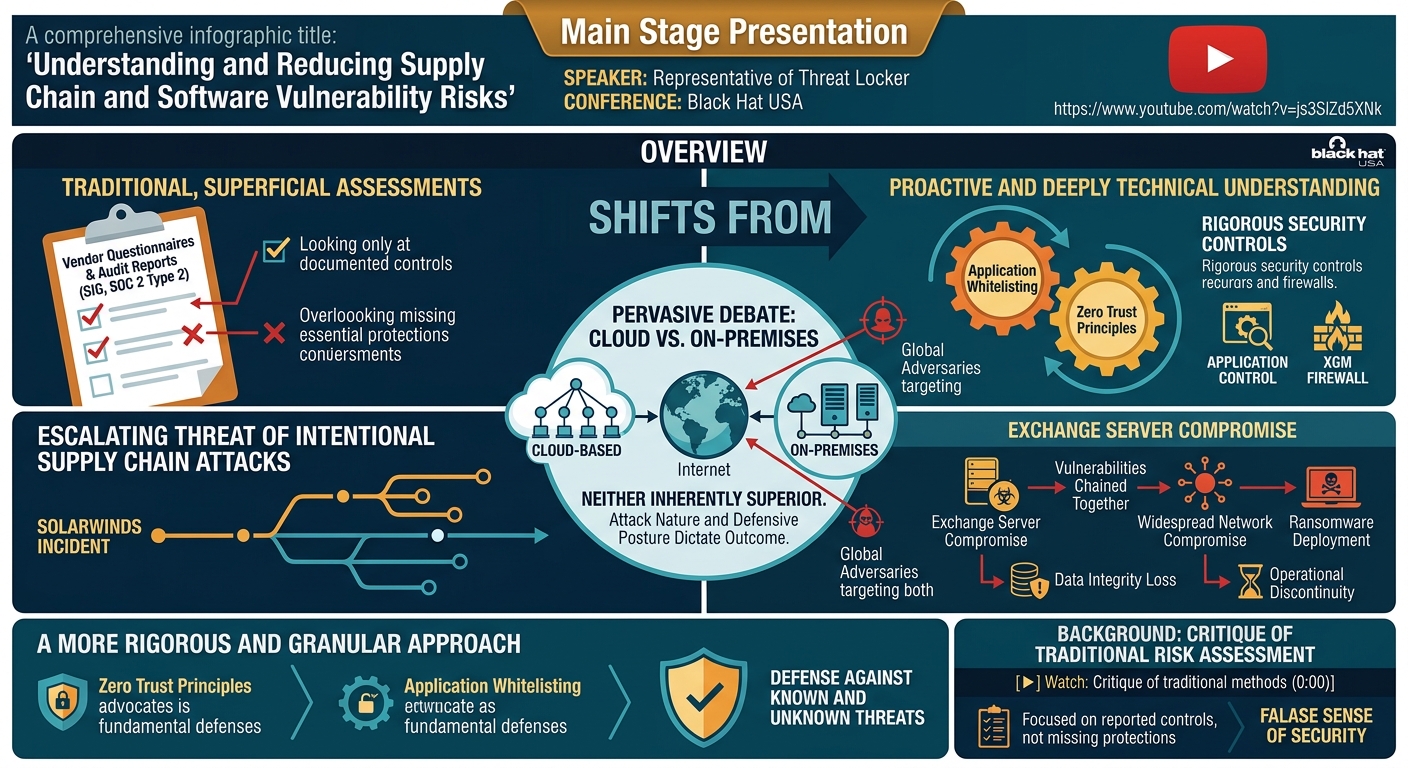
This talk delves into the multifaceted challenges of supply chain and software vulnerability risks, urging a shift from conventional, often superficial, security assessments to a more proactive and deeply technical understanding. Presented by a representative of Threat Locker, the discussion moves beyond the typical vendor questionnaires and audit reports, which frequently overlook critical vulnerabilities by focusing solely on documented controls rather than the absence of essential protections. The speaker critically examines the pervasive debate between cloud versus on-premises security, illustrating that neither deployment model inherently guarantees superior protection, but rather the nature of the attack and the organization's defensive posture dictate the outcome.
Key moments
- 0:00 Critique of traditional supply chain risk assessment methods
- 1:59 Audience poll: cloud vs. on-premise security perceptions
- 2:20 Case study: on-premise Exchange server vulnerability explained
- 4:50 Devastating impact: ransomware encrypts every device in hours
- 5:58 Cloud's potential for containing specific data breaches
- 6:20 SolarWinds Orion: a major software supply chain attack
Main Stage: Understanding and Reducing Supply Chain and Software Vulnerability Risks
Speakers: Representative of Threat Locker
Conference: Black Hat USA
YouTube: https://www.youtube.com/watch?v=js3SiZd5XNk
Overview
This talk delves into the multifaceted challenges of supply chain and software vulnerability risks, urging a shift from conventional, often superficial, security assessments to a more proactive and deeply technical understanding. Presented by a representative of Threat Locker, the discussion moves beyond the typical vendor questionnaires and audit reports, which frequently overlook critical vulnerabilities by focusing solely on documented controls rather than the absence of essential protections. The speaker critically examines the pervasive debate between cloud versus on-premises security, illustrating that neither deployment model inherently guarantees superior protection, but rather the nature of the attack and the organization's defensive posture dictate the outcome.
The core of the presentation emphasizes the escalating threat of intentional supply chain attacks, exemplified by high-profile incidents like SolarWinds. By dissecting specific attack vectors, such as a sophisticated Exchange server compromise, the speaker highlights how vulnerabilities in widely used software can be chained together to achieve widespread network compromise, even leading to ransomware deployment across an entire enterprise. This detailed exploration serves to underscore the profound impact these attacks can have, not just on data integrity but on an organization's operational continuity.
Ultimately, the talk advocates for a more rigorous and granular approach to cybersecurity, one that prioritizes Zero Trust principles and application whitelisting as fundamental defenses against both known and unknown threats. It aims to reframe the perception of risk, moving away from a primary fear of accidental breaches towards a sober recognition of the strategic and devastating potential of adversaries intentionally embedding malicious code within trusted software. This perspective is vital for security professionals seeking to build resilient systems in an increasingly interconnected and hostile digital landscape.
Background
▶ Watch: Critique of traditional supply chain risk assessment methods (0:00)
The traditional approach to managing supply chain risk, as highlighted by the speaker, often revolves around standardized assessments like SIG questionnaires and SOC 2 Type 2 reports. While these instruments provide a structured framework for evaluating vendor security posture, their inherent limitations can create a false sense of security. Organizations typically review these reports, noting any exceptions or control failures, and then decide to accept, reject, or transfer the identified risks. However, a critical flaw in this process is its focus on what is documented and reported, rather than what is missing. For instance, a report might confirm that 546 out of 550 employees completed cybersecurity training, but it typically doesn't specify whether the vendor implements crucial controls like application control or uses an XGM firewall. This oversight means that significant security gaps, pertaining to fundamental architectural and operational safeguards, can go unnoticed, leaving organizations exposed to sophisticated attacks.
The discourse also touches upon the ongoing debate regarding the security merits of cloud versus on-premises deployments. Many perceive cloud environments as inherently more secure due to the substantial resources and expertise of major cloud providers. Conversely, others advocate for on-premises solutions, believing they offer greater control and isolation. The speaker argues that the cloud is "just another network" exposed to the internet, making services visible to global adversaries. However, the critical distinction lies in the potential blast radius of a successful attack. While an on-premises compromise, such as a vulnerable Exchange server, can lead to the infection of an entire internal network, a similar vulnerability in a cloud-hosted service might contain the damage to that specific cloud segment, isolating it from the broader organizational infrastructure. This nuance reveals that the security advantage of either model is not absolute but contingent on specific attack vectors and the architectural separation of systems.
The underlying problem that enables supply chain vulnerabilities is the inherent trust placed in third-party software and services. When an organization integrates a new product, whether cloud-based or on-premises, it implicitly extends its trust boundaries to include the vendor's development practices, security controls, and operational integrity. This extended trust becomes a critical attack surface, as malicious actors can exploit weaknesses not directly within the organization's own infrastructure, but within the software it consumes, as dramatically demonstrated by the SolarWinds incident. This sets the stage for understanding why intentional, embedded malware represents a particularly insidious and feared form of supply chain attack.
Key Findings
▶ Watch: Case study: on-premise Exchange server vulnerability explained (2:20)
The talk presents several key findings and arguments that challenge conventional wisdom in cybersecurity, particularly concerning supply chain risk and deployment models:
- Limitations of Standardized Security Assessments: The speaker asserts that common compliance frameworks and vendor questionnaires, such as SIG and SOC 2 Type 2, are often "self-fulfilling" and inadequate for truly assessing risk. Their primary flaw is their focus on confirming the existence of stated controls rather than identifying the absence of critical, unmentioned security measures like application control or advanced firewalls. This creates blind spots where significant vulnerabilities can persist undetected, despite a vendor appearing "compliant."
- Nuanced Perspective on Cloud vs. On-Premise Security: Contrary to popular dichotomies, neither cloud nor on-premises deployments are inherently more secure. The speaker illustrates that while cloud services are exposed to the global internet, a breach in an on-premises system can have a far greater blast radius, potentially compromising an entire internal network. The example of the Exchange server vulnerability shows how an on-premise exploit can spread ransomware across all devices, whereas a similar cloud-based compromise might be contained to specific mailboxes or data sets, assuming proper architectural separation. The key is understanding the containment capabilities and interconnectivity of each environment.
- The Insidious Nature of Intentional Supply Chain Attacks: The talk identifies intentional attacks as the "biggest fear" in supply chain risk, citing incidents like SolarWinds. Unlike accidental vulnerabilities, intentional compromises involve adversaries deliberately injecting malicious code into trusted software during its development or distribution. This leverages the inherent trust organizations place in their software vendors, allowing malware to bypass initial defenses and establish deep persistence. The psychological impact of such "violation" further amplifies this fear, making it a critical focus for boards and security leaders.
- Chaining Vulnerabilities for Widespread Impact: The detailed breakdown of the Exchange server attack demonstrates how seemingly isolated vulnerabilities can be chained together. Exploiting a remote code execution flaw, manipulating the Offline Address Book (OAB) URL, and then leveraging administrator login scripts and Group Policy Objects (GPOs) allows for a complete takeover and widespread ransomware deployment across an entire Active Directory domain. This highlights the importance of understanding not just individual vulnerabilities but their potential for lateral movement and privilege escalation within an interconnected system.
- The Power of Application Control: A crucial finding, demonstrated by the Exchange server scenario, is the effectiveness of application control or whitelisting. In the described incident, the
sstart.batfile, central to the ransomware deployment, was blocked because it was not on an allow list. This single control prevented an entire organization from falling victim to a catastrophic ransomware attack, underscoring its potential as a fundamental and highly effective defensive mechanism against unknown and polymorphic threats.
Technical Deep Dive
▶ Watch: Devastating impact: ransomware encrypts every device in hours (4:50)
The talk provides a granular technical analysis of two distinct, yet equally critical, supply chain attack vectors: a sophisticated compromise of an on-premises Microsoft Exchange server and the notorious SolarWinds Orion breach. These examples serve to illustrate the mechanisms, impact, and defensive implications of modern supply chain threats.
Exchange Server Remote Code Execution and Ransomware Deployment
The speaker details a real-world incident involving an on-premises Exchange server vulnerability, occurring approximately two years prior to the talk. The vulnerability specifically targeted port 443, which is commonly opened to the internet to allow users Outlook Anywhere access for email synchronization from various devices. This exposure to the internet, without strict IP address restrictions, made the server a global target.
The attack unfolded in several stages:
- Initial Exploitation: An unknown vulnerability on the Exchange server allowed for remote code execution. The specific CVEs are not mentioned, but the impact was significant.
- Offline Address Book (OAB) URL Manipulation: Attackers exploited the RCE to modify the server's Offline Address Book (OAB) URL. Initially, the speaker thought this would lead users to download malicious OABs, but the actual mechanism was more subtle and server-side.
- Server-Side File Download: When a user subsequently attempted to download their OAB, the compromised Exchange server was instructed by the manipulated URL to download an arbitrary file from an external source and save it to a specific location on the server. This established a critical foothold.
- Persistence and Staging with
sstart.bat: Two weeks after the initial compromise and file download, an administrator logged into the server. The downloaded file, namedsstart.bat, had been placed in the administrator's login script directory, ensuring its execution upon the next administrative login. - Multi-Stage Payload Delivery: The
sstart.batscript initiated a complex, multi-stage payload delivery:
- It first downloaded a PowerShell script.
- This PowerShell script then downloaded another PowerShell script, which was Base64 encoded. The speaker noted this encoding was likely "for no apparent reason other than maybe it's harder to detect as bad," highlighting a common obfuscation technique.
- The Base64-encoded PowerShell script then downloaded an executable file.
- Widespread Ransomware Deployment via GPO: Finally, the executable created a Group Policy Object (GPO) within the organization's Active Directory domain. This GPO was configured to push the malicious executable to "every device in the organization," including servers, laptops, and desktops.
In the described customer's case, the sstart.bat file was blocked by an application control solution, preventing the entire chain of events. However, the speaker's team replicated this exact scenario in a lab environment, building an Active Directory domain with laptops, desktops, backup servers, and an Exchange server. Within a mere two hours of executing the initial steps, every single device in the replicated environment was infected with ransomware, displaying a red screen indicating encrypted files. This demonstration powerfully illustrated the speed and devastating impact of such a chained attack.
SolarWinds Orion Compromise
The SolarWinds Orion attack, a prime example of an intentional supply chain compromise, is presented as a significant concern, particularly due to its stealth and broad impact.
- Initial Access and Test Injection (October 2019): Threat actors gained access to SolarWinds' internal systems. In October 2019, they performed a "test code injection" into the SolarWinds Orion platform's codebase. This was a crucial reconnaissance step to determine if their malicious code could be introduced without detection by SolarWinds' internal development and quality assurance (QA) processes. The test was successful.
- Malicious Code Injection (February 2020): Following the successful test, in February 2020, the attackers injected the full malicious code, later dubbed SUNBURST, into the legitimate SolarWinds Orion software. This code was designed with a "three-week timer," meaning it remained dormant for three weeks after deployment. This delay allowed the compromised software to pass through SolarWinds' QA, be signed with legitimate certificates, and be distributed to customers as a trusted update, without immediate malicious activity.
- Widespread Distribution and Dormancy: SolarWinds pushed out the compromised updates to thousands of customers, including government agencies and major corporations. The three-week timer ensured that the malware was deeply embedded and widely distributed before it activated.
- Activation and Command & Control: Once activated, the malicious code in the Orion software would reach out to the internet to receive instructions from Command and Control (C2) servers. It was designed to exfiltrate data, create backdoors, and execute arbitrary commands.
- Unknown Full Extent of Damage: A key technical aspect highlighted is that "nobody really knows what it did" in its entirety across all compromised environments. Because the malware was designed to receive instructions and could perform "anything," the specific actions varied by target. This uncertainty led to widespread paranoia among affected organizations, particularly regarding data exfiltration.
The SolarWinds incident underscores the danger of trusting software updates, even from reputable vendors, when the vendor's own development pipeline has been compromised. The ability of attackers to inject code, bypass QA, and distribute it widely before activation represents a sophisticated and highly effective supply chain attack methodology.
Demo / Proof of Concept
▶ Watch: Cloud's potential for containing specific data breaches (5:58)
While the talk itself did not feature a live, real-time demonstration, the speaker vividly described a crucial proof of concept conducted by their team. This replication served as a powerful validation of the severe implications of the Exchange server vulnerability chain discussed earlier.
The team meticulously recreated an enterprise environment, establishing a full Active Directory domain complete with essential infrastructure components such as an Exchange server, backup servers, and a range of end-user devices including laptops and desktops. This setup was designed to mirror a typical organizational network, allowing for a realistic assessment of the attack's potential.
Following the exact steps identified in the real-world incident – from the initial exploitation of the Exchange server, the manipulation of the Offline Address Book (OAB) URL, to the subsequent execution of the sstart.bat file and its multi-stage payload delivery – the team observed the attack unfold. The results were stark and immediate: within two hours of initiating the attack sequence, every single device within the replicated domain, including critical servers and user workstations, had been successfully infected with ransomware. The screen of each device displayed the characteristic red message, indicating that files had been encrypted.
This simulated attack served as a critical demonstration, transforming theoretical vulnerability into a tangible, high-impact scenario. It highlighted several key aspects:
- Speed of Compromise: The rapid propagation of ransomware across an entire network (two hours) underscores the limited window defenders often have to detect and respond to such threats.
- Blast Radius: The complete compromise of all devices, from servers to endpoints, illustrates the potential for a single entry point to devastate an entire IT infrastructure when lateral movement and privilege escalation are successful.
- Effectiveness of Chained Exploits: It validated how combining a server-side vulnerability with administrative login scripts and Group Policy Objects (GPOs) can achieve maximum impact.
- The Criticality of Application Control: The speaker's emphasis on the customer's actual outcome—where the
sstart.batfile was blocked by an application control solution—implicitly served as a contrasting "negative proof," demonstrating that effective controls can indeed halt even sophisticated, multi-stage attacks.
Although not a live demonstration during the conference, this detailed recounting of a successful, controlled replication provided compelling evidence for the talk's core arguments regarding supply chain risk and the necessity of robust defensive measures.
Defensive Implications
▶ Watch: SolarWinds Orion: a major software supply chain attack (6:20)
The insights gleaned from this talk offer critical defensive implications for organizations aiming to fortify their cybersecurity posture against both known and emerging supply chain threats. The speaker's analysis moves beyond superficial compliance, advocating for deeper, more effective security strategies.
- Rethink Supply Chain Risk Assessment: Organizations must move beyond merely reviewing vendor SIG questionnaires and SOC 2 Type 2 reports. Instead of focusing solely on documented controls, security teams should actively look for what is missing in these reports. This includes inquiring about fundamental security controls like application control (whitelisting), Next-Generation Firewall (XGM) deployments, and robust Endpoint Detection and Response (EDR) capabilities. A lack of these foundational elements, even if not explicitly required by a standard, indicates significant risk.
- Implement Strong Application Control/Whitelisting: The Exchange server ransomware incident serves as a stark testament to the power of application control. The fact that
sstart.batwas blocked because it wasn't on an allow list highlights that preventing unauthorized executables from running can be a single point of failure for sophisticated multi-stage attacks. Organizations should implement strict application whitelisting on all endpoints and servers, allowing only known, trusted applications to execute. This significantly reduces the attack surface for malware, even zero-day exploits.
- Embrace Zero Trust Principles: The speaker mentions Threat Locker's Zero Trust Endpoint Protection Platform, reinforcing the necessity of a Zero Trust architecture. This means explicitly verifying everything and trusting nothing by default, regardless of whether it's inside or outside the network perimeter. For endpoints, this translates directly to application whitelisting and least privilege access. For network segmentation, it means micro-segmentation and strict access controls between different network zones, limiting lateral movement.
- Understand and Mitigate Blast Radius: When considering cloud versus on-premises deployments, the focus should shift to understanding and mitigating the potential blast radius of a compromise. While cloud services are internet-facing, proper architectural design, including strong segmentation and identity and access management (IAM), can help contain breaches to specific services or datasets, preventing them from impacting the entire enterprise. For on-premises systems, robust internal network segmentation, isolating critical assets (like Active Directory and Exchange servers), and implementing strong egress filtering are paramount to prevent widespread infection from a single point of entry.
- Fortify Against Intentional Compromise: The SolarWinds incident underscores that adversaries are increasingly targeting the software supply chain itself. Defenders must assume that trusted software or updates could potentially be compromised. This necessitates:
- Secure Software Development Life Cycle (SSDLC): Encouraging vendors to adopt robust SSDLC practices, including secure coding, static/dynamic analysis, and integrity checks.
- Software Bill of Materials (SBOMs): Demanding SBOMs from vendors to understand the components within their software.
- Runtime Monitoring: Implementing advanced EDR and behavioral analytics to detect anomalous activity, even from seemingly legitimate applications, as seen with SolarWinds.
- Supply Chain Risk Management: Developing a comprehensive program that goes beyond questionnaires to include validation of vendor security practices, third-party penetration testing, and continuous monitoring.
- Layered Security and Incident Response: While specific tools like pineapples and Metasploit are mentioned in the context of ethical hacking training, the underlying message is the need for a multi-layered defense. This includes firewalls, intrusion detection/prevention systems, EDR, security awareness training, and, critically, robust backup and recovery procedures. The ransomware scenario highlights that even with "the best backups in the world," the impact of an entire network being encrypted simultaneously is catastrophic, emphasizing the need for prevention at earlier stages.
- Focus on Detection and Containment: Given the sophisticated nature of attacks like SolarWinds, which can remain dormant for extended periods, detection capabilities must evolve to identify subtle anomalies and behaviors rather than just signature-based threats. Rapid containment strategies are equally vital to prevent initial footholds from escalating into full-scale compromises.
By implementing these defensive strategies, organizations can move towards a more resilient security posture, better equipped to withstand the evolving landscape of supply chain and software vulnerability risks.
Key Takeaways
- Go Beyond Basic Compliance: Traditional security questionnaires (SIG, SOC 2) often create blind spots by focusing on what's reported rather than what critical controls are missing (e.g., application control, advanced firewalls).
- Application Control is a Critical Defense: Implementing robust application whitelisting can block even sophisticated, multi-stage attacks like the Exchange server ransomware scenario by preventing unauthorized executables from running.
- Cloud vs. On-Premise Security is Nuanced: Neither deployment model is inherently more secure; the key lies in architectural separation, containment capabilities, and understanding the potential blast radius of a breach in each environment.
- Intentional Supply Chain Attacks are a Major Threat: Adversaries are actively compromising software vendors (e.g., SolarWinds) to embed malicious code directly into trusted products, bypassing traditional perimeter defenses and leveraging implicit trust.
- Vulnerabilities Chain Together Rapidly: A single vulnerability can be chained with other weaknesses (e.g., OAB manipulation, admin login scripts, GPOs) to achieve widespread network compromise and ransomware deployment within hours.
- Embrace Zero Trust Principles: A Zero Trust approach, including explicit verification and least privilege, is essential for mitigating risks from both internal and external threats, regardless of their origin.
About the Speaker(s)
The talk was delivered by a representative of Threat Locker, a company specializing in Zero Trust Endpoint Protection Platforms. The speaker shared insights drawn from their personal experience, stating, "I did about four years as an ethical hacker, my job was to bypass antivirus and EDR." This background provides a unique perspective on attacker methodologies and effective defensive strategies. The speaker's affiliation with Threat Locker is further evident through mentions of the company's offerings, follow-up presentations on malware campaigns, and invitations to their booth and training events, including a technical conference in Orlando, Florida, featuring hands-on labs with tools like pineapples and Metasploit. While the specific name of the speaker is not provided in the metadata or transcript, their expertise is clearly rooted in practical cybersecurity offense and defense, emphasizing the importance of understanding attacker tactics to build more resilient systems.