Locked Down but Not Out: Fighting the Hidden War in Your Bootloader
Unknown
Black Hat USA 2024 · Day 1 · Briefing
Overview
In this insightful Black Hat USA presentation, Bill Demirkapa, Emerging Threats Lead at the Microsoft Security Response Center, shed light on the critical state of Secure Boot security. The talk, titled "Locked Down but Not Out: Fighting the Hidden War in Your Bootloader," delved into the intricacies of the Unified Extensible Firmware Interface (UEFI) Secure Boot mechanism, Microsoft's ongoing efforts to enhance its security, and the significant challenges that necessitate a fundamental re-evaluation of its architecture. Demirkapa, leveraging his background in cloud security and low-level OS internals, emphasized that while Secure Boot is a vital security feature, it faces systemic issues that leave boot environments vulnerable to sophisticated attackers.
Key moments
- 0:30 Introduction to Secure Boot and UEFI benefits
- 2:00 How Secure Boot defines trust with variables
- 3:00 DBX: Revoking trust of vulnerable images
- 4:00 Understanding Secure Boot's threat model
- 5:30 Firmware challenges: decentralized updates, shared vulnerabilities
- 7:00 Recommendations for organizational security
- 7:40 Final thoughts: Secure Boot requires an overhaul
Locked Down but Not Out: Fighting the Hidden War in Your Bootloader
Speakers: Bill Demirkapa, Emerging Threats Lead, Microsoft Security Response Center
Conference: Black Hat USA
YouTube: https://www.youtube.com/watch?v=pfr_sb4fyrI
Overview
In this insightful Black Hat USA presentation, Bill Demirkapa, Emerging Threats Lead at the Microsoft Security Response Center, shed light on the critical state of Secure Boot security. The talk, titled "Locked Down but Not Out: Fighting the Hidden War in Your Bootloader," delved into the intricacies of the Unified Extensible Firmware Interface (UEFI) Secure Boot mechanism, Microsoft's ongoing efforts to enhance its security, and the significant challenges that necessitate a fundamental re-evaluation of its architecture. Demirkapa, leveraging his background in cloud security and low-level OS internals, emphasized that while Secure Boot is a vital security feature, it faces systemic issues that leave boot environments vulnerable to sophisticated attackers.
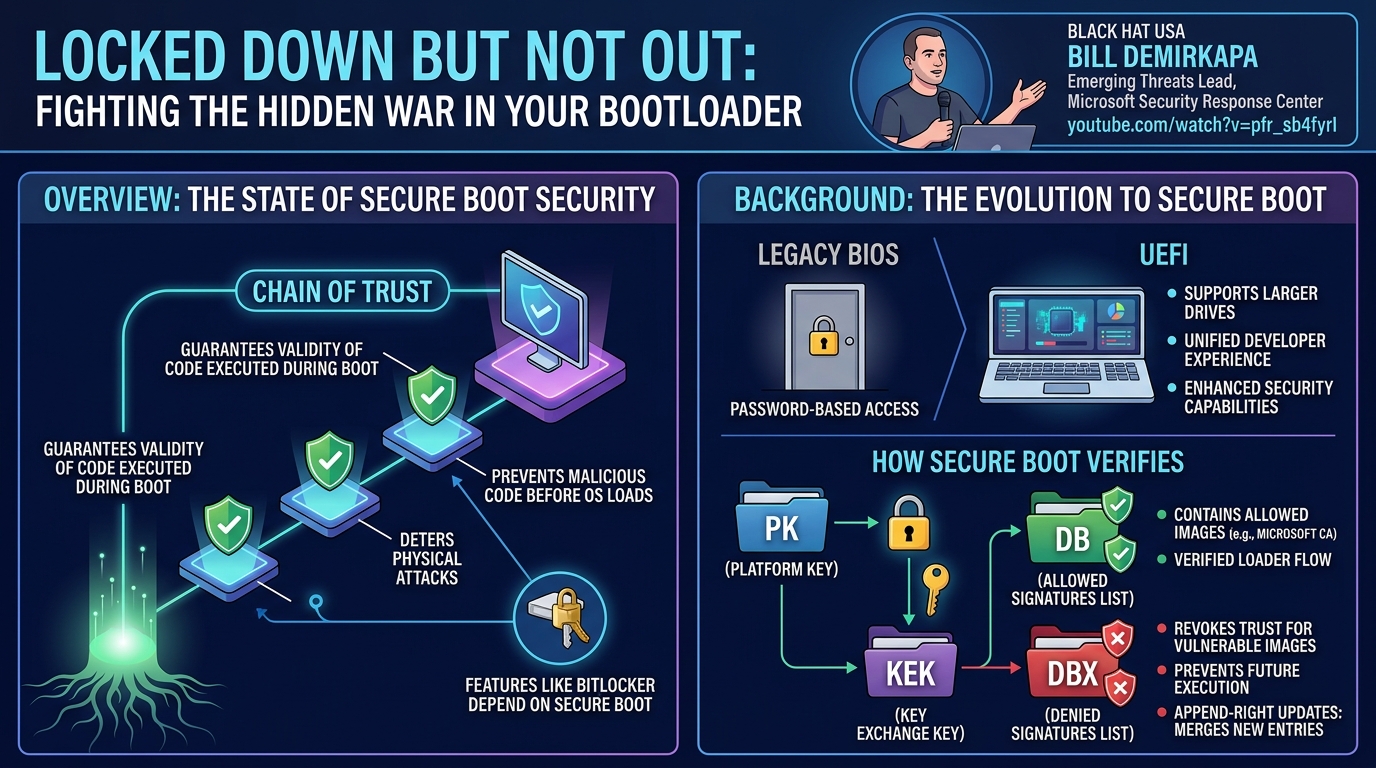
The presentation underscored why Secure Boot is indispensable in modern computing. It forms the foundational chain of trust that guarantees the validity of code executed during the boot process, substantially deterring physical attacks and preventing malicious code from executing before the operating system even loads. Features like BitLocker, for example, are intrinsically linked to Secure Boot for their integrity. However, Demirkapa argued that the current implementation and ecosystem surrounding Secure Boot are akin to a system that "ties our hands behind our back," necessitating an industry-wide overhaul to remain defensible against evolving threats.
Background
▶ Watch: Introduction to Secure Boot and UEFI benefits (0:30)
The journey to Secure Boot began with the advent of UEFI, which succeeded the legacy BIOS as an industry standard for firmware interfaces. UEFI brought numerous advantages, including support for larger drives, a unified developer experience, and significantly enhanced security capabilities. Among these, Secure Boot stands out as a pivotal feature, designed to ensure that only trusted code can execute during the boot sequence. Unlike BIOS, which primarily relied on simple password-based access control, Secure Boot introduces a robust cryptographic verification process.
The core challenge for Secure Boot is establishing and maintaining a definitive sense of trust – determining precisely "what code is allowed to load in the first place." This trust is managed through UEFI runtime variables, which facilitate interaction between the operating system and the firmware. Key among these are the signature list variables: the Platform Key (PK), the Key Exchange Key (KEK), the Allowed Signatures List (DB), and the Denied Signatures List (DBX). The DB contains cryptographic hashes or certificates of images permitted to load, typically including the Microsoft production CA and the UEFI third-party certificate authority by default. To modify the DB, a payload signed by a KEK is required, and similarly, modifying the KEK necessitates control over the PK. This hierarchical trust model forms the backbone of Secure Boot's integrity.
Crucially, Secure Boot isn't merely about allowing signed images; it's also about revoking trust when vulnerabilities emerge. The DBX, or Denied Signatures List, plays a critical role here. If a legitimately signed UEFI image contains a vulnerability, the DBX allows for its revocation, preventing its future execution and mitigating potential abuse. These signature list variables are not only authenticated but also support append-right updates. This means that instead of overwriting the entire list, new entries (such as custom revocations from an OEM or updates from Microsoft) can be merged, preserving existing configurations. Demirkapa highlighted that Secure Boot, while not a security boundary (as it includes administrators in its threat model), is an essential security feature intended for continuous servicing and protection against sophisticated boot-time attacks.
Key Findings
▶ Watch: DBX: Revoking trust of vulnerable images (3:00)
Demirkapa’s presentation brought to light several critical vulnerabilities and systemic challenges that undermine the efficacy of Secure Boot in its current form. The primary "hidden war" is waged within a highly complex and fragmented firmware ecosystem, presenting an uphill battle for defenders.
One of the most significant findings is the decentralized and fragmented nature of the UEFI firmware ecosystem. As Demirkapa explained, "everyone has their own fork," leading to a situation where a single shared codebase can harbor "a million vulnerabilities." When this vulnerable codebase is forked by numerous hardware vendors (OEMs), those vulnerabilities propagate across countless devices. The decentralized update mechanisms further exacerbate this problem, making it incredibly challenging to ensure that patches are consistently and promptly applied across the entire ecosystem. This lack of a unified supply chain creates widespread, persistent exposure for users.
Another key finding relates to disk-level vulnerabilities, emphasizing that even with Secure Boot, trust cannot be unilaterally assumed. Attackers can exploit the ability to swap out a legitimate, updated bootloader with an older, vulnerable version that might still be cryptographically signed. This "downgrade attack" capability underscores why the DBX (Denied Signatures List) is not just a beneficial feature but an absolutely critical component of Secure Boot. Without the ability to revoke trust for previously signed, yet now compromised, images, the entire chain of trust can be circumvented.
Ultimately, Demirkapa concluded that Secure Boot, despite its foundational importance, is currently operating under severe limitations. He starkly stated that the system "ties our hands behind our back" and that the industry often falls into the trap of "focusing on short-term fixes." The overarching message was that Secure Boot "needs an overhaul to remain defensible," a sentiment that highlights the urgent need for a more comprehensive and collaborative approach to bootloader security.
Technical Deep Dive
▶ Watch: Understanding Secure Boot's threat model (4:00)
The technical foundation of Secure Boot relies on a sophisticated interplay of cryptographic signatures and UEFI runtime variables. At the highest level, the Platform Key (PK) establishes the root of trust, typically controlled by the system owner or OEM. Below the PK is the Key Exchange Key (KEK), which is used to sign updates to the Allowed Signatures List (DB) and the Denied Signatures List (DBX). The DB contains the cryptographic hashes or digital certificates of trusted boot components (e.g., bootloaders, drivers, option ROMs). Conversely, the DBX holds hashes or certificates of components that are explicitly untrusted, typically those found to have vulnerabilities.
A critical aspect of these signature list variables (DB and DBX) is their authenticated, append-right update mechanism. Instead of entirely replacing the existing lists, updates are signed payloads that merge with the current entries. This design ensures that custom revocations or allowed entries made by OEMs or system administrators are not inadvertently wiped out by subsequent updates from Microsoft or other vendors. For instance, if an OEM has a specific driver signed by a custom certificate in DB, or has revoked a particular vulnerable component in DBX, a Windows update to DB/DBX will append to these lists rather than overwrite them, preserving the OEM's security posture. By default, a typical Windows machine's DB includes the Microsoft production CA and the UEFI third-party certificate authority, allowing a broad range of legitimate software to boot.
The boot process itself, from power-on to OS initialization, presents numerous attack surfaces. When a device powers on, the firmware loads necessary option ROMs and drivers to support hardware. Subsequently, the OS bootloader takes over, initializing the environment for the operating system. Each of these stages, from firmware loading to bootloader execution, is a potential point of compromise if the code being executed is not properly validated by Secure Boot. An attacker could, for example, manipulate an option ROM or substitute a vulnerable bootloader to gain early control of the system.
Demirkapa highlighted the "firmware challenge" as a significant systemic weakness. The widespread practice of forking shared codebases (e.g., common UEFI reference implementations) means that vulnerabilities discovered in the original code can proliferate across countless derivative products from different vendors. This fragmentation, coupled with decentralized update processes, makes it incredibly difficult to ensure consistent patching and security across the entire hardware ecosystem. A vulnerability in one fork could persist for extended periods in others, leaving a vast number of devices exposed.
The concept of disk-level vulnerabilities further elaborates on the necessity of DBX. An attacker with physical access or administrative privileges could replace the legitimate, updated bootloader on a system's disk with an older version known to contain a vulnerability. If this older version was originally signed by a trusted certificate (e.g., the Microsoft CA), Secure Boot would, in the absence of DBX, still permit its execution. The DBX mechanism specifically addresses this by allowing the revocation of trust for specific hashes of vulnerable bootloaders, even if their signing certificate remains valid. This ensures that even if an attacker attempts to "downgrade" the bootloader, Secure Boot will prevent its execution.
While not the primary focus, Demirkapa briefly touched upon Measured Boot and Trusted Platform Modules (TPMs) as complementary technologies. Measured Boot, in conjunction with a TPM, records cryptographic hashes of boot components and configuration data into the TPM's PCRs (Platform Configuration Registers). This creates an immutable log of the boot process, which can then be used to verify system integrity before sensitive data (like BitLocker encryption keys) is released. This mechanism protects secrets by ensuring that the system boots into a "trusted environment." He also mentioned Dynamic Root of Trust for Measurement (DRTM) as a promising long-term investment, suggesting future enhancements in boot integrity verification.
Demo / Proof of Concept
▶ Watch: Recommendations for organizational security (7:00)
The presented talk focused on a high-level technical discussion of Secure Boot's architecture, its current challenges, and strategic defensive measures. The transcript does not mention any specific live demonstration or proof-of-concept exploit being showcased during the presentation.
Defensive Implications
▶ Watch: Final thoughts: Secure Boot requires an overhaul (7:40)
Understanding the inherent vulnerabilities and systemic challenges within the Secure Boot ecosystem provides crucial insights for organizations and individuals seeking to bolster their security posture. Demirkapa outlined several actionable defensive strategies:
- Utilize BitLocker for Physical Attack Protection: BitLocker Drive Encryption leverages Secure Boot and Measured Boot to ensure that when a machine starts, it's booting into a verified, trusted environment. This significantly deters physical attacks by preventing unauthorized access to data even if an attacker gains physical control of the device.
- Implement TPM + PIN for Maximum Security: For the highest level of data protection, combining BitLocker with a TPM (Trusted Platform Module) and a user-defined PIN is strongly recommended. Even if a hypothetical vulnerability were discovered in a BitLocker image, the presence of a PIN ensures that an attacker cannot access the encrypted data without both control over the boot process and knowledge of the user's secret. This multi-factor approach significantly raises the bar for adversaries.
- Deploy Secured Core PCs: Microsoft's Secured Core PCs are designed with enhanced hardware, firmware, and software integrations to reduce third-party attack surfaces. These systems come with opt-in protections from Microsoft, offering a more robust baseline security posture from the ground up, particularly against firmware and boot-level threats.
- Consider Managing Custom Certificates for Advanced Organizations: For organizations with stringent security requirements and the necessary expertise, managing their own PK (Platform Key) and associated certificates can provide granular control over the entire Secure Boot process. This allows them to dictate precisely which bootloaders, drivers, and firmware components are trusted on their systems, beyond the default CAs. This approach requires significant operational overhead and expertise but offers the highest level of customization and control.
- Advocate for Industry-Wide Collaboration and Overhaul: Beyond individual technical steps, Demirkapa's overarching message was a call to action for collective industry effort. He emphasized the need to "rethink Secure Boot" and move beyond "short-term fixes." Defenders should advocate for and support initiatives that aim to unify the firmware supply chain, streamline vulnerability remediation, and fundamentally overhaul Secure Boot's architecture to make it more defensible against future threats. This requires collaboration among hardware vendors, OS developers, and security researchers.
Key Takeaways
- Secure Boot is foundational but critically challenged: While essential for establishing a chain of trust and deterring boot-time attacks, Secure Boot's current implementation and ecosystem are struggling to keep pace with evolving threats.
- Decentralized firmware ecosystem poses significant risks: The fragmented nature of UEFI firmware, with numerous vendor-specific forks of common codebases, leads to widespread and persistent vulnerabilities that are difficult to patch consistently.
- DBX is vital for mitigating downgrade attacks: The Denied Signatures List (DBX) is indispensable for revoking trust in legitimate but vulnerable boot components, preventing attackers from exploiting older, signed versions.
- Secure Boot requires a fundamental overhaul: The current system is described as "tying our hands behind our back," necessitating a comprehensive re-evaluation and overhaul rather than just incremental fixes to remain defensible.
- Leverage existing and advanced defensive measures: Defenders should implement BitLocker (especially with TPM+PIN), deploy Secured Core PCs, and for advanced needs, consider managing custom Secure Boot certificates.
- Industry collaboration is paramount: Addressing the deep-seated issues in Secure Boot security requires a collective, industry-wide effort to rethink and improve the entire boot integrity story.
About the Speaker(s)
Bill Demirkapa is the Emerging Threats Lead at the Microsoft Security Response Center. He possesses a strong background in both cloud security and low-level operating system internals, bringing a deep technical understanding to complex security challenges. Demirkapa has been actively involved with Secure Boot for over a year, focusing on its security implications and contributing to Microsoft's efforts to enhance the security of the boot environment. His expertise makes him a key voice in the ongoing battle against sophisticated firmware and bootloader attacks.