Modern Anti-Abuse Mechanisms in Competitive Video Games
Unknown
Black Hat USA 2024 · Day 1 · Briefing
Overview
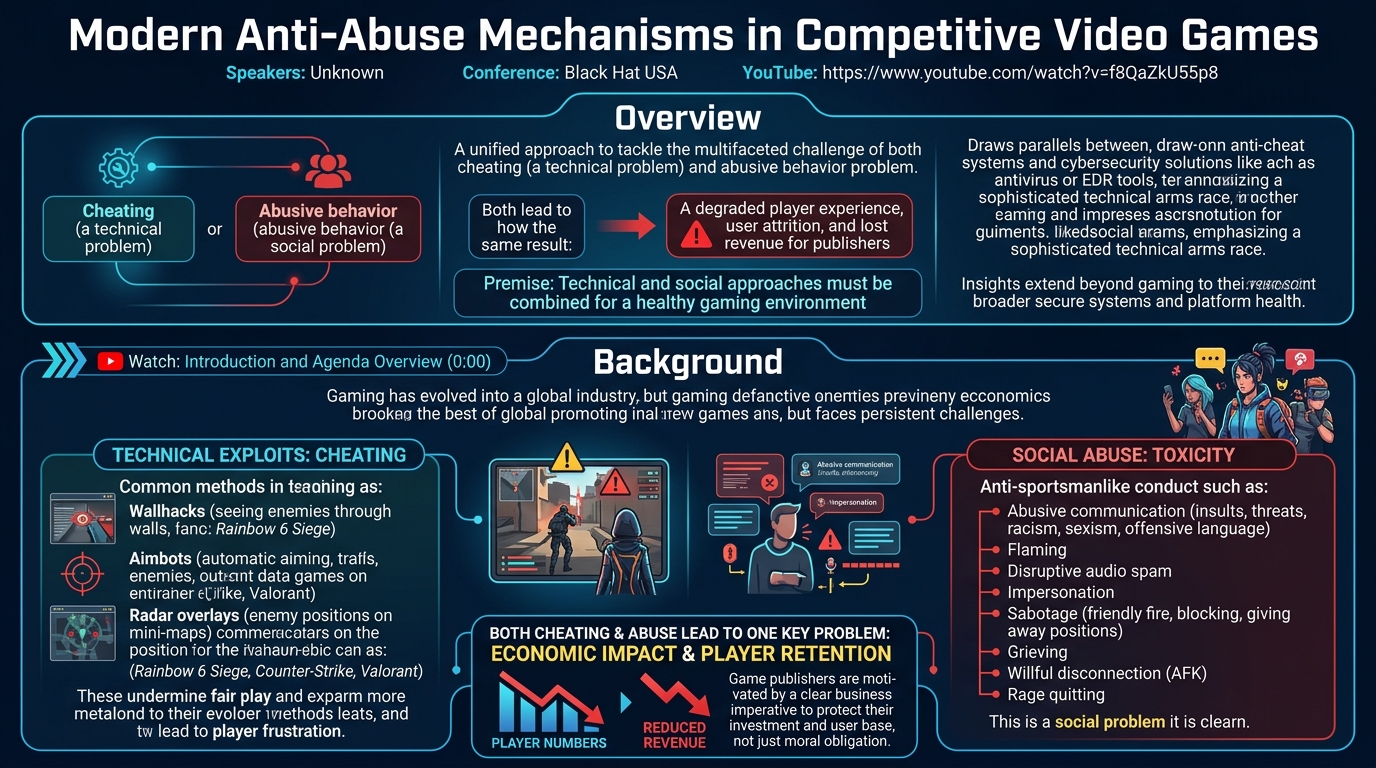
This Black Hat USA talk delves into the multifaceted challenge of combating both cheating and abusive behavior within competitive video games. The speaker, whose identity was not explicitly stated during the presentation, aims to provide a broad perspective on the strategies employed by game developers, moving beyond highly technical, niche discussions to encompass the holistic fight against actions that undermine fair play and player enjoyment. The core premise of the talk is that while cheating is often perceived as a purely technical problem, and abuse as a social one, both ultimately lead to the same detrimental outcome for game publishers: a degraded player experience that drives users away and impacts revenue.
Key moments
- 0:00 Introduction and Agenda Overview
- 0:40 Visual Example of In-Game Cheats
- 2:00 Defining Toxicity and Abusive Behaviors
- 3:00 Why Cheats and Abuse are Bundled
- 3:40 Overview of Technical Countermeasures
- 4:50 Advanced Cheating: Direct Memory Access (DMA)
- 5:30 Sneaky Anti-Cheat: Phone Number & TPM Bans
Modern Anti-Abuse Mechanisms in Competitive Video Games
Speakers: Unknown
Conference: Black Hat USA
YouTube: https://www.youtube.com/watch?v=f8QaZkU55p8
Overview
This Black Hat USA talk delves into the multifaceted challenge of combating both cheating and abusive behavior within competitive video games. The speaker, whose identity was not explicitly stated during the presentation, aims to provide a broad perspective on the strategies employed by game developers, moving beyond highly technical, niche discussions to encompass the holistic fight against actions that undermine fair play and player enjoyment. The core premise of the talk is that while cheating is often perceived as a purely technical problem, and abuse as a social one, both ultimately lead to the same detrimental outcome for game publishers: a degraded player experience that drives users away and impacts revenue.
The presentation draws parallels between anti-cheat systems and traditional cybersecurity solutions like antivirus software or Endpoint Detection and Response (EDR) tools, highlighting the sophisticated technical arms race involved in maintaining game integrity. However, it critically emphasizes that technical measures alone are insufficient to address the pervasive issue of player toxicity. Acknowledging the social dimension of abuse, the talk advocates for a combined technical and social approach to create a healthier and more sustainable gaming environment.
The importance of this topic extends beyond the gaming community, offering insights into how complex systems are secured against persistent adversaries and how user behavior impacts platform health. The strategies discussed, particularly the advanced technical countermeasures and the recognition of social engineering aspects, resonate with broader cybersecurity challenges in protecting digital ecosystems and user communities. This article will dissect the speaker's arguments, detailing the technical mechanisms, exploring the social dynamics, and outlining the comprehensive strategies required to mitigate modern anti-abuse threats.
Background
▶ Watch: Introduction and Agenda Overview (0:00)
The landscape of competitive video gaming has evolved significantly, transforming from a niche hobby into a global industry worth billions. With this growth, however, comes the persistent challenge of maintaining fair play and fostering positive player interactions. Cheating, in its various forms, has long plagued competitive titles, ranging from simple exploits to sophisticated third-party software that grants unfair advantages. Examples such as wallhacks (seeing enemies through walls), aimbots (automatic aiming), and radar overlays (displaying enemy positions on a mini-map) are commonplace in games like Rainbow 6 Siege, Counter-Strike, and Valorant. These cheats directly undermine the skill-based nature of competitive play, leading to frustration and player attrition.
Beyond technical exploits, the gaming environment is frequently marred by toxicity and abusive behaviors. This encompasses a wide spectrum of anti-sportsmanlike conduct, including but not limited to: abusive communication (insults, threats, racism, sexism, offensive language), flaming, disruptive audio spam, impersonation, sabotage, friendly fire, blocking teammates, giving away positions, grieving, willful disconnection (AFK), and rage quitting. The speaker highlights that while cheating often involves technical bypasses, toxicity is fundamentally a social problem. Despite their different origins, both cheating and abuse share a common economic impact: they deter players from engaging with the game, ultimately reducing player retention and revenue for game publishers. Publishers, therefore, are motivated to combat these issues not necessarily out of moral obligation, but out of a clear business imperative to protect their user base and investment.
The problem is compounded by what the speaker terms the "industrialization of cheating." What once might have been rudimentary, freely available cheats are now often sophisticated, paid-for services, complete with licensing servers and dedicated development teams. This professionalization of cheating necessitates equally advanced and persistent countermeasures from game developers, pushing anti-cheat solutions into territories previously occupied by enterprise-level security tools like EDRs. The speaker emphasizes that the fight against these abuses is an ongoing arms race, requiring continuous innovation and adaptation from both sides.
Key Findings
▶ Watch: Defining Toxicity and Abusive Behaviors (2:00)
The central finding of this talk is the recognition that cheating and abuse, despite their distinct technical and social origins, are two sides of the same coin in their detrimental impact on competitive video games. Both erode player satisfaction and, consequently, game publisher revenue. This understanding necessitates a holistic, multi-pronged approach that integrates technical countermeasures with social interventions.
A significant insight presented is the industrialization of cheating. Modern, effective cheats are no longer simple, free downloads but rather commercial products, often requiring subscriptions and licensing keys. This shift elevates the complexity of detection, as cheat developers invest in advanced obfuscation and evasion techniques. Consequently, anti-cheat systems must evolve beyond basic signature detection to become sophisticated, persistent monitoring solutions akin to Endpoint Detection and Response (EDR) systems in enterprise security, albeit "shadier" due to their intrusive nature and kernel-level access.
On the social front, the talk underscores the pervasive and damaging nature of toxicity. The speaker explicitly lists a comprehensive array of abusive behaviors, from direct insults and threats to more subtle forms like grieving and sabotaging teammates. A particularly poignant finding highlighted is an experiment conducted by Women in Game Argentina. In this study, professional male players of Valorant used voice changers to sound female. The video documenting this experience, initially intended to be humorous, quickly devolved into a "sad" and "hilarious" demonstration of the rampant sexism and harassment faced by female-presenting players. This experiment serves as a crucial piece of evidence, illustrating that social problems like sexism and abuse cannot be solved by technical means alone; they require a "social component" to address.
Finally, the talk reveals the increasing severity and persistence of anti-abuse measures, extending beyond simple account bans to hardware-level punishments. The implementation of phone number bans and Trusted Platform Module (TPM) bans demonstrates a radical escalation in efforts to deter repeat offenders, forcing cheaters to incur significant financial and logistical costs (e.g., buying new phones or motherboards) to circumvent bans. These aggressive measures highlight the industry's commitment to protecting the integrity of competitive play, even at the cost of highly intrusive detection and banning methodologies.
Technical Deep Dive
▶ Watch: Why Cheats and Abuse are Bundled (3:00)
The technical countermeasures employed against cheating in competitive video games have evolved significantly, moving from rudimentary checks to highly sophisticated, persistent monitoring systems that often operate at a deeper system level than typical enterprise security solutions. The speaker likened these anti-cheat mechanisms to Endpoint Detection and Response (EDR), but with an added layer of intrusiveness often necessitated by the cunning of cheat developers.
One of the most fundamental detection methods involves network connection monitoring. As cheating has become industrialized, many sophisticated cheats require communication with external licensing servers to verify subscriptions or distribute updates. Anti-cheat systems can monitor outgoing network connections from the game client or even the entire system for known IP addresses, domains, or communication patterns associated with these cheat licensing servers. Detecting such connections serves as a strong indicator of cheat usage.
Beyond network activity, anti-cheat solutions perform rigorous file system checks. This involves scanning for known cheat executable files (e.g., che.exe), dynamic-link libraries (DLLs), or other related artifacts. These scans often leverage specific hashes or digital signatures of known cheat binaries. Furthermore, anti-cheat systems can monitor process names, window titles, and icons for suspicious applications running concurrently with the game. This is a basic form of process-level detection, similar to how EDRs identify malicious processes.
A more advanced technique is memory space inspection. Cheats frequently operate by injecting code or modifying the game's memory to alter its behavior, such as revealing hidden information or manipulating game mechanics. Anti-cheat software actively scans the game's memory regions for unauthorized code, unexpected data patterns, or injected DLLs that shouldn't be present. This requires deep integration with the operating system and often kernel-level access to prevent cheats from hiding their memory modifications.
Hardware-based detection marks a significant escalation in anti-cheat efforts. On consoles, where players are expected to use gamepads, detecting the use of a mouse and keyboard is a common challenge. Specialized adapters allow players to use mouse/keyboard inputs, providing an unfair aiming advantage. Anti-cheat systems can analyze input patterns, responsiveness, and precision to differentiate between gamepad and mouse input, flagging users of such devices.
Even more critical is the detection of Direct Memory Access (DMA) devices. These are external hardware devices that can directly read and write to the computer's memory without involving the CPU or operating system's normal memory access routines. A DMA cheat device, often connected via PCIe, can bypass all software-based anti-cheat mechanisms because it operates outside the scope of the software environment. It can transparently read the entire memory space of the computer, including game memory, to extract sensitive information (like enemy positions) or inject commands. Detecting DMA devices is incredibly challenging, often requiring behavioral analysis for anomalous game data patterns or highly specialized hardware-level monitoring.
Perhaps the most aggressive and persistent technical countermeasures involve hardware fingerprinting and persistent banning mechanisms:
- Phone Number Bans: For competitive play, some games require Multi-Factor Authentication (MFA), often via SMS-based identification. If a player is caught cheating, their associated phone number can be banned. This forces the cheater to acquire a new phone number, and potentially a new physical phone, to continue playing competitively. This adds a significant real-world cost and hurdle for repeat offenders.
- Trusted Platform Module (TPM) Bans: This is arguably the most severe hardware ban discussed. The game client can associate itself with the system's TPM, a secure cryptoprocessor that stores cryptographic keys and performs platform integrity checks. If a player cheats, their entire motherboard can be "banned" by associating the ban with the unique cryptographic identity stored in the TPM. To bypass such a ban, a cheater would need to physically remove the TPM chip from their motherboard and replace it with a new one, or acquire an entirely new motherboard. The speaker noted that some dedicated cheaters resort to buying "whole bags of TPMs" to circumvent these bans, highlighting the lengths to which both sides are willing to go in this arms race.
These technical measures collectively represent a robust, multi-layered defense strategy, demonstrating the lengths game developers must go to protect the integrity of their competitive ecosystems.
Demo / Proof of Concept
▶ Watch: Advanced Cheating: Direct Memory Access (DMA) (4:50)
The talk did not feature a live technical demonstration or a detailed proof of concept of the anti-abuse mechanisms themselves. Instead, the speaker illustrated the effects of cheating with visual examples from Rainbow 6 Siege at the beginning of the presentation. These examples depicted common cheat functionalities such as a radar displaying enemy positions (blue for player, red for adversaries), character outlines drawn in red with green life bars (revealing enemy health and location through walls), and a large circle around the crosshair indicating an auto-aim system that automatically targets adversaries within its radius. While these visual aids effectively conveyed what cheating looks like from a player's perspective, the presentation focused on the theoretical and practical aspects of detection and mitigation rather than a live exploit or countermeasure demonstration.
Defensive Implications
▶ Watch: Sneaky Anti-Cheat: Phone Number & TPM Bans (5:30)
The defensive implications for both game developers and the broader cybersecurity community are profound, underscoring the escalating nature of the anti-abuse arms race. For game developers, the primary takeaway is the absolute necessity of a multi-layered, adaptive defense strategy that integrates both technical and social components. Relying solely on one aspect will inevitably lead to failure.
Technically, developers must embrace sophisticated, low-level system monitoring akin to enterprise EDR solutions. This means investing in robust anti-cheat engines capable of:
- Deep system introspection: Monitoring network traffic for cheat licensing servers, scanning file systems for known cheat artifacts (e.g.,
che.exewith specific hashes/signatures), and inspecting game memory for injected code or anomalous modifications. - Hardware-level detection: Implementing advanced heuristics to detect hardware-based cheats like mouse/keyboard adapters on consoles and, crucially, identifying Direct Memory Access (DMA) devices that bypass traditional software defenses. This requires continuous research into new hardware exploits and developing corresponding detection methods.
- Persistent banning mechanisms: Moving beyond simple account bans to implement more impactful and costly punishments like phone number bans and Trusted Platform Module (TPM) bans. While controversial due to their intrusiveness, these measures raise the barrier to re-entry for persistent cheaters, forcing them to incur significant financial and logistical overhead to continue their illicit activities. This implies a need for robust legal frameworks and user agreements to support such aggressive measures.
Socially, game developers must recognize that abuse cannot be solved by technology alone. This necessitates:
- Robust reporting and moderation systems: Providing clear, accessible channels for players to report abuse and ensuring timely, consistent action against offenders. This includes utilizing both automated detection (e.g., for offensive language) and human moderators.
- Community engagement: Fostering a positive community culture through guidelines, rewards for good behavior, and educational initiatives. The example of the "Women in Game Argentina" experiment highlights the need for explicit measures to combat specific forms of harassment like sexism.
- Behavioral analysis: Employing data science to identify patterns of toxic behavior, even if not explicitly reported, and intervening proactively.
For the broader cybersecurity community, the talk offers several valuable insights:
- The "industrialization of cheating" mirrors the commercialization of cybercrime tools. The evolution of paid cheats with licensing servers and dedicated development teams is analogous to ransomware-as-a-service or exploit kits, demonstrating how malicious capabilities are productized and sold.
- Anti-cheat systems push the boundaries of endpoint security. The intrusive nature of anti-cheat, often operating with kernel-level privileges and engaging in deep hardware introspection (like TPM checks), provides a case study in extreme endpoint protection. Security professionals can learn from these aggressive detection and prevention techniques, even if they are not directly applicable to enterprise environments due to privacy or operational concerns.
- The human element remains critical. The emphasis on social solutions for abuse reinforces the understanding that technology alone cannot solve all security problems. User education, policy enforcement, and community management are as vital in preventing online harassment as they are in combating phishing or social engineering attacks in the enterprise.
Ultimately, the defensive implications highlight that protecting digital ecosystems, whether a video game or a corporate network, is an ongoing, dynamic battle requiring constant innovation, a holistic approach that considers both technical vulnerabilities and human behavior, and a willingness to implement persistent and sometimes aggressive countermeasures.
Key Takeaways
- Holistic Approach Required: Combating abuse in competitive video games demands a strategy that integrates both technical countermeasures against cheating and social interventions against toxicity, as both ultimately degrade player experience and impact revenue.
- Industrialization of Cheating: Modern, effective cheats are often commercial products with licensing servers, necessitating advanced, persistent anti-cheat solutions that mirror enterprise-level EDR systems.
- Advanced Technical Countermeasures: Anti-cheat systems employ sophisticated techniques including network monitoring for cheat licensing, file system scanning, process and memory inspection, hardware detection (e.g., mouse on console, DMA devices), and aggressive persistent bans like phone number and TPM bans.
- Toxicity as a Social Problem: Abusive behaviors (insults, racism, sexism, griefing, etc.) are pervasive social issues that cannot be solved by technical means alone, requiring robust reporting, moderation, and community management.
- Hardware Bans as Escalation: Measures like binding game access to a player's phone number or Trusted Platform Module (TPM) represent a significant escalation in anti-cheat efforts, imposing real-world costs (e.g., buying new hardware) on repeat offenders.
- Real-world Impact of Abuse: Experiments like the one by Women in Game Argentina, where players experienced harassment after using voice changers to sound female, vividly demonstrate the severe and gendered nature of online toxicity.
About the Speaker(s)
The speaker for this talk was not identified in the provided metadata or transcript, though they did mention having a website for their bio and contact information.