Navigating the Complex Challenges of Setting Up Efficient and Robust OT SOC Capabilities
Unknown
Black Hat USA 2024 · Day 1 · Briefing
Overview
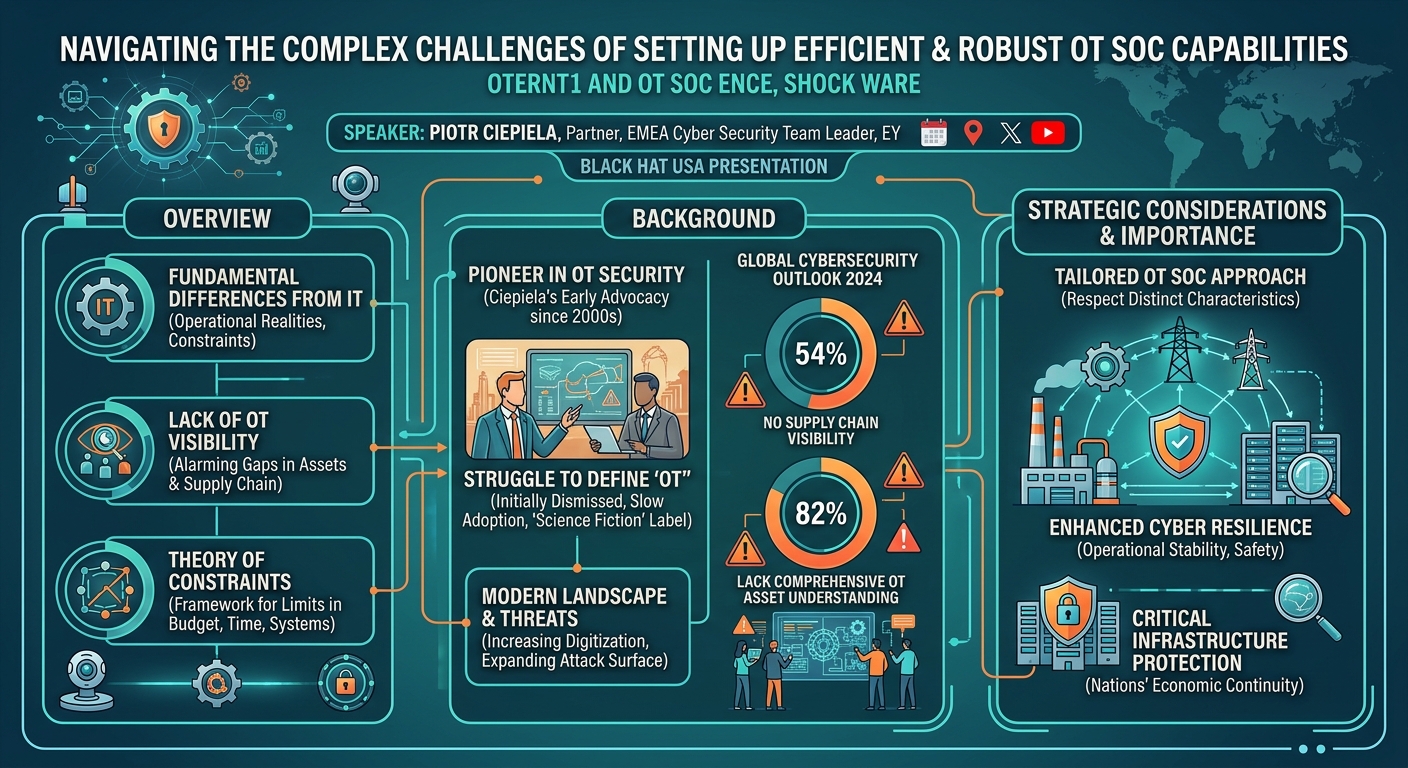
Piotr Ciepiela's Black Hat USA presentation, "Navigating the Complex Challenges of Setting Up Efficient and Robust OT SOC Capabilities," delves into the unique and often underestimated difficulties organizations face when trying to secure their Operational Technology (OT) environments. As a pioneer in the field, Ciepiela brings over two decades of experience to highlight why traditional IT security approaches fall short in industrial control system (ICS) contexts and what strategic considerations are paramount for establishing effective OT Security Operations Centers (SOCs). The talk emphasizes the critical need for a distinct understanding of OT's operational realities, resource constraints, and the pervasive lack of visibility that plagues many organizations.
Key moments
- 0:00 Speaker introduction, experience, and pioneering OT security
- 2:50 Startling statistics on lack of OT asset visibility
- 4:00 New sectors discovering their extensive OT environments
- 4:50 Critical limitations: budget, time, and resources for OT SOCs
- 6:20 Understanding unique challenges and long maintenance windows in OT
Navigating the Complex Challenges of Setting Up Efficient and Robust OT SOC Capabilities
Speakers: Piotr Ciepiela, Partner, EMEA Cyber Security Team Leader, EY
Conference: Black Hat USA
YouTube: https://www.youtube.com/watch?v=mWgMtkhz39E
Overview
Piotr Ciepiela's Black Hat USA presentation, "Navigating the Complex Challenges of Setting Up Efficient and Robust OT SOC Capabilities," delves into the unique and often underestimated difficulties organizations face when trying to secure their Operational Technology (OT) environments. As a pioneer in the field, Ciepiela brings over two decades of experience to highlight why traditional IT security approaches fall short in industrial control system (ICS) contexts and what strategic considerations are paramount for establishing effective OT Security Operations Centers (SOCs). The talk emphasizes the critical need for a distinct understanding of OT's operational realities, resource constraints, and the pervasive lack of visibility that plagues many organizations.
The core message of the presentation is that OT security is fundamentally different from IT security, a reality that many organizations are only beginning to grasp. Ciepiela underscores this by sharing alarming statistics regarding supply chain and asset visibility, painting a picture of a sector grappling with foundational security challenges. He introduces the "theory of constraints" as a framework for understanding the limitations—primarily budget, time, and the inherent differences of OT systems—that dictate the art of the possible in building robust OT SOC capabilities. This talk is crucial for cybersecurity professionals, industrial operators, and organizational leadership seeking to mature their OT security posture in an increasingly threatened landscape.
The importance of this discussion cannot be overstated. As critical infrastructure and manufacturing sectors become increasingly interconnected and targeted by sophisticated cyber adversaries, the operational stability, safety, and economic continuity of nations hinge on effective OT security. Ciepiela's insights provide a pragmatic roadmap for addressing the unique challenges, advocating for a tailored approach that respects the distinct characteristics of OT environments while striving for enhanced cyber resilience.
Background
▶ Watch: Speaker introduction, experience, and pioneering OT security (0:00)
The concept of Operational Technology (OT) security, while now a recognized discipline, faced significant skepticism and a slow adoption rate in its nascent years. Piotr Ciepiela, a self-proclaimed pioneer in the field, recounted his personal struggle to even introduce the term "OT" into Wikipedia, with rejections spanning from 2009 to 2015. This anecdote vividly illustrates the historical perception that industrial control systems (ICS) and supervisory control and data acquisition (SCADA) systems were either isolated from cyber threats or simply an extension of IT. This prevailing mindset, often dismissing OT security as "science fiction," allowed a significant security gap to widen as these critical systems became increasingly digitized and networked.
The current landscape, however, presents a starkly different reality. Cyberattacks are on a relentless rise, expanding the attack surface across all sectors, including the historically insulated OT domain. Ciepiela cited alarming statistics from the Global Cybersecurity Outlook 2024, revealing that a staggering 54% of companies report having no visibility into their supply chain vulnerabilities. This lack of insight extends even further into their own operational environments, with 82% of companies admitting to lacking a comprehensive understanding of their OT assets. These figures underscore a fundamental deficiency in foundational security practices—you cannot protect what you cannot see or identify.
Manufacturing, according to the World Economic Forum, stands out as the most targeted sector, highlighting its critical role in global economies and its attractiveness to threat actors. Yet, Ciepiela pointed out that the remaining 75% of targeted sectors are equally compelling, with "new kids on the block" such as water utilities, healthcare facilities, and various infrastructure operators (e.g., trains, airports) only recently beginning to acknowledge the extent of their OT footprint. This broadening awareness, supported by initiatives from organizations like NIST (National Institute of Standards and Technology) and the International Society of Automation (ISA), marks a crucial turning point, moving OT security from a niche concern to a mainstream imperative. The historical underinvestment and lack of dedicated focus have created a challenging environment, where organizations must now rapidly mature their security capabilities to catch up with evolving threats.
Key Findings
▶ Watch: Startling statistics on lack of OT asset visibility (2:50)
The presentation didn't unveil new vulnerabilities or zero-days but rather highlighted critical findings regarding the pervasive challenges in establishing effective OT SOC capabilities. The central "key finding" is the persistent and widespread lack of visibility within OT environments, forming a significant impediment to robust security. As revealed by the Global Cybersecurity Outlook 2024, 82% of companies lack comprehensive data on their OT assets, making asset inventory, vulnerability management, and threat detection exceptionally difficult. Similarly, 54% lack visibility into supply chain vulnerabilities, exposing critical dependencies to unknown risks.
Another core finding revolves around the "theory of constraints" applied to OT security. Ciepiela emphasized that organizations are invariably limited by three primary factors: money (budget), time, and the inherent differences of the OT environment (which implicitly includes people/skills). OT cyber budgets are often severely constrained, frequently constituting only about 20% of the broader IT or IT security budget. This financial limitation directly impacts the ability to invest in necessary tools, skilled personnel, and comprehensive security programs. Time is another critical constraint; even with increased budget, rapid implementation of OT security measures is often impractical due to operational complexities and long planning cycles.
Perhaps the most fundamental finding articulated by Ciepiela is the unequivocal assertion that "OT is different." This isn't just a philosophical statement but a practical reality that dictates distinct security approaches. Unlike IT, where frequent patching and updates are standard, OT environments are characterized by extended maintenance windows that can stretch for years (e.g., two to four years, or even a hypothetical "next reboot in 2030" scenario). This makes traditional vulnerability management and patch cycles infeasible. The primary drivers for these differences include the paramount importance of continuous operation, the physical safety implications of system disruptions, the use of legacy hardware and software, and often proprietary communication protocols. These factors collectively demand a specialized understanding and a tailored security strategy, moving beyond a mere replication of IT security practices.
Technical Deep Dive
▶ Watch: New sectors discovering their extensive OT environments (4:00)
While Piotr Ciepiela's talk primarily focused on the strategic and organizational challenges of building an OT SOC, rather than detailing specific technical exploits or architectural designs, it inherently touched upon several critical technical distinctions that make OT security unique. The speaker's repeated emphasis that "OT is different" directly implies a divergence in underlying technical architectures, protocols, and operational philosophies compared to traditional IT.
The most prominent technical challenge highlighted is the issue of long maintenance windows. In an IT context, security patches and updates are often applied frequently, sometimes weekly or even daily, to address newly discovered vulnerabilities. However, OT systems, particularly Industrial Control Systems (ICS) such as SCADA (Supervisory Control and Data Acquisition) and Distributed Control Systems (DCS), operate under entirely different constraints. These systems are designed for continuous operation, often controlling physical processes in critical infrastructure or manufacturing. Any downtime, even for security patching, can lead to significant production losses, safety incidents, or environmental damage. Consequently, updates are typically relegated to highly infrequent, meticulously planned maintenance windows that can occur every few months, every few years, or even less frequently, as illustrated by the speaker's humorous "next reboot in 2030" example. This technical reality means that vulnerabilities, once discovered, may persist in OT environments for extended periods, demanding alternative compensating controls.
The inherent "difference" of OT also stems from its reliance on legacy systems and proprietary protocols. Many industrial control systems were deployed decades ago, predating modern cybersecurity considerations and often running on outdated operating systems (e.g., Windows XP, older versions of Linux) and hardware that cannot be easily upgraded. These systems frequently communicate using specialized industrial protocols (e.g., Modbus, DNP3, EtherNet/IP, OPC) that were not designed with security in mind. They often lack authentication, encryption, or integrity checks, making them vulnerable to eavesdropping, manipulation, and unauthorized commands if an attacker gains network access. While the talk didn't name specific protocols, the context of "control system environment" undeniably points to these underlying technical realities.
Furthermore, the physical impact of cyber incidents is a key technical differentiator. A cyberattack on an IT system might lead to data loss or service disruption, but an attack on an OT system can directly result in physical damage to equipment, environmental harm, or even loss of life. This elevates the criticality of system availability and integrity, making any technical intervention, including security measures, subject to rigorous testing and validation to ensure it does not inadvertently disrupt physical processes. This also influences how monitoring and detection operate; an OT SOC must understand not just network anomalies but also deviations in physical process parameters that could indicate a compromise.
Given these constraints, a technical deep dive into establishing an OT SOC would typically involve:
- Passive Asset Discovery: Due to the sensitivity of OT networks, active scanning is often avoided. Instead, passive listening to network traffic (e.g., using Network Detection and Response (NDR) tools) is preferred to build an inventory of assets, their vulnerabilities, and communication patterns without disrupting operations.
- Network Segmentation: Implementing strict network segmentation, often following models like the Purdue Enterprise Reference Architecture, to isolate critical control systems from less secure enterprise networks and the internet. This creates defensible zones and limits the lateral movement of adversaries.
- Protocol Analysis: Deep packet inspection specifically tailored for industrial protocols to identify anomalous commands, unauthorized access, or deviations from baseline operational behavior.
- Secure Remote Access: Implementing highly secure, multi-factor authenticated remote access solutions for vendors and engineers, often through jump servers or zero-trust network access (ZTNA) principles, to minimize the attack surface.
While the talk did not delve into these specifics, the understanding of "OT is different" provides the foundational context for why these technical considerations are paramount in designing and operating an OT SOC that can effectively monitor, detect, and respond to threats in such a unique environment. The focus was on the strategic acknowledgment of these differences as the first step toward effective technical implementation.
Demo / Proof of Concept
▶ Watch: Critical limitations: budget, time, and resources for OT SOCs (4:50)
The presentation by Piotr Ciepiela focused on the strategic challenges and foundational principles for establishing OT SOC capabilities, rather than showcasing specific technical demonstrations or proofs of concept. There were no live demonstrations of tools, exploit techniques, or architectural implementations during the talk. The speaker's objective was to articulate the unique constraints and inherent differences of the Operational Technology (OT) environment and their implications for security operations, emphasizing the need for a distinct strategic approach rather than presenting tactical solutions.
Defensive Implications
▶ Watch: Understanding unique challenges and long maintenance windows in OT (6:20)
The challenges outlined in Piotr Ciepiela's talk have profound defensive implications for organizations operating OT environments. Given the widespread lack of visibility, budget constraints, and the unique operational characteristics of OT, defenders must adopt tailored strategies that diverge significantly from traditional IT security practices.
- Prioritize OT Asset Visibility and Inventory: The alarming statistic that 82% of companies lack comprehensive visibility into their OT assets necessitates an immediate and sustained effort to establish a robust asset inventory. Defenders must deploy passive network monitoring solutions, such as Network Detection and Response (NDR) platforms, designed specifically for OT protocols. These tools can discover assets, map network topology, identify communication flows, and detect deviations from normal behavior without disrupting sensitive industrial processes. A complete and accurate asset inventory is the bedrock for all subsequent security controls, enabling vulnerability assessment, configuration management, and effective threat detection.
- Develop OT-Specific Vulnerability and Patch Management Strategies: The reality of two-to-four-year maintenance windows renders traditional IT patching cycles infeasible. Defenders must accept that many OT systems will remain unpatched for extended periods. This requires a shift towards compensating controls. Strategies include:
- Network Segmentation: Implementing robust network segmentation (e.g., using the Purdue Enterprise Reference Model) to isolate vulnerable OT assets from less secure networks and the internet. This limits the attack surface and prevents lateral movement.
- Virtual Patching/Intrusion Prevention Systems (IPS): Deploying virtual patching solutions or OT-aware IPS at network boundaries to detect and block exploit attempts targeting known vulnerabilities on unpatched systems.
- Application Whitelisting: Implementing application whitelisting on critical endpoints to prevent the execution of unauthorized code, a highly effective control for static OT systems.
- Risk-Based Prioritization: Focusing patching efforts during planned outages on the most critical vulnerabilities and assets, informed by a thorough risk assessment that considers both cyber and operational impact.
- Advocate for Dedicated OT Security Budget and Resources: The speaker highlighted that OT cyber budgets are often a mere fraction (e.g., 20%) of IT security budgets. Defenders must actively articulate the unique risks and potential operational, safety, and financial consequences of OT compromises to executive leadership and boards. This involves translating technical risks into business impact, demonstrating the return on investment for dedicated OT security spending, and advocating for ring-fenced budgets for specialized tools, training, and personnel.
- Invest in OT-Specific Threat Detection and Incident Response: An OT SOC requires specialized capabilities. Defenders need to:
- Train Personnel: Cross-train IT security personnel on OT fundamentals, or hire dedicated OT security experts who understand industrial processes, protocols, and equipment.
- Integrate OT-Specific Threat Intelligence: Leverage threat intelligence feeds focused on ICS/SCADA threats, including specific malware families (e.g., Stuxnet, Triton, Industroyer) and attack techniques targeting industrial protocols.
- Develop OT-Centric Playbooks: Create incident response playbooks that account for the unique operational constraints of OT, prioritizing safety and operational continuity over rapid system shutdowns. This might involve procedures for safe equipment shutdown, manual operation, or controlled process adjustments during a cyber incident.
- Implement Anomaly Detection: Utilize behavioral analytics and machine learning within OT monitoring tools to establish baselines of normal operational behavior and detect subtle anomalies that could indicate a compromise.
- Address Supply Chain Risk: With 54% of companies lacking supply chain visibility, defenders must implement rigorous vetting processes for OT vendors and suppliers. This includes:
- Security Assessments: Requiring vendors to provide evidence of secure development lifecycle practices and conducting security assessments of third-party components.
- Contractual Security Clauses: Incorporating strong cybersecurity clauses in contracts with OT system integrators and equipment manufacturers.
- Network Segregation for Vendor Access: Ensuring that vendor remote access is strictly controlled, segmented, and monitored.
By proactively addressing these defensive implications, organizations can begin to bridge the security gap between IT and OT, building a more resilient and secure operational environment that safeguards critical processes and infrastructure.
Key Takeaways
- OT Security is Fundamentally Different: Traditional IT security practices are often unsuitable for Operational Technology (OT) environments due to unique operational constraints, safety considerations, and system lifecycles.
- Pervasive Lack of Visibility: A significant majority of organizations (82%) lack comprehensive visibility into their OT assets, and 54% have no visibility into OT supply chain vulnerabilities, creating substantial blind spots.
- Constraints Dictate the Possible: Establishing an OT SOC is heavily constrained by limited budgets (often only 20% of IT security), time pressures, and the inherent difficulties of working with sensitive, continuously operating OT systems.
- Long Maintenance Windows are a Major Hurdle: OT systems often have maintenance windows spanning years, making rapid patching and updates infeasible and necessitating alternative compensating controls like network segmentation and virtual patching.
- Strategic Approach Over Tactical Solutions: Effective OT security requires a strategic understanding of these unique challenges, advocating for dedicated resources, specialized training, and tailored security programs rather than simply extending IT security tools.
- Growing Attack Surface and Sector Awareness: The attack surface is expanding, with manufacturing being highly targeted, and new sectors (water, health, trains, airports) are increasingly recognizing their OT security needs, spurred by awareness efforts from organizations like NIST and ISA.
About the Speaker(s)
Piotr Ciepiela is a highly experienced and recognized leader in the field of cybersecurity, with a career spanning over 20 years. He currently holds the distinguished role of Partner at EY, where he leads the media cyber security team, overseeing a vast team of 4,000 professionals across Europe, India, the Middle East, and Africa. Ciepiela is particularly noted for his pioneering contributions to OT (Operational Technology) security, a domain he has been involved with for nearly two decades. He recounts the early days when OT security was often dismissed as "SCADA security," "industrial control system security," or even "science fiction," highlighting the significant shift in industry perception over time. A testament to his early advocacy, Ciepiela successfully campaigned to have "Operational Technology" recognized on Wikipedia in 2015, after six years of rejections. Beyond his corporate leadership, he is also deeply involved in academia, serving as a lecturer at the University of Warsaw and the University of Dallas, and collaborating with Oxford University, further cementing his influence and expertise in the cybersecurity community.