Predict, Prioritize, Patch: How Microsoft Harnesses LLMs for Security Response
Unknown
Black Hat USA 2024 · Day 1 · Briefing
Overview
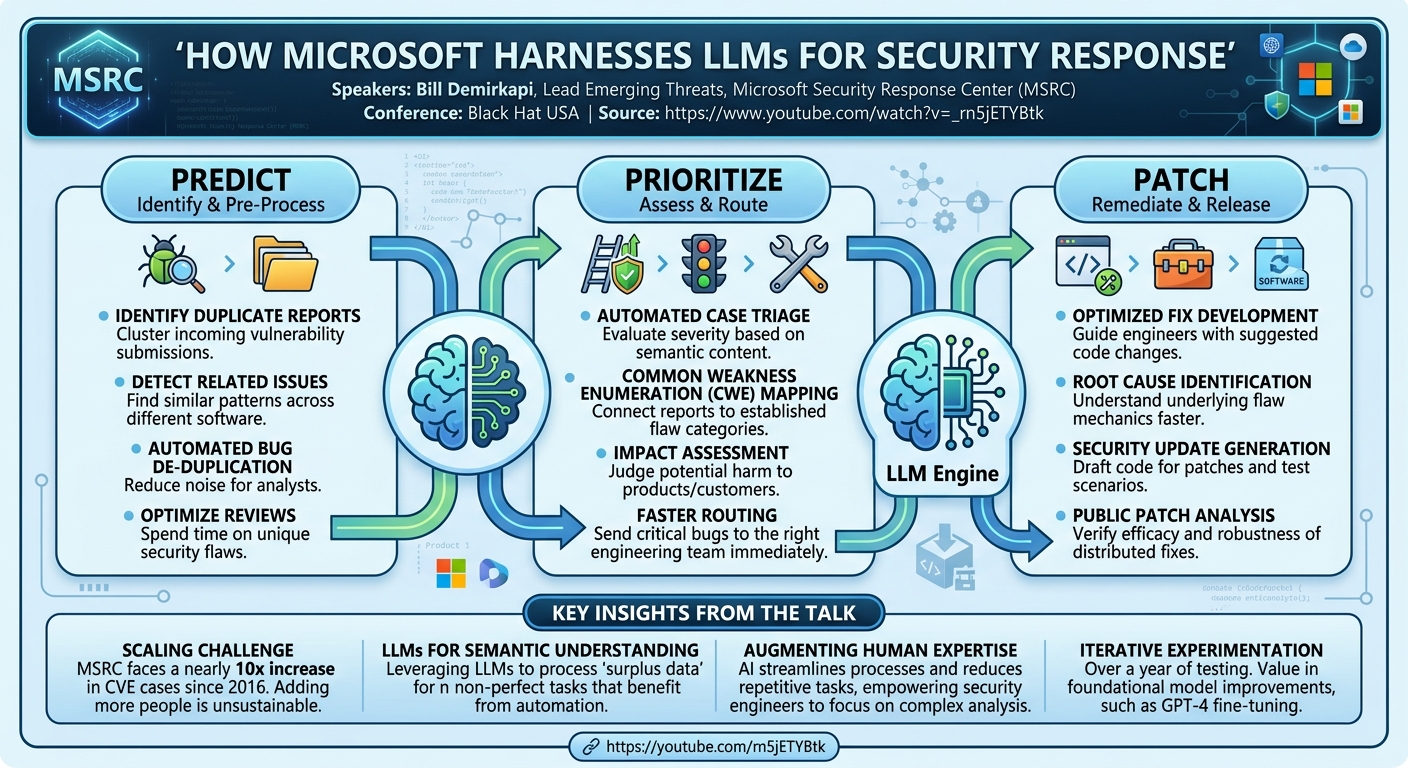
In this Black Hat USA 2024 talk, Bill Demirkapi, who leads Emerging Threats at the Microsoft Security Response Center (MSRC), presented an insightful exploration into how large language models (LLMs) are being leveraged to enhance the efficiency and scalability of security response workflows at Microsoft. Demirkapi, drawing from his background in low-level software and cloud security, shared practical applications and lessons learned from over a year of experimentation with LLMs, emphasizing that his perspective comes from an implementer rather than a machine learning expert. The core of the presentation revolved around addressing the escalating volume of vulnerabilities and security-related data, demonstrating how LLMs can automate repetitive yet technically demanding tasks, ultimately aiding in the prediction, prioritization, and patching of security flaws.
Key moments
- 0:00 Introduction and Talk Overview
- 2:00 Microsoft's Challenge: Increasing Vulnerability Volume
- 3:00 LLM Fundamentals: Tokens, Embeddings, Semantic Meaning
- 4:00 Core LLM Interaction: Chat Completions API
- 4:50 Improving LLM Performance with GPT-4 Fine-tuning
- 5:10 Practical Demo: LLM-Generated Vulnerability Root Cause Summary
Predict, Prioritize, Patch: How Microsoft Harnesses LLMs for Security Response
Speakers: Bill Demirkapi, Lead Emerging Threats, Microsoft Security Response Center
Conference: Black Hat USA
YouTube: https://www.youtube.com/watch?v=_rn5jETYBtk
Overview
In this Black Hat USA 2024 talk, Bill Demirkapi, who leads Emerging Threats at the Microsoft Security Response Center (MSRC), presented an insightful exploration into how large language models (LLMs) are being leveraged to enhance the efficiency and scalability of security response workflows at Microsoft. Demirkapi, drawing from his background in low-level software and cloud security, shared practical applications and lessons learned from over a year of experimentation with LLMs, emphasizing that his perspective comes from an implementer rather than a machine learning expert. The core of the presentation revolved around addressing the escalating volume of vulnerabilities and security-related data, demonstrating how LLMs can automate repetitive yet technically demanding tasks, ultimately aiding in the prediction, prioritization, and patching of security flaws.
The talk highlights the critical need for innovative solutions beyond simply increasing human resources to manage the ever-growing landscape of reported vulnerabilities. By focusing on areas where LLMs can provide semantic understanding and generate natural language insights, Microsoft aims to streamline its security response processes. Demirkapi presented a pragmatic view of LLM capabilities, showcasing their potential for tasks that do not demand absolute perfection but can significantly benefit from automation and intelligent data synthesis. This approach offers a compelling vision for the future of security operations, where AI augments human expertise to tackle complex challenges at an unprecedented scale.
The significance of this work lies in its direct application to a high-stakes environment like the MSRC, which handles every vulnerability reported to Microsoft across its vast ecosystem of software and web applications. The insights shared offer a blueprint for other organizations grappling with similar challenges, illustrating how LLMs can transform reactive security measures into more proactive and efficient strategies. Demirkapi's candid discussion about iterative experimentation and the value of foundational model improvements, such as GPT-4 fine-tuning, provides actionable intelligence for security professionals considering the integration of AI into their own workflows.
Background
▶ Watch: Introduction and Talk Overview (0:00)
The Microsoft Security Response Center (MSRC) operates on a massive scale, tasked with addressing every single vulnerability reported across Microsoft's extensive portfolio of software and web applications. This includes everything from operating systems and productivity suites to cloud services and developer tools. The sheer breadth of this responsibility means the MSRC processes an immense and ever-increasing volume of security cases annually. Demirkapi highlighted a striking trend: since 2016, the MSRC has observed a nearly tenfold increase in the volume of cases that meet the bar for a Common Vulnerabilities and Exposures (CVE) identifier. What once constituted roughly 200 to 400 annual CVE-worthy cases has now surged to nearly a thousand each year.
This escalating volume presents a significant operational challenge. Traditional methods of scaling security response, primarily by adding more human resources, become unsustainable and inefficient beyond a certain point. The MSRC found itself facing a "surplus of security-related data," both internal (Microsoft's own vulnerability data, analysis, and patches) and external (public CVE databases, open-source vulnerability information, exploits, and third-party analysis). While this data is abundant, the challenge lies in effectively collecting, processing, and deriving actionable insights from it in a timely manner.
Furthermore, the MSRC identified numerous repetitive response workflows. These workflows, despite often being technically demanding, frequently follow predictable patterns. Crucially, many of these tasks do not require absolute perfection in their initial execution, meaning that an AI system providing a highly accurate but not flawless output could still significantly reduce the human workload. This combination of increasing vulnerability volume, a wealth of disparate security data, and the presence of repetitive analytical tasks created a fertile ground for exploring advanced automation solutions. The MSRC's interest in Large Language Models (LLMs) stemmed from the recognition that these models could potentially offer a scalable and intelligent approach to augment human analysts, moving beyond simple staffing increases to fundamentally transform how vulnerabilities are handled from prediction to patch.
Key Findings
▶ Watch: LLM Fundamentals: Tokens, Embeddings, Semantic Meaning (3:00)
Microsoft's exploration into leveraging LLMs for security response yielded several pivotal findings that underscore the technology's potential and practical implementation challenges. The primary discovery was that LLMs are remarkably well-suited for repetitive response workflows within the security domain, particularly those that do not demand absolute perfection in their output. This characteristic makes them ideal for initial triage, data synthesis, and summarization tasks where human review remains the ultimate arbiter, but significant time savings can be achieved through automated first passes.
A fundamental insight into LLM operation, crucial for their application in security, is their ability to represent and understand semantic meaning. LLMs process text by tokenization, breaking down natural language into smaller fragments called tokens. These tokens are then converted into embeddings, which are numerical vector floats. The spatial relationship of these embeddings in a multi-dimensional space reflects the semantic closeness of the original tokens or concepts. For instance, "king" and "queen" would be represented by embeddings that are numerically "close" to each other, signifying their related meaning. This capability for semantic understanding is what allows LLMs to grasp the context and implications of vulnerability descriptions, exploit narratives, and patch details.
The practical application of this semantic understanding is primarily realized through chat completions, which allow interaction with LLMs via an API, akin to an automated ChatGPT session. By providing a system prompt (defining the LLM's role), a user question, and potentially a history of conversation context, the LLM can generate coherent and relevant responses. This API-driven approach enables the integration of LLM capabilities directly into existing security tools and workflows, making it a powerful tool for automating tasks like generating vulnerability summaries or extracting key information.
Furthermore, Demirkapi highlighted the immense value of iterative experimentation in optimizing LLM performance for specific security use cases. Simply deploying an off-the-shelf model often yields suboptimal results. Continuous refinement of prompts, fine-tuning of models with domain-specific data, and methodical evaluation of outputs are essential. A compelling example of this iterative improvement was observed when the MSRC transitioned to GPT-4 fine-tuning. This foundational model improvement alone resulted in a 16% decrease in loss for their specific tasks, demonstrating that advancements in the underlying LLM architecture significantly enhance the practical utility and accuracy of applications built upon them. This underscores that staying abreast of model improvements and integrating them through fine-tuning is a critical component of successful LLM deployment in security.
Technical Deep Dive
▶ Watch: Core LLM Interaction: Chat Completions API (4:00)
The technical foundation for Microsoft's application of LLMs in security response hinges on the core mechanics of how these models process and generate natural language. At a high level, Large Language Models (LLMs) are sophisticated statistical models designed to understand and generate human language. Their power in security stems from their ability to distill complex textual information, such as vulnerability reports or exploit descriptions, into actionable insights.
The process begins with tokenization. When an LLM receives input text, a tokenizer breaks down the continuous string of characters into discrete units called tokens. These tokens are not always whole words; they can be sub-word units, punctuation, or even individual characters, depending on the tokenizer's design. For example, the sentence "Let's go to NY!" might be tokenized into "Let", "'s", "go", "to", "N", "Y", "!". Each token is assigned a unique identifier. The significance of tokenization lies in its ability to handle linguistic nuances; for instance, an exclamation point might be its own token because it conveys a distinct semantic meaning (emphasis, emotion) separate from the words it accompanies. This granular breakdown allows the LLM to process language more effectively, capturing subtleties that might be lost with coarser word-level tokenization.
Once text is tokenized, these tokens are fed into the LLM, which transforms them into embeddings. Embeddings are vector floats, essentially numerical representations of tokens in a high-dimensional space. The remarkable property of embeddings is that they capture the semantic meaning of the tokens. In this vector space, tokens with similar meanings or contexts are positioned closer to each other. Demirkapi illustrated this with the classic example of "king" and "queen" being geographically close when graphed in an embedding space, reflecting their shared semantic relationship. This semantic understanding, enabled by embeddings, is what allows LLMs to perform tasks like identifying related vulnerabilities, classifying threat types, or summarizing complex technical reports. The ability to perform mathematical operations on these vectors (e.g., vector addition or subtraction) allows the model to reason about relationships between concepts.
The primary mechanism for interacting with these models is through chat completions, typically exposed via an API. This allows developers to programmatically send prompts and receive generated text. A chat completion interaction involves several key components:
- System Prompt: This initial instruction sets the persona and overall directive for the LLM. For a security application, it might be "You are a cybersecurity analyst specializing in vulnerability root cause analysis."
- User Question: This is the specific query or task provided by the user, such as "Summarize the root cause of this vulnerability report."
- Conversation Context: For multi-turn interactions, previous questions and the LLM's responses are provided as context to maintain coherence and allow the LLM to build upon prior information.
The LLM then leverages its learned patterns and semantic understanding to generate the "next message in the conversation," which could be a summary, an answer to a question, or a piece of analysis.
A critical aspect of optimizing LLM performance for specialized tasks like security response is fine-tuning. Fine-tuning involves taking a pre-trained foundational LLM (like GPT-4) and further training it on a smaller, domain-specific dataset. This process adapts the general knowledge of the foundational model to the specific language, terminology, and nuances of the target domain. Demirkapi highlighted the significant impact of simply using an improved foundational model, noting that upgrading to GPT-4 fine-tuning resulted in a 16% decrease in loss. "Loss" in this context refers to a measure of the model's error rate; a decrease in loss indicates that the model's predictions are becoming more accurate and aligned with the desired output. This demonstrates that continuous iteration, including leveraging advancements in foundational models, is vital for achieving high-quality results in practical LLM applications within complex fields like cybersecurity.
Demo / Proof of Concept
▶ Watch: Improving LLM Performance with GPT-4 Fine-tuning (4:50)
While the talk did not feature a live, interactive demonstration in the traditional sense, Demirkapi presented a compelling proof of concept by comparing a human-generated root cause summary of a legitimate vulnerability with one produced by their LLM model. This example effectively showcased the LLM's capability to understand and articulate complex security issues.
The vulnerability in question involved a wallet service with an integer overflow flaw. Specifically, a reference counter within the wallet X object was only 32 bits. This counter was accessible over COM (Component Object Model), and repeatedly calling the increment function could cause the 32-bit counter to overflow. Such an overflow typically leads to a use-after-free condition, a critical memory corruption vulnerability where a program attempts to access memory after it has been freed, often resulting in crashes or arbitrary code execution.
The real root cause summary, crafted by a human security analyst, succinctly described the issue: "due to a reference counter only being 32 bits, it's possible to overflow the reference count leading to use after free." This summary precisely identifies the mechanism (32-bit counter, overflow) and the consequence (use-after-free).
The LLM model, when tasked with generating its own root cause summary for the same vulnerability, produced a remarkably similar and accurate output: "The root cause of the vulnerability is a reference count overflow in the wallet X object which leads to a use after free."
This direct comparison served as a powerful validation of the LLM's ability to derive critical insights from technical vulnerability data. The LLM not only identified the core problem (reference count overflow) but also correctly linked it to the resulting security impact (use-after-free). This capability is crucial because, as Demirkapi noted, relying on traditional machine translations for such critical information often results in "too low quality" outputs. Furthermore, the cost of manual human translation or summarization can quickly escalate, especially when dealing with a high volume of vulnerabilities, potentially requiring "5 to 10 plus translations per CVE per month" across various internal and external communications.
The demonstration underscored that while LLMs might not achieve "perfection" in every instance, their ability to generate highly accurate and semantically correct summaries for complex technical vulnerabilities is a significant advancement. It provides a viable, scalable alternative to manual processes for tasks where initial insight derivation is paramount, allowing human experts to focus on verification, deeper analysis, and strategic decision-making rather than repetitive summarization.
Defensive Implications
▶ Watch: Practical Demo: LLM-Generated Vulnerability Root Cause Summary (5:10)
The work presented by Bill Demirkapi at Black Hat USA 2024 offers profound defensive implications for organizations grappling with the accelerating pace and complexity of cybersecurity threats. The core takeaway is that Large Language Models (LLMs) can serve as powerful force multipliers for security teams, enabling them to scale their response capabilities beyond what is achievable through human effort alone.
Firstly, the ability of LLMs to perform automated root cause summarization is a game-changer for vulnerability management. As demonstrated with the 32-bit reference counter overflow, an LLM can quickly distill complex technical reports into concise, accurate summaries. This directly impacts the prediction and prioritization phases of security response. By rapidly understanding the essence of a vulnerability, security analysts can more effectively:
- Triage incoming reports: Quickly assess the severity and nature of new vulnerabilities, allowing for faster categorization and assignment.
- Accelerate threat intelligence: Synthesize information from various sources (internal reports, CVE databases, public exploits) to build a comprehensive understanding of emerging threats.
- Inform patch development: Provide developers with clear, actionable summaries of flaws, streamlining the patch creation process and reducing misinterpretations.
Secondly, by automating repetitive response workflows, even those that are technically demanding, LLMs free up highly skilled security engineers to focus on more complex, novel, and strategic challenges that require human intuition, creativity, and deep expertise. This is particularly relevant in an environment like the MSRC, where the volume of CVEs is increasing exponentially. LLMs can handle the initial parsing, categorization, and summarization of vulnerability data, allowing human experts to concentrate on critical tasks such as exploit analysis, impact assessment, and the development of intricate mitigation strategies. This shift in workload optimizes the utilization of scarce human talent.
Thirdly, the emphasis on semantic understanding through embeddings means that LLMs can go beyond keyword matching. They can identify conceptual similarities between vulnerabilities, even if described using different terminology. This capability can enhance proactive defense by:
- Identifying patterns: Detecting common vulnerability classes or recurring design flaws across a large codebase.
- Improving vulnerability research: Suggesting related vulnerabilities or potential variants based on semantic similarity, aiding in the discovery of similar flaws before they are exploited.
- Enhancing security policy enforcement: Automatically analyzing code or configuration against security best practices and identifying deviations based on their meaning, not just syntax.
Finally, Demirkapi's experience highlights the importance of an iterative and experimental approach to integrating LLMs. Defenders should not expect out-of-the-box perfection but rather commit to continuous refinement through prompt engineering, fine-tuning with domain-specific data, and rigorous evaluation. The observed 16% decrease in loss with GPT-4 fine-tuning underscores that investing in model optimization pays significant dividends in accuracy and reliability. Organizations should also establish clear human-in-the-loop processes, where LLM-generated outputs are always reviewed and validated by human experts, especially for high-stakes decisions. This ensures that while LLMs provide scale and speed, critical security judgments remain under expert human control, mitigating the risks of AI hallucinations or errors.
In essence, LLMs empower defenders to better predict potential attack vectors by synthesizing vast amounts of data, prioritize remediation efforts based on intelligent analysis, and ultimately patch vulnerabilities more efficiently, thereby strengthening the overall security posture against an ever-evolving threat landscape.
Key Takeaways
- LLMs are essential for scaling security response: With CVE volumes increasing tenfold since 2016, traditional staffing models are unsustainable; LLMs offer a scalable solution for repetitive, data-intensive workflows.
- Semantic understanding is key for security insights: LLMs leverage tokenization and embeddings to grasp the meaning of security data, enabling tasks like accurate root cause summarization and vulnerability classification.
- Chat completion APIs facilitate practical integration: LLMs can be seamlessly integrated into existing security tools via APIs, using system prompts and conversation context to automate analytical tasks.
- Iterative experimentation and fine-tuning are crucial: Achieving effective LLM performance in security requires continuous refinement, prompt engineering, and leveraging foundational model improvements (e.g., GPT-4 fine-tuning led to a 16% decrease in loss).
- LLMs augment, not replace, human analysts: They excel at deriving initial insights and automating repetitive tasks, freeing human experts to focus on complex analysis, strategic decisions, and validation.
About the Speaker(s)
Bill Demirkapi is a Lead in Emerging Threats at the Microsoft Security Response Center (MSRC). His professional background spans both low-level software security and cloud security, providing him with a comprehensive understanding of diverse security challenges. Demirkapi has actively experimented with large language models for over a year, applying this technology to real-world security response challenges within Microsoft. He humbly states that he is not a machine learning expert with an academic background in the field, but rather approaches LLMs from the perspective of an implementer focused on practical applications and demonstrable results in enhancing security operations.