Securing Network Appliances: New Technologies and Old Challenges
Unknown
Black Hat USA 2024 · Day 1 · Briefing
Overview
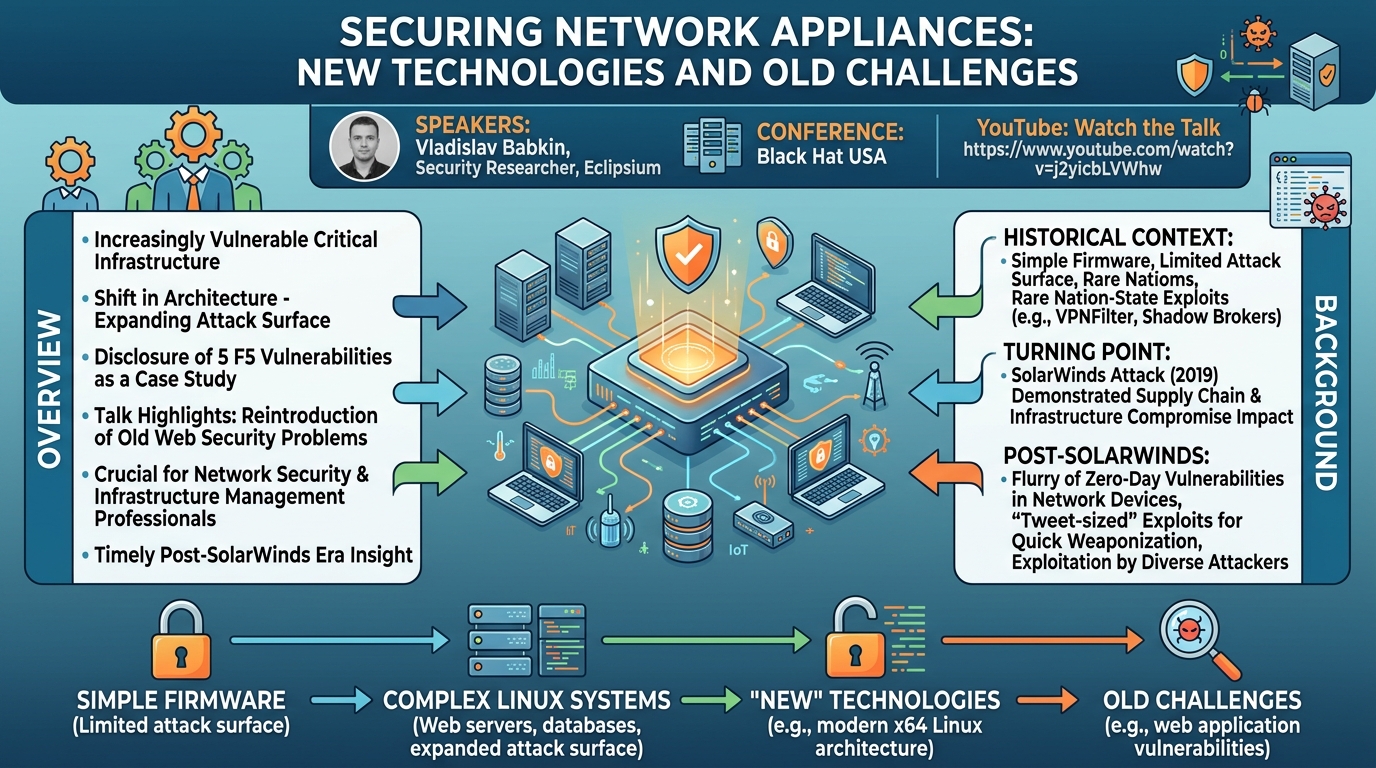
In this Black Hat USA talk, Vladislav Babkin, a security researcher at Eclipsium, sheds light on the evolving threat landscape for network appliances, arguing that these critical infrastructure components are increasingly vulnerable due to a fundamental shift in their architecture. The presentation centers on the disclosure of five vulnerabilities to F5, which Babkin uses as a case study to illustrate a broader, recurring pattern of security weaknesses plaguing modern network devices. This talk is crucial for anyone involved in network security, infrastructure management, or secure software development, as it highlights how the increasing complexity and feature-rich nature of these devices have inadvertently reintroduced "old" web application security problems on a grand scale.
Key moments
- 0:00 Introduction: Five F5 vulnerabilities and recurring issues
- 0:45 Evolution of network device attack surface and early attacks
- 2:00 Post-SolarWinds: Rise of 'tweet-sized' exploits and zero-days
- 3:55 Modern network devices: full-scale Linux x64 platforms with web apps
- 8:00 The 'single glass pane' problem for defenders
- 8:25 The big question: How the industry can fix these problems
Securing Network Appliances: New Technologies and Old Challenges
Speakers: Vladislav Babkin, Security Researcher, Eclipsium
Conference: Black Hat USA
YouTube: https://www.youtube.com/watch?v=j2yicbLVWhw
Overview
In this Black Hat USA talk, Vladislav Babkin, a security researcher at Eclipsium, sheds light on the evolving threat landscape for network appliances, arguing that these critical infrastructure components are increasingly vulnerable due to a fundamental shift in their architecture. The presentation centers on the disclosure of five vulnerabilities to F5, which Babkin uses as a case study to illustrate a broader, recurring pattern of security weaknesses plaguing modern network devices. This talk is crucial for anyone involved in network security, infrastructure management, or secure software development, as it highlights how the increasing complexity and feature-rich nature of these devices have inadvertently reintroduced "old" web application security problems on a grand scale.
Babkin emphasizes that what were once simple, purpose-built firmware devices have transformed into full-fledged X64 Linux systems, complete with web servers, scripting languages, and databases. This transformation, while enabling greater functionality and management capabilities, has simultaneously expanded their attack surface dramatically. The talk argues that these devices are now susceptible to common web application vulnerabilities, often with root-level impact, making them prime targets for a wide range of attackers, from nation-state actors to script kiddies.
The speaker's insights are particularly timely given the post-SolarWinds era, where infrastructure attacks have become a top concern for organizations worldwide. The ease with which "tweet-sized" exploits can be weaponized against these devices, coupled with inherent difficulties in patching and monitoring, presents a significant challenge for defenders. Babkin's discussion serves as a stark warning and a call to action for both vendors and the security community to address these systemic issues, including a strong endorsement of CISA's directive for memory-safe software development.
Background
▶ Watch: Introduction: Five F5 vulnerabilities and recurring issues (0:00)
The evolution of network appliances provides critical context for understanding their current security predicament. Historically, these devices were characterized by their simplicity: often running a single binary firmware with a limited attack surface. Exploits against them were rare, costly, and primarily the domain of sophisticated nation-state groups, as evidenced by incidents like VPNFilter and the Shadow Brokers leaks. These attacks were highly specialized, requiring significant resources and expertise, making them inaccessible to the average attacker.
However, a pivotal shift occurred in 2019 with the SolarWinds attack. While not directly targeting network devices, SolarWinds served as a watershed moment, demonstrating the devastating impact of supply chain and infrastructure compromises. This event fundamentally altered the perception of infrastructure security, revealing how widespread reliance on a single vendor's software could lead to global compromises. In the aftermath of SolarWinds, the security landscape for network devices underwent a dramatic transformation.
What followed was a "flurry of new zero-day vulnerabilities" in virtually all imaginable network devices. The nature of these attacks also changed profoundly. No longer exclusively the realm of nation-state actors, many vulnerabilities became so simple that "random script kiddies" could weaponize them. Babkin highlights that some exploits are "tweet-sized," meaning they are incredibly concise and easy to reproduce. He notes that it sometimes took only a day for even small-time attackers to weaponize these vulnerabilities and install malware. This trend is exemplified by CVE-2022-1388, which the speaker presents as a "full exploit" fitting into a single screenshot, demonstrating simple command execution.
This surge in vulnerabilities is not isolated, with recurring issues observed across major vendors. Babkin specifically calls out F5, Citrix, and Fortinet as recurring topics in the zero-day landscape of 2020, 2021, and 2022, each experiencing multiple high-profile security flaws. The situation became so dire that the Cybersecurity and Infrastructure Security Agency (CISA) intervened, issuing directives urging the industry to fix these problems and advocating for more secure software development practices.
The underlying cause for this decline in security, according to Babkin, is the modernization of network appliances. These devices are no longer simple embedded systems; they are now typically X64 platforms, essentially full-scale computers running Linux. This powerful hardware enables them to host sophisticated web applications, often built with scripting languages like PHP, Lua, and Python, and sometimes even incorporating databases for central management panels. This architectural shift means network devices now face the same "basic web application problems" that have plagued traditional web servers for decades. Crucially, these Linux systems often run everything, including the web server and its components, as a single user, typically root, creating a high-privilege attack surface reminiscent of the unsecured systems of the 1990s. Furthermore, these devices often come with pre-installed tools like curl and wget, which, while useful for legitimate operations, also provide attackers with ready-made utilities for post-exploitation activities. Compounding these issues, network appliances frequently do not receive regular OS updates, leading to a slow but continuous accumulation of unpatched vulnerabilities.
Key Findings
▶ Watch: Post-SolarWinds: Rise of 'tweet-sized' exploits and zero-days (2:00)
The central discovery highlighted in this talk is the alarming convergence of modern network appliance architecture with antiquated security practices, leading to a resurgence of easily exploitable vulnerabilities. Babkin's research, culminating in the disclosure of five vulnerabilities to F5, underscores a systemic issue rather than isolated flaws. These vulnerabilities are not complex, cutting-edge exploits but rather variations of "basic web application problems" that have been understood for decades.
A critical finding is that modern network devices, once simple embedded systems, have evolved into X64 Linux platforms. This means they are essentially full-fledged computers, complete with robust operating systems, web servers, and support for high-level scripting languages like PHP, Lua, and Python. This increased computational power and software complexity, while beneficial for functionality, dramatically expands the attack surface, introducing a wide array of potential entry points that were previously non-existent in simpler firmware.
Another key insight is the prevalence of the single root user problem. On many of these devices, the entire operating environment, including critical web applications and services, runs with root privileges. This design choice means that a successful exploit, even a seemingly minor one like a command injection in a web interface, immediately grants an attacker full control over the device. As Babkin notes, this effectively transports network security back to the "90s and good old times when you just had to get a code execution and suddenly you got your entire machine."
The speaker also identifies the ease and speed of exploitation as a major finding. Many of these vulnerabilities are "tweet-sized," meaning the exploit code is remarkably short and straightforward. An example given is CVE-2022-1388, where the full exploit can fit into a single screenshot and involves a simple instruction to the device to run a command. This simplicity allows "small time people" or "script kiddies," not just nation-state actors, to weaponize zero-days within a day, rapidly expanding the pool of potential attackers.
Finally, the talk highlights a significant defensive challenge: the lack of visibility and update mechanisms. Defenders often interact with these devices through a "single glass pane view," lacking direct shell access or robust monitoring capabilities. Furthermore, network appliances frequently do not receive regular OS updates, distinct from their application-level patches. This means the underlying Linux operating system and its components can become outdated and vulnerable over time, creating a persistent security debt that is difficult to address.
Technical Deep Dive
▶ Watch: Modern network devices: full-scale Linux x64 platforms with web apps (3:55)
The technical core of Babkin's presentation revolves around the fundamental architectural shift in network appliances and its security implications. Modern network devices are no longer monolithic, specialized firmware. Instead, they are robust X64 platforms running a full-scale Linux operating system. This transformation brings the power and flexibility of general-purpose computing to network infrastructure, but also its inherent vulnerabilities.
At the heart of the problem are the web applications that now commonly run on these devices. With significant processing power and memory, vendors are incorporating sophisticated web-based management interfaces. These interfaces are often built using popular scripting languages such as PHP, Lua, and Python, rather than just compiled binaries. This introduces a vast array of "basic web application problems" that have been well-documented for decades in the web development world. These include, but are not limited to, command injection, SQL injection (especially in devices with central manager appliances that use databases), cross-site scripting (XSS), authentication bypasses, and directory traversal.
A critical technical detail is the execution context of these web applications. Babkin stresses that on many network devices, the web server and its associated processes run with root privileges. This means that a successful exploitation of a web vulnerability, such as a command injection, directly leads to arbitrary code execution as the highest-privileged user on the system. This bypasses many layers of defense that would typically be present in a multi-user Linux environment, where web servers might run as a low-privilege user (e.g., www-data). The absence of proper user isolation means that an attacker achieving remote code execution effectively "owns" the entire machine.
The speaker cites CVE-2022-1388 as a prime example of such a "tweet-sized" exploit. While the specifics of the vulnerability's payload are not deeply elaborated in the transcript, the key takeaway is its simplicity: a direct instruction to the device to execute a command. This points to a likely command injection vulnerability where user-supplied input is not properly sanitized before being passed to a shell or system command. Such vulnerabilities are easily discoverable through common web application penetration testing techniques and can be exploited with minimal effort.
Furthermore, the "full scale Linux" environment often comes equipped with utilities that facilitate post-exploitation. Babkin notes that attackers often find tools like curl and wget already installed on these devices. These tools, intended for legitimate network interactions, can be repurposed by an attacker to download additional malware, exfiltrate data, or interact with external command-and-control servers, streamlining the attacker's operations once initial access is gained.
This architectural shift is not exclusive to network devices; Babkin also mentions Baseboard Management Controllers (BMC) as facing similar issues. BMCs, which manage server hardware, have also become more powerful, incorporating web applications and suffering from the same class of vulnerabilities, extending the problem beyond traditional network perimeters into the heart of data centers. The recurring nature of these issues across different device categories underscores a systemic lack of secure development practices within the embedded and infrastructure hardware industry.
Demo / Proof of Concept
▶ Watch: The 'single glass pane' problem for defenders (8:00)
While the live presentation likely included visual aids, the provided transcript does not detail a live, interactive demonstration or a step-by-step proof of concept. However, Vladislav Babkin effectively illustrates the nature of the vulnerabilities and their impact through specific examples and descriptions.
The most prominent example used to convey the ease of exploitation is CVE-2022-1388. Babkin states that he "took a screenshot" of this vulnerability's exploit, noting that it "literally fits in a single screenshot" and is "pretty simple, we just instruct the device to run a command." This description, while not a direct demonstration, serves as a powerful proof of concept by highlighting the minimal complexity required for successful exploitation. It strongly suggests a command injection vulnerability where an attacker can execute arbitrary system commands through a simple HTTP request, leveraging an unauthenticated or poorly authenticated web interface. The visual representation of such a concise exploit would underscore its "tweet-sized" nature, making it highly impactful for the audience.
Babkin also alludes to gaining shell access on a "Mega Rock device" through exploitation. He states, "the shell that I did show you on Mega Rock device, this one on the right, it's not normally even available to the administrator. So we have to exploit a vulnerability in the device to get to this shell." This implicitly serves as a demonstration of the result of successful exploitation: gaining a high-privileged shell on a device where administrative shell access is typically restricted. This point is crucial for defenders, as it highlights that once compromised, these devices can become entirely opaque to legitimate administrators, making detection and remediation extremely difficult without further, often complex, forensic efforts like unsoldering chips to dump firmware. The absence of native, easily accessible diagnostic tools further exacerbates this challenge.
Although a live, step-by-step hacking session was not transcribed, the speaker's narrative effectively conveys the simplicity and profound impact of these recurring vulnerabilities, using real-world examples and the outcome of his own research to illustrate the critical security risks.
Defensive Implications
▶ Watch: The big question: How the industry can fix these problems (8:25)
The security posture of modern network appliances presents significant challenges for defenders, demanding a multi-faceted approach to mitigation. The core defensive implication is the urgent need to recognize that these devices are no longer simple black boxes but full-fledged, vulnerable computing platforms.
Firstly, patching and updates are paramount, yet uniquely complicated. Network appliances often lack the sophisticated, attended update mechanisms found in general-purpose operating systems. Babkin notes that they "don't even get OS updates normally because of different complications," leading to a slow and continuous accumulation of unpatched vulnerabilities in their underlying Linux distributions and bundled software. Defenders must push vendors for more robust, regular, and easily deployable update processes that cover not just the application layer but the entire software stack, including the operating system and dependencies. Organizations must also prioritize applying these updates promptly, understanding that delays can quickly expose them to "tweet-sized" exploits.
Secondly, visibility and monitoring are critically hindered. The speaker highlights that administrators often get only a "single glass pane view" of these devices, lacking direct shell access or comprehensive logging capabilities. If an attacker establishes a foothold, defenders "would literally not see it until I exploit the device or maybe unsolder the chip and pretty much dump the firmware, which is... not very productive on a large deployment." This means traditional endpoint detection and response (EDR) tools or host-based intrusion detection systems (HIDS) are often ineffective or non-existent on these platforms. Defenders need to demand better telemetry, logging, and diagnostic access from vendors, allowing for proactive threat hunting and post-compromise analysis without resorting to physical device manipulation.
Thirdly, a fundamental shift in software development practices is required from vendors. CISA has issued a directive calling for an "urgent need for memory safety in software products," urging new developments to use memory-safe languages like Go and Rust, or scripting languages that offer protection against memory leaks and buffer overflows. This proactive measure aims to prevent a significant class of binary exploits that have historically plagued software. While this addresses lower-level vulnerabilities, vendors must also rigorously apply secure web development best practices, including input validation, secure authentication, least privilege principles, and robust error handling, to mitigate the "basic web application problems" that are currently prevalent.
Finally, organizations must adopt a zero-trust mindset toward these devices. Given the high privilege level (root) often granted to web services and the presence of pre-installed attacker tools (like curl and wget), any compromise can lead to immediate and full control. Defenders should segment networks, limit exposure of management interfaces to trusted networks, and implement strong access controls. Furthermore, organizations should conduct regular security audits and penetration tests specifically targeting their network appliances, treating them as critical infrastructure components with a high-risk profile. The industry cannot "just dump this on a vendor"; a collective effort involving secure design, rigorous testing, and proactive defense is essential to secure these increasingly complex and vulnerable devices.
Key Takeaways
- Modern network appliances are full-fledged X64 Linux systems: They are no longer simple embedded devices but complex computing platforms running full operating systems, web servers, and scripting languages (PHP, Lua, Python).
- They suffer from "basic web application problems": This architectural shift has reintroduced decades-old web vulnerabilities like command injection and SQL injection, often with root-level impact due to poor privilege separation.
- Exploits are "tweet-sized" and easily weaponized: Vulnerabilities like CVE-2022-1388 demonstrate that exploits can be extremely simple, allowing non-nation-state actors (script kiddies) to weaponize zero-days within a day.
- Defenders face severe visibility and update challenges: Administrators often lack direct shell access, comprehensive monitoring, and these devices frequently do not receive regular OS updates, creating a significant security debt and hindering incident response.
- CISA advocates for memory-safe languages: The Cyber and Infrastructure Security Agency is pushing for the use of languages like Go and Rust to mitigate fundamental binary exploitation risks like buffer overflows, addressing a critical aspect of secure software development.
- A systemic industry shift is required: Securing network appliances necessitates a collective effort from vendors to adopt secure-by-design principles, implement robust update mechanisms, and provide better defensive tooling, coupled with vigilant patching and network segmentation from organizations.
About the Speaker(s)
Vladislav Babkin, also known as Vlad Babkin, is a seasoned security researcher currently working at Eclipsium. With approximately 10 years of experience in the security field, he primarily focuses on network and web hacking, while also having a background as a web developer. Babkin is a long-time CTF (Capture The Flag) player, having participated in competitive hacking challenges since around 2015 or even earlier, honing his practical exploitation skills. His expertise in both offensive and defensive security, particularly in web and network domains, positions him as a knowledgeable voice on the evolving challenges of securing critical infrastructure.