SnailLoad: Anyone on the Internet Can Learn What You're Doing
Unknown
Black Hat USA 2024 · Day 1 · Briefing
Overview
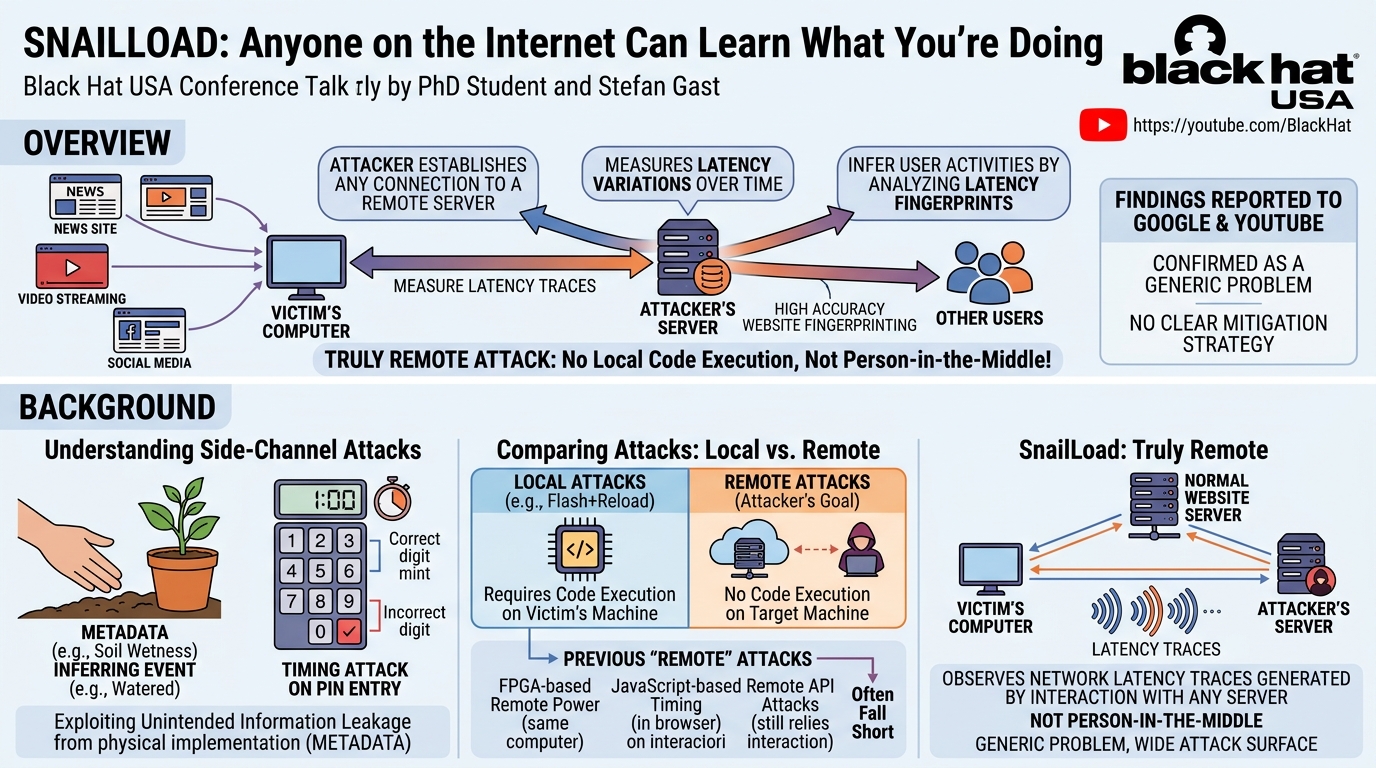
The "SnailLoad" talk at Black Hat USA unveiled a potent new form of remote side-channel attack that allows an attacker to infer a user's online activities, such as which websites they are visiting or which videos they are watching, with surprising accuracy. What makes SnailLoad particularly concerning is its truly remote nature: it requires no local code execution on the victim's machine and does not necessitate a "person-in-the-middle" position. Instead, the attack leverages the subtle, yet distinct, latency traces observed from any connection to a remote server.
Key moments
- 0:50 SnailLoad attack overview: High accuracy website fingerprinting
- 1:30 Understanding side channels: Observing metadata, not data
- 3:20 Pursuing the 'holy grail' of remote attacks
- 4:45 SnailLoad's mechanism: Inferring activity via latency traces
- 5:30 Google/YouTube acknowledge SnailLoad as generic problem
- 6:50 Key takeaway: 37% accuracy in worst-case scenario
- 8:00 Q&A: Scaling SnailLoad with multiple simultaneous connections
SnailLoad: Anyone on the Internet Can Learn What You're Doing
Speakers: PhD Student (name not provided in transcript), Stefan Gast
Conference: Black Hat USA
YouTube: https://www.youtube.com/watch?v=YcldiAW6knk
Overview
The "SnailLoad" talk at Black Hat USA unveiled a potent new form of remote side-channel attack that allows an attacker to infer a user's online activities, such as which websites they are visiting or which videos they are watching, with surprising accuracy. What makes SnailLoad particularly concerning is its truly remote nature: it requires no local code execution on the victim's machine and does not necessitate a "person-in-the-middle" position. Instead, the attack leverages the subtle, yet distinct, latency traces observed from any connection to a remote server.
Presented by a PhD student and Stefan Gast, this research highlights a fundamental privacy vulnerability inherent in network communication. The speakers demonstrated that even encrypted traffic leaves behind metadata in the form of timing patterns that can be fingerprinted. The implications are far-reaching, as virtually any online activity involving data transfer can potentially be exposed, challenging conventional notions of privacy and security in the digital age. The researchers reported their findings to Google and YouTube, who confirmed the issue as a generic problem with no clear, efficient mitigation strategy currently available.
Background
▶ Watch: SnailLoad attack overview: High accuracy website fingerprinting (0:50)
To understand SnailLoad, it's crucial to first grasp the concept of side-channel attacks. Unlike direct attacks that aim to compromise data or systems explicitly, side channels exploit unintended information leakage from a system's physical implementation. This involves observing metadata—information about the data—rather than the data itself, to infer sensitive details. A simple analogy provided in the talk is inferring whether a flower has been watered by feeling the soil's wetness; the wetness is metadata, from which the watering event is inferred. More technically, timing attacks on PIN entries, where the time taken to verify each digit reveals how many were correct, are a classic example discussed in academic literature.
The speakers then delved into a critical distinction: local versus remote attacks. Local attacks, such as Flash+Reload (a cache timing attack that determines if data is in a cache by measuring access times), typically require code execution on the victim's system. This restricts their applicability, as gaining local code execution is often a significant hurdle for an attacker. The "holy grail" for adversaries is a truly remote attack, one that doesn't rely on any code running on the target machine. Previous attempts at "remote" attacks often fell short of this ideal; for instance, FPG-based remote power side-channel attacks might involve a separate chip but still operate within the same physical computer, and JavaScript-based timing attacks still execute code locally within the browser. Even remote timing attacks through exposed APIs merely shift parts of the attack outside, still relying on some interaction with the target system.
SnailLoad transcends these limitations. It's not a person-in-the-middle attack, which would imply intercepting and analyzing traffic directly. Instead, it operates on a more fundamental level, observing the network latency traces generated by the victim's interaction with any remote server. This means the attacker doesn't need to be on the same network segment or possess privileged access to the victim's traffic. As long as the attacker can establish any connection to a remote server and measure its latency, they can gather the necessary metadata. This broadens the attack surface dramatically, making it a generic problem that challenges existing security paradigms that primarily focus on encrypting data content rather than its timing characteristics.
Key Findings
▶ Watch: Pursuing the 'holy grail' of remote attacks (3:20)
The core finding of the SnailLoad research is that an attacker can accurately fingerprint a user's online activities solely by analyzing network latency traces. This remote side-channel attack successfully inferred which of the top 100 websites a user was visiting or which videos they were watching, even in an open-world website fingerprinting scenario where the attacker also had to distinguish from an "unknown" class of activity. The speakers presented a compelling visual of their results: a matrix showing a "nice diagonal" when fingerprinting websites, indicating a high degree of accuracy in correctly identifying activities.
Specifically, the attack demonstrated significant practical success. Even under challenging conditions, such as a fiber-to-the-building connection with potentially high noise due to multiple users watching YouTube simultaneously, SnailLoad achieved an accuracy of approximately 37%. While this might not seem exceptionally high in absolute terms, it's crucial to compare it to a baseline of 10% average guessing accuracy for a scenario involving 10 possible activities (9 known + 1 unknown). This means SnailLoad performed nearly four times better than random chance, even in the "worst case" scenario with increased ambient network noise. The researchers posited that with more training data and potentially advanced noise filtering techniques (e.g., if the attacker could characterize the specific noise patterns), the accuracy could be further improved.
A critical implication of these findings is that the issue is generic. The researchers reported their findings to Google and YouTube, as their proof-of-concept was demonstrated on YouTube. Both companies investigated the issue for several weeks and concluded that it is indeed a broad problem, not specific to their platforms or implementations. Furthermore, they acknowledged that there is currently "no clear" or "efficient and effective way" to mitigate this type of attack, underscoring the fundamental nature of the vulnerability. The ability to conduct such an attack without requiring any local code execution on the victim's system makes SnailLoad a particularly potent and difficult-to-defend-against threat to user privacy.
Technical Deep Dive
▶ Watch: SnailLoad's mechanism: Inferring activity via latency traces (4:45)
The fundamental principle behind SnailLoad lies in the unique network latency traces generated by different online activities. When a user streams a video, loads a complex webpage, or interacts with various online services, the volume, rate, and pattern of data transfer over the network are distinct. These distinct traffic patterns, in turn, manifest as unique fluctuations in network latency. Even though the actual content of the data might be encrypted (e.g., HTTPS traffic), the timing and size of packets, and thus the resulting latency, remain observable metadata.
The "snail" in SnailLoad likely refers to the relatively slow and variable nature of network latency, which, despite its apparent slowness, carries sufficient information to act as a fingerprint. An attacker does not need to intercept the victim's traffic directly. Instead, they can simply monitor the latency of their own connection to a remote server. The premise is that the victim's network activity will influence the overall network conditions, including the latency experienced by the attacker, if they share common network infrastructure or if the victim's traffic patterns are broad enough to affect general internet conditions or specific routing paths. More likely, the attack relies on the attacker being able to induce the victim to connect to a server the attacker controls (e.g., via a malicious ad or link) or being able to observe latency from a server that the victim also connects to, and then correlating the timing patterns. The talk emphasizes that "any connection to a remote server can obtain latency traces and by that infer what you are currently doing," which suggests a very broad applicability.
The process typically involves:
- Profiling: The attacker first builds a database of latency patterns associated with known activities. For instance, they might visit the top 100 websites themselves or watch specific YouTube videos while monitoring network latency. Each activity generates a unique "signature" or latency fingerprint.
- Observation: The attacker then observes the latency traces from their connection to a remote server when a victim is active.
- Inference: Using machine learning algorithms or statistical analysis, the observed latency trace is compared against the profiled fingerprints to identify the most probable activity the victim is engaged in. The "nice diagonal" in the presented matrix suggests a classification algorithm successfully mapping observed patterns to their true labels.
The discussion also touched upon the impact of noise on the attack's effectiveness. In environments with less network activity, the signal (the victim's specific latency pattern) is clearer, leading to higher accuracy. Conversely, in a "fiber to the building" scenario where many users might be watching YouTube simultaneously, their overlapping video streams introduce significant noise, making the analysis more challenging. However, the researchers noted that even in this "worst case," the attack still yielded a 37% accuracy, significantly better than random guessing. They also hypothesized that an attacker with knowledge of the specific noise characteristics could potentially filter it out, much like separating overlaid images if one of the originals is known, further improving accuracy. This implies sophisticated signal processing and machine learning techniques are central to mitigating or enhancing the attack.
The speakers briefly mentioned buffering occurring before the "last mile" of the victim's internet connection as a common practice. While buffering helps smooth out video playback and network fluctuations, it doesn't entirely obscure the distinct traffic patterns that SnailLoad exploits. This suggests that current buffering strategies are insufficient to mask the latency signatures effectively.
Demo / Proof of Concept
▶ Watch: Key takeaway: 37% accuracy in worst-case scenario (6:50)
The SnailLoad presentation included a clear demonstration and proof-of-concept (PoC) of the attack's capabilities. The researchers explicitly stated that they "did our demo on YouTube," indicating that their PoC targeted video streaming activities on the platform. This involved creating a dataset of latency traces corresponding to users watching various videos on YouTube.
The primary visual evidence of their PoC was a matrix illustrating the results of their open-world website fingerprinting experiment. This matrix displayed a "nice diagonal," which is a common visual representation in classification tasks, signifying that the model correctly identified the target activity a high percentage of the time. The experiment included fingerprinting the top 100 websites in addition to an "unknown class," demonstrating the attack's ability to operate in a realistic scenario where not all possible activities are known beforehand.
The quantitative results from their PoC further underscored the attack's efficacy. They reported an average accuracy significantly higher than random guessing, highlighting the distinctiveness of the latency patterns. Crucially, they cited a "worst-case" scenario involving a fiber-to-the-building connection where, despite increased network noise from multiple simultaneous users, the attack still achieved 37% accuracy. This figure is notable when contrasted with the 10% average guessing accuracy expected in a 1-in-10 classification task, demonstrating that the attack retains considerable inferential power even under suboptimal conditions.
The credibility of the PoC was further reinforced by the fact that the researchers reported their findings to Google and YouTube. Both companies conducted their own investigations over "several weeks" and ultimately "concluded that it is a generic problem." This independent verification by major online service providers validates the practical feasibility and broader implications of the SnailLoad attack, confirming that it is not merely a theoretical construct but a demonstrable threat.
Defensive Implications
▶ Watch: Q&A: Scaling SnailLoad with multiple simultaneous connections (8:00)
The SnailLoad attack presents a particularly challenging problem for defenders because it exploits a fundamental characteristic of network communication: latency. Unlike vulnerabilities that can be patched with software updates or mitigated with stronger encryption, SnailLoad derives information from the timing of data flow, a form of metadata that is inherently difficult to obscure without severely degrading network performance. Google and YouTube's conclusion that it's a "generic problem" with no clear, efficient, or effective mitigation strategy underscores this difficulty.
Traditional security measures, such as HTTPS encryption, are ineffective against SnailLoad. While HTTPS protects the content of communication, preventing an attacker from reading the data, it does not hide the fact that data is being transferred, nor does it obscure the timing and volume characteristics of that transfer. These characteristics are precisely what SnailLoad leverages.
Given the nature of the attack, potential defensive strategies would need to focus on disrupting the predictability of latency patterns:
- Traffic Shaping and Padding: One approach could involve introducing artificial noise or standardizing traffic patterns. This means adding dummy packets (padding) or delaying real packets to create a uniform flow of data, regardless of the actual content or activity. However, this could significantly increase bandwidth consumption and introduce unnecessary latency, impacting user experience. The speakers' mention of noise and an attacker's ability to filter it suggests that simple padding might not be enough; sophisticated, adaptive padding might be required.
- Increased and Adaptive Buffering: While buffering is already used to smooth out network fluctuations, more aggressive or dynamically adjusted buffering could potentially mask the unique latency signatures. If data is consistently delivered in larger, less frequent bursts, or with randomized delays, it might become harder to discern the underlying activity. However, this could lead to higher initial load times or increased memory usage.
- Randomized Server-Side Delivery: Content delivery networks (CDNs) and web servers could implement strategies to randomize how data is sent to clients. Instead of predictable streaming rates or packet sizes, they could introduce variability, making it harder for an attacker to build consistent latency fingerprints. This would require significant changes to server infrastructure and content delivery protocols.
- Network-Level Obfuscation: Internet Service Providers (ISPs) or network operators could potentially implement techniques at a deeper network level to obfuscate traffic patterns. However, such measures would be complex to deploy at scale and could interfere with legitimate network optimizations.
- Awareness and Education: For users, understanding that even encrypted online activities can leave privacy-compromising metadata is crucial. While there are no direct user-side mitigations for SnailLoad, awareness can inform choices about what information is shared online and under what assumptions of privacy.
The challenge lies in implementing any of these measures without crippling network performance or usability. The SnailLoad attack highlights a tension between network efficiency and privacy, suggesting that the very mechanisms designed for fast and reliable data transfer also inadvertently leak sensitive information. This problem will likely require collaborative research efforts from academia, industry, and standards bodies to develop new paradigms for privacy-preserving network communication.
Key Takeaways
- SnailLoad is a novel, truly remote side-channel attack that infers user online activity without requiring local code execution or a person-in-the-middle position.
- The attack leverages network latency traces—metadata about the timing of data transfers—to create unique "fingerprints" for different websites and videos.
- It demonstrated significant accuracy, correctly identifying top 100 websites and YouTube videos, even achieving 37% accuracy in noisy, "worst-case" scenarios compared to 10% random guessing.
- HTTPS encryption offers no protection against SnailLoad, as the attack exploits timing characteristics rather than content.
- Google and YouTube investigated the findings and confirmed that it is a generic problem with no clear, efficient, or effective mitigation strategy currently known.
- SnailLoad underscores the persistent challenge of metadata leakage and highlights a fundamental privacy vulnerability in current internet communication protocols and infrastructure.
About the Speaker(s)
The talk was presented by a PhD student (whose name was not specified in the transcript) and Stefan Gast. The PhD student is part of "Daniel's group" and noted that this was their first Black Hat talk, expressing gratitude for the opportunity to present their research. Stefan Gast was presented as a co-speaker, with a photo shown during the introduction. Further details about their specific affiliations or titles were not explicitly stated in the provided transcript.