That Gambling Site? It's Fueled by Chinese Organized Crime
Unknown
Black Hat USA 2024 · Day 1 · Briefing
Overview
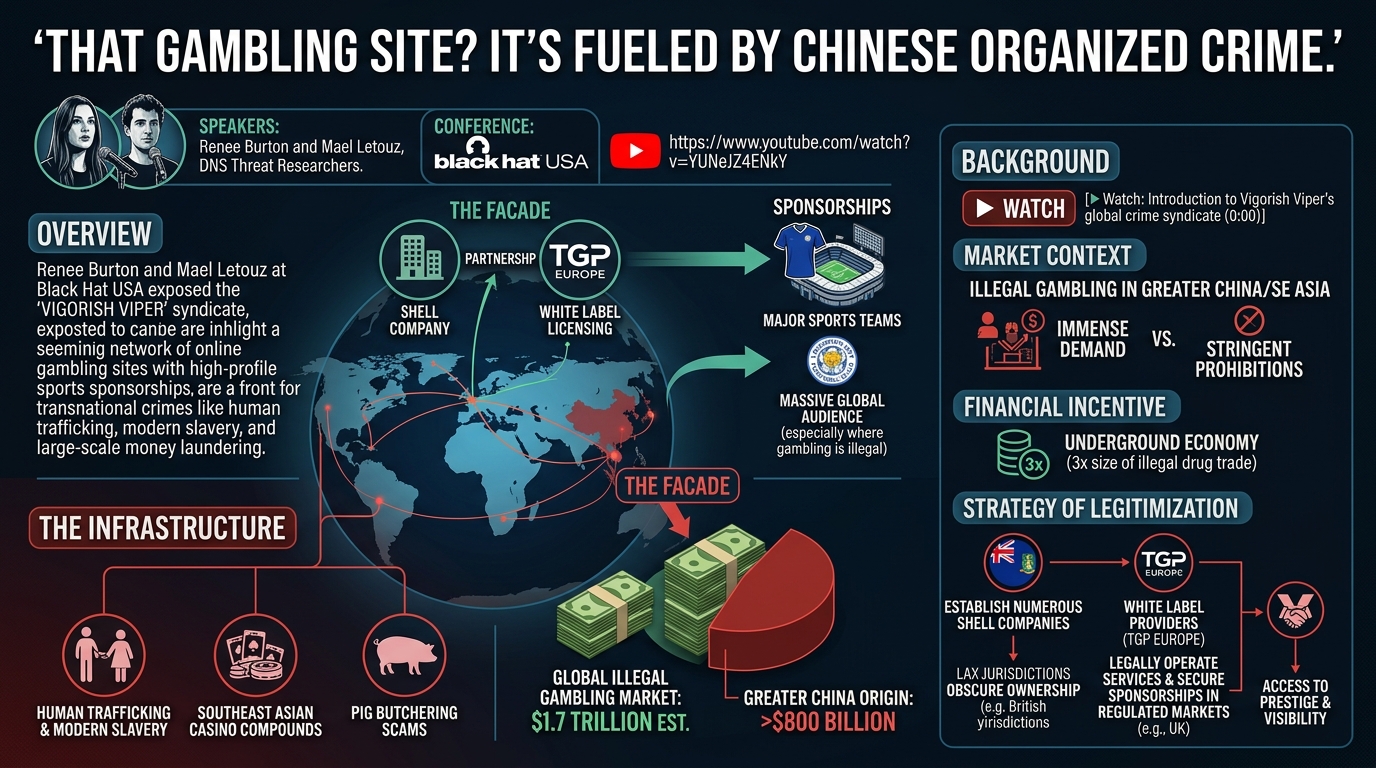
In a revealing presentation at Black Hat USA, DNS threat researchers Renee Burton and Mael Letouz unveiled the intricate and disturbing operations of a Chinese organized crime syndicate they've dubbed Vigorish Viper. This talk exposed how a seemingly legitimate network of online gambling sites, often promoted through high-profile sports sponsorships, serves as a front for a vast array of transnational crimes, including human trafficking, modern slavery, and large-scale money laundering. The speakers meticulously detailed the deceptive tactics employed by Vigorish Viper, highlighting their sophisticated technical defenses and their deep financial entanglement with an illegal gambling economy estimated at a staggering $1.7 trillion globally, with over $800 billion originating from Greater China alone.
Key moments
- 0:00 Introduction to Vigorish Viper's global crime syndicate
- 2:00 Defining Vigorish Viper's massive, global criminal operations
- 4:00 Linking to pig butchering scams and the Philippines' crackdown
- 5:00 Unveiling the staggering $1.7 trillion illegal gambling economy
- 6:00 How Vig Viper uses shell companies and white-label providers
- 7:00 The deceptive power and types of sports sponsorships
That Gambling Site? It's Fueled by Chinese Organized Crime
Speakers: Renee Burton and Mael Letouz, DNS Threat Researchers
Conference: Black Hat USA
YouTube: https://www.youtube.com/watch?v=YUNeJZ4ENkY
Overview
In a revealing presentation at Black Hat USA, DNS threat researchers Renee Burton and Mael Letouz unveiled the intricate and disturbing operations of a Chinese organized crime syndicate they've dubbed Vigorish Viper. This talk exposed how a seemingly legitimate network of online gambling sites, often promoted through high-profile sports sponsorships, serves as a front for a vast array of transnational crimes, including human trafficking, modern slavery, and large-scale money laundering. The speakers meticulously detailed the deceptive tactics employed by Vigorish Viper, highlighting their sophisticated technical defenses and their deep financial entanglement with an illegal gambling economy estimated at a staggering $1.7 trillion globally, with over $800 billion originating from Greater China alone.
The core of Vigorish Viper's strategy involves creating a facade of legitimacy through shell companies and partnerships with white label licensing providers like TGP Europe. This allows them to secure highly visible sponsorships with major sports teams, such as Leicester City, thereby marketing their illicit gambling platforms to a massive global audience, particularly within regions where gambling is illegal. The presentation underscored that behind the glossy promotional materials and celebrity endorsements (often featuring actors portraying CEOs), lies a dark infrastructure directly linked to brutal practices in Southeast Asian casino compounds, notorious for their role in pig butchering scams and forced labor.
This talk serves as a critical warning, illustrating the profound real-world consequences of cyber-enabled financial crime. It moves beyond typical discussions of online fraud to expose a highly organized, technologically adept criminal enterprise whose digital operations directly fuel severe human rights abuses and economic destabilization. By dissecting Vigorish Viper's operational model, the researchers provided invaluable insights into how these complex networks operate, evade detection, and exploit both technological loopholes and human vulnerabilities on a global scale.
Background
▶ Watch: Introduction to Vigorish Viper's global crime syndicate (0:00)
The genesis of Vigorish Viper's operations lies in the lucrative, yet highly illegal, gambling market within Greater China and much of Southeast Asia. Despite stringent prohibitions, the demand for gambling remains immense, fostering an underground economy that dwarfs the illegal drug trade by three times, reaching an estimated $1.7 trillion. A significant 60% of this illicit market, roughly $800 billion, is attributed to individuals from Greater China, making it an irresistible target for organized crime syndicates. This immense financial incentive drives groups like Vigorish Viper to develop elaborate schemes to circumvent legal restrictions and access their target audience.
Historically, various forms of illegal gambling have plagued the region, but the digital age has provided new avenues for expansion and obfuscation. Vigorish Viper's innovation lies in its sophisticated approach to legitimization and audience acquisition. They establish numerous shell companies across jurisdictions known for lax corporate transparency, such as the British Virgin Islands, to obscure their true ownership and operational nexus. These shell entities then partner with white label providers, such as TGP Europe, whose express purpose is to allow anonymous organizations to legally operate gambling services and secure sports sponsorships in regulated markets like the UK. This arrangement grants the criminal enterprise access to the prestige and visibility associated with major sports leagues, like the Premier League, through shirt sponsorships, stadium perimeter advertising, and even dynamic text sponsorships that can alter content during transmission.
This strategy effectively launders the image of the illicit gambling sites, making them appear as legitimate online sportsbooks. The speakers highlighted the deceptive nature of these operations, noting that the "CEO" of entities like Yabo Sports (which is directly linked to Vigorish Viper) is often an actor, underscoring the pervasive use of fake identities throughout the syndicate's structure. The connection to broader criminal activities, particularly human trafficking and modern slavery, is stark. These gambling operations are inextricably linked to notorious casino compounds on the borders of Laos and Cambodia, which have received media attention for their role in pig butchering scams. While these investment scams often capture headlines, the underlying infrastructure and criminal networks are the same, all ultimately connected to the illegal gambling schemes.
Recent governmental actions provide additional context, such as President Marcos of the Philippines' decision on July 22nd to halt Philippine Offshore Gaming Operator (POGO) licenses. This move, coinciding with the release of a 76-page paper by the researchers, aimed to curb human trafficking and money laundering associated with these offshore gambling operations. While such measures indicate growing international pressure, the inherent adaptability and global reach of groups like Vigorish Viper suggest that a full cessation of their activities remains a significant challenge.
Key Findings
▶ Watch: Linking to pig butchering scams and the Philippines' crackdown (4:00)
The research into Vigorish Viper uncovered several critical findings that shed light on the sophistication and scale of modern organized crime. Firstly, the direct identification of Yabo Sports as an alias for Vigorish Viper was a pivotal discovery. Despite Yabo's prominent sports sponsorships and professional appearance, the investigation revealed that its entire public-facing identity, including its CEO, is fabricated, serving as a front for the criminal syndicate. This illustrates a highly deliberate strategy to project legitimacy while maintaining complete anonymity for the true operators.
Secondly, the talk exposed the intricate web of deception used to attract and retain gamblers. Vigorish Viper leverages the global appeal of sports through extensive sports sponsorships with reputable teams, effectively using these partnerships to advertise their illegal platforms. This strategy allows them to bypass traditional advertising restrictions and reach a vast audience, particularly within regions where gambling is prohibited. The use of white label licensing providers further enables this, creating a legal buffer that shields the criminal enterprise from direct accountability.
Thirdly, the investigation firmly established the direct link between these online gambling operations and severe transnational crimes. The revenue generated from illegal gambling fuels human trafficking, modern slavery, and money laundering, particularly in casino compounds located in Southeast Asia. These compounds, often associated with pig butchering scams, are run by the same criminal elements, demonstrating a deeply integrated and multi-faceted criminal enterprise where various illicit activities mutually reinforce each other.
Finally, the researchers detailed the advanced technical measures Vigorish Viper employs to protect its operations and target its audience effectively. This includes sophisticated geo-fencing mechanisms that primarily restrict access to users within China while blocking most international IPs, and multi-layered anti-analysis defenses designed to thwart researchers. Furthermore, their non-standard methods for distributing mobile applications, bypassing official app stores, highlight a deliberate effort to maintain control over user devices and evade scrutiny. These technical findings underscore that Vigorish Viper is not merely a simple gambling ring but a technologically adept organization capable of implementing complex digital strategies.
Technical Deep Dive
▶ Watch: Unveiling the staggering $1.7 trillion illegal gambling economy (5:00)
Vigorish Viper's operational infrastructure demonstrates a highly sophisticated approach to both user engagement and evasion. A key technical aspect is their rigorous geo-fencing strategy. Mael Letouz explained that approximately 99% of attempts to access Vig Viper websites from IP addresses outside of China result in an error message, indicating that the service is specifically geo-fenced for the Chinese market. However, occasional "slips" allow researchers to access these sites from other regions, revealing their consistent design. These websites are typically identical in functionality and layout, with only minor alterations like logos or illustrative graphics to differentiate them, suggesting a templated deployment model.
Beyond simple IP-based geo-fencing, Vigorish Viper employs multiple, layered defenses to hinder analysis and reverse engineering. These defenses include:
- Multi-layered fingerprinting: This involves collecting extensive data about the user's device, browser, and environment to ascertain its legitimacy.
- Geolocation routines: Highly efficient routines are used to determine the user's precise location. Intriguingly, these routines exhibit an extremely fine-grain geolocation capability for specific Chinese universities and internet egress points, contrasting with a much coarser categorization (e.g., "Europe" or "Asia") for the rest of the world. This suggests a deep understanding of Chinese network infrastructure and a targeted approach to their primary audience.
- VPN detection: The systems are designed to detect and block users attempting to access the sites via VPNs.
- Device verification: They actively check if mobile and non-mobile devices are real, attempting to identify emulated software or virtual machines (e.g., Android boxes in VMware).
- Behavioral tracking: The platforms track user mouse movements and other sensor data to identify automated or non-human interaction patterns.
- Complex JavaScript queries: These are timed and analyzed to detect anomalies that might indicate automated analysis or bot activity.
Once a user successfully navigates these defenses, they encounter a full-featured gambling platform. Users can bet on a vast array of events, from major international sports like the Paris Olympic Games to more obscure events like a Uruguayan second-division football match. The platforms also incorporate softcore adult content streamed between games, designed to keep users engaged and "hooked." Full payment processing and live customer service, staffed by "real physical people," are integrated into the website, creating a seemingly legitimate and responsive user experience.
The ultimate goal of these websites is to push users toward two primary directions:
- VIP gambling: This involves betting large sums of money in live, interactive sessions with a real card dealer located "somewhere in Asia," streamed directly to the user's screen.
- Mobile applications: Vigorish Viper bypasses official app stores for app distribution. For Android devices, they provide direct downloads of obfuscated APKs with "multiple layers of encryption." For iPhones, they leverage VPN profiles and mobile device management (MDM) systems typically used by corporations. Installing the iOS app requires installing an MDM profile, which grants the criminal group significant control over the user's iPhone, posing severe security risks.
Furthermore, the websites incorporate various "booby traps" to deter researchers or non-Chinese speakers. These include puzzles that might require typing or defining Chinese characters, alongside explicit messages stating that the user's "IP address is out of our service range" and advising them to "change to an IP of a Chinese country." These measures collectively illustrate the advanced technical prowess and deliberate efforts by Vigorish Viper to secure their illicit operations and maintain their target-specific focus.
Demo / Proof of Concept
▶ Watch: How Vig Viper uses shell companies and white-label providers (6:00)
While the presentation did not feature a live hacking demonstration in the traditional sense, Mael Letouz walked the audience through a comprehensive proof-of-concept of the Vigorish Viper user experience and defensive mechanisms. This involved showcasing screenshots and describing the interactive elements encountered when attempting to access and navigate their illicit gambling websites.
The demonstration began by illustrating the effectiveness of Vigorish Viper's geo-fencing. Mael showed how, in approximately 99% of cases, an attempt to access their websites from a non-Chinese IP address would result in an explicit error message, clearly stating that the user's IP was "out of our service range" and that the site was geo-fenced "specifically to China." This visually confirmed the primary access control mechanism.
However, Mael then described instances where these defenses "slip up," allowing access from outside China. This allowed him to demonstrate the striking similarity across various Vigorish Viper-controlled websites. He showed how these platforms utilize nearly identical templates, offering the same core functionality, with only minor aesthetic changes like logos or "illustrations" (referring to the attractive female models used to entice users). This highlighted the efficiency of their content delivery and branding strategy.
The demonstration further delved into the user interaction on these sites, showcasing the diverse betting options, including obscure sports and the live streaming of softcore adult content between games. Crucially, Mael detailed the methods for distributing mobile applications: direct APK downloads for Android and, more alarmingly, the requirement to install a mobile device management (MDM) profile for iPhone users. This was presented as a significant security risk, granting the criminal group control over the user's device.
Finally, the proof-of-concept included examples of the anti-analysis puzzles and "booby traps" embedded within the websites. Mael showed simple sliding puzzles but emphasized more complex ones that would require users to type or define Chinese characters, effectively blocking non-Chinese speakers or automated analysis tools. These interactive elements served as a compelling demonstration of Vigorish Viper's multi-layered approach to securing their illicit empire and segmenting their user base.
Defensive Implications
▶ Watch: The deceptive power and types of sports sponsorships (7:00)
The detailed exposure of Vigorish Viper's operations carries significant defensive implications for individuals, organizations, and governments alike. The primary takeaway for defenders is the need to recognize the sophisticated and multi-faceted nature of modern organized crime, which seamlessly blends cyber tactics with severe real-world human rights abuses.
For individuals, extreme caution is paramount. The allure of online gambling, especially when endorsed by seemingly legitimate sports sponsorships, can be highly deceptive. Users should be highly suspicious of any gambling platform that requires installing applications outside of official app stores (Apple App Store, Google Play Store). Specifically, the demand to install a VPN profile or a mobile device management (MDM) profile on an iPhone should be an immediate and unequivocal red flag, as this grants malicious actors significant control over the device. Furthermore, individuals should be wary of investment opportunities that originate from online gambling sites or social media contacts, as these are often precursors to pig butchering scams that are directly linked to these criminal networks.
For organizations, particularly those involved in sports, advertising, or financial services, enhanced due diligence is critical. Sports clubs and leagues must implement more rigorous vetting processes for their sponsors, extending beyond basic legal checks to include comprehensive threat intelligence analysis of beneficial ownership and operational history. The use of white label licensing providers should be scrutinized, as these entities can inadvertently (or knowingly) facilitate illicit operations by obscuring the true identities of their clients. Financial institutions need to bolster their anti-money laundering (AML) controls to identify and disrupt the complex financial flows that support these criminal enterprises, paying close attention to transactions linked to offshore gambling or entities with opaque ownership structures.
From a cybersecurity perspective, the technical defenses employed by Vigorish Viper highlight the need for advanced detection and analysis capabilities. Their sophisticated geo-fencing, fingerprinting, and anti-analysis routines mean that traditional security tools may struggle to penetrate and understand these networks. Security researchers and threat intelligence teams should develop methodologies to bypass these defenses and gain visibility into the inner workings of such platforms. Furthermore, the prevalence of obfuscated applications and non-standard app distribution methods necessitates robust mobile threat defense solutions capable of detecting and analyzing malicious APKs and unauthorized MDM profile installations.
Finally, governments and law enforcement agencies must enhance international cooperation to combat these transnational criminal syndicates. The global nature of Vigorish Viper's operations, spanning multiple jurisdictions for shell companies, licensing, and physical compounds, demands a coordinated response. Initiatives like the Philippines' crackdown on POGO licenses are steps in the right direction, but sustained pressure and intelligence sharing are essential to dismantle these deeply entrenched networks that leverage digital platforms to fuel human misery.
Key Takeaways
- Vigorish Viper is a massive Chinese organized crime syndicate that operates a global network of illegal gambling sites, directly linked to human trafficking, modern slavery, and money laundering.
- They leverage legitimate-looking sports sponsorships and fake identities (e.g., Yabo Sports with an actor as CEO) to create a facade of legitimacy and attract a vast audience, particularly in regions where gambling is illegal.
- The illegal gambling economy is enormous, estimated at $1.7 trillion globally, with $800 billion (60%) originating from Greater China, providing immense financial incentive for these criminal operations.
- Vigorish Viper employs sophisticated technical defenses, including advanced geo-fencing (blocking 99% of non-Chinese IPs), multi-layered fingerprinting, VPN detection, and anti-analysis puzzles to thwart researchers and secure their platforms.
- Mobile application distribution bypasses official app stores, with Android apps delivered via obfuscated APKs and iOS apps requiring the installation of a Mobile Device Management (MDM) profile, granting the syndicate significant control over user devices and posing severe security risks.
- Their operations are deeply intertwined with physical casino compounds in Southeast Asia, which are also known hubs for human trafficking and pig butchering scams, highlighting the interconnected nature of their various illicit activities.
About the Speaker(s)
Renee Burton and Mael Letouz are DNS threat researchers. Their work involves investigating and exposing sophisticated online criminal enterprises by analyzing domain name system (DNS) data and related digital footprints. Their presentation at Black Hat USA demonstrated their expertise in uncovering complex, multi-layered criminal operations that blend cyber tactics with traditional organized crime activities, shedding light on how these networks operate globally and impact human lives.