The Overlooked Attack Surface: Diving into Windows Client Components for RCE Vulnerabilities
Unknown
Black Hat USA 2024 · Day 1 · Briefing
Overview
This talk, presented by researchers from the University of Chinese Academy of Sciences, sheds light on a frequently overlooked yet critical attack surface within the Windows ecosystem: privileged client-side components. While traditional security research and audits have predominantly focused on server-side vulnerabilities, especially in high-privilege services, this presentation argues that significant weaknesses persist in client components that interact with remote systems. The speakers introduce a novel perspective, urging the security community to explore these "unconventional attack surfaces" which they term a "blue ocean" for vulnerability discovery.
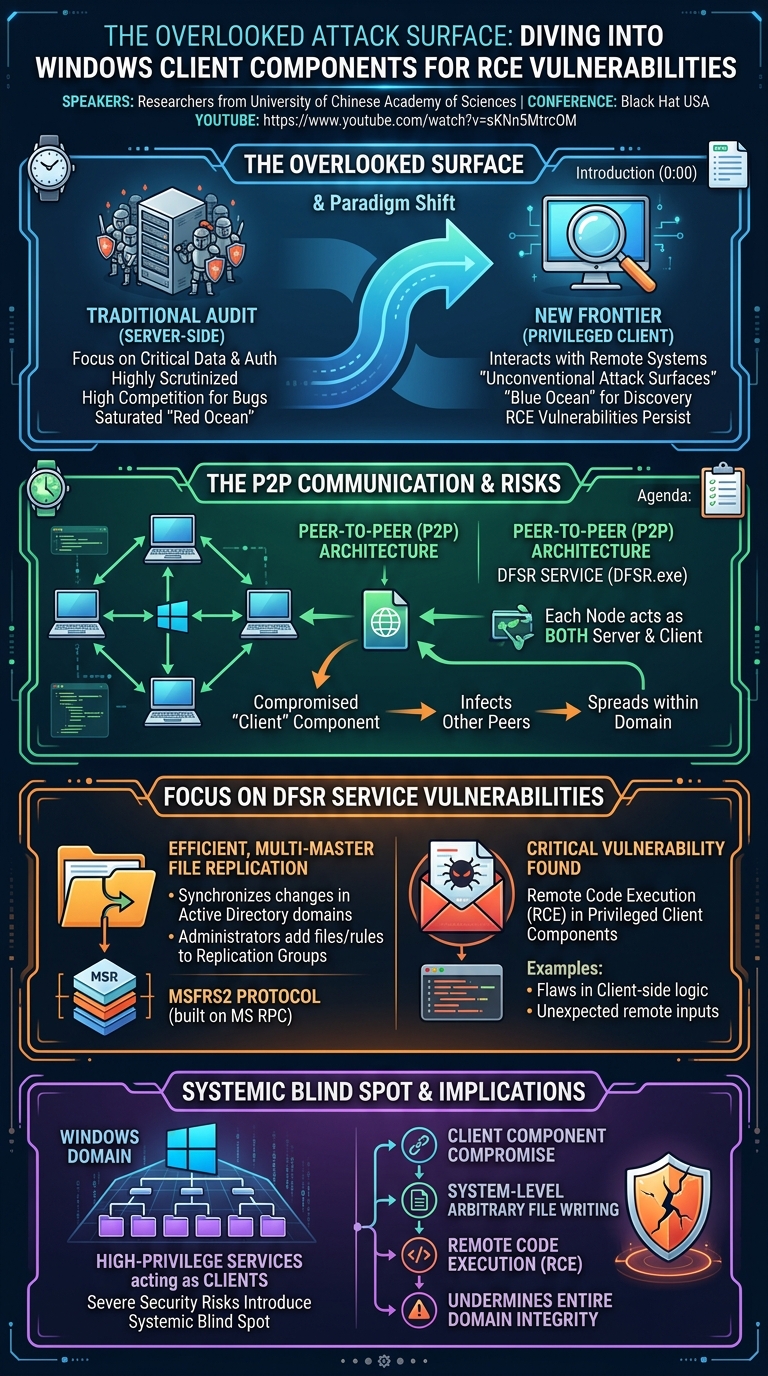
Key moments
- 0:00 Introduction and talk agenda
- 0:45 Overview of DFS service and replication groups
- 2:10 Initial DFS RCE discovery: unverified client-side data
- 3:20 The overlooked attack surface: client-side vulnerabilities
- 4:30 Why client security is critical: P2P and management
- 5:50 Performance Monitor example: high-privilege client component
- 7:00 Detailed DFS RCE root cause: file writing via symbolic links
The Overlooked Attack Surface: Diving into Windows Client Components for RCE Vulnerabilities
Speakers: Researchers from the University of Chinese Academy of Sciences
Conference: Black Hat USA
YouTube: https://www.youtube.com/watch?v=sKNn5MtrcOM
Overview
This talk, presented by researchers from the University of Chinese Academy of Sciences, sheds light on a frequently overlooked yet critical attack surface within the Windows ecosystem: privileged client-side components. While traditional security research and audits have predominantly focused on server-side vulnerabilities, especially in high-privilege services, this presentation argues that significant weaknesses persist in client components that interact with remote systems. The speakers introduce a novel perspective, urging the security community to explore these "unconventional attack surfaces" which they term a "blue ocean" for vulnerability discovery.
The core of their research centers on uncovering Remote Code Execution (RCE) vulnerabilities in these client components. They illustrate their findings through a detailed analysis of a critical vulnerability discovered in the Distributed File System Replication (DFSR) service, a fundamental component in Windows domains. This talk not only exposes a specific high-impact flaw but also provides a framework for identifying similar vulnerabilities in other client-side services, challenging long-held assumptions about the relative security importance of client versus server roles in distributed architectures.
The significance of this research lies in its potential to redirect security efforts towards a less-scrutinized area of Windows. By demonstrating that high-privilege services, when acting as clients, can introduce severe security risks, the speakers highlight a systemic blind spot. This has profound implications for enterprise security, as compromising such client components can lead to system-level arbitrary file writing and ultimately, remote code execution, undermining the integrity of entire Windows domains.
Background
▶ Watch: Introduction and talk agenda (0:00)
In the realm of cybersecurity, the focus has historically been on securing servers. This prioritization stems from the understanding that servers often host critical data, manage user authentication, and provide essential services, making them prime targets for attackers. Consequently, Microsoft and security researchers worldwide have extensively reviewed and audited remote server components, leading to a high level of scrutiny and a corresponding reduction in easily discoverable vulnerabilities on the server side. As the speakers note, "Until today, most of the remote servers have been reviewed and audited by the best security researchers worldwide."
However, this server-centric view has inadvertently created a blind spot: the security of client components, particularly those operating with elevated privileges or participating in peer-to-peer (P2P) communication architectures. The speakers emphasize that "it seems that MRC rarely disclosed client related vulnerabilities in Windows before except for critical components such as RDP client." For bug hunters, this competitive landscape on the server side makes it "more worthwhile to explore unconventional attack surfaces." Their research began with precisely such an exploration, sparked by a vulnerability they discovered in the DFSR service.
The DFSR service (DFSR.exe) is a privileged Windows service designed for efficient, multi-master file replication in Active Directory domains. It allows administrators to add files and rules to replication groups, ensuring that changes to files in one replicated folder are synchronized across multiple machines. This service operates using the MSFRS2 protocol, which is built upon MS RPC. Crucially, the DFSR service operates in a P2P communication architecture, meaning it can act as both an RPC server and an RPC client depending on the context. When a file is modified locally, DFSR acts as a server to push updates. Conversely, when it receives updates from other machines in the replication group, it acts as a client. This dual role, combined with the traditional oversight of client-side security, laid the groundwork for the vulnerabilities uncovered in this research.
Key Findings
▶ Watch: Initial DFS RCE discovery: unverified client-side data (2:10)
The central and most impactful finding of this research is the identification of privileged Windows client components as a significant, yet largely overlooked, attack surface for Remote Code Execution (RCE). The speakers argue that while server-side components have been rigorously tested, client-side services, especially those operating with high privileges or in P2P communication models, represent a "blue ocean" for vulnerability discovery.
Specifically, the researchers uncovered a critical vulnerability in the Distributed File System Replication (DFSR) service that allows for remote arbitrary file writing with System privilege. This vulnerability arises when the DFSR service, acting as an RPC client, receives data from a remote machine. The root cause is a fundamental lack of input validation: the DFSR service does not verify the file name received to be synchronized from the remote server. This oversight, when combined with the DFSR feature that synchronizes directory symbolic links, creates a powerful primitive for attackers. A malicious actor could leverage a compromised or controlled low-privileged machine within a replication group to send a crafted filename, potentially containing path traversal sequences or pointing to a symbolic link, which the high-privileged DFSR client would then blindly attempt to write to. This can lead to overwriting critical system files, ultimately resulting in RCE with System privileges.
The research further categorizes two types of client components that are particularly susceptible to such vulnerabilities:
- P2P Communication Components: In these systems, like DFSR, both the client and server operate on an equal footing. A vulnerability in the client-side logic can be just as impactful as a server-side flaw, as a compromised peer can exploit a privileged peer.
- Management Components for Cross-Network Machines: These involve high-privileged clients managing lower-privileged remote servers. In such scenarios, if the high-privileged client can be tricked into executing malicious commands or writing arbitrary files based on unverified input from the low-privileged server, the impact is severe. The speakers briefly mentioned Windows Performance Monitor for remote computers as an example of such a component, although they did not detail a specific vulnerability in it within this talk.
These findings collectively highlight a crucial shift in perspective required for comprehensive security: the security posture of a distributed system is only as strong as its weakest link, and that link can often be found on the client side, especially when privileged services are involved.
Technical Deep Dive
▶ Watch: The overlooked attack surface: client-side vulnerabilities (3:20)
The technical core of this talk revolves around the deep dive into the Distributed File System Replication (DFSR) service and the Remote Code Execution (RCE) vulnerability discovered within its client-side operations. The DFSR service, identified by its executable DFSR.exe, is a cornerstone of file management in Windows domains, enabling multi-master replication of files and folders between servers. It operates as a highly privileged service, running with SYSTEM privileges, making any vulnerability within it extremely critical.
DFSR's architecture is fundamentally peer-to-peer (P2P). This means that any machine participating in a replication group can act as both a source (server) and a destination (client) for file changes. For instance, in a replication group comprising machines A, B, and C, with shared folders C:\users\test on each, a change on machine A's C:\users\test would trigger machine A's DFSR service to act as an RPC server, pushing the update to machines B and C. Conversely, when machines B and C receive this update, their respective DFSR services act as RPC clients, processing the incoming changes. The communication underpinning this replication is based on the MSFRS2 protocol, which itself is built upon MS RPC.
The critical vulnerability emerges precisely when the DFSR service assumes its role as an RPC client. The researchers discovered that the DFSR client does not adequately verify the file name received from the remote server during the synchronization process. This lack of validation creates a dangerous primitive. An attacker, having compromised a low-privileged machine within the replication group or controlling a malicious peer, can send a specially crafted filename as part of the replication data. This filename could include:
- Path Traversal Sequences: Characters like
..\that allow moving outside the intended replication folder. - Symbolic Link Manipulation: Leveraging the DFSR service's inherent feature to synchronize directory symbolic links. If an attacker can create a symbolic link on their controlled machine that points to a sensitive system directory (e.g.,
C:\Windows\System32), and then trick the DFSR client into synchronizing a file through this symbolic link, the client will write arbitrary data to that sensitive location.
The combination of unverified filenames and symbolic link synchronization is potent. An attacker could, for example, create a symbolic link on a compromised machine pointing to C:\Windows\System32\, and then send a replication request for a file named evil.dll (or any other executable file). The high-privileged DFSR client, failing to validate the path, would resolve the symbolic link and write evil.dll into C:\Windows\System32\, effectively achieving remote arbitrary file writing with System privilege. This primitive is a common precursor to Remote Code Execution (RCE), as overwriting critical system binaries or libraries can lead to the execution of attacker-controlled code.
The speakers did not provide a specific CVE ID for this vulnerability in the talk, but they referenced a previous, more detailed presentation titled "Hunting and Exploiting Bugs in Windows File Share and Management" at Typhoon 2024 (URL: https://1dv.ms/AF.qb.s8.w67.Qga.A.qdn.lytk.Dgtya7e.imx9c) for those interested in the full exploit chain and technical specifics. This reference implies that the vulnerability has been thoroughly researched and potentially reported to Microsoft.
While the talk mentioned Performance Monitor as another example of a client component that could be vulnerable in a management scenario (where a high-privileged client monitors a low-privileged server via RPC), it did not delve into specific technical details or vulnerabilities within Performance Monitor itself. The focus remained squarely on the DFSR service as the primary technical illustration of their "overlooked attack surface" thesis.
Demo / Proof of Concept
▶ Watch: Performance Monitor example: high-privilege client component (5:50)
While the talk extensively detailed the nature and root cause of the Remote Code Execution (RCE) vulnerability in the DFSR service, it did not include a live demonstration or a new proof-of-concept (PoC) during this Black Hat USA presentation. The speakers explicitly stated that the intricate details of the DFSR vulnerability, including its full exploitation chain and a potential PoC, had been covered in their earlier "Typhoon 2024 presentation hunting and exploiting bugs in Windows file share and management."
Therefore, for those seeking a practical demonstration of how the arbitrary file writing with System privilege leads to RCE, the audience was directed to their previous work. This indicates that while the existence and mechanism of the vulnerability are well-established, this particular Black Hat talk focused more on the strategic implication of the "overlooked attack surface" rather than a live exploit walkthrough. The talk's intent was to highlight the category of vulnerabilities and the shift in research focus they advocate, using DFSR as a compelling example rather than presenting a novel exploit demonstration.
Defensive Implications
▶ Watch: Detailed DFS RCE root cause: file writing via symbolic links (7:00)
The discovery of critical vulnerabilities in privileged Windows client components, particularly the DFSR service, carries significant defensive implications for organizations running Windows environments. Defenders must adjust their security posture and threat models to account for these previously overlooked attack vectors.
- Prioritize Patching: The most immediate and crucial defensive action is to ensure that all Windows systems, especially those running the DFSR service, are fully patched. While a specific CVE number was not mentioned in the talk, the vulnerability described is severe and likely addressed by Microsoft through their regular security updates. Organizations should implement a robust patch management strategy, ensuring timely deployment of security fixes across their entire infrastructure.
- Rethink Threat Modeling for Client Components: Traditional threat models often assume clients are less critical targets than servers. This research unequivocally challenges that assumption. Defenders must expand their threat modeling to include scenarios where privileged client services, especially those involved in P2P communication or managing remote machines, could be exploited by a compromised peer or a malicious low-privileged server. This involves identifying all client-side components that interact with external or potentially untrusted data sources and assessing their input validation mechanisms.
- Network Segmentation and Least Privilege for Replication: For services like DFSR, network segmentation is vital. Isolate domain controllers and machines participating in DFSR replication groups into dedicated, highly restricted network segments. Furthermore, apply the principle of least privilege to DFSR configurations. Restrict which machines can join replication groups and ensure that only trusted, well-managed systems are part of these critical data synchronization processes. Limit the scope of replication to only necessary folders and avoid replicating sensitive system directories.
- Enhanced Monitoring and Logging: Implement enhanced monitoring for DFSR activity. Look for unusual file creation or modification events, especially in system-critical directories (e.g.,
C:\Windows\System32,C:\Program Files). Monitor for the creation or manipulation of directory symbolic links by privileged services like DFSR, as this is a key primitive for exploiting the described vulnerability. Endpoint Detection and Response (EDR) solutions should be configured to flag such suspicious behaviors.
- Secure Configuration of Replication Services: Review and harden the configuration of all replication and synchronization services. Ensure that only authenticated and authorized machines can participate in replication. If possible, enable features that enforce strict file integrity checks or digital signatures for replicated content, although the talk did not specify if MSFRS2 supports such features for filename validation.
- Supply Chain and Peer Security: Given the P2P nature of DFSR, the security of any machine within a replication group directly impacts the security of others. This implies a need for rigorous security controls on all endpoints, even those considered "low privilege," if they participate in such protocols. A compromised low-privileged machine can become an attacker's launchpad against high-privileged peers.
- Developer Education: For organizations developing their own distributed applications, this research serves as a crucial reminder for developers to implement comprehensive input validation on all received data, not just on the server side. File names, paths, and other metadata received by client components from remote sources must be treated as untrusted and thoroughly sanitized before being processed or used in file system operations.
Key Takeaways
- Overlooked Attack Surface: Windows client components, particularly privileged ones, represent a significant and largely overlooked attack surface for high-impact vulnerabilities.
- Client-Side Vulnerabilities are Critical: The traditional security focus on servers has created a blind spot; client-side vulnerabilities in privileged services can be just as, if not more, critical, leading to system-level compromise.
- DFSR RCE Vulnerability: The Distributed File System Replication (DFSR) service was found vulnerable to remote arbitrary file writing with System privilege due to a lack of filename verification when acting as an RPC client, combined with its symbolic link synchronization feature.
- P2P and Management Components at Risk: Client components involved in peer-to-peer communication or managing remote machines are particularly susceptible, as a low-privileged or compromised peer can exploit a high-privileged client.
- "Blue Ocean" for Bug Hunters: This research highlights a new frontier for security researchers, offering a "blue ocean" for discovering high-impact vulnerabilities in less-explored areas of Windows.
- Defensive Re-evaluation Needed: Organizations must re-evaluate their threat models, prioritize patching, enhance monitoring for client-side activity, and implement strict security configurations for all distributed services to counter these newly highlighted risks.
About the Speaker(s)
The research presented in this talk was conducted by a team of researchers from the University of Chinese Academy of Sciences. While specific names and individual titles were not provided in the talk's metadata or transcript, the collective effort from this academic institution highlights their contributions to uncovering novel attack surfaces and advancing the understanding of Windows security. Their work underscores the importance of academic research in identifying and addressing critical vulnerabilities that might otherwise remain undiscovered in complex software ecosystems.