Unraveling the Mind Behind the APT - Analyzing the Role of Pretexting in CTI and Attribution
Unknown
Black Hat USA 2024 · Day 1 · Briefing
Overview
In the ever-evolving landscape of cyber threats, attributing sophisticated attacks to specific Advanced Persistent Threat (APT) groups remains a formidable challenge. While traditional methods of threat intelligence focus on technical indicators, tactical sequences, and strategic victimology, a critical dimension often goes overlooked: the behavioral characteristics of the attackers themselves. Sanne, a Senior Analyst at Mandiant, presented a compelling case at Black Hat USA for integrating "Vibe Intelligence" or Vint into the cyber threat intelligence (CTI) framework, specifically for analyzing phishing campaigns launched by nation-state actors.
Key moments
- 0:00 Engaging introduction and linking pretexts to APTs
- 1:06 Speaker's background and professional experience
- 1:45 APT initial access statistics: phishing vs. exploits
- 2:18 Defining APTs and threat groups for research scope
- 3:07 Traditional technical, tactical, and strategical APT clustering
- 4:13 Introducing behavioral clustering for APT attribution
- 5:00 Demonstrating behavioral 'Vint' (Vibe Intelligence) with example
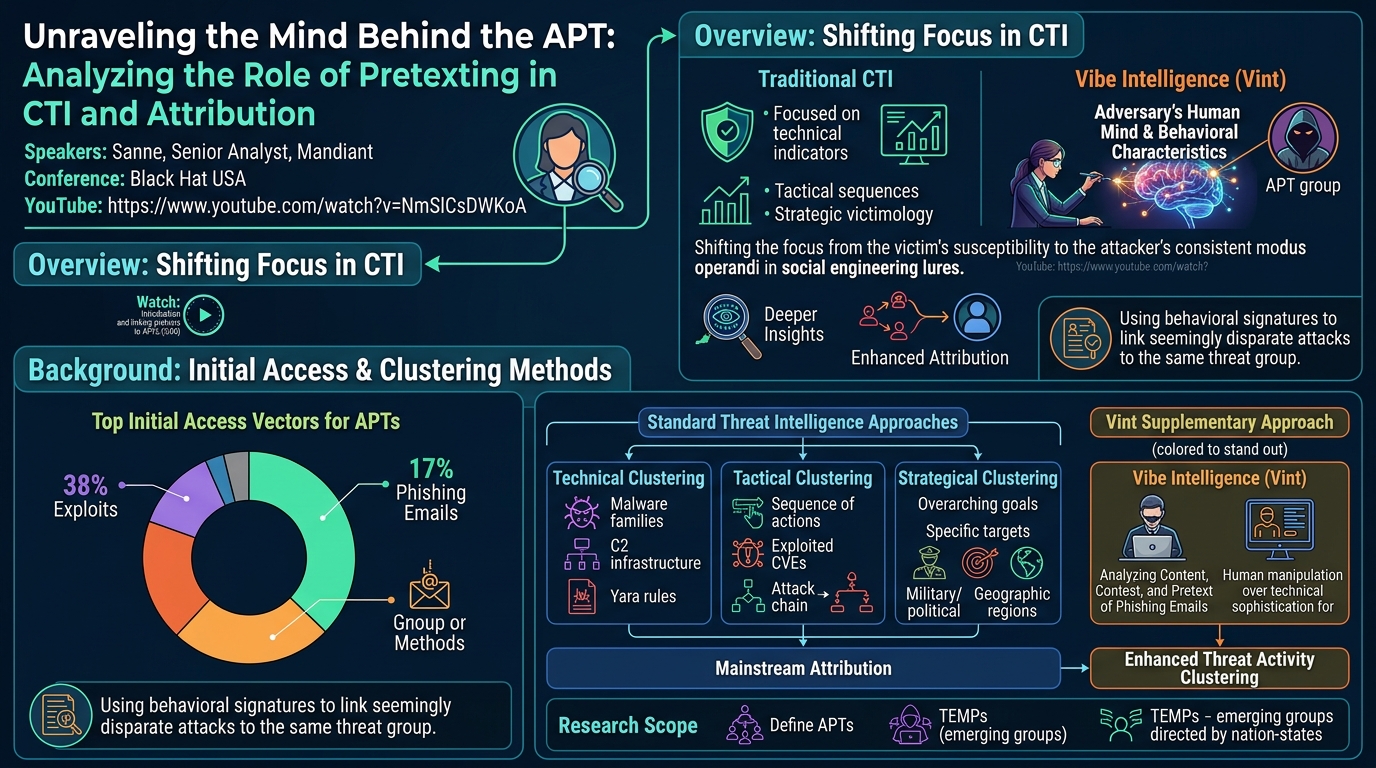
Unraveling the Mind Behind the APT - Analyzing the Role of Pretexting in CTI and Attribution
Speakers: Sanne, Senior Analyst, Mandiant
Conference: Black Hat USA
YouTube: https://www.youtube.com/watch?v=NmSlCsDWKoA
Overview
In the ever-evolving landscape of cyber threats, attributing sophisticated attacks to specific Advanced Persistent Threat (APT) groups remains a formidable challenge. While traditional methods of threat intelligence focus on technical indicators, tactical sequences, and strategic victimology, a critical dimension often goes overlooked: the behavioral characteristics of the attackers themselves. Sanne, a Senior Analyst at Mandiant, presented a compelling case at Black Hat USA for integrating "Vibe Intelligence" or Vint into the cyber threat intelligence (CTI) framework, specifically for analyzing phishing campaigns launched by nation-state actors.
This talk delves into the human element of APT operations, shifting the focus from the victim's susceptibility to the attacker's consistent modus operandi in crafting social engineering lures. By meticulously analyzing the content, context, and pretext of phishing emails, Sanne demonstrated how seemingly disparate attacks could be linked to the same threat group based on their unique behavioral signatures. This novel approach offers a powerful supplementary method for clustering threat activity, providing deeper insights into the adversary's tradecraft and enhancing the accuracy of attribution efforts.
The research highlights that despite the technical sophistication often associated with APTs, their initial access often relies on human manipulation. Understanding the subtle, yet consistent, behavioral patterns in their social engineering attempts can significantly bolster an organization's defensive posture and refine the broader CTI ecosystem.
Background
▶ Watch: Engaging introduction and linking pretexts to APTs (0:00)
The initial access vector for many sophisticated cyberattacks frequently hinges on social engineering. Sanne highlighted that in the past year, 17% of initial access for APTs was gained through phishing emails, making it the second most prevalent method after exploits, which accounted for 38%. This statistic underscores the enduring effectiveness of phishing, even against well-defended targets. However, current methods for clustering and attributing APT activity often fall short in fully leveraging the rich data contained within these phishing attempts.
Traditionally, threat intelligence professionals categorize and link threat activities using three primary approaches:
- Technical Clustering: This involves identifying shared technical artifacts, such as specific malware families, unique command-and-control (C2) infrastructure, or distinct file signatures. For example, a Yara rule detecting a particular malware signature might indicate a common origin.
- Tactical Clustering: This method focuses on the sequence of actions an adversary takes, or the specific vulnerabilities (CVEs) they exploit. If multiple campaigns employ the same attack chain or target identical flaws, they might be linked tactically.
- Strategical Clustering: This approach considers the overarching goals and targets of an APT. Groups that consistently target specific industries, geographical regions, or types of organizations (e.g., military, political, economic entities) can be clustered based on their strategic objectives.
While these methods are valuable, Sanne argued that they predominantly focus on the technical and objective aspects of an attack, neglecting the "human factor" on the attacker's side. The research scope specifically defined APTs as large groups directed by nation-states for military, political, or economic advantages. It also included TEMPs (Mandiant's designation for emerging or uncategorized threat groups that are precursors to full APTs) and UNKs (uncategorized threat clusters suspected to be linked to APTs with varying degrees of confidence). Notably, financially motivated groups, or FINs, were explicitly excluded from this research, as their often less stealthy and more scattergun approach to phishing makes their behavioral patterns less indicative of advanced, targeted threat actors. The exclusion of FINs ensures the focus remains on the more deliberate and often tailored social engineering tactics employed by nation-state actors.
The speaker emphasized that while much attention is paid to the victim's behavior (e.g., clicking a malicious link), there's an equally important, yet often unexamined, behavioral aspect on the attacker's side. The individual(s) crafting these emails, developing the pretexts, and designing the social engineering lures exhibit distinct patterns that can be analyzed and used for attribution. This gap in existing methodologies formed the core motivation for Sanne's research into behavioral characteristics of APT phishing emails.
Key Findings
▶ Watch: APT initial access statistics: phishing vs. exploits (1:45)
The central finding of Sanne's research is the introduction and validation of Vint, or Vibe Intelligence, as a crucial fourth dimension for attributing and clustering APT activities, specifically concerning phishing campaigns. Vint moves beyond traditional technical, tactical, and strategic indicators by focusing on the behavioral characteristics of the threat actor embedded within their social engineering attempts.
Sanne demonstrated that APT groups often exhibit consistent, recognizable "vibrations" or styles in their phishing emails, much like how one might recognize the writing style of an individual. This includes the choice of pretext (the cover story or scenario used to trick the victim), the specific social engineering techniques employed, and the overall content and context of the email. For example, two initial emails presented at the beginning of the talk – one offering a new car and another inviting to a wine tasting event – were linked to the same threat group not through traditional technical means, but by their shared strategic features and, crucially, their behavioral patterns in pretext and social engineering.
The research asserts that these behavioral patterns are not accidental; they reflect the preferences, cultural context, operational constraints, and even the "personality" of the individuals or teams behind the APT. By analyzing elements such as:
- The chosen scenario (e.g., a service desk request, a professional networking event, a personal interest lure).
- The language used, including specific phrases, tone, and grammatical quirks.
- The type of urgency or fear invoked.
- The instructions given to the victim.
- The perceived sender's identity.
Threat intelligence analysts can develop a "gut feeling" or Vint that allows them to intuitively link seemingly disparate phishing attempts. This "if it walks like a duck, squawks like a duck" principle, as Sanne put it, becomes a quantifiable and actionable intelligence category. The speaker provided an example of two phishing emails, both purporting to be from a service desk and instructing recipients to install software via a malicious link. While these might be technically distinct in their payloads or infrastructure, their identical pretext, scenario, and instructions strongly suggested a common origin, which was confirmed to be the same APT group. This highlights the power of Vint to identify underlying connections that might be missed by purely technical or strategic analysis.
Technical Deep Dive
▶ Watch: Defining APTs and threat groups for research scope (2:18)
The "technical deep dive" in the context of Vint does not refer to code analysis or network protocols, but rather a methodological deep dive into the qualitative analysis of phishing campaigns. It's about systematically deconstructing the human-centric aspects of an attack to uncover the attacker's behavioral fingerprint. This involves a rigorous examination of the content and context of phishing emails.
The core of this analysis lies in dissecting the pretext – the fabricated narrative designed to manipulate the recipient. Threat actors do not randomly choose pretexts; they often reuse successful ones, adapt them to target specific industries or individuals, or develop signature themes. The process of behavioral analysis involves:
- Pretext Identification and Categorization:
- What is the overt topic of the email? (e.g., IT service desk, HR update, financial transaction, professional event, personal interest).
- What is the underlying psychological trigger? (e.g., urgency, fear, curiosity, authority, greed).
- Are there common themes or recurring scenarios? (e.g., "install this update," "your account is locked," "new policy document").
The examples given, like "new car offers" or "wine tasting events," illustrate how specific pretexts can be linked. The service desk email example, where two distinct emails shared the same scenario and instructions, further solidifies this concept.
- Social Engineering Technique Analysis:
- How does the email attempt to persuade the victim? Is it through a sense of authority (e.g., IT department), urgency (e.g., "action required immediately"), or relevance (e.g., "important information for your role")?
- Are there specific linguistic patterns, grammatical errors, or stylistic choices that are consistent across different emails attributed to the same group? These could include unusual phrasing, specific salutations or closings, or even the way instructions are formatted.
- What is the specific call to action? (e.g., click a link, open an attachment, reply to the email, provide credentials). The nature and specificity of these instructions can be highly indicative.
- Contextual Analysis:
- Who is the email purporting to be from? (e.g., internal IT, a known vendor, a conference organizer, a colleague).
- What specific information is leveraged to make the email seem legitimate? (e.g., references to real-world events, company policies, industry-specific jargon).
- How is the email tailored to the target? Is it a generic lure or a highly personalized spear-phishing attempt? Even the level of personalization can be a behavioral characteristic.
By compiling and comparing these qualitative data points across numerous phishing campaigns, analysts can begin to identify recurring patterns that form an APT's behavioral signature. This is not about a single indicator, but a holistic assessment of the "vibe" that an attacker consistently projects. For instance, an APT might consistently use pretexts related to human resources, always demanding immediate action, and frequently employing specific grammatical errors or a particular tone of formality or informality. These subtle, yet persistent, elements contribute to the overall Vint and allow for a more nuanced and accurate form of attribution, especially for uncategorized threat clusters (UNKs) that might otherwise lack sufficient technical or tactical evidence to be merged with known APTs. This approach adds a critical layer of human-centric intelligence to the existing machine-driven and strategic CTI frameworks.
Demo / Proof of Concept
▶ Watch: Introducing behavioral clustering for APT attribution (4:13)
While the talk did not feature a live, interactive technical demonstration or a novel software-based proof of concept, Sanne effectively demonstrated the core principles of Vint through compelling real-world examples. The presentation began by showcasing two distinct phishing emails: one themed around a new car offer and another around a wine tasting event. These were initially presented as potentially unrelated but were then revealed to be linked to the same threat group based on their strategic and, crucially, behavioral features.
A more direct example illustrating the power of Vint was the comparison of two phishing emails, both masquerading as internal service desk communications. These emails instructed recipients to install certain software and included a malicious link. Despite potential differences in their underlying technical payloads or delivery mechanisms, the striking similarity in their chosen scenario, the specific instructions provided, and the overall "vibe" or pretext strongly suggested a common author. Sanne confirmed that these two emails were indeed attributed to the same APT group. This served as a practical illustration of how Vint allows analysts to move beyond purely technical indicators and recognize the consistent behavioral patterns of threat actors in their social engineering craft. The examples served as powerful evidence for the validity and utility of behavioral analysis in attributing APT phishing campaigns.
Defensive Implications
▶ Watch: Demonstrating behavioral 'Vint' (Vibe Intelligence) with example (5:00)
The integration of Vibe Intelligence (Vint) into an organization's threat intelligence and defensive strategies offers several critical implications for bolstering cybersecurity. By understanding the behavioral characteristics of APTs, defenders can move beyond reactive indicator-based defenses to more proactive and adaptive security measures.
- Enhanced Phishing Detection and Prevention: Security teams should develop an understanding of common pretexts and social engineering patterns used by APTs targeting their sector or region. This knowledge can be fed into email security gateways, not just for technical indicators like malicious URLs or attachments, but for behavioral cues. Machine learning models could be trained on these behavioral features to identify anomalous or signature-matching pretexts.
- Improved Security Awareness Training: Traditional security awareness often focuses on generic advice ("don't click suspicious links"). Vint allows for more targeted and effective training. Organizations can educate employees about the specific types of pretexts, language patterns, and social engineering tactics that known APTs use against them. For example, if a specific APT consistently uses "HR policy update" pretexts with a particular tone, employees can be specifically trained to recognize and report such emails. This transforms generic training into intelligence-driven education.
- Refined Threat Hunting: Threat hunters can actively search for emails exhibiting known behavioral patterns, even if the technical indicators (IPs, domains, hashes) are novel or have changed. This involves analyzing email content, subject lines, sender masquerading techniques, and calls to action against a library of known APT behavioral signatures. This proactive approach can identify new campaigns from known adversaries before they fully mature.
- Strengthened Attribution and Threat Intelligence: For CTI teams, Vint provides a powerful new lens for clustering uncategorized threat activity (UNKs) and linking them to established APTs with higher confidence. This improved attribution enhances the overall understanding of adversary capabilities, intentions, and operational tempo. Better attribution leads to more precise threat modeling and resource allocation for defense.
- Focus on the Human Firewall: Recognizing that APTs rely heavily on human exploitation, organizations should invest in robust processes for reporting suspicious emails and fostering a culture of caution. By understanding the attacker's behavioral playbook, employees become more effective "human firewalls," capable of discerning subtle manipulative tactics that automated systems might miss.
- Developing Behavioral Signatures: Similar to how Yara rules are used for malware, organizations can develop internal "behavioral signatures" or profiles for APT groups. These profiles would document preferred pretexts, social engineering vectors, linguistic quirks, and common scenarios. This allows for a more structured and consistent application of Vint across an organization's defensive operations.
By embracing Vint, defenders can gain a more holistic and human-centric view of their adversaries, allowing them to anticipate and counter phishing campaigns with greater precision and efficacy.
Key Takeaways
- Vint (Vibe Intelligence) is a crucial, often overlooked, dimension in APT attribution, complementing technical, tactical, and strategic clustering. It focuses on the behavioral characteristics of threat actors in their social engineering.
- Phishing remains a highly effective initial access vector for APTs, accounting for 17% of initial access last year, second only to exploits (38%). This underscores the importance of understanding and defending against social engineering.
- APT groups exhibit consistent behavioral patterns in their phishing emails, including specific choices of pretext, social engineering techniques, and overall content/context. These patterns can be used to link seemingly disparate campaigns.
- Analyzing the "human factor" on the attacker's side—how they craft emails, choose scenarios, and formulate instructions—provides deep insights into their tradecraft. This allows for a more nuanced understanding of adversary operations.
- Defenders can leverage Vint to improve phishing detection, enhance security awareness training with specific examples, and conduct more effective threat hunting for behavioral signatures. This shifts defense from reactive to proactive.
- Excluding financially motivated groups (FINs) from behavioral analysis is important, as their less stealthy and advanced methods can dilute the distinct patterns of nation-state APTs.
About the Speaker(s)
Sanne is a Senior Analyst at Mandiant, bringing a wealth of experience from various facets of cybersecurity. Prior to joining Mandiant, she honed her skills as a red teamer, gaining practical insights into the creation and deployment of numerous phishing emails. Following her red teaming tenure, Sanne contributed to the Dutch NCSC (National Cyber Security Centre), where she specialized in analyzing emerging threats. Outside of her professional role, Sanne is deeply passionate about cybersecurity education and community building. She coaches the European CTF team, which is backed by Enisa, and runs her own platform, Hack Challenges, dedicated to teaching children how to hack. Her diverse background in offensive security, national threat analysis, and educational outreach provides her with a unique and comprehensive perspective on threat actor methodologies and defensive strategies.