Will We Survive the Transitive Vulnerability Locusts?
Unknown
Black Hat USA 2024 · Day 1 · Briefing
Overview
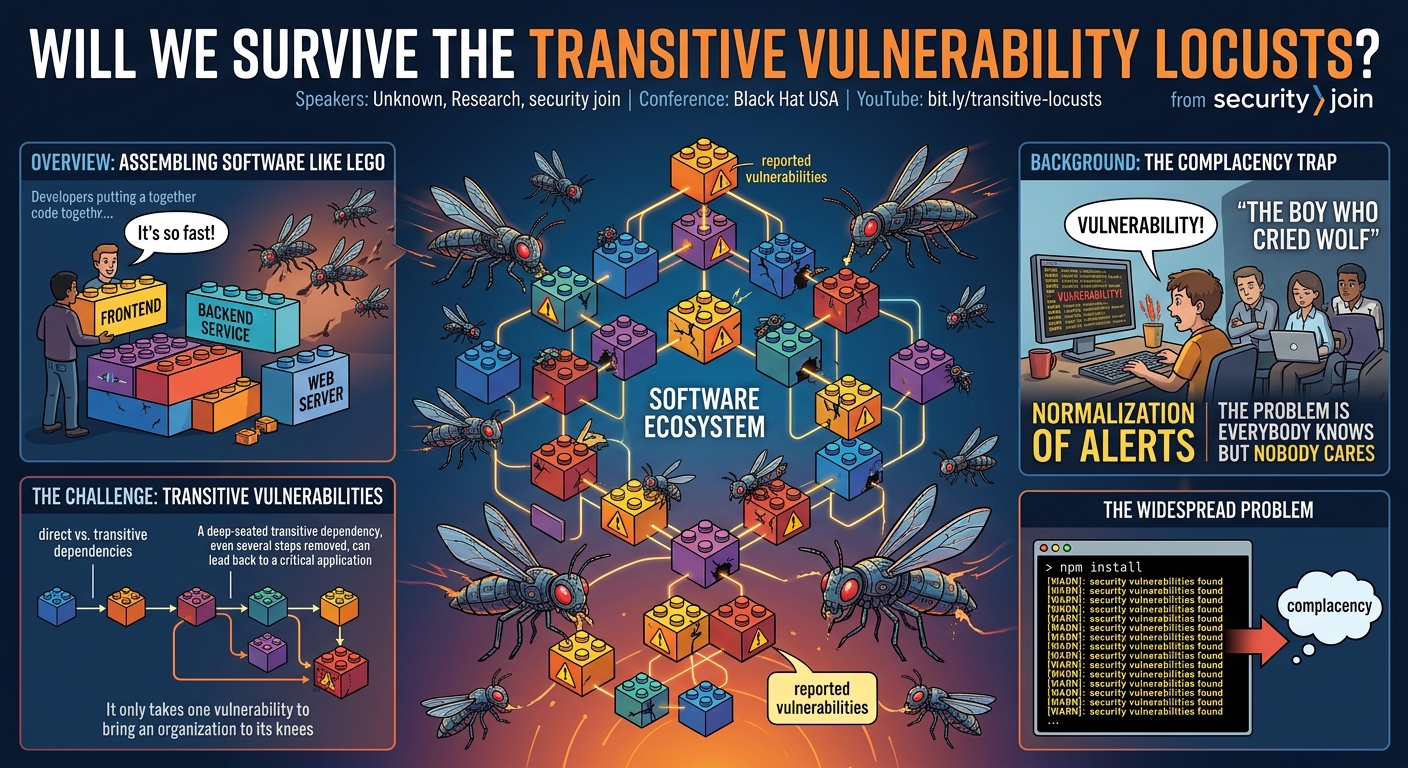
In an era where software development increasingly relies on assembling existing components like "Lego," the proliferation of open-source dependencies has introduced a pervasive and often underestimated security challenge: transitive vulnerabilities. This talk addresses the critical issue of Software Composition Analysis (SCA), highlighting how organizations often neglect the vast number of reported vulnerabilities in their dependency trees, akin to the fable of "the boy who cried wolf." The speaker, a seasoned security researcher from "security join," argues that despite the daily sight of numerous security warnings during routine operations like npm install, the industry's collective indifference leaves many organizations exposed. The presentation delves into a scalable methodology for identifying genuinely exploitable vulnerabilities within these complex dependency graphs, moving beyond mere detection to determine actual risk. It emphasizes that it only takes "one vulnerability to bring an organization to its knees" and offers practical defensive strategies to counter these "transitive vulnerability locusts."
Key moments
- 0:30 The widespread problem of ignored SCA warnings
- 2:15 Understanding SCA and the challenge of transitive dependencies
- 3:50 Explanation of Parse Server open source vulnerability
- 4:50 Researching direct open source vulnerability exploitation likelihood
- 6:20 Scalable five-step methodology for vulnerability analysis
- 7:40 Utilizing LLMs for automated vulnerability triage
- 9:00 Practical mitigation strategies like virtual patching and WAFs
Will We Survive the Transitive Vulnerability Locusts?
Speakers: Unknown, Research, security join
Conference: Black Hat USA
YouTube: https://www.youtube.com/watch?v=DVlFHen9hh0
Overview
In an era where software development increasingly relies on assembling existing components like "Lego," the proliferation of open-source dependencies has introduced a pervasive and often underestimated security challenge: transitive vulnerabilities. This talk addresses the critical issue of Software Composition Analysis (SCA), highlighting how organizations often neglect the vast number of reported vulnerabilities in their dependency trees, akin to the fable of "the boy who cried wolf." The speaker, a seasoned security researcher from "security join," argues that despite the daily sight of numerous security warnings during routine operations like npm install, the industry's collective indifference leaves many organizations exposed. The presentation delves into a scalable methodology for identifying genuinely exploitable vulnerabilities within these complex dependency graphs, moving beyond mere detection to determine actual risk. It emphasizes that it only takes "one vulnerability to bring an organization to its knees" and offers practical defensive strategies to counter these "transitive vulnerability locusts."
The core of the discussion revolves around understanding the true exploitability of both direct and transitive dependencies. Many vulnerabilities reported by SCA tools are not actively imported or used in a way that makes them exploitable in a given application. This talk introduces a multi-step approach that combines dependency graph analysis, code import verification, and the sophisticated application of Large Language Models (LLMs) and statistical probabilities to filter out noise and pinpoint critical risks. By focusing on real-world examples, such as the widely used Parse Server project, the speaker illustrates how even seemingly minor flaws in deep-seated dependencies can be leveraged, underscoring the urgent need for a more nuanced and automated approach to software supply chain security.
Background
▶ Watch: The widespread problem of ignored SCA warnings (0:30)
The modern software development paradigm is fundamentally built on reuse. Developers rarely start from scratch, instead leveraging a vast ecosystem of open-source libraries, frameworks, and modules to accelerate development. As the speaker aptly puts it, software is "being composed like Lego." Whether building a web server, a frontend application, or a backend service, teams integrate readily available components, significantly boosting productivity. However, this convenience comes with a substantial security overhead. Each chosen dependency often brings its own set of dependencies, known as transitive dependencies, which in turn might have their own dependencies, creating a sprawling and intricate web.
This intricate dependency graph is precisely where the "security baggage" accumulates. When a developer runs a command like npm install in a JavaScript project, they are frequently confronted with a torrent of warnings and vulnerability reports. The speaker recounts a personal experience from seven or eight years prior, where the sheer volume of these warnings in a new JavaScript project was mind-boggling, only to be dismissed by a team leader with "don't worry about it, it's nothing, forget about it." This anecdote perfectly encapsulates the widespread attitude: a normalization of vulnerability alerts leading to a dangerous complacency. The problem is so prevalent that "everybody knows about those kind of [vulnerabilities] but nobody cares."
This apathy is critical because, as the speaker warns, it mirrors the fable of "the boy who cried wolf." While many reported vulnerabilities might indeed be false positives or non-exploitable in context, there are genuine "wolves out there." The challenge lies in distinguishing the noise from the signal. The industry-standard approach to managing this complexity is Software Composition Analysis (SCA), which aims to identify and inventory all open-source components within an application and their associated vulnerabilities. However, the sheer volume of alerts generated by traditional SCA tools often overwhelms security teams, leading to a triage backlog and, ultimately, the dismissal of potentially critical threats. The underlying issue is not just the existence of vulnerabilities, but the inability of organizations to effectively prioritize and address the ones that pose a real, exploitable risk to their applications.
Key Findings
▶ Watch: Explanation of Parse Server open source vulnerability (3:50)
The talk highlights several critical findings regarding the nature and management of transitive vulnerabilities:
Firstly, the problem of widespread, ignored vulnerabilities in software dependencies is not merely theoretical but a pervasive reality across "every organization." The speaker's observation of developers routinely seeing and dismissing npm install warnings underscores a deep-seated issue of security fatigue and a lack of effective prioritization mechanisms. This normalization of alerts is a significant barrier to improving software supply chain security.
Secondly, a crucial insight is that a significant percentage of reported vulnerabilities in manifest files do not translate to actual risk within the application's codebase. The research found that approximately 10% of applications declared in manifest files are never actually imported into the code. This discrepancy can arise from developers changing libraries but neglecting to update manifest files, leading to a substantial amount of "noise" in SCA reports. This finding directly challenges the efficacy of basic SCA scans that only check manifest files, emphasizing the need for deeper code analysis.
Thirdly, the speaker demonstrates that exploitation of open-source vulnerabilities can be remarkably straightforward, often requiring minimal effort. In the context of the Parse Server example, the Proof of Concept (POC) code necessary for exploitation was "very very simple" and, in fact, "a part of the advisory that it was published on the security advisory website." This suggests that attackers do not always need sophisticated zero-day exploits; readily available information and simple code snippets can be sufficient to compromise systems through known, unpatched, or improperly used open-source components.
Finally, the talk implicitly finds that manual triage of SCA findings is unsustainable and inefficient. The volume and complexity of dependency graphs necessitate a scalable, automated approach that goes beyond human analysis. The proposed methodology, leveraging dependency graph construction, code import verification, Large Language Models (LLMs) for usage analysis, and statistical probabilities, represents a significant finding in how organizations can move towards a more accurate and efficient assessment of true exploitability, thereby filtering out the "boy who cried wolf" scenarios and focusing on genuine threats.
Technical Deep Dive
▶ Watch: Researching direct open source vulnerability exploitation likelihood (4:50)
The core technical contribution of this talk lies in its proposed methodology for accurately assessing the exploitability of vulnerabilities within complex dependency trees, moving beyond simple detection to a nuanced understanding of risk. This process addresses the critical question: "What is the likelihood of a direct vulnerability coming from an open source dependency to be exploited?"
The speaker outlines a five-step methodology, though not all five are explicitly named with distinct titles, their functions are clearly described:
- Building a Comprehensive Dependency Graph:
The first step involves constructing a detailed map of all dependencies, both direct and transitive. Unlike basic npm audit commands that might only show top-level issues, this approach meticulously parses manifest files (e.g., package.json for Node.js, requirements.txt for Python) to identify every component an application relies upon. This creates a "huge [graph] of your dependencies and their dependencies," forming the foundational understanding of the software's composition. This graph is crucial for tracing the origin of vulnerabilities deep within the supply chain.
- Verifying Code Imports:
Once the dependency graph is established, the next crucial step is to determine if the identified dependencies are actually being used by the application's source code. The speaker highlights a significant insight here: "10% of applications that are imported in in the manifest files are never imported in code." This can occur if a developer switches libraries but leaves the old entry in the manifest, or if a dependency is pulled in by a transitive chain but never explicitly invoked by the main application logic. By checking actual import or require statements, organizations can immediately filter out a substantial portion of non-issues, significantly reducing the noise in SCA reports.
- Analyzing Exploitable Usage with LLMs:
For dependencies that are indeed imported, the methodology then shifts to a more granular analysis: determining if the vulnerable code path is actually invoked in an exploitable manner. This is where the talk introduces a novel application of Large Language Models (LLMs). Traditionally, this step involves laborious manual code review by security engineers. The LLM-driven approach aims to automate this by taking "all of the data from the previous steps and all of the context... especially the usage part," including "the arguments and the flags and the objects that you use in order to use the dependency." The LLM is tasked with analyzing how the dependency is integrated and used within the application to reach a "conclusion that the code is actually exploitable." This significantly scales the triage process, replacing time-consuming human effort with automated intelligence.
The speaker illustrates the concept of exploitable usage with an example involving a vulnerable Web Socket Server library (version 8.16) used within the Parse Server application. The vulnerability was an other overflow leading to a null reference and application crash. The key insight was that "the default usage of the web socket server is missing a flag which make it vulnerable." This means the vulnerability wasn't just present in the library, but the application's specific way of initializing or interacting with it (or rather, not interacting with it by omitting a crucial flag) created the exploitable condition. A malicious packet with "many many others" (likely referring to HTTP headers or similar fields) could then trigger the crash.
- Statistical Approach for Transitive Vulnerability Exploitation:
While LLMs can provide deep analysis, applying them to every potential transitive vulnerability can be computationally expensive. To address this, the methodology incorporates a "statistical way" to assess transitive risks. The insight here is that "the transitive one is the direct of a direct dependency." This means that for a transitive vulnerability to be exploitable, it must satisfy not only its own conditions but also the conditions of all its parent dependencies up the chain. As one goes "deeper and deeper," more preconditions must be fulfilled, inherently decreasing the probability of exploitability. The talk suggests leveraging existing CWE Exploitation Probabilities and inferring that the likelihood of a transitive vulnerability being exploitable decreases proportionally with its depth in the dependency tree. This allows for a more efficient prioritization of resources, focusing LLM analysis on higher-probability, direct, or shallow transitive vulnerabilities, while using statistical models for the broader, deeper graph.
In essence, the technical deep dive presents a sophisticated, multi-layered approach to SCA that moves beyond superficial scanning. It combines robust dependency mapping, precise code analysis for actual usage, and intelligent automation (LLMs and statistical models) to provide a more accurate and scalable assessment of an application's true vulnerability posture in the face of complex dependency chains.
Demo / Proof of Concept
▶ Watch: Utilizing LLMs for automated vulnerability triage (7:40)
The talk intended to feature a live demonstration of a real-world exploitation scenario, specifically targeting an open-source dependency within the latest version of Parse Server, a popular project for full-stack applications. Unfortunately, due to technical issues (internet connectivity), the demo could not be loaded and executed live during the presentation.
Despite the demo not being shown, the speaker clearly described its intended outcome and the underlying mechanism. The demonstration would have involved crafting a malicious packet, which was visually represented by a packet capture recording on the right side of the slide. This specially designed packet, when sent to the vulnerable Parse Server instance, would have triggered an exploitation. The Proof of Concept (POC) code required for this exploitation was notably simple; the speaker mentioned it was so straightforward that they "didn't even had to develop it," as it was "actually a part of the advisory that it was published on the security advisory website."
This description strongly implies that the demo was related to the Web Socket Server vulnerability discussed earlier, where a missing flag in the server's default usage made it susceptible to an "other overflow" leading to a "null reference" and application crash. The malicious packet would likely have contained an excessive number of headers or malformed data designed to trigger this specific overflow condition, demonstrating how a simple omission in configuration or usage of a common library could lead to a critical application failure. The inability to show the live exploit underscored the speaker's point about the ease with which such vulnerabilities, even those with publicly documented POCs, can be leveraged by attackers.
Defensive Implications
▶ Watch: Practical mitigation strategies like virtual patching and WAFs (9:00)
Understanding the pervasive nature and exploitability of transitive vulnerabilities is only half the battle; implementing effective defenses is paramount. The speaker, drawing from a network security background, emphasizes practical, actionable strategies that organizations can adopt.
- Basic Security Hygiene and Virtual Patching:
The first line of defense, described as "the basics" for security professionals, involves strategic virtual patching. This means deploying a security solution in front of the application to intercept and neutralize malicious requests before they reach the vulnerable code. Virtual patching essentially applies a protective layer, preventing known attack patterns from exploiting underlying flaws without requiring immediate code changes or redeployments. This is particularly useful for dependencies that are difficult or time-consuming to patch directly.
- Leveraging API Security Solutions and Web Application Firewalls (WAFs):
A key recommendation is the deployment of robust security systems such as API security solutions or Web Application Firewalls (WAFs). The speaker confidently states that "most or every WAF solution that is out there should detect this kind of exploitation very very easily." The malicious packet demonstrated (or intended to be demonstrated) against Parse Server was characterized as "very very clear that this is a malicious pocket." This highlights that many common exploitation techniques for dependency vulnerabilities, especially those involving malformed requests or overflows, are often detectable by modern WAFs and API gateways. Deploying such systems can "save you a lot of trouble" by providing an immediate, network-level defense against known attack vectors.
- Direct Patching for Unmaintained Projects:
While virtual patching and WAFs offer a protective layer, direct code-level patching remains the most robust solution. The speaker acknowledges that not all open-source projects are "well maintained," making it difficult to rely on official updates. In such cases, organizations with a "mature program" and the necessary resources can apply patches themselves. An example was shown on the slides: "This is actually the patch that was applied on the W module." This illustrates that even if an upstream project is dormant, implementing the necessary code fix internally can be "really really simple" and "not complicated," directly mitigating the vulnerability at its source. This approach requires development resources but offers the highest level of assurance.
In summary, the defensive implications revolve around a multi-layered strategy: using network-level controls like WAFs for immediate protection and virtual patching, while also investing in the capability to apply direct code patches for critical vulnerabilities, especially in less maintained open-source components. This combination allows organizations to address both the immediate threat landscape and the long-term health of their software supply chain.
Key Takeaways
- Pervasive Neglect of Dependency Vulnerabilities: Despite widespread awareness and daily encounters with SCA warnings (e.g.,
npm install), organizations commonly dismiss or deprioritize these "transitive vulnerability locusts," creating significant security debt. - Beyond Simple Detection to True Exploitability: A significant percentage (around 10%) of reported vulnerabilities in manifest files are not actually imported or used in an exploitable way by the application, necessitating a deeper analysis beyond basic SCA scans.
- Multi-Step Methodology for Scalable Triage: Effective vulnerability management requires a systematic approach involving comprehensive dependency graph construction, verification of code imports, and intelligent analysis of usage patterns, including the application of Large Language Models (LLMs) for determining exploitability.
- Statistical Prioritization for Transitive Risks: For deep transitive dependencies, a statistical approach leveraging CWE Exploitation Probabilities can efficiently estimate exploitability likelihood, allowing for resource-effective prioritization over computationally intensive LLM analysis for every component.
- Layered Defensive Strategies are Crucial: Basic security measures like virtual patching, deploying Web Application Firewalls (WAFs), or API security solutions can effectively detect and block common exploitation attempts, acting as a critical first line of defense.
- Empowerment for Direct Patching: For unmaintained open-source projects, organizations should be prepared and capable of applying direct code-level patches themselves, a process often described as "simple" and highly effective in mitigating specific risks.
About the Speaker(s)
The speaker, whose name is not explicitly stated in the transcript but is listed as "Unknown" in the metadata, is a seasoned security professional currently working at "security join." They introduced themselves as having joined the company three years prior, focusing on research into application security problems. Before transitioning to application security, their background was primarily in network security and threat intelligence research. The speaker mentioned a personal journey starting as a "script kiddy" who enjoyed "hacking stuff, breaking things," and is now on "the other side," dedicated to developing detection systems, ranging from Proof of Concepts (POCs) to production-ready remediation tools. This diverse experience across offensive and defensive security, coupled with their current role in research and development, positions them uniquely to discuss the complexities of software supply chain vulnerabilities.