Windows Downdate: Downgrade Attacks Using Windows Updates
Unknown
Black Hat USA 2024 · Day 1 · Briefing
Overview
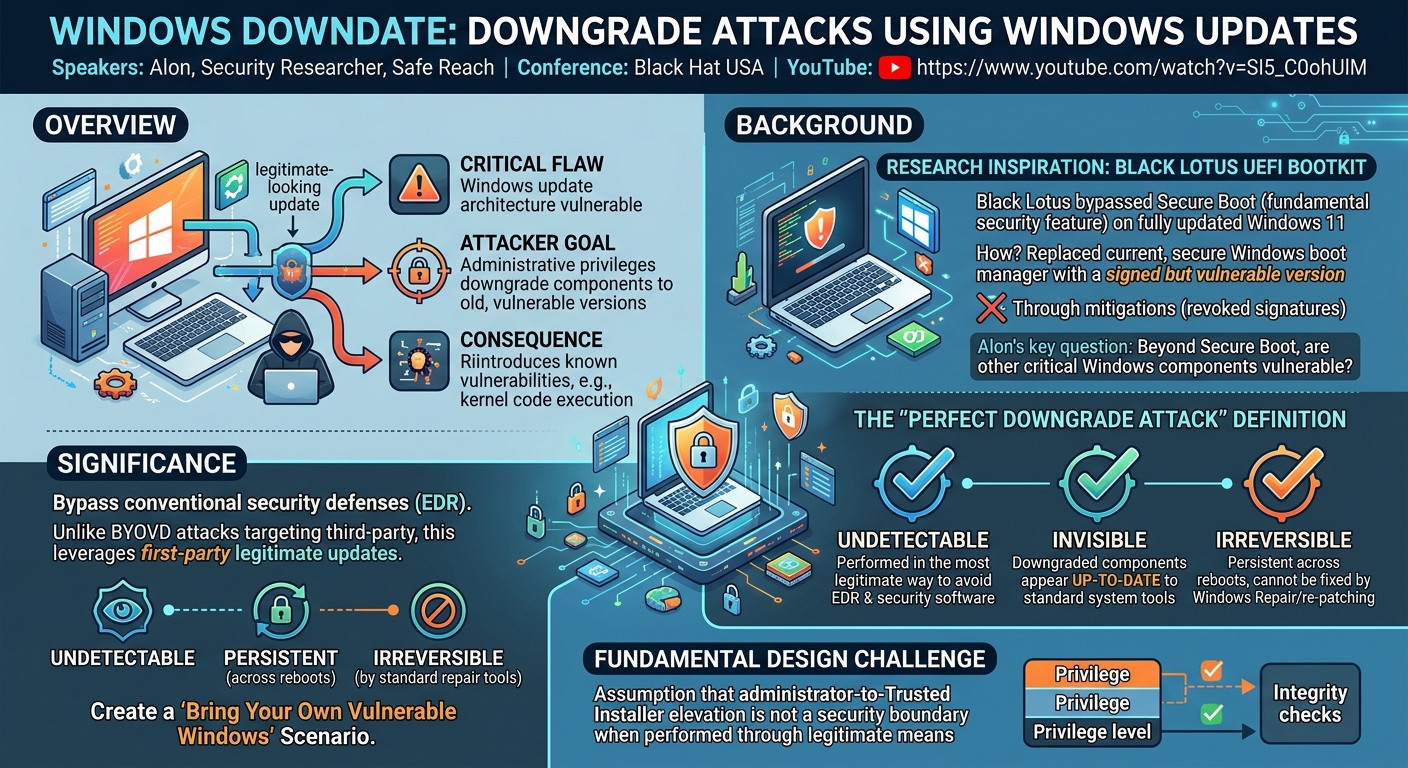
In this compelling talk, security researcher Alon from Safe Reach unveils a novel class of attack dubbed "Windows Downdate," demonstrating how Windows's own update mechanisms can be subverted to perform sophisticated downgrade attacks. The research highlights a critical flaw in the Windows update architecture, allowing an attacker with administrative privileges to downgrade fully patched system components, including kernel drivers, to old, vulnerable versions. This reintroduction of known vulnerabilities can then be exploited for severe system compromise, such as kernel code execution.
Key moments
- 0:00 Introduction to downgrade attacks and Black Lotus
- 2:50 Defining characteristics of a perfect downgrade attack
- 3:40 Revealing Windows Updates as the unexpected target
- 4:30 Identifying core design flaw in Windows Update architecture
- 5:20 Overview of simplified Windows Update process flow
- 7:40 Crucial insight: What update components are not signed
Windows Downdate: Downgrade Attacks Using Windows Updates
Speakers: Alon, Security Researcher, Safe Reach
Conference: Black Hat USA
YouTube: https://www.youtube.com/watch?v=SI5_COohUlM
Overview
In this compelling talk, security researcher Alon from Safe Reach unveils a novel class of attack dubbed "Windows Downdate," demonstrating how Windows's own update mechanisms can be subverted to perform sophisticated downgrade attacks. The research highlights a critical flaw in the Windows update architecture, allowing an attacker with administrative privileges to downgrade fully patched system components, including kernel drivers, to old, vulnerable versions. This reintroduction of known vulnerabilities can then be exploited for severe system compromise, such as kernel code execution.
The significance of this research lies in its ability to bypass conventional security defenses. Unlike traditional "bring your own vulnerable driver" (BYOVD) attacks that often target third-party components and are frequently flagged by Endpoint Detection and Response (EDR) solutions, Windows Downdate leverages legitimate, first-party update processes. This allows the downgrade to remain largely undetectable, persistent across reboots, and irreversible by standard repair tools, effectively creating a "bring your own vulnerable Windows" scenario where the operating system itself is forced to regress to an exploitable state.
Alon's work underscores a fundamental design challenge in Windows security: the assumption that an administrator-to-Trusted Installer elevation is not a security boundary when performed through legitimate means. By meticulously detailing the Windows update flow and exposing how its integrity checks can be circumvented, the talk presents a powerful new attack vector that demands immediate attention from both Microsoft and security practitioners.
Background
▶ Watch: Introduction to downgrade attacks and Black Lotus (0:00)
The concept of a downgrade attack involves forcing an updated and patched software component to revert to an older, vulnerable version. This reintroduces previously fixed flaws, allowing attackers to exploit known vulnerabilities that security updates were designed to eliminate. Alon's research was initially inspired by the infamous Black Lotus UEFI bootkit, which made headlines for its ability to bypass Secure Boot on fully updated Windows 11 systems.
Secure Boot is a fundamental security feature designed to verify that every component in the boot chain is digitally signed, ensuring that only trusted software is loaded during startup. Black Lotus circumvented this by performing a downgrade attack: it replaced the current, secure Windows boot manager with a signed but vulnerable version. Although Microsoft had implemented mitigations, primarily by revoking the digital signatures of known vulnerable boot managers and applications, Black Lotus demonstrated that the mechanism could still be exploited if the vulnerable component was somehow reintroduced.
This sparked Alon's central research question: Beyond Secure Boot, are there other critical Windows components that might be vulnerable to similar downgrade attacks? The existing landscape of "bring your own vulnerable driver" (BYOVD) attacks typically focuses on third-party drivers, often relying on known privilege escalation vulnerabilities in those components. Alon envisioned a more impactful threat: targeting first-party Windows entities, including those residing at or even below the kernel level, to create a new category of "bring your own vulnerable Windows."
To achieve this ambitious goal, Alon defined the criteria for a "perfect downgrade attack":
- Undetectable: The downgrade must be performed in the most legitimate way possible to avoid detection by EDRs and other security software.
- Invisible: The downgraded components should appear up-to-date to standard system checks, masking their vulnerable state.
- Persistent: The downgrade must survive future software updates, ensuring the vulnerable state remains active.
- Irreversible: Scanning and repairing tools should be unable to detect or revert the downgrade.
With these stringent requirements, Alon sought the least expected vector for performing such an attack and identified Windows Updates as the prime candidate. This choice was strategic, as Windows Update is a highly trusted, integral part of the operating system, making any subversion of its processes particularly insidious.
Key Findings
▶ Watch: Revealing Windows Updates as the unexpected target (3:40)
Alon's research uncovered a critical vulnerability within the trusted Windows Update process itself, allowing for sophisticated and stealthy downgrade attacks. The primary findings can be summarized as follows:
- Abuse of Windows Update Architecture: The talk demonstrates that the seemingly robust Windows Update mechanism, designed to secure and maintain the operating system, can be co-opted by an attacker with administrative privileges to perform malicious downgrades.
- Administrator to Trusted Installer is Not a Security Boundary (in context): A core design flaw identified is the interaction between administrator privileges and the Trusted Installer account. While Trusted Installer is intended to protect critical system files, files initially managed by Windows Update are only accessible to Trusted Installer. However, the talk highlights that administrator-to-Trusted Installer elevations are not considered a security boundary by Microsoft, and public proof-of-concepts for such elevations exist. The challenge for attackers is that direct, explicit elevation attempts are typically flagged and blocked by EDR solutions.
- Undetected Flow in the Update Process: Alon's breakthrough was discovering a specific flow within the Windows Update process that allows an administrator to achieve the effects of Trusted Installer-level modification without triggering EDRs. This circumvents the detection mechanisms that would normally block direct privilege escalation attempts.
- Vulnerable Integrity Verification of Update Components: While the update process incorporates integrity checks, these checks are not uniformly applied or are susceptible to manipulation. Specifically, the speaker found that differential files (which determine the final content of an updated file) are not explicitly digitally signed, and crucially, the action list (
pending.xml), which dictates the actual update operations performed during a reboot, can be manipulated by an administrator. - Successful Kernel Driver Downgrade: The research culminated in a successful demonstration of downgrading a critical first-party kernel driver,
AFD.sys, to a known vulnerable version. This allowed for the subsequent exploitation of the reintroduced vulnerability to achieve kernel code execution, proving the severity and practicality of the attack. - Meeting "Perfect Downgrade" Criteria: The attack successfully met all of Alon's defined criteria: it was undetectable by EDRs (using legitimate update channels), invisible (system checks still reported the system as up-to-date), persistent (surviving reboots and subsequent updates), and irreversible by standard repair tools.
These findings reveal a significant oversight in how Windows Update's security mechanisms interact with administrative privileges, creating a powerful and stealthy attack vector for threat actors.
Technical Deep Dive
▶ Watch: Identifying core design flaw in Windows Update architecture (4:30)
The technical foundation of the Windows Downdate attack lies in a nuanced understanding and subsequent manipulation of the Windows Update architecture and process flow.
The Windows Update architecture involves two primary components: an update client and an update server. These communicate using COM (Component Object Model), an interprocess communication method in Windows. Crucially, the update client typically operates with administrator privileges, while the update server, responsible for handling critical system files, enforces the highly privileged Trusted Installer account. A key security design principle is that files "owned" by Windows Updates are only accessible to Trusted Installer, preventing even administrator or NT AUTHORITY\SYSTEM accounts from directly modifying them.
However, Alon identified a critical design problem: Microsoft does not consider an administrator to Trusted Installer elevation a security boundary. While public proof-of-concepts exist for achieving this elevation, these direct methods are often flagged as malicious by EDRs, contradicting the "undetectable" principle of a perfect downgrade. This forced Alon to look for a more subtle, legitimate-looking flow within the update process.
A simplified flow of the update process unfolds as follows:
- Client Request: The update client initiates an update request to the server, providing an update folder containing the necessary components.
- Integrity Validation: The server performs integrity checks on the client-supplied update folder.
- File Finalization: Following validation, the server processes the update folder, finalizing the update files. These final files are then saved to a server-controlled folder, making them inaccessible to the client for direct modification.
- Action List Creation: The server also saves an action list, named
pending.xml, to another server-controlled folder. Thispending.xmlfile is critical; it enumerates all the update actions to be performed, including which files to update, their source and destination paths, registry keys to modify, and installers to execute. - Reboot and Execution: Upon the next operating system reboot, the system operates on the
pending.xmlaction list, performing all the specified update actions.
Alon initially focused on manipulating the initial update folder supplied by the client. The update folder contains several component types:
- MUM files (Microsoft Update Metadata): Contain metadata like component dependencies and installation order.
- Manifest files: Detail installation-specific data such as file paths, registry keys, and installers.
- Differential files: These are deltas from base files. A base file combined with a differential file yields the full updated file. Critically, these files control the actual final update file content.
- Catalog files: These are digital signatures for the MUM and Manifest files. Catalog files are themselves digitally signed, making them extremely difficult to modify without breaking their signature.
The initial thought was to modify the differential files, as they directly control the final content. However, the speaker found that the expected hash of the final update file is hardcoded within the Manifest file, and since the Manifest is signed by the Catalog, altering the differential files would break the integrity checks. This path was blocked.
The breakthrough came from examining the action list (pending.xml). While pending.xml itself is saved to a server-controlled folder, the path to this action list is stored in the registry. Alon discovered that this registry path is not Trusted Installer enforced. This is the crucial vulnerability. An administrator can modify the registry entry pointing to pending.xml, effectively redirecting the system to execute a malicious, attacker-controlled action list during the reboot phase.
By crafting a custom pending.xml file that specifies a downgrade operation (e.g., replacing a current, patched kernel driver with an older, vulnerable version) and ensuring this custom file is placed in a location accessible to the system during boot (or by directly modifying the registry entry to point to a malicious path), an attacker can dictate the update actions. Because this manipulation occurs via a registry entry that isn't Trusted Installer-protected and then leverages the legitimate Windows Update reboot process, it bypasses EDRs and appears as a standard system update, fulfilling the "undetectable" and "legitimate" criteria. The system then loads the vulnerable components, reintroducing exploitable flaws.
Demo / Proof of Concept
▶ Watch: Overview of simplified Windows Update process flow (5:20)
The speaker provided a clear demonstration of the Windows Downdate attack, showcasing its effectiveness in downgrading a critical system component and subsequently exploiting the reintroduced vulnerability.
The target for the demonstration was the AFD.sys kernel driver. This driver, known as the Ancillary Function Driver for WinSock, is a core component of the Windows networking stack, operating at the kernel level.
The demonstration proceeded through the following steps:
- Initial System State Verification:
- The speaker first verified the Windows version, confirming it was a fully updated system with no missing patches.
- The Sigcheck utility was then used to inspect the current version of
AFD.sys. The output showed the driver was fully updated, displaying a version such as3672. - To confirm the driver's patched state, an exploit targeting a known, fixed vulnerability in
AFD.syswas attempted. This exploit was designed to elevate privileges by executing code in the kernel, given a process ID. As expected, the exploit failed, confirming that theAFD.sysdriver was indeed patched and secure against that specific vulnerability.
- Executing the Downgrade:
- The custom tool, named Windows Downdate, was then executed. This tool takes a configuration file that specifies the target component (
AFD.sysin this case) and the desired vulnerable version to downgrade to. - The
Windows Downdatetool leverages the identified vulnerability in the Windows Update process, likely by manipulating thepending.xmlaction list's registry path or content, to instruct the system to perform the downgrade. - Upon completion of the tool's execution, the system required a restart for the "update" (downgrade) actions to take effect.
- Post-Downgrade Verification and Exploitation:
- After the machine rebooted and the user logged back in, the system's state was re-evaluated.
- The SK tool (or potentially Sigcheck, as the transcript mentions SK tool but then refers to "hypervisor" which is likely a slip of the tongue and meant
AFD.sysor the system state) was used again to check the version ofAFD.sys. The output confirmed that the driver had been successfully downgraded to an older version, specifically22621, which was identified as a base version from approximately two years prior. - Crucially, the demonstration also noted that Virtualization-Based Security (VBS) features were still running as usual, indicating that the downgrade was stealthy and did not disrupt other core security features, thereby maintaining its "invisible" characteristic.
- Finally, the previously failed exploit for the
AFD.sysvulnerability was re-executed. This time, the exploit succeeded, achieving kernel code execution. This conclusively proved that the downgrade attack successfully reintroduced a patched vulnerability and allowed for its exploitation to gain high-level system control.
The demo effectively illustrated the entire attack chain, from identifying a target, performing the downgrade using the Windows Downdate tool, and then leveraging the reintroduced vulnerability for system compromise.
Defensive Implications
▶ Watch: Crucial insight: What update components are not signed (7:40)
The "Windows Downdate" attack presents significant challenges for current defensive strategies and necessitates a re-evaluation of how system integrity and update processes are secured.
- Patching is Insufficient: The most immediate and critical implication is that simply applying security patches is no longer a guarantee of protection against known vulnerabilities. Downgrade attacks can effectively nullify months or even years of patching efforts by reintroducing old, fixed flaws. Defenders must shift their mindset from merely ensuring the latest versions are installed to actively verifying that no components have been rolled back.
- EDRs Need Deeper Visibility into Update Processes: Traditional EDRs often focus on detecting malicious executables, suspicious process injection, or unauthorized access to protected files. However, this attack leverages the legitimate Windows Update mechanism and manipulates its internal logic through registry modifications and custom
pending.xmlfiles. EDRs need enhanced capabilities to:
- Monitor modifications to critical registry keys associated with Windows Update, particularly those pointing to the
pending.xmlaction list. - Analyze the content and source of
pending.xmlfiles for unexpected downgrade instructions or references to non-standard update packages. - Detect unusual execution patterns of the Windows Update client or server components that deviate from expected update cycles.
- Strengthening the Administrator-Trusted Installer Boundary: Microsoft's current stance on the administrator-to-Trusted Installer boundary within the update context needs reassessment. While direct explicit elevation attempts are often blocked, the fact that an administrator can indirectly manipulate Trusted Installer-controlled processes via legitimate channels is a significant security gap. Microsoft should implement stronger integrity checks and access controls around the
pending.xmlaction list and its associated registry paths, ensuring they are truly protected by Trusted Installer against even administrative manipulation.
- Enhanced System Integrity Monitoring: Organizations should implement robust system integrity monitoring solutions that can:
- Continuously verify the versions and hashes of critical system files, especially kernel drivers and other low-level components. Tools like Sigcheck are useful, but automated, continuous monitoring is essential.
- Detect unexpected changes in file versions that do not correspond to official, logged update events.
- Regularly audit the Windows Update logs for any discrepancies or unusual activities that might indicate a manipulated update process.
- Application Whitelisting and Code Integrity Policies: Strict application whitelisting and Windows Defender Application Control (WDAC) policies can help prevent the execution of arbitrary, unsigned code. While this attack reintroduces signed but vulnerable code, WDAC can be configured to enforce specific versions of binaries, potentially preventing the loading of older, vulnerable versions even if they are signed. However, this requires meticulous configuration and maintenance to avoid breaking legitimate functionality.
- User Education and Least Privilege: The attack requires administrative privileges. Reinforcing the principle of least privilege—ensuring users and applications only have the minimum necessary permissions—remains paramount. Reducing the attack surface by limiting administrative access can significantly hinder an attacker's ability to initiate such a downgrade.
- Supply Chain Security for Updates: While the talk focuses on internal manipulation, it also highlights the critical importance of the update supply chain. Any compromise of Microsoft's update signing infrastructure or distribution channels could lead to even more widespread and severe downgrade attacks.
In summary, defenders must move beyond simply patching and start actively verifying the integrity and versioning of their system components, particularly those managed by Windows Update. The "undetectable" nature of this attack means that traditional EDRs alone may not be sufficient, requiring a more holistic approach to system integrity and process monitoring.
Key Takeaways
- Windows Update can be weaponized for downgrade attacks: The talk demonstrates a critical flaw allowing an attacker with administrative privileges to leverage the trusted Windows Update mechanism to intentionally revert system components to older, vulnerable versions.
- Administrator to Trusted Installer is a critical security gap: The research highlights that while direct privilege escalation to Trusted Installer is often blocked by EDRs, an indirect manipulation through the update process's registry configuration bypasses these defenses.
- Downgrades reintroduce patched kernel-level vulnerabilities: The attack successfully demonstrated downgrading a core kernel driver (
AFD.sys), enabling the exploitation of a previously fixed vulnerability for kernel code execution. - Attacks are designed to be undetectable, invisible, persistent, and irreversible: The "perfect downgrade" criteria were met, meaning the attack evades EDRs, hides its presence from standard checks, survives reboots and future updates, and resists repair tools.
- Traditional security tools and patching are insufficient: Relying solely on EDRs and consistent patching will not protect against this class of attack, as it subverts the very process meant to deliver security updates.
- The
pending.xmlaction list is a critical target: Manipulation of the registry path pointing to thepending.xmlupdate action list is the key technical vulnerability that enables these stealthy downgrades.
About the Speaker(s)
The speaker, Alon, is a security researcher currently working at Safe Reach. At 22 years old, Alon is primarily self-taught in the field of cybersecurity. His main areas of focus include operating system internals, reverse engineering, and vulnerability research. Before embarking on his career in security, Alon was a professional Brazilian Jiu-Jitsu athlete, where he achieved notable success, winning several world and European titles.