The Village Peoples' Panel What Really Goes On in a Village
Panel
DEF CON 32 Creator Stage · Day 1 · Creator Stage
Overview
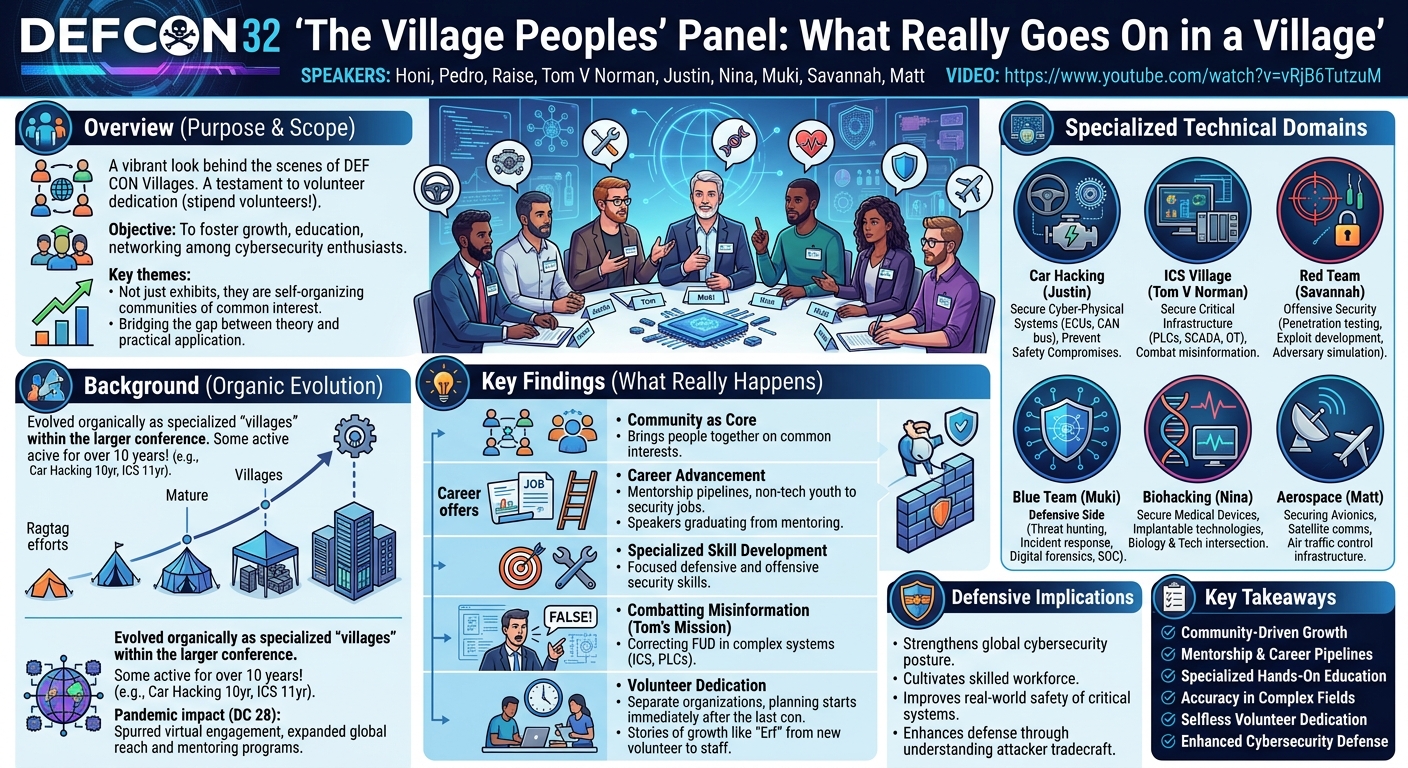
This panel session, titled "The Village Peoples' Panel: What Really Goes On in a Village," provided an insightful look into the vibrant and often unsung efforts behind the various specialized villages at DEF CON. Featuring leads from prominent villages such as Blue Team, Car Hacking, Red Team, ICS, Biohacking, and Aerospace, the discussion centered on the fundamental purpose, operational intricacies, and profound impact of these unique communities within the larger DEF CON ecosystem. The primary objective was to articulate why village organizers dedicate immense personal time and resources, highlighting their mission to foster growth, education, and networking among cybersecurity enthusiasts.
Key moments
- 0:00 Panel introductions and village affiliations
- 0:30 Initial question: What is the point of the villages?
- 0:50 Muki's story: Mentorship transforming a speaker's career
- 2:00 Justin on growing new talent in car hacking
- 2:50 Savannah emphasizes networking and practical skill development
The Village Peoples' Panel What Really Goes On in a Village
Speakers: Honi (DEF CON Village Lead Coordinator), Pedro (DEF CON Village Lead Coordinator), Raise, Tom V Norman (ICS Village Lead), Justin (Car Hacking Village Lead), Nina (Biohacking Village Lead), Muki (Blue Team Village Lead), Savannah (Red Team Village Lead), Matt (Aerospace Village Lead)
Conference: DEF CON 32
YouTube: https://www.youtube.com/watch?v=vRjB6TutzuM
Overview
This panel session, titled "The Village Peoples' Panel: What Really Goes On in a Village," provided an insightful look into the vibrant and often unsung efforts behind the various specialized villages at DEF CON. Featuring leads from prominent villages such as Blue Team, Car Hacking, Red Team, ICS, Biohacking, and Aerospace, the discussion centered on the fundamental purpose, operational intricacies, and profound impact of these unique communities within the larger DEF CON ecosystem. The primary objective was to articulate why village organizers dedicate immense personal time and resources, highlighting their mission to foster growth, education, and networking among cybersecurity enthusiasts.
The panel underscored that DEF CON Villages are far more than mere exhibition spaces; they function as self-organizing, passionate communities driven by common interests. Speakers shared personal anecdotes and philosophical insights into their motivations, revealing a deep commitment to nurturing new talent, providing practical hands-on experience, and correcting misinformation prevalent in the broader security discourse. This talk is crucial for anyone seeking to understand the grassroots nature of cybersecurity skill development, the power of community-driven initiatives, and the significant volunteer effort that underpins one of the world's largest hacker conferences.
The discussion served as a testament to the enduring spirit of collaboration and mentorship within the cybersecurity community, demonstrating how these specialized "villages" serve as critical incubators for future security professionals and innovators. It illuminated the unseen dedication of volunteers who, often unpaid, invest countless hours to create invaluable learning environments that bridge the gap between theoretical knowledge and practical application, ensuring the continuous evolution of the security landscape.
Background
▶ Watch: Panel introductions and village affiliations (0:00)
The DEF CON conference, renowned as a premier gathering for hackers, security professionals, and enthusiasts, has evolved significantly since its inception. A pivotal aspect of this evolution has been the proliferation and maturation of specialized "Villages." These villages originated organically, often as "ragtag" efforts by individuals passionate about a particular niche within cybersecurity. Unlike the main conference tracks, which feature formal presentations, villages offer a more immersive, hands-on, and community-centric experience, typically including workshops, Capture-the-Flag (CTF) competitions, demonstrations, and dedicated spaces for collaborative learning and networking.
The panel members themselves highlighted this organic growth, with Muki from the Blue Team Village noting its seven-year history, starting with a group that "had no idea what the hell they were doing," a sentiment echoed as "how Defcon works in general." Justin from the Car Hacking Village pointed out its ten-year legacy, while Tom from the ICS Village proudly stated his village was founded eleven years prior. This longevity underscores the enduring need for these focused communities.
A significant development in the background of these villages was the impact of the COVID-19 pandemic. As Muki recounted, the Blue Team Village, like many others, had to adapt by going virtual for DEF CON 28. This necessity spurred innovation, leading to the creation of remote events and mentoring programs that expanded their reach globally. This period of virtual engagement proved instrumental in connecting with a broader and more diverse audience, laying the groundwork for continued community building even as physical conferences resumed. The panel collectively painted a picture of villages as dynamic, self-sustaining organizations that are integral to the DEF CON experience, driven by a deep-seated desire to educate, empower, and connect individuals within specialized security domains. The volunteer nature of these efforts, with organizers working tirelessly year-round, often without direct compensation beyond stipends, forms the essential backbone of their operation.
Key Findings
▶ Watch: Initial question: What is the point of the villages? (0:30)
The panel discussion revealed several key insights into the purpose, operation, and profound impact of DEF CON Villages:
- Community as the Core: A recurring theme was the role of villages as self-contained communities and organizations within Defcon. Muki from Blue Team Village emphasized that villages "really help bring people together based on common interests." This community aspect fosters a sense of belonging and shared purpose, vital for sustained engagement and learning in a complex field like cybersecurity.
- Nurturing New Talent and Career Progression: A primary driver for village organizers is the commitment to mentorship and career development. Muki shared a powerful success story of a speaker from India who, after participating in the Blue Team Village's mentoring program (started during the virtual DC 28), progressed in their career and eventually gave a talk at the village. Justin from Car Hacking Village highlighted his initiative to bring in "younger people or newer people into this industry," including non-security tech individuals aged 17 to 20. He proudly noted that two of these individuals now hold security jobs and actively assist the village, demonstrating a direct pipeline from village engagement to professional careers. Savannah from Red Team Village corroborated this, mentioning a friend who secured an internship offer within a village just days into the conference, underscoring the immediate networking and opportunity generation.
- Specialized Skill Development: Villages provide unique spaces for focused skill acquisition. Savannah explicitly mentioned giving people "a space to be able to have people grow like their offensive security skills" within the Red Team Village. This specialization allows attendees to delve deep into niche areas that might not be covered in general conference talks, from cyber physical systems to biohacking and aerospace security.
- Combating Misinformation and Promoting Accuracy: Tom V Norman from the ICS Village articulated a critical mission: to counter inaccurate or misleading information about hacking complex systems. Coming from a control systems engineering background, he expressed frustration with individuals on stage "talking about hacking that PLC, hacking this thing" who were "full of shit" or simply "wrong on what they're saying." His village's purpose is to "educate, uplift, let's go and spread instead of spreading FUD [Fear, Uncertainty, Doubt], let's go and show people what you can do. What matters." This highlights the villages' role in providing grounded, practical, and accurate technical education.
- Volunteerism and Dedication: The panel shed light on the immense personal sacrifice and volunteer spirit involved. Savannah explicitly stated that she and Honi are "stipend volunteers," not paid by DEF CON, emphasizing their dedication despite having "families and lives and work." An unnamed speaker further elaborated that villages are "separate organizations" with "very few people that have been invested for a long time," and that planning for the next DEF CON begins immediately after the current one, involving "hot wash" reviews and "lessons learned." The story of "Erf," a new volunteer who arrived early, helped with badge counting, and is now slated to become a "goon" (DEF CON staff) next year, exemplifies the self-starting and committed nature of village contributors.
- Cross-Pollination of Knowledge: Savannah also noted the benefit of people taking skills learned in one village "over to other villages to learn other areas too." This indicates a healthy ecosystem where specialized knowledge isn't siloed but encourages broader learning and interdisciplinary understanding.
In essence, the panel collectively affirmed that DEF CON Villages are dynamic, volunteer-driven educational platforms that are critical for community building, practical skill development, career advancement, and ensuring the integrity of cybersecurity knowledge, all while addressing the unique challenges of niche security domains.
Technical Deep Dive
▶ Watch: Muki's story: Mentorship transforming a speaker's career (0:50)
While this panel itself was a discussion about the operational and philosophical underpinnings of DEF CON Villages rather than a demonstration of specific technical exploits or tools, the very nature of the villages represented speaks to a diverse and critical array of technical domains. The leads present on the panel represent areas that are at the forefront of cybersecurity research and practical application.
For instance, Justin, representing the Car Hacking Village, is deeply invested in the security of cyber physical systems. This domain involves understanding the intricate electronic control units (ECUs) that manage everything from engine performance to braking, the Controller Area Network (CAN bus) that allows these components to communicate, and the vulnerabilities inherent in infotainment systems and telematics. Technical activities within such a village would typically include reverse engineering vehicle firmware, analyzing CAN bus traffic for anomalies or injection points, exploiting remote keyless entry systems, and assessing the security of onboard diagnostics (OBD-II) ports. The goal is often to identify weaknesses that could lead to unauthorized control, data exfiltration, or safety compromises in modern vehicles.
Tom V Norman, the lead for the ICS Village, focuses on Industrial Control Systems (ICS) and Operational Technology (OT). This highly specialized field involves securing critical infrastructure components such as Programmable Logic Controllers (PLCs), Supervisory Control and Data Acquisition (SCADA) systems, and Distributed Control Systems (DCS). These technologies manage everything from power grids and water treatment plants to manufacturing facilities. A technical deep dive in this context would explore common industrial protocols (e.g., Modbus, DNP3, OPC UA), vulnerabilities in legacy hardware and software, network segmentation strategies for OT environments, and the unique challenges of securing systems that prioritize availability and safety over traditional IT security tenets. The ICS Village often showcases real-world industrial equipment, allowing attendees to interact with and analyze systems that are rarely accessible in a controlled environment. Tom's background in control systems engineering directly informs the village's mission to provide accurate, practical education on these critical systems, contrasting with superficial or misinformed public narratives.
Savannah, representing the Red Team Village, is involved in offensive security methodologies. This encompasses a broad range of technical skills, including penetration testing, vulnerability research, exploit development, adversary simulation, and red teaming. Participants learn techniques for initial access, privilege escalation, lateral movement, command and control (C2) infrastructure, and data exfiltration across various operating systems and network architectures. Tools like Metasploit, Nmap, Burp Suite, and custom scripts are commonly explored. The emphasis is on understanding attacker tradecraft to effectively identify and exploit weaknesses in systems and organizations.
Muki, leading the Blue Team Village, focuses on the defensive side of cybersecurity. This involves threat hunting, incident response, digital forensics, security operations center (SOC) practices, and implementing robust security architectures. Technical discussions and exercises often cover log analysis, endpoint detection and response (EDR) tools, network intrusion detection systems (NIDS), security information and event management (SIEM) solutions, and strategies for building resilient defenses. The Blue Team Village aims to equip defenders with the knowledge and skills to detect, analyze, and respond to sophisticated cyber threats.
Nina, the Biohacking Village lead, delves into the security of medical devices, implantable technologies, and the intersection of biology and technology. This can involve analyzing the security of pacemakers, insulin pumps, hospital networks, genetic sequencing equipment, and even human-computer interfaces. Technical challenges include securing proprietary protocols, addressing software vulnerabilities in embedded systems, and understanding privacy implications of biological data.
Matt, from the Aerospace Village, focuses on the security of avionics systems, satellite communications, air traffic control infrastructure, and other critical components of aerospace technology. This involves highly specialized knowledge of aerospace-specific protocols, hardware, and safety-critical design considerations.
While the panel did not delve into specific code snippets or protocol dissections, the collective expertise and stated missions of these village leads underscore a deep commitment to exploring, understanding, and securing highly technical and often safety-critical domains. The villages serve as living laboratories where these complex technical challenges are openly discussed, analyzed, and often, solved.
Demo / Proof of Concept
▶ Watch: Justin on growing new talent in car hacking (2:00)
This panel discussion was a conversational exploration of the DEF CON Villages themselves, their purpose, and their operational dynamics, rather than a technical presentation featuring a specific demonstration or proof of concept. Therefore, the panel did not include any live demos of exploits, tools, or techniques.
However, it is crucial to understand that hands-on demonstrations, practical labs, and interactive challenges are the very cornerstone of what makes DEF CON Villages invaluable. While this specific talk did not showcase a proof of concept, the villages represented by the panelists—such as the Car Hacking Village, ICS Village, Red Team Village, and Blue Team Village—are renowned for providing attendees with direct, practical experience. This often includes access to specialized hardware, custom-built tools, and simulated environments where participants can safely engage in activities ranging from reverse engineering ECUs and probing PLCs to conducting penetration tests and performing incident response simulations. The absence of a demo in this particular panel is a reflection of its focus on the meta-discussion of village operations, not a lack of practical application within the broader village ecosystem.
Defensive Implications
▶ Watch: Savannah emphasizes networking and practical skill development (2:50)
The insights shared by the village leads carry significant defensive implications for the broader cybersecurity landscape. The core mission of these villages, as articulated by the panelists, directly contributes to strengthening global cybersecurity posture in several critical ways:
- Cultivating a Skilled Workforce: The emphasis on mentorship and bringing "younger people or newer people into this industry," as highlighted by Justin from Car Hacking Village, is paramount. By providing accessible learning environments and pathways to employment (as evidenced by the 17-20 year olds who found security jobs), villages actively address the persistent cybersecurity talent gap. A larger, more skilled workforce means more capable defenders for organizations of all sizes.
- Securing Critical Cyber-Physical Systems: Justin's passion for cyber physical systems and his desire to make vehicles safer directly translates into improved real-world security. By researching and exposing vulnerabilities in automotive systems, the Car Hacking Village indirectly pressures manufacturers to enhance their security practices, preventing potentially catastrophic physical consequences of cyberattacks. Similarly, Tom V Norman's ICS Village directly impacts the security of critical infrastructure. By educating professionals on the accurate workings and vulnerabilities of SCADA systems and PLCs, the village helps prevent FUD-driven approaches and promotes informed, effective defensive strategies for protecting essential services like power, water, and manufacturing.
- Enhancing Defensive Strategies through Offensive Knowledge: While the Red Team Village focuses on offensive security skills, the knowledge gained there is invaluable for defense. Understanding attacker methodologies, exploit development, and adversary simulation allows Blue Teams to anticipate threats, build more robust defenses, and improve threat hunting and incident response capabilities. Savannah's mention of cross-pollination between villages reinforces this: offensive insights can directly inform defensive postures.
- Promoting Accurate and Practical Education: Tom V Norman's mission to counter misinformation is a vital defensive measure. In an industry often plagued by hype and inaccurate claims, providing grounded, practical, and accurate technical education ensures that defenders are equipped with what actually matters. This prevents misallocation of resources on ineffective solutions and fosters a more competent and realistic approach to security.
- Building Resilient Communities of Practice: Muki's description of villages as self-sustaining communities fosters collaboration and knowledge sharing. When defenders can readily connect with peers, share experiences, and collaborate on solutions, the collective defensive posture improves. These communities become informal networks for rapid intelligence sharing and mutual support during security incidents.
- Early Identification of Emerging Threats: Villages dedicated to niche areas like Biohacking and Aerospace security serve as early warning systems. By exploring the security implications of novel technologies, they help identify potential attack surfaces and vulnerabilities before they become widespread threats, allowing for proactive defensive measures to be developed.
In essence, the DEF CON Villages, through their unique blend of hands-on education, community building, and specialized focus, act as critical force multipliers for global cybersecurity defense, ensuring a continuous supply of skilled professionals and robust strategies to protect an increasingly interconnected world.
Key Takeaways
- Community-Driven Growth: DEF CON Villages are self-organizing communities built on shared interests, providing essential spaces for connection, collaboration, and sustained engagement within niche cybersecurity domains.
- Mentorship and Career Pathways: Villages serve as vital incubators for new talent, offering mentorship programs and direct opportunities that lead to career progression, internships, and entry-level security jobs for individuals, including young, non-security tech enthusiasts.
- Specialized Hands-On Education: They offer unique environments for developing practical, specialized skills, ranging from offensive security techniques to securing cyber physical systems like vehicles and industrial control systems (ICS).
- Combating Misinformation: Village leads are committed to providing accurate, practical technical education, challenging superficial or incorrect narratives about complex security topics, and focusing on "what matters" in real-world applications.
- Volunteer Dedication: The operation of these villages relies heavily on the passionate, often unpaid, volunteer efforts of dedicated individuals who commit significant personal time and resources, planning year-round to deliver these invaluable experiences.
- Enhanced Defensive Posture: By fostering a skilled workforce, addressing critical infrastructure security, promoting accurate knowledge, and enabling cross-domain learning, villages significantly contribute to strengthening global cybersecurity defenses against evolving threats.
About the Speaker(s)
The panel featured a diverse group of dedicated leaders from various DEF CON Villages, each bringing their unique expertise and passion to the discussion:
- Honi: Identified as a DEF CON Village Lead Coordinator, Honi plays a central role in orchestrating the overall village experience at the conference, ensuring coordination and support across the diverse range of specialized communities.
- Pedro: Also a DEF CON Village Lead Coordinator, Pedro shares the responsibility with Honi for guiding and supporting the various villages, demonstrating the collaborative leadership required to manage such a complex ecosystem.
- Raise: Mentioned as actively participating by "tweeting," Raise contributes to the communication and outreach efforts for the villages.
- Tom V Norman: Lead of the ICS Village, Tom brings over eleven years of experience with his village, which operates as a registered nonprofit. His background in control systems engineering drives his mission to provide accurate, practical education on Industrial Control Systems, countering misinformation in the field.
- Justin: The lead for the Car Hacking Village, which has been active for ten years, Justin has personally run it for five years. He is deeply committed to encouraging younger individuals into cybersecurity, particularly focusing on the security of cyber physical systems in vehicles.
- Nina: The lead for the Biohacking Village, Nina contributes expertise in the intersection of biology and cybersecurity, focusing on the security aspects of medical devices and related technologies.
- Muki: Lead of the Blue Team Village, Muki has been instrumental in its seven-year history. She championed the village's expansion into a virtual format during DC 28 and initiated a successful mentoring program, emphasizing community building and career growth for defenders.
- Savannah: Representing the Red Team Village, Savannah highlights the importance of networking and developing offensive security skills. She also underscored the significant volunteer effort involved in running the villages, noting that organizers are "stipend volunteers" who dedicate personal time alongside their professional and family lives.
- Matt: The lead for the Aerospace Village, Matt contributes to the specialized domain of securing avionics and other aerospace technologies.
Collectively, these speakers represent the backbone of the DEF CON Villages, embodying the spirit of volunteerism, education, and community building that defines these unique spaces within the cybersecurity conference landscape.