Reality Defender — RSA Conference 2024 Innovation Sandbox
RSA Conference 2024 · Innovation Sandbox
Overview
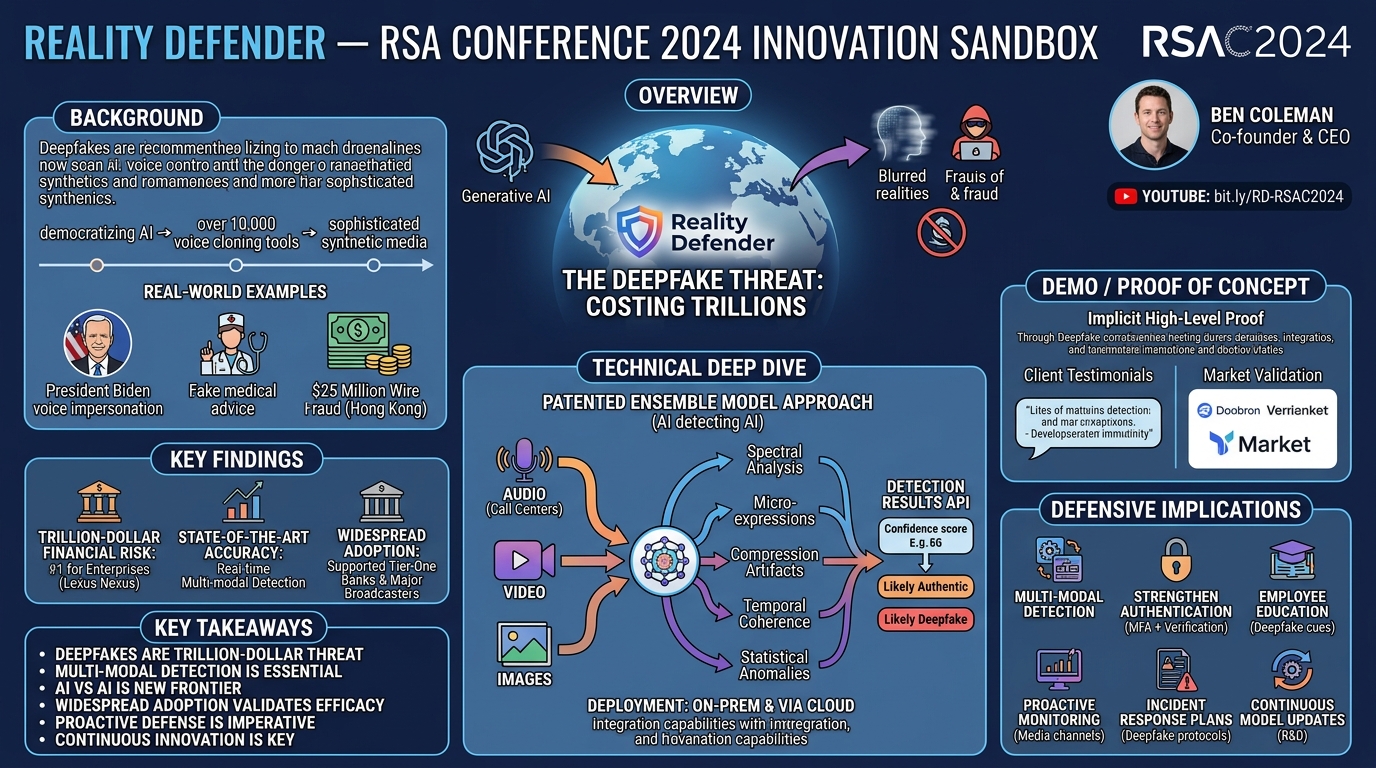
In an era increasingly shaped by the rapid advancements of generative artificial intelligence, the line between reality and fabrication has become dangerously blurred. Ben Coleman, Co-founder and CEO of Reality Defender, took the stage at RSAC 2024's Innovation Sandbox to address one of the most pressing cybersecurity challenges of our time: the proliferation of AI-generated fraudulent media, commonly known as deepfakes. This presentation underscored the profound societal and economic implications of this technology, positioning deepfakes not merely as a novelty but as a formidable threat costing industries trillions.
Key moments
- 0:00 Introduction to Reality Defender and the deep fake problem
- 0:35 Reality Defender's patented AI detection model explained
- 1:10 Real-world examples of pervasive deep fake threats
- 1:45 Deep fakes: the #1 financial risk, $1 trillion cost
- 2:00 Protecting tier one banks from audio deep fake fraud
- 2:30 Reality Defender's expert team and future vision
Reality Defender — RSA Conference 2024 Innovation Sandbox
Speakers: Ben Coleman, Co-founder and CEO, Reality Defender
Conference: RSAC 2024
YouTube: https://www.youtube.com/watch?v=TKOZmwyNUNM
Overview
In an era increasingly shaped by the rapid advancements of generative artificial intelligence, the line between reality and fabrication has become dangerously blurred. Ben Coleman, Co-founder and CEO of Reality Defender, took the stage at RSAC 2024's Innovation Sandbox to address one of the most pressing cybersecurity challenges of our time: the proliferation of AI-generated fraudulent media, commonly known as deepfakes. This presentation underscored the profound societal and economic implications of this technology, positioning deepfakes not merely as a novelty but as a formidable threat costing industries trillions.
Coleman's talk centered on Reality Defender's innovative approach to combating this pervasive problem. The company leverages a patented ensemble model that employs AI to detect AI-generated content across multiple modalities—audio, video, and images—in real-time. The significance of this work is amplified by the sheer scale of the deepfake threat, which has evolved from niche concern to a primary financial risk for enterprises, as evidenced by high-profile fraud cases and widespread malicious use. Reality Defender aims to serve as the foundational detection layer for all AI-generated fraud, providing a crucial defense mechanism in a rapidly evolving digital landscape.
Background
▶ Watch: Introduction to Reality Defender and the deep fake problem (0:00)
The genesis of the deepfake problem lies in the democratization and accelerating capabilities of generative AI. What was once the domain of highly specialized researchers is now accessible to anyone with a basic understanding of AI tools. Coleman highlighted the staggering statistic that over 10,000 voice cloning tools are readily available via a simple Google search, illustrating the low barrier to entry for creating sophisticated synthetic media. This accessibility has fueled an explosion of AI-generated content, capable of producing new bodies of work in seconds, limited only by imagination. While generative AI promises immense benefits in productivity and creativity, its darker side manifests in the creation of highly convincing, yet entirely fabricated, media.
The consequences of this technological duality are severe and far-reaching. Deepfakes are no longer theoretical threats; they are actively being weaponized across various sectors. Coleman cited alarming real-world examples: deepfake phone calls impersonating President Biden to influence elections, fabricated videos of medical professionals disseminating misinformation about vaccinations, and the high-profile $25 million wire fraud in Hong Kong where deepfake technology was used to impersonate a company's CFO. These incidents underscore the multi-modal nature of the threat, impacting all forms of media and communication—audio, video, and still images. Financial institutions are particularly vulnerable, with audio deepfakes emerging as the number one enterprise use case for fraud due to the prevalence of voice-based interactions in call centers. The economic impact is equally dire, with Lexus Nexus forecasting deepfakes to cost over $1 trillion in the coming year, solidifying their position as the number one financial risk to enterprises. The challenge is compounded by the continuous evolution of generative models, making detection a constant race against increasingly sophisticated adversaries.
Key Findings
▶ Watch: Real-world examples of pervasive deep fake threats (1:10)
Reality Defender's presentation at RSAC 2024 illuminated several key findings regarding both the pervasive threat of deepfakes and the efficacy of their proposed solution. Foremost among these is the undeniable reality that deepfakes represent a trillion-dollar industry of potential fraud and disruption, solidifying their status as the number one financial risk to enterprises. This is not a speculative future threat but a present danger, as evidenced by the $25 million wire fraud incident in Hong Kong and the widespread malicious use across political, social, and financial domains.
In response to this escalating threat, Reality Defender has developed a patented ensemble model approach that leverages AI to detect AI-generated media. The core finding here is the demonstrated capability of their system to achieve state-of-the-art accuracy, precision, and recall in real-time detection across audio, video, and images. This multi-modal detection capability is crucial, acknowledging that deepfake threats rarely manifest in a single format but often combine various media types to create a more convincing illusion.
Further validating their solution's effectiveness and market relevance, Coleman revealed that two of the three largest broadcasters have chosen Reality Defender to scan media before it goes on air, indicating a critical need for such technology in high-stakes environments where media authenticity is paramount. Moreover, the company proudly announced its support for the majority of tier-one banks, protecting their call centers, employees, and customers from AI-generated voice fraud. These adoptions by leading institutions serve as powerful endorsements of Reality Defender's robust capabilities and its vision to become the definitive detection layer for all AI-generated fraud. The consistent updating and benchmarking of their models against emerging deepfake threats also highlight a commitment to ongoing innovation, ensuring clients remain one step ahead of fraudsters.
Technical Deep Dive
▶ Watch: Deep fakes: the #1 financial risk, $1 trillion cost (1:45)
Reality Defender's core technological offering is an advanced, patented ensemble model approach designed to detect AI-generated media across real-time audio, video, and images. This multi-modal detection capability is critical, as deepfakes often combine different media types to enhance their believability. An ensemble model, in this context, refers to a machine learning technique where multiple individual models (often called "base learners" or "weak learners") are trained and their predictions are combined to achieve better performance than any single model could achieve alone. This approach typically enhances robustness, reduces variance, and improves overall accuracy, especially when dealing with complex and evolving adversarial data like deepfakes.
The "AI to detect AI" paradigm is central to their methodology. This involves training sophisticated machine learning models, likely deep neural networks, on vast datasets comprising both authentic and synthetically generated media. For audio detection, the system would analyze a multitude of acoustic features. This includes spectral analysis to identify inconsistencies in voice characteristics, intonation, pitch, and prosody that might betray synthetic generation. Deepfake audio often exhibits subtle artifacts related to the generation process, such as unnatural pauses, abnormal frequency responses, or inconsistencies in background noise that differ from legitimate recordings. The models learn to discern these minute deviations from natural human speech patterns and acoustic environments. Given the prevalence of voice cloning tools, detecting these nuances in real-time within call centers is a significant technical challenge requiring low-latency processing and high accuracy.
For video detection, the ensemble model likely incorporates various forensic techniques. This could involve analyzing facial landmark consistency and micro-expressions, as deepfake algorithms often struggle to perfectly replicate the subtle, unconscious movements of real human faces. Anomalies in eye blinks, lip synchronization, or even physiological signals like heart rate (detectable through subtle skin color changes) can be indicators. Furthermore, the models would look for compression artifacts or pixel-level inconsistencies that arise from the manipulation process, often manifesting as unnatural edge blending, texture distortions, or repetitive patterns in specific regions of the image. The detection might also involve analyzing the temporal coherence of frames, identifying jitters or unnatural transitions that are characteristic of video manipulation.
Image detection shares many principles with video analysis but focuses on static artifacts. This includes analyzing EXIF metadata (though this can be easily stripped or faked), noise patterns, lighting inconsistencies, and geometric distortions. Generative adversarial networks (GANs) and other generative models often leave subtle "fingerprints" or statistical anomalies in the generated image's pixel distribution or frequency domain that differ from naturally captured photographs. The ensemble approach allows Reality Defender to combine the strengths of various detection methods—some potentially focusing on specific types of artifacts (e.g., GAN artifacts), others on general image forensics, and others still on statistical anomalies.
The platform's deployment flexibility—on-prem and via cloud, with integration into "any application or product"—suggests a robust and scalable architecture. This implies the provision of a comprehensive API (Application Programming Interface) that allows third-party applications to submit media for analysis and receive rapid detection results. Cloud deployment offers scalability and ease of access, while on-prem deployment caters to organizations with stringent data sovereignty or low-latency requirements. The ability to integrate into diverse systems, from broadcasting workflows to banking call center infrastructure, speaks to a well-engineered and modular system capable of handling high throughput and varied input formats. The continuous updating and benchmarking of models are crucial, as deepfake generation techniques are constantly evolving, requiring an adaptive and agile detection system to stay effective against emerging threats.
Demo / Proof of Concept
▶ Watch: Protecting tier one banks from audio deep fake fraud (2:00)
While Ben Coleman's presentation at the RSA Conference 2024 Innovation Sandbox was a concise pitch outlining Reality Defender's capabilities and market impact, it did not include a live, explicit technical demonstration or proof of concept in the traditional sense. However, the talk implicitly served as a high-level conceptual proof, primarily through the speaker's strong claims of market adoption and efficacy.
Coleman highlighted that two of the three largest broadcasters utilize Reality Defender to scan media before it goes on air, and that the company supports the majority of tier-one banks in protecting their call centers from AI-generated voice fraud. These real-world deployments and established client relationships serve as powerful testimonials and de facto proofs of concept for the platform's ability to operate effectively in high-stakes, real-time environments. A comprehensive demo, had one been presented, would likely have showcased the platform's user interface, demonstrating the submission of various media types (audio, video, images), the real-time analysis process, and the display of detection results, including confidence scores and identified deepfake characteristics. Such a demonstration would aim to visually corroborate the "state-of-the-art accuracy, precision, and recall" claimed by the speaker, illustrating how the ensemble model identifies subtle artifacts undetectable by the human eye or ear.
Defensive Implications
▶ Watch: Reality Defender's expert team and future vision (2:30)
The rise of sophisticated deepfakes presents a multifaceted challenge for cybersecurity defenders, demanding a proactive and multi-layered defense strategy. Reality Defender's solution offers critical insights into the necessary steps organizations must take:
- Implement Multi-Modal Detection Solutions: Organizations must recognize that deepfakes are not confined to a single medium. A robust defense requires solutions capable of analyzing audio, video, and images simultaneously. Relying on single-modality detection leaves significant vulnerabilities. Integrating specialized AI-driven platforms like Reality Defender into existing security infrastructure is paramount for real-time identification of synthetic media.
- Strengthen Authentication and Verification Processes: The prevalence of voice cloning and video impersonation necessitates a re-evaluation of authentication protocols. Relying solely on voice biometrics or visual identification for high-value transactions or sensitive access requests is no longer sufficient. Organizations should implement multi-factor authentication (MFA) that incorporates additional, less spoofable factors, and establish out-of-band verification processes for critical communications. If a voice or video request seems unusual, a follow-up via a pre-established, secure channel (e.g., a known phone number or email) should be mandatory.
- Employee Education and Awareness Training: Human vigilance remains a crucial defense layer. Employees, especially those in customer service, finance, or executive roles, must be trained to recognize the subtle cues of deepfakes and the social engineering tactics often employed alongside them. This includes skepticism towards urgent, high-value requests, unusual communication channels, or emotionally charged messages, even if they appear to come from a trusted source. Regular phishing and deepfake awareness exercises are essential.
- Proactive Monitoring of Media Channels: For organizations with significant public presence, continuous monitoring of social media, news channels, and internal communication platforms for potential deepfake misuse is vital. This allows for rapid detection and response to reputation-damaging or misinformation campaigns that leverage synthetic media. Broadcasters and media companies, as highlighted by Reality Defender's client base, are already taking this seriously by scanning media pre-broadcast.
- Establish Incident Response Plans for Deepfake Incidents: Organizations need specific protocols for responding to confirmed deepfake attacks. This includes procedures for isolating compromised systems, notifying affected parties, engaging legal counsel, and communicating transparently with stakeholders and the public to mitigate reputational damage and financial loss. The $25 million Hong Kong wire fraud serves as a stark reminder of the financial stakes.
- Invest in Continuous Model Updates and Research: The adversarial nature of deepfake technology means that generation techniques are constantly evolving. Defensive solutions must, therefore, be continuously updated and benchmarked against the latest deepfake models. Organizations should partner with providers like Reality Defender who demonstrate a commitment to ongoing research and development to stay ahead of emerging threats.
Key Takeaways
- Deepfakes are a Trillion-Dollar Threat: AI-generated fraudulent media represents the number one financial risk to enterprises, with projected costs exceeding $1 trillion in the coming year, impacting finance, politics, and public trust.
- Multi-Modal Detection is Essential: Effective deepfake defense requires sophisticated AI solutions capable of real-time detection across all media types: audio, video, and images, as threats rarely manifest in isolation.
- AI vs. AI is the New Frontier: Reality Defender's patented ensemble model leverages AI to detect AI, demonstrating a crucial technological paradigm for combating increasingly sophisticated synthetic content.
- Widespread Adoption Validates Efficacy: The use of Reality Defender by major broadcasters and tier-one banks underscores the critical need for and proven effectiveness of their solution in high-stakes, real-world environments.
- Proactive Defense is Imperative: Organizations must implement multi-layered defenses, including advanced detection tools, enhanced authentication protocols, and comprehensive employee training, to counter the evolving deepfake landscape.
- Continuous Innovation is Key: The rapid advancement of generative AI necessitates that deepfake detection solutions are constantly updated and benchmarked against new threats to maintain a defensive edge.
About the Speaker(s)
Ben Coleman is the Co-founder and CEO of Reality Defender, a company at the forefront of combating AI-generated fraud. With a dedicated team, two-thirds of whom are PhD researchers and engineers, Coleman has been actively involved in solving the deepfake problem since 2021. His expertise and the company's innovative work have gained significant recognition, including his testimony before Congress on the critical need for regulations to protect against the growing deepfake threat while supporting AI innovation. Under his leadership, Reality Defender is committed to becoming the detection layer for all AI-generated fraud, constantly evolving its models to stay ahead of sophisticated adversaries.