VulnCheck — RSA Conference 2024 Innovation Sandbox
RSA Conference 2024 · Innovation Sandbox
Overview
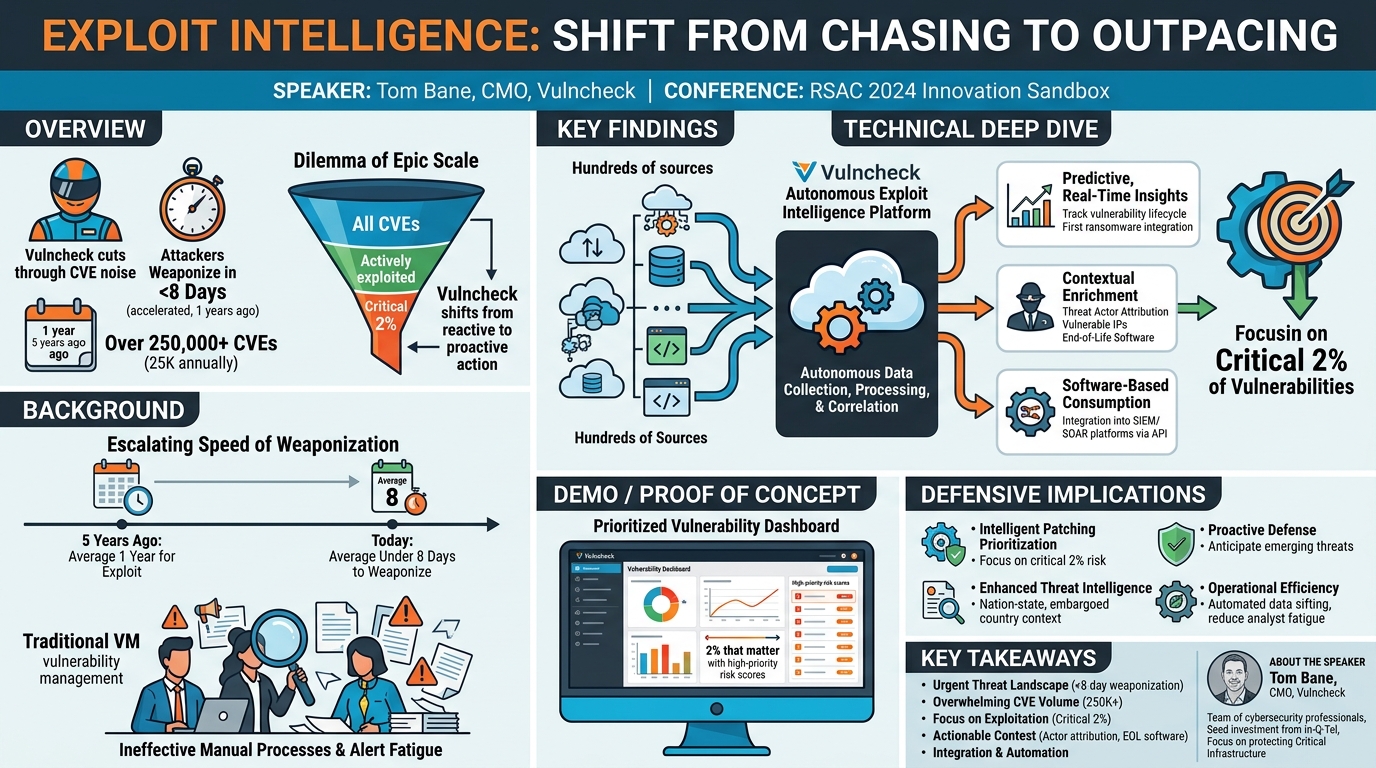
In an era where cyber attackers are weaponizing vulnerabilities with unprecedented speed, Tom Bane, Chief Marketing Officer of Vulncheck, presented a compelling case for a paradigm shift in vulnerability management at the RSA Conference 2024 Innovation Sandbox. His talk, "Exploit Intelligence: Shift from Chasing to Outpacing," introduced Vulncheck as an autonomous exploit intelligence platform designed to cut through the noise of an ever-expanding CVE landscape. The core premise is that traditional vulnerability management (VM) approaches are failing to keep pace with modern threats, leading organizations to chase an unmanageable volume of vulnerabilities.
Key moments
- 0:00 Introduction: The escalating speed of vulnerability weaponization
- 2:00 Vulncheck's autonomous exploit intelligence platform
- 2:15 How Vulncheck distills 2% of critical vulnerabilities
- 3:15 Actionable insights: threat actor attribution, IPs, nation state intel
- 4:00 Empowering teams with predictive real-time vulnerability insights
- 4:20 Enriching cybersecurity platforms and protecting critical infrastructure
- 4:45 Closing message: Stop chasing, start outpacing
Exploit Intelligence: Shift from Chasing to Outpacing
Speakers: Tom Bane, Chief Marketing Officer, Vulncheck
Conference: RSAC 2024
YouTube: https://www.youtube.com/watch?v=PUJzVymtwFc
Overview
In an era where cyber attackers are weaponizing vulnerabilities with unprecedented speed, Tom Bane, Chief Marketing Officer of Vulncheck, presented a compelling case for a paradigm shift in vulnerability management at the RSA Conference 2024 Innovation Sandbox. His talk, "Exploit Intelligence: Shift from Chasing to Outpacing," introduced Vulncheck as an autonomous exploit intelligence platform designed to cut through the noise of an ever-expanding CVE landscape. The core premise is that traditional vulnerability management (VM) approaches are failing to keep pace with modern threats, leading organizations to chase an unmanageable volume of vulnerabilities.
Bane highlighted the critical dilemma facing cybersecurity teams: attackers now weaponize vulnerabilities in under eight days, a drastic acceleration from the average of one year just five years ago. Compounding this challenge, the CVE program currently lists over 250,000 vulnerabilities and is projected to add another 25,000 annually. This sheer volume, coupled with the rapid exploitation timeline, renders manual or legacy VM processes ineffective. Vulncheck aims to address this by moving beyond a reactive stance, providing organizations with actionable, real-time intelligence focused on the critical 2% of vulnerabilities that are actively exploited or highly likely to be.
The significance of Vulncheck's approach lies in its potential to transform how enterprises and federal teams protect critical infrastructure. By distilling vast quantities of vulnerability data into actionable insights, the platform promises to empower security teams to prioritize effectively, respond proactively, and ultimately outpace adversaries. This shift from "chasing" every disclosed vulnerability to "outpacing" attackers by focusing on true exploitation risk is presented as the single biggest cybersecurity threat mitigation strategy for today's dynamic threat landscape.
Background
▶ Watch: Introduction: The escalating speed of vulnerability weaponization (0:00)
The cybersecurity landscape has undergone a profound transformation, marked by an exponential increase in both the volume and velocity of threats. Historically, vulnerability management was a largely reactive discipline. Organizations would receive alerts about newly discovered vulnerabilities, assess their potential impact, and then embark on a patching cycle that could span weeks or even months. This model, while imperfect, was somewhat sustainable when the time window between vulnerability disclosure and active exploitation was relatively long, often extending to a year or more.
However, as Tom Bane articulated, that world has fundamentally changed. The advent of sophisticated threat actors, including nation-state groups, organized cybercrime syndicates, and even independent researchers, has drastically compressed this window. Today, the average time to weaponization—the development of a functional exploit for a newly disclosed vulnerability—has plummeted to less than eight days. This rapid weaponization is often followed swiftly by integration into exploit kits, inclusion in ransomware campaigns, and widespread active exploitation, leaving defenders with minimal time to react.
Compounding this speed challenge is the sheer scale of vulnerabilities. The Common Vulnerabilities and Exposures (CVE) program, while invaluable for standardizing vulnerability identification, has become a torrent of information. With over 250,000 CVEs currently listed and an estimated 25,000 new ones added each year, security teams are drowning in data. Traditional vulnerability scanners and management platforms often present long lists of vulnerabilities, many of which may not be actively exploited or pose an immediate threat. This "dilemma of epic scale and proportion" means that security analysts, already a scarce resource, are forced to chase an unmanageable number of potential issues, leading to alert fatigue, misprioritization, and ultimately, an increased risk of breach. The core problem Vulncheck seeks to solve is this inability of human-centric or legacy systems to cope with the speed and scale of modern exploit development and deployment. The industry needs a mechanism to identify not just what is vulnerable, but what is truly dangerous right now.
Key Findings
▶ Watch: How Vulncheck distills 2% of critical vulnerabilities (2:15)
Vulncheck's central contribution and key finding is the development of an autonomous exploit intelligence platform designed to address the speed and scale challenges of modern cybersecurity. Rather than building another legacy vulnerability management system, Vulncheck's innovation lies in its ability to autonomously collect, normalize, sanitize, and distill vast quantities of vulnerability intelligence down to what truly matters for defense.
The primary finding is the identification and focus on the critical 2% of vulnerabilities that are either already exploited in the wild or highly likely to be exploited. This selective focus is a direct response to the overwhelming volume of CVEs and the limited resources of security teams. By shifting attention from the entire universe of disclosed vulnerabilities to this high-priority subset, organizations can significantly improve their defensive posture and resource allocation.
Key aspects of Vulncheck's findings and contributions include:
- Autonomous Data Collection and Processing: The platform operates without significant human intervention in its core data collection and processing. It aggregates data from "hundreds of sources collected at the time of disclosure," maintaining over 300 million records related to all CVEs, refreshed multiple times a day. This ensures comprehensive and up-to-date intelligence.
- Exploit Association and Correlation: Vulncheck autonomously associates known vulnerabilities with confirmed exploitation and active exploits. This goes beyond theoretical risk scoring, providing concrete evidence of weaponization. The platform correlates this information correctly from disparate sources, offering a holistic view of the threat.
- Actionable Response Insights: Beyond simply identifying exploited vulnerabilities, Vulncheck enriches its intelligence with practical, actionable insights. These include threat actor attribution, identification of vulnerable IPs, embargoed country and nation-state intelligence, comprehensive data on end-of-life software, all GitHub commits relevant to vulnerabilities, and intelligence on every open-source package ever built. These enrichments provide context critical for strategic defense and incident response.
- Predictive, Real-time Insights: The platform offers real-time insights that track the lifecycle of a vulnerability, from its disclosure date to the first exploit confirmed, first weaponization, and even first ransomware integration. This predictive capability allows organizations to anticipate threats rather than merely react to them.
- Software-based Consumption and Integration: Vulncheck is designed for seamless integration into existing cybersecurity workflows. Its data can enrich existing scoring, alerting, and response actioning systems, making any cyber workflow more accurate and efficient. This focus on integration underscores its role as an intelligence layer rather than a standalone, siloed tool.
In essence, Vulncheck's core finding is that by leveraging an autonomous, intelligence-driven approach, it's possible for organizations to move from a reactive "chasing" model to a proactive "outpacing" strategy, effectively mitigating the most pressing cybersecurity threats posed by rapidly weaponized vulnerabilities.
Technical Deep Dive
▶ Watch: Actionable insights: threat actor attribution, IPs, nation state intel (3:15)
Vulncheck's operational efficacy stems from its sophisticated, autonomous architecture designed for comprehensive data ingestion, intelligent processing, and real-time dissemination of exploit intelligence. At its core, the platform is engineered to overcome the limitations of human analysts and traditional data silos by employing a multi-faceted approach to vulnerability and exploit intelligence.
The system's foundation is its massive data collection capability. It ingests information from "hundreds of sources" continuously, aiming to capture data "at the time of disclosure." This includes, but is not limited to:
- All CVEs: Maintaining a comprehensive database of every known Common Vulnerability and Exposure, tracking its status and associated metadata.
- GitHub Commits: Monitoring public code repositories for vulnerability fixes, proof-of-concept exploits, and discussions related to security flaws, including those in every open-source package ever built. This provides early indicators of potential weaponization or public disclosure.
- End-of-Life (EOL) Software: Tracking software reaching its end-of-life, which often becomes a target for attackers due to lack of vendor support and patching.
- Threat Intelligence Feeds: Aggregating data from various commercial and open-source threat intelligence feeds, security research blogs, dark web forums, and other sources where exploits are discussed or traded.
- Security Advisories and Vendor Patches: Consuming official advisories from vendors and security organizations to correlate vulnerabilities with recommended mitigations.
This continuous ingestion process results in a colossal dataset of over 300 million records, which is refreshed multiple times a day to ensure currency.
Once collected, the raw data undergoes rigorous normalization and sanitization. This crucial step involves standardizing diverse data formats, resolving ambiguities, removing noise, and ensuring data quality. This process is essential for effective correlation across disparate sources. For instance, different sources might refer to the same vulnerability using different identifiers or descriptions, which the normalization process reconciles.
The true intelligence of Vulncheck emerges in its autonomous correlation and distillation engine. This is where the platform differentiates itself from raw data aggregators. It employs advanced analytical techniques, likely incorporating elements of machine learning (ML), natural language processing (NLP), and graph databases, to perform several critical functions:
- Vulnerability-to-Exploit Association: The system autonomously links known vulnerabilities (CVEs) to evidence of active exploitation or the existence of functional exploits. This involves identifying patterns in threat intelligence, analyzing exploit code repositories, and tracking the use of vulnerabilities in real-world attacks. This goes beyond theoretical CVSS scores to provide a direct indication of weaponization.
- Risk Prioritization (The 2% Rule): Through sophisticated algorithms, Vulncheck distills the vast ocean of vulnerabilities down to the 2% that are actively exploited or highly likely to be exploited. This prioritization is not based solely on severity scores but on real-world threat intelligence, attacker behavior, and the availability of exploit code. This is the core mechanism that enables organizations to "shift from chasing to out pacing."
- Contextual Enrichment: Beyond identifying exploited vulnerabilities, Vulncheck enriches this data with critical context. This includes:
- Threat Actor Attribution: Linking specific exploits or campaigns to known threat groups, including nation-state actors or those from embargoed countries. This provides insights into the "who" behind the attacks, aiding in strategic defense.
- Vulnerable IPs: Potentially identifying specific IP ranges or assets that are known to be vulnerable to actively exploited flaws, either through passive scanning data or other intelligence sources.
- Timeline Analysis: Tracking the lifecycle of a vulnerability from disclosure to first exploit confirmed, first weaponization, and first ransomware integration. This provides a predictive capability, allowing defenders to understand the typical progression of a threat and anticipate its next phase.
The output of this autonomous processing is designed for software-based consumption. Vulncheck provides its intelligence through APIs and integrations, allowing existing cybersecurity platforms to consume its data. This means organizations can enrich their current vulnerability management systems, Security Information and Event Management (SIEM) platforms, Security Orchestration, Automation, and Response (SOAR) tools, and other security workflows with accurate, real-time exploit intelligence. This integration capability allows for dynamic adjustment of vulnerability scoring, more intelligent alerting, and automated response actions, ultimately driving "infinite efficiency" and enabling "the best security decisions possible."
In essence, Vulncheck acts as a highly intelligent, automated threat intelligence layer that sifts through the noise of the internet to pinpoint the most dangerous and immediately actionable threats, delivering precise context directly into an organization's existing security ecosystem.
Demo / Proof of Concept
▶ Watch: Enriching cybersecurity platforms and protecting critical infrastructure (4:20)
The presentation delivered by Tom Bane at the RSA Conference 2024 Innovation Sandbox was a high-level pitch, constrained by the strict time limits inherent in such a competition. As such, the talk focused on articulating the strategic vision, the problem Vulncheck solves, and the overarching capabilities of the platform, rather than providing a live, interactive demonstration or a detailed walkthrough of its user interface or specific Proof of Concept (PoC) exploits.
While the talk did not feature a specific demo, the descriptions of Vulncheck's capabilities strongly imply the types of demonstrations that would likely showcase its value. A typical demonstration of such a platform would probably illustrate:
- Prioritized Vulnerability Dashboard: A user interface displaying a concise list of actively exploited or highly probable-to-be-exploited vulnerabilities, contrasting sharply with a traditional VM report showing thousands of CVEs. This dashboard would likely highlight the "2% that matter."
- Vulnerability Lifecycle Tracking: A visual timeline showing a specific CVE's progression from disclosure date to the confirmation of its first exploit, weaponization, and subsequent use in ransomware campaigns. This would underscore the real-time, predictive nature of the intelligence.
- Contextual Intelligence Drill-Down: Clicking on a high-priority vulnerability would reveal enriched data, such as associated threat actors, links to public exploit code (e.g., GitHub commits), affected software versions, and potentially even identified vulnerable IP ranges.
- Integration Examples: A demonstration might show how Vulncheck's intelligence seamlessly integrates with a popular vulnerability management solution (e.g., Tenable, Qualys), a SIEM (e.g., Splunk, QRadar), or a SOAR platform, dynamically updating risk scores, triggering alerts, or initiating automated patching workflows based on real-time exploit intelligence.
- Search and Filter Functionality: Illustrating the ability to query the vast dataset for specific vulnerabilities, threat actors, or software types, and immediately surface exploit intelligence.
Although a live demo was not part of the RSA Innovation Sandbox presentation, the clear articulation of Vulncheck's features and benefits provides a strong conceptual framework for how such a system would demonstrate its value in a practical setting, empowering security teams with actionable insights to "stop chasing and start out pacing."
Defensive Implications
▶ Watch: Closing message: Stop chasing, start outpacing (4:45)
The implications of Vulncheck's exploit intelligence platform for cybersecurity defenders are profound and multifaceted, offering a strategic shift from reactive vulnerability management to proactive threat mitigation. By providing highly curated and actionable intelligence, Vulncheck empowers organizations to optimize their security operations and significantly enhance their defensive posture.
Firstly, and most critically, Vulncheck enables intelligent prioritization of patching efforts. Traditional vulnerability management often leaves organizations with an overwhelming backlog of thousands of CVEs, making it impossible to patch everything promptly. By distilling this down to the critical 2% of vulnerabilities that are actively exploited or likely to be, Vulncheck allows security teams to focus their limited resources on the threats that pose the most immediate and severe risk. This ensures that patching cycles are driven by real-world threat intelligence rather than theoretical severity scores, directly reducing the attack surface against the most dangerous exploits.
Secondly, the platform significantly enhances threat intelligence capabilities. Defenders gain access to enriched data that goes far beyond basic vulnerability information. Insights into threat actor attribution, including nation-state intel and groups from embargoed countries, provide crucial context for understanding who might be targeting an organization and what their motivations or capabilities might be. This allows for more tailored defensive strategies, such as implementing specific detection rules or enhancing monitoring for known TTPs associated with those actors. The identification of vulnerable IPs and comprehensive data on end-of-life software further aids in asset inventory and risk assessment, highlighting forgotten or unsupported systems that are prime targets.
Thirdly, Vulncheck facilitates proactive defense through predictive insights. By tracking the full lifecycle of a vulnerability—from disclosure to first exploit confirmed, first weaponization, and first ransomware integration—organizations gain an early warning system. This predictive intelligence allows defenders to anticipate emerging threats, prepare mitigations before widespread exploitation occurs, and potentially even block attacks before they impact systems. This capability is vital in a world where attackers weaponize vulnerabilities in under eight days.
Fourthly, the platform promotes operational efficiency and reduces analyst fatigue. By automating the collection, normalization, and distillation of massive amounts of vulnerability data, Vulncheck frees up scarce security analysts from tedious, time-consuming research. Instead of sifting through countless reports and feeds, analysts can immediately focus on implementing the recommended defensive actions based on pre-digested, high-fidelity intelligence. This "software-based consumption" and integration with existing cybersecurity platforms means that exploit intelligence can enrich current scoring, alerting, and response actioning, making security workflows more accurate and efficient.
Finally, Vulncheck's mission to support enterprise and federal teams in protecting critical infrastructure underscores its broader defensive implications. By providing a clear, prioritized view of exploit intelligence, it helps safeguard essential services and national assets from the most potent cyber threats. The ability to integrate this intelligence into a wide array of cybersecurity platforms ensures that its benefits are broadly distributed across the defensive ecosystem, enabling a collective uplift in cyber resilience.
Key Takeaways
- Urgent Threat Landscape: Attackers now weaponize vulnerabilities in under eight days, a drastic acceleration from the one-year average five years ago, creating an unprecedented challenge for defenders.
- Overwhelming Vulnerability Volume: The CVE program's 250,000+ vulnerabilities, with 25,000 new additions annually, overwhelm traditional vulnerability management approaches and human analysts.
- Focus on Exploitation: Vulncheck autonomously distills this vast data to identify the critical 2% of vulnerabilities that are actively exploited or highly likely to be, enabling prioritized and effective defensive actions.
- Comprehensive Exploit Intelligence: The platform collects and correlates data from over 300 million records and hundreds of sources, providing real-time, predictive insights on vulnerability lifecycle, including first exploit, weaponization, and ransomware integration.
- Actionable Context: Beyond basic vulnerability data, Vulncheck enriches intelligence with crucial context like threat actor attribution, vulnerable IPs, nation-state intel, GitHub commits, and end-of-life software information.
- Integration and Automation: Designed for software-based consumption, Vulncheck's data seamlessly integrates with existing cybersecurity platforms to enrich scoring, alerting, and response, shifting organizations from reactive "chasing" to proactive "outpacing" of threats.
About the Speaker(s)
The presentation was delivered by Tom Bane, the Chief Marketing Officer of Vulncheck. While the talk was brief, it highlighted the collective expertise behind Vulncheck. Bane mentioned that "Anthony assembled an entire team who's been working on solving this problem for years with deep detection, research, and response backgrounds." This indicates that Vulncheck is backed by a group of experienced cybersecurity professionals with practical knowledge in identifying, analyzing, and responding to cyber threats. The company also received a seed investment from In-Q-Tel, a non-profit strategic investor that accelerates the development and delivery of cutting-edge technologies for national security. This background underscores Vulncheck's commitment to developing robust solutions for enterprise and federal teams, particularly for protecting critical infrastructure.