RSA Conference 2024 Innovation Sandbox - 2023 Winner Interview
RSA Conference 2024 · Innovation Sandbox
Overview
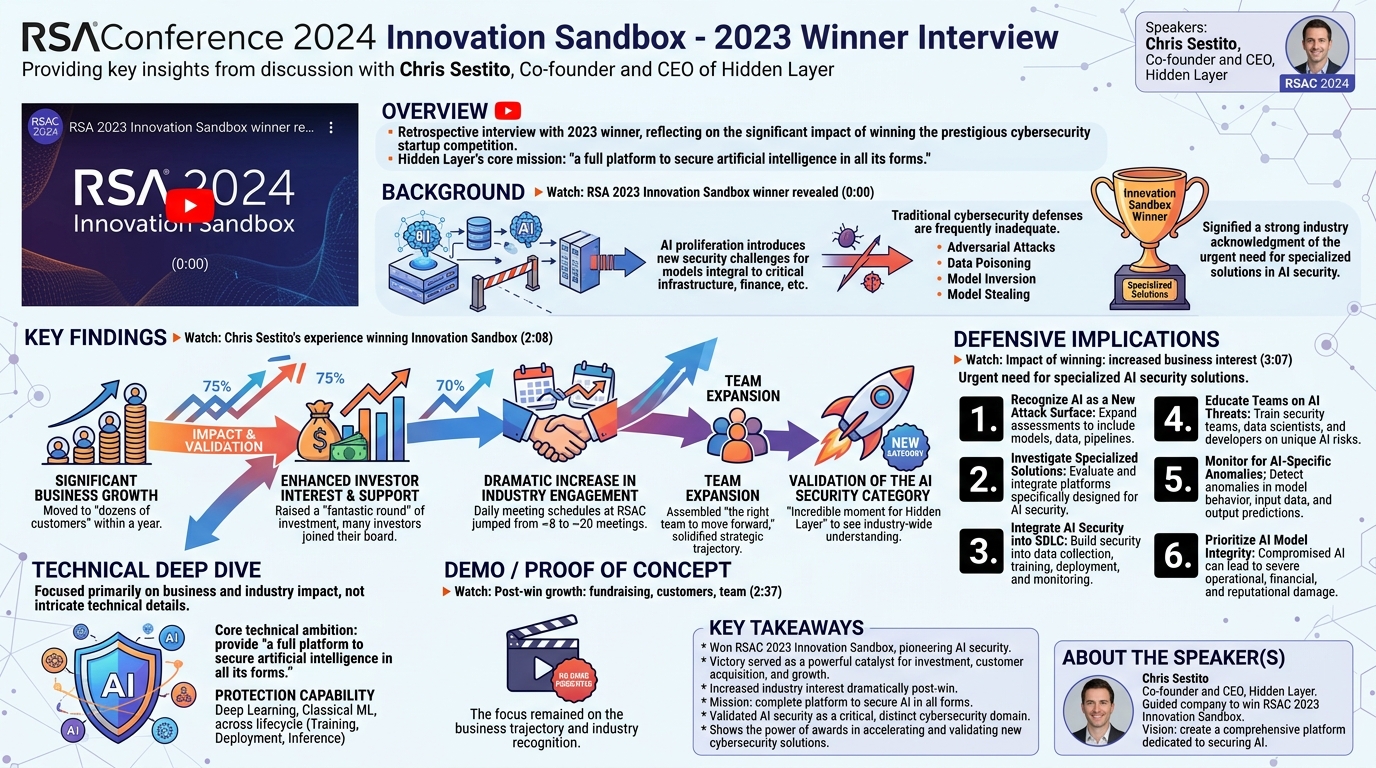
This talk provides a retrospective interview with Chris Sestito, Co-founder and CEO of Hidden Layer, following their victory as the RSA Conference 2023 Innovation Sandbox winner. The discussion, held during RSAC 2024, reflects on the significant impact of winning one of cybersecurity's most prestigious startup competitions. Hidden Layer's core mission, as articulated by Sestito, is to provide "a full platform to secure artificial intelligence in all its forms," addressing a rapidly evolving and critical area of cybersecurity.
Key moments
- 0:00 RSA 2023 Innovation Sandbox winner revealed
- 2:00 Hidden Layer CEO Chris Sestito interviewed
- 2:08 Chris Sestito's experience winning Innovation Sandbox
- 2:29 Hidden Layer's core mission: securing AI
- 2:37 Post-win growth: fundraising, customers, team
- 3:07 Impact of winning: increased business interest
RSA Conference 2024 Innovation Sandbox - 2023 Winner Interview
Speakers: Chris Sestito, Co-founder and CEO, Hidden Layer
Conference: RSAC 2024
YouTube: https://www.youtube.com/watch?v=zx-dBUaU92c
Overview
This talk provides a retrospective interview with Chris Sestito, Co-founder and CEO of Hidden Layer, following their victory as the RSA Conference 2023 Innovation Sandbox winner. The discussion, held during RSAC 2024, reflects on the significant impact of winning one of cybersecurity's most prestigious startup competitions. Hidden Layer's core mission, as articulated by Sestito, is to provide "a full platform to secure artificial intelligence in all its forms," addressing a rapidly evolving and critical area of cybersecurity.
The interview delves into the immediate and long-term consequences of such a high-profile win, highlighting how it acted as a powerful catalyst for Hidden Layer's growth. It underscores the industry's increasing recognition of artificial intelligence (AI) security as a paramount concern, validating the innovative approach Hidden Layer brought to the forefront. This conversation offers valuable insights not only into the journey of a successful cybersecurity startup but also into the broader landscape of emerging threats and the crucial role of innovation in addressing them.
Background
▶ Watch: RSA 2023 Innovation Sandbox winner revealed (0:00)
The rapid proliferation of artificial intelligence across virtually every industry has introduced unprecedented capabilities, but also a new frontier of security challenges. As AI models become integral to critical infrastructure, financial systems, healthcare, and national security, the integrity, confidentiality, and availability of these systems become paramount. Traditional cybersecurity defenses, often designed for conventional software and network vulnerabilities, are frequently inadequate for the unique attack vectors targeting AI and machine learning (ML) models. These new threats include adversarial attacks, where subtle input perturbations can trick models into misclassification; data poisoning, where malicious data corrupts training sets; model inversion attacks, which aim to reconstruct sensitive training data; and model stealing, where attackers illicitly copy proprietary models.
The RSA Conference Innovation Sandbox contest serves as a vital platform for identifying and elevating promising cybersecurity startups that are tackling these complex, often nascent, problems. Hidden Layer's win in 2023 signified a strong industry acknowledgment of the urgent need for specialized solutions in AI security. Prior to this recognition, while the academic community had been exploring AI vulnerabilities for some time, dedicated commercial platforms offering comprehensive protection for AI systems were still in their nascent stages. Hidden Layer emerged to address this gap, aiming to provide a holistic defense against the myriad of threats facing AI deployments. The context of their victory, therefore, is rooted in the accelerating adoption of AI and the corresponding emergence of a new, high-stakes cyber threat landscape that demands specialized, proactive security measures.
Key Findings
▶ Watch: Chris Sestito's experience winning Innovation Sandbox (2:08)
While this interview did not present technical findings in the traditional sense of research or vulnerability disclosures, it offered significant insights into the impact and validation of a cybersecurity startup winning a major industry award. The "findings" from this discussion primarily revolve around the tangible benefits and accelerated growth experienced by Hidden Layer following their RSA Conference Innovation Sandbox 2023 victory.
Chris Sestito highlighted several key outcomes:
- Significant Business Growth: The win served as a powerful catalyst for the company's expansion. Hidden Layer experienced a rapid increase in its customer base, moving to "dozens of customers" within a year of the win. This demonstrates the immediate market validation and trust garnered by such a prestigious award.
- Enhanced Investor Interest and Support: Sestito explicitly mentioned raising a "fantastic round" of investment, with many investors encountered on the day of the Innovation Sandbox competition subsequently joining their board. This underscores how the award acts as a powerful signal to the venture capital community, attracting crucial funding and strategic guidance.
- Dramatic Increase in Industry Engagement: The company observed a "waterfall of interest" immediately after the announcement. Specifically, daily meeting schedules at RSA Conference jumped from approximately eight meetings per day to around twenty, indicating a massive surge in inbound interest from potential partners, customers, and industry stakeholders.
- Team Expansion and Strategic Direction: The increased resources and visibility enabled Hidden Layer to assemble "the right team to move forward," suggesting that the win facilitated talent acquisition and solidified their strategic trajectory.
- Validation of the AI Security Category: Beyond Hidden Layer's individual success, the victory itself served as a broader validation of the critical importance of AI security as a distinct and urgent category within cybersecurity. Sestito noted the "incredible moment for Hidden Layer" was seeing "so many who are so plugged into the cyber universe, understand what we're up to in a new category." This highlights how the Innovation Sandbox platform can drive industry-wide awareness and acceptance of emerging security domains.
These points collectively illustrate the profound and multifaceted impact that industry recognition can have on an innovative cybersecurity startup, transforming it from a promising contender into a rapidly growing market player addressing a critical, emerging threat landscape.
Technical Deep Dive
▶ Watch: Hidden Layer's core mission: securing AI (2:29)
The interview with Chris Sestito focused primarily on the business and industry impact of Hidden Layer's RSA Conference Innovation Sandbox win, rather than delving into the intricate technical details of their platform. Consequently, the transcript does not provide specific information regarding the underlying architectures, protocols, algorithms, or code implementations that constitute Hidden Layer's solution for securing artificial intelligence.
However, the core technical ambition of Hidden Layer was clearly articulated: to provide "a full platform to secure artificial intelligence in all its forms." This statement implies a comprehensive approach to AI security, suggesting a capability to protect various types of AI/ML models (e.g., deep learning, classical machine learning) across different stages of their lifecycle (e.g., training, deployment, inference). While the specifics were not discussed, such a platform would typically involve mechanisms for detecting and mitigating common AI threats such as adversarial examples, data poisoning, model extraction, and backdoor attacks. It would likely incorporate techniques like model monitoring, input validation, robustness enhancing methods, and potentially blockchain-based provenance for data and models. Without further detail from the talk, however, any further technical description would be speculative and fall outside the scope of information provided in the transcript. The conversation was centered on the recognition of the problem Hidden Layer solves, rather than the how of their technical solution.
Demo / Proof of Concept
▶ Watch: Post-win growth: fundraising, customers, team (2:37)
The discussion during this RSA Conference 2024 interview was a retrospective conversation about Hidden Layer's win at the 2023 Innovation Sandbox and its subsequent growth. As such, no live demonstration or proof of concept of Hidden Layer's platform or its capabilities was presented during this particular session. The focus remained on the business trajectory and industry recognition rather than a technical showcase of their product.
Defensive Implications
▶ Watch: Impact of winning: increased business interest (3:07)
The primary defensive implication highlighted by Hidden Layer's victory and subsequent growth is the undeniable and urgent need for specialized AI security solutions within the broader cybersecurity landscape. As AI becomes more pervasive, organizations can no longer rely solely on generic network and endpoint security tools to protect their sophisticated AI models and data. The unique vulnerabilities inherent in AI systems demand a dedicated and comprehensive defensive strategy.
Defenders should interpret Hidden Layer's success as a strong signal from the industry that AI security is not merely an academic concern but a practical, operational imperative. This implies several key actions for security professionals and organizations:
- Recognize AI as a New Attack Surface: Understand that AI/ML models, their training data, and inference pipelines represent distinct and potent attack vectors. Traditional security assessments must be expanded to include these components.
- Investigate Specialized Solutions: Organizations deploying AI should actively evaluate and consider integrating platforms specifically designed for AI security, such as the one Hidden Layer aims to provide. These platforms are engineered to detect and mitigate AI-specific threats like adversarial attacks, data poisoning, and model theft.
- Integrate AI Security into the SDLC: Security for AI should be built into the entire Software Development Life Cycle (SDLC), from data collection and model training to deployment and continuous monitoring. This ensures robustness and resilience against AI-specific threats from the outset.
- Educate Teams on AI Threats: Security teams, data scientists, and AI developers need to be educated on the unique risks associated with AI/ML and the techniques used by attackers to exploit them.
- Monitor for AI-Specific Anomalies: Implement monitoring tools capable of identifying anomalies in model behavior, input data, and output predictions that could indicate an ongoing AI attack.
- Prioritize AI Model Integrity: Emphasize the integrity of AI models and their training data as a critical security objective, recognizing that compromised AI can lead to severe operational, financial, and reputational damage.
The recognition of Hidden Layer by the RSA Innovation Sandbox signifies a collective industry move towards embracing and addressing these new challenges head-on, urging all defenders to prioritize and adapt their security strategies for the age of artificial intelligence.
Key Takeaways
- Hidden Layer was crowned the winner of the RSA Conference 2023 Innovation Sandbox, a testament to its pioneering work in artificial intelligence security.
- The victory served as a significant catalyst for Hidden Layer, leading to a "fantastic round" of investment, the addition of new board members, and rapid customer acquisition, reaching "dozens of customers" within a year.
- The company experienced a dramatic increase in industry interest, with daily meeting requests at RSA Conference surging from approximately eight to twenty post-win, indicative of strong market validation.
- Hidden Layer's core mission is to provide "a full platform to secure artificial intelligence in all its forms," addressing the complex and emerging threat landscape posed by AI/ML systems.
- The recognition of Hidden Layer by the Innovation Sandbox underscores the cybersecurity industry's growing awareness and prioritization of AI security as a critical and distinct domain requiring specialized solutions.
- The interview highlights the power of industry awards like the Innovation Sandbox in accelerating growth, fostering investor confidence, and validating the importance of innovative solutions for new cybersecurity challenges.
About the Speaker(s)
Chris Sestito is the Co-founder and CEO of Hidden Layer. As the leader of the company, he guided Hidden Layer to win the prestigious RSA Conference Innovation Sandbox competition in 2023. His vision for Hidden Layer centers on creating a comprehensive platform dedicated to securing artificial intelligence in all its manifestations. Sestito's interview reflected on the profound impact of the Innovation Sandbox award on Hidden Layer's growth, investor relations, customer acquisition, and overall strategic trajectory, demonstrating his leadership in a rapidly evolving sector of cybersecurity.