Compromising Confidential Compute, One Bug at a Time
Unknown
Black Hat USA 2024 · Day 1 · Briefing
Overview
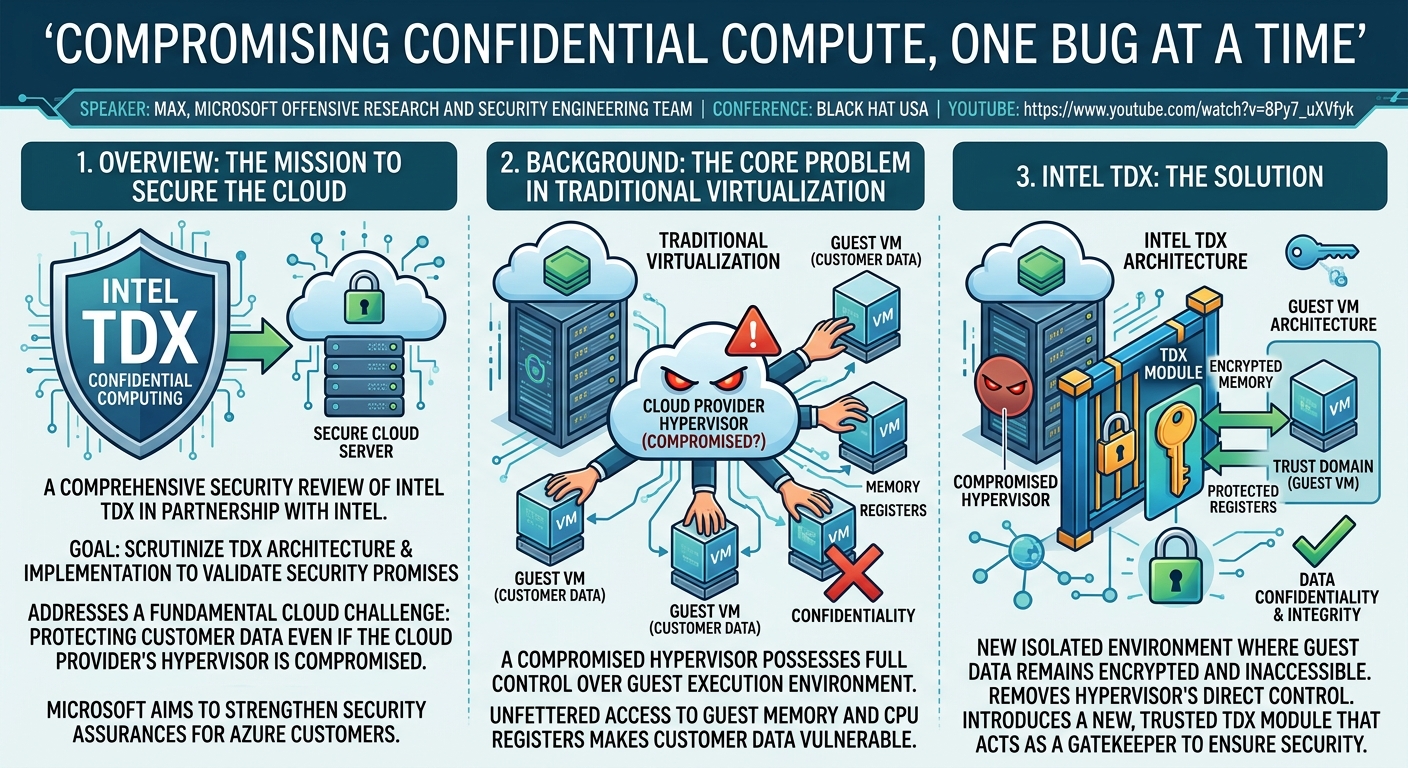
This talk, presented by Max from Microsoft's Offensive Research and Security Engineering team, delves into a comprehensive security review of Intel TDX (Trust Domain Extensions), an emerging confidential computing technology. Conducted in partnership with Intel, the review aimed to scrutinize TDX's architecture and implementation to ascertain whether its ambitious security promises truly hold. TDX represents a critical architectural shift designed to address a fundamental security challenge in cloud environments: protecting customer data even if the underlying cloud provider's hypervisor is compromised.
Key moments
- 0:00 Introduction and problem: hypervisor sees guest data
- 0:45 Introducing Intel TDX: isolating guests from hypervisor
- 2:30 TDX module internals: software, open source, protected memory
- 3:20 CPU instructions: Sim call and Sim ret mechanism
- 4:30 Hypervisor interaction: TDX module command interface
- 5:20 Executing a guest: VM launch inside TDX module
Compromising Confidential Compute, One Bug at a Time
Speakers: Max, Microsoft Offensive Research and Security Engineering Team
Conference: Black Hat USA
YouTube: https://www.youtube.com/watch?v=8Py7_uXVfyk
Overview
This talk, presented by Max from Microsoft's Offensive Research and Security Engineering team, delves into a comprehensive security review of Intel TDX (Trust Domain Extensions), an emerging confidential computing technology. Conducted in partnership with Intel, the review aimed to scrutinize TDX's architecture and implementation to ascertain whether its ambitious security promises truly hold. TDX represents a critical architectural shift designed to address a fundamental security challenge in cloud environments: protecting customer data even if the underlying cloud provider's hypervisor is compromised.
The core problem TDX seeks to solve is the inherent lack of confidentiality guarantees in traditional virtualization. In such setups, the hypervisor, controlled by the cloud provider, has unfettered access to guest memory and registers, making customer data vulnerable if the hypervisor is breached. TDX introduces an isolated environment where guest data remains encrypted and inaccessible to a compromised hypervisor, thereby bolstering the security posture for cloud customers. Microsoft's keen interest in TDX stems from its commitment to strengthening security assurances for Azure cloud customers, making this deep dive into TDX's architecture and potential vulnerabilities highly relevant for the future of secure cloud computing.
While the speaker intended to present specific vulnerabilities discovered during their review, the provided transcript concludes before these details are revealed. However, the foundational explanation of TDX's architecture, its operational model, and the identified attack surfaces provide invaluable insights into the complexities of securing confidential computing platforms. The discussion underscores the meticulous work required to validate the security claims of such a critical technology before its widespread deployment.
Background
▶ Watch: Introduction and problem: hypervisor sees guest data (0:00)
The evolution of cloud computing has brought unprecedented flexibility and scalability, but it has also introduced complex security challenges, particularly concerning data confidentiality. In a standard virtualization architecture, a hypervisor manages and runs multiple guest virtual machines. This hypervisor, typically owned by the cloud provider, possesses full control over the guest's execution environment, including direct access to its memory and CPU registers. This architectural design, while efficient for resource isolation and management, inherently means there are no confidentiality guarantees for the guest's data. If an attacker gains control of the hypervisor—a scenario often referred to as a "cloud provider compromise"—they can easily exfiltrate or tamper with all customer data residing within the guest VMs.
Recognizing this critical vulnerability, the industry has been developing confidential computing technologies. These technologies aim to protect data in use by performing computation in a hardware-protected environment, preventing unauthorized access even from privileged software like the hypervisor or other system firmware. Intel TDX is one such pivotal technology, designed to fundamentally alter this security landscape. TDX stands for Trust Domain Extensions, and its core principle is to remove the hypervisor's direct control over guest execution and memory. Instead of the hypervisor running guests directly, it interacts with a new, trusted component: the TDX module. It is this TDX module that is responsible for running guests in an isolated manner, acting as a gatekeeper to ensure that guest memory is encrypted and that guest registers are not exposed to the hypervisor. This architectural shift means that even if the hypervisor is compromised, the customer data within TDX-protected guests remains confidential and its integrity is maintained.
TDX is poised to become available in future generations of Intel CPUs, marking a significant step towards more secure cloud environments. The Microsoft Offensive Research and Security Engineering team, deeply invested in enhancing the security promises for Azure customers, undertook this security review of TDX to thoroughly understand its mechanisms and validate its security claims. Their work focuses on proactive identification of weaknesses in nascent technologies to ensure robust protection for end-users as these technologies roll out.
Key Findings
▶ Watch: TDX module internals: software, open source, protected memory (2:30)
The speaker explicitly stated the intention to present two specific vulnerabilities discovered during the security review of Intel TDX. However, the provided transcript concludes before any of these findings are detailed. Therefore, it is not possible to describe the main discoveries, results, or contributions of the talk in terms of specific bugs or exploits.
Typically, in a security review of a complex system like TDX, key findings would encompass a range of issues, such as:
- Memory corruption vulnerabilities: Buffer overflows, use-after-free, or integer overflows within the TDX module's code, potentially leading to privilege escalation or information disclosure from the protected SEAM range.
- Logical flaws: Errors in the TDX module's state machine, access control logic, or command dispatching that could allow a malicious hypervisor to bypass intended protections, tamper with guest state, or gain unauthorized access to guest memory.
- Side-channel attacks: While TDX aims to protect against direct access, subtle side channels (e.g., timing attacks, cache attacks) might still exist, potentially allowing a compromised hypervisor to infer sensitive information about guest operations or data.
- Denial-of-Service (DoS) vulnerabilities: Flaws that could allow a malicious hypervisor to crash the TDX module or prevent legitimate guest operations, impacting availability.
The rigorous nature of a security review, especially one conducted by a team like Microsoft's Offensive Research, typically uncovers critical issues that require patching and architectural refinements. The absence of these specific findings in the transcript highlights the importance of comprehensive security research in validating the promises of confidential computing platforms. Had they been presented, these findings would have demonstrated concrete instances where the hypervisor-to-TDX module security boundary, the focus of this talk, could be breached, thus compromising the confidentiality and integrity guarantees intended by TDX.
Technical Deep Dive
▶ Watch: CPU instructions: Sim call and Sim ret mechanism (3:20)
The Intel TDX architecture introduces a fundamental shift in how virtualized environments achieve confidentiality and integrity. Central to this architecture is the TDX module, a purely software component that runs directly on the main CPU, rather than on a separate, dedicated hardware chip. This design choice implies that the module operates within the existing CPU environment, leveraging specific hardware enhancements for its protection.
The TDX module's codebase is open source, with its source code available for download from the Intel website. It is programmed in C, compiled using Clang, and results in a standard ELF binary. It utilizes the X64 instruction set, without relying on any "magic instructions" beyond those specifically introduced for TDX interaction. Critically, the TDX module executes in ring zero 64-bit page mode, a privilege level analogous to a traditional operating system kernel.
Upon initialization, the TDX module is loaded into a dedicated region of physical memory known as the SEAM range (System Environment Abstraction Module). This range is specifically protected by the hardware, meaning the hypervisor is explicitly denied access to it. Only the TDX module itself can write into the SEAM range, ensuring the integrity and confidentiality of its internal state and critical data structures.
Once initialized, the TDX module does not run continuously. Instead, it executes only when explicitly invoked by the hypervisor. This invocation mechanism relies on two new CPU instructions: SIMCALL and SIMRET.
- The
SIMCALLinstruction allows the hypervisor to transition the CPU into the TDX module's execution context. WhenSIMCALLis executed, the CPU switches from "host mode" to "TDX mode," making the protected SEAM range accessible to the TDX module. - Conversely, the
SIMRETinstruction is executed by the TDX module to return control to the hypervisor. This causes the CPU to switch back to "host mode," and the SEAM range once again becomes inaccessible to the hypervisor.
This SIMCALL/SIMRET pair creates a secure boundary and controlled entry/exit points for the TDX module. The SIMCALL instruction is utilized to implement an interface that closely resembles the syscall interface found in traditional operating system kernels. Before executing SIMCALL, the hypervisor populates the RAX register with a specific value to select a desired command. Other CPU registers are then used to supply parameters for that command. Upon executing SIMCALL, the CPU jumps into the TDX module, which then dispatches the command specified in RAX, using the provided parameters.
The TDX module implements approximately 80 such commands. The majority of these commands are related to guest management, covering operations such as:
- Creating a new guest (a "Trust Domain").
- Assigning memory regions to a guest.
- Configuring guest properties.
- And, crucially, a command to run a guest.
The "run guest" command is where the actual execution of the confidential virtual machine begins. The hypervisor invokes this command via SIMCALL, the TDX module dispatches it, and then performs a VM launch. This VM launch causes the CPU to transition into the guest's execution context, allowing the guest to run for real, protected by the TDX module's isolation mechanisms.
The security review focused primarily on the hypervisor-to-TDX module attack surface. This is a critical boundary because a compromised hypervisor, despite being conceptually isolated from the guest by TDX, still serves as the primary entity interacting with the TDX module's interface. Any vulnerability within the TDX module's handling of SIMCALL commands or its internal logic could potentially allow a malicious hypervisor to undermine the very confidentiality and integrity guarantees TDX is designed to provide. The thorough examination of this interface and the TDX module's implementation is paramount to ensuring the overall security of the confidential computing environment.
Demo / Proof of Concept
▶ Watch: Hypervisor interaction: TDX module command interface (4:30)
The speaker indicated that the talk would present two vulnerabilities discovered during the security review. Typically, a demonstration or proof of concept (PoC) would accompany such findings to illustrate the exploitability of these vulnerabilities and their impact on the system's security posture. However, the provided transcript concludes abruptly before any specific vulnerabilities were detailed or any demonstration of their exploitation was described.
Had a demo been presented, it would likely have showcased how a malicious hypervisor, exploiting one of the discovered flaws in the TDX module, could bypass the confidential computing protections. This might involve:
- Exfiltrating encrypted guest memory: Demonstrating how, despite memory encryption, a vulnerability allows access to decrypted guest data or the encryption keys.
- Modifying guest state: Showing how a compromised hypervisor could alter guest registers or memory in a way that compromises the integrity of the guest's execution.
- Crashing the TDX module or guest: Illustrating a denial-of-service attack that disrupts the confidential environment.
Such demonstrations are crucial for validating theoretical vulnerabilities, understanding their practical impact, and communicating the severity of the findings to both developers and the security community. Without the specific details of the vulnerabilities, it is impossible to describe the exact nature of any potential demo or PoC that would have been presented.
Defensive Implications
▶ Watch: Executing a guest: VM launch inside TDX module (5:20)
While the specific vulnerabilities discovered by Max and the Microsoft team were not detailed in the provided transcript, the general defensive implications of a security review targeting a confidential computing technology like Intel TDX are profound. For defenders, understanding the architecture and potential attack surfaces of TDX is crucial for building and maintaining secure cloud environments.
Firstly, the very existence of a security review by a team like Microsoft's Offensive Research highlights the continuous need for proactive security validation of foundational technologies. Even hardware-assisted security features are implemented with software components (like the TDX module), which are susceptible to the same classes of bugs as any other complex software. Defenders must recognize that "confidential computing" is not a magic bullet but rather a strong security primitive that still requires careful implementation and ongoing scrutiny.
Secondly, the focus on the hypervisor-to-TDX module boundary underscores a critical threat model for cloud customers. While TDX aims to protect against a compromised hypervisor, vulnerabilities in the TDX module itself could undermine this protection. This means cloud providers utilizing TDX must:
- Prioritize rapid patching and updates: As vulnerabilities are discovered in the TDX module (or the underlying hardware microcode), cloud providers must have robust mechanisms to promptly deploy patches and updates to their infrastructure. The open-source nature of the TDX module can facilitate community review and faster identification of issues, but also means that disclosed vulnerabilities can be quickly weaponized.
- Monitor for anomalous
SIMCALLpatterns: While direct exploitation might be difficult to detect, unusual sequences or parameters inSIMCALLinvocations from the hypervisor could indicate an attempted attack against the TDX module. Implementing advanced telemetry and behavioral analytics for these low-level interactions could be a future defensive measure. - Enhance attestation processes: TDX includes mechanisms for remote attestation, allowing guests to cryptographically verify the integrity of their confidential environment. Defenders should leverage these features to continuously verify that their workloads are running on a healthy, uncompromised TDX environment. Any deviation should trigger alerts and potentially workload migration or termination.
Finally, for customers leveraging confidential computing, the defensive strategy involves understanding the scope of protection. TDX protects data in use from the hypervisor. However, it does not necessarily protect against vulnerabilities within the guest operating system or applications themselves. Therefore, traditional security hygiene—such as secure coding practices, regular patching of guest software, and robust network security—remains essential. The findings from this type of research provide critical intelligence for both platform developers (Intel, Microsoft) to harden the technology and for cloud operators and customers to implement more effective defensive strategies in their confidential computing deployments.
Key Takeaways
- Confidential Computing is Essential for Cloud Security: Traditional virtualization lacks confidentiality guarantees against a compromised hypervisor, making technologies like Intel TDX critical for protecting customer data in multi-tenant cloud environments.
- Intel TDX Architecture: TDX introduces a software-based TDX module running on the main CPU, which manages guests in an isolated manner, encrypting guest memory and protecting registers from the hypervisor.
- Protected Execution Environment: The TDX module operates within a hardware-protected physical memory region called the SEAM range, inaccessible to the hypervisor, ensuring the integrity of the module's state.
- Controlled Interface via
SIMCALL/SIMRET: New CPU instructions,SIMCALLandSIMRET, provide a controlled, syscall-like interface for the hypervisor to interact with the TDX module, managing guest lifecycle and execution. - Software Security is Paramount: Despite hardware backing, the TDX module is a complex software component (C, Clang, ELF, X64, Ring 0) and thus subject to software vulnerabilities, requiring extensive security reviews like the one conducted by Microsoft.
- Hypervisor-to-TDX Module is a Critical Attack Surface: The interaction boundary between a potentially malicious hypervisor and the TDX module is a primary focus for security research, as flaws here could directly undermine TDX's core security promises.
About the Speaker(s)
The speaker for this talk is Max, who works in the Microsoft Offensive Research and Security Engineering team. This team is dedicated to proactive security research, focusing on identifying and mitigating vulnerabilities in emerging technologies and critical infrastructure. Max's role involves conducting in-depth security reviews of complex systems like Intel TDX, often in collaboration with hardware and software vendors, to ensure the robustness and trustworthiness of security promises made to customers, particularly within Microsoft's Azure cloud services.