Confusion Attacks: Exploiting Hidden Semantic Ambiguity in Apache HTTP Server!
Unknown
Black Hat USA 2024 · Day 1 · Briefing
Overview
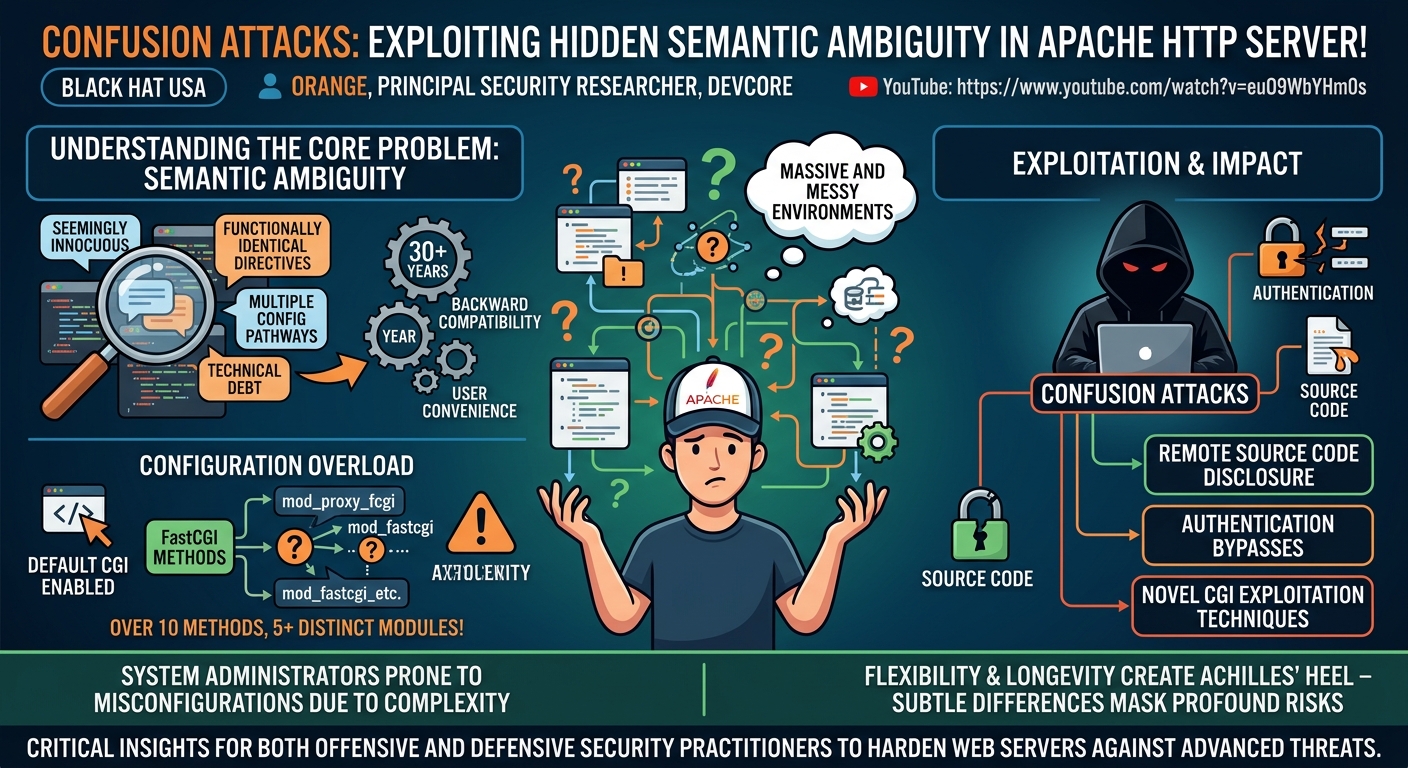
This talk, presented by Orange, Principal Security Researcher at DEVCORE, delves into a pervasive class of vulnerabilities termed confusion attacks within the Apache HTTP Server ecosystem. The core premise is that Apache's extensive history, coupled with its highly flexible and often complex configuration options—especially when integrated with PHP—introduces semantic ambiguity that can be exploited by attackers. Orange highlights how seemingly innocuous or functionally identical configuration directives can harbor critical security flaws, leading to issues ranging from remote source code disclosure to authentication bypasses and novel CGI exploitation techniques.
Key moments
- 0:00 Speaker introduction and Apache HTTP Server overview
- 2:00 Apache PHP environment complexity and security risks
- 3:32 AddHandler vs. AddType: a common, vulnerable configuration
- 4:40 Apache environments and specific attack techniques overview
- 5:30 Introduction of a brand-new CGI exploitation technique
- 6:00 The challenges of maintaining a 30-year-old open-source project
- 6:50 Speaker's background, achievements, and future research directions
Confusion Attacks: Exploiting Hidden Semantic Ambiguity in Apache HTTP Server!
Speakers: Orange, Principal Security Researcher, DEVCORE
Conference: Black Hat USA
YouTube: https://www.youtube.com/watch?v=euO9WbYHm0s
Overview
This talk, presented by Orange, Principal Security Researcher at DEVCORE, delves into a pervasive class of vulnerabilities termed confusion attacks within the Apache HTTP Server ecosystem. The core premise is that Apache's extensive history, coupled with its highly flexible and often complex configuration options—especially when integrated with PHP—introduces semantic ambiguity that can be exploited by attackers. Orange highlights how seemingly innocuous or functionally identical configuration directives can harbor critical security flaws, leading to issues ranging from remote source code disclosure to authentication bypasses and novel CGI exploitation techniques.
The presentation underscores the challenges inherent in maintaining a mature, open-source project like Apache, which has accumulated significant technical debt over its nearly three-decade existence. This debt, combined with the need for backward compatibility and user convenience, has led to a sprawling and sometimes inconsistent configuration landscape. Orange argues that system administrators, often operating in "massive" and "messy" environments, are prone to misconfigurations due to this complexity, inadvertently creating exploitable pathways that sophisticated attackers can leverage.
The talk is particularly relevant for anyone involved in securing web infrastructure, especially those managing Apache deployments. It offers a fresh perspective on how the very flexibility and longevity that define Apache can become its Achilles' heel, revealing that even common configuration patterns and seemingly harmless choices can mask profound security risks. By illustrating how attackers can exploit the subtle differences and unintended consequences of Apache directives, Orange provides critical insights for both offensive and defensive security practitioners aiming to harden their web servers against advanced threats.
Background
▶ Watch: Speaker introduction and Apache HTTP Server overview (0:00)
Apache HTTP Server, a cornerstone of the internet for nearly 30 years, stands as one of the most widely deployed web servers globally. Its longevity and open-source nature have fostered immense flexibility and compatibility, but this comes at a significant cost: a considerable amount of technical debt. This debt manifests in various ways, notably through its default enablement of Common Gateway Interface (CGI), which inherently expands the potential attack surface. The necessity of maintaining backward compatibility across decades of development means that design decisions made in earlier, less security-conscious eras continue to influence its current state, often creating subtle vulnerabilities that are difficult to identify and rectify.
A critical factor contributing to Apache's complexity, and thus its vulnerability to confusion attacks, is its deep integration with PHP. Setting up a PHP environment with Apache is far from straightforward, offering a bewildering array of configuration options. The speaker points out that for FastCGI alone, there are over ten methods, involving at least five distinct modules that perform similar functions. This doesn't even account for traditional CGI combinations or process managers like PHP-FPM. Each module and setup method comes with its own set of directives, multiplying the overall complexity.
This proliferation of configuration options leads directly to the problem of semantic ambiguity. Many directives, while distinct, appear very similar or even have identical usages and effects, making it exceptionally easy for system administrators to misinterpret their true intent. A prime example highlighted in the talk is the choice between AddHandler and AddType for configuring PHP execution. While both can successfully get PHP running, their underlying mechanisms and security implications differ significantly. AddType, for instance, has a documented history of being vulnerable, allowing attackers to remotely disclose PHP source code under specific conditions. This illustrates a critical principle: merely achieving functionality does not equate to achieving security.
Furthermore, Orange observes that sysadmins managing Apache typically oversee "massive environments" often characterized by "messy" filesystems and the hosting of numerous third-party services (e.g., Java web servers, Nginx instances) locally. In such scenarios, RewriteRule directives are frequently employed to remap traffic to these services or to implement custom logic, such as hiding file extensions. These complex and often hastily written rules, combined with the general disarray of the server's file system, create fertile ground for misconfigurations and exploitable weaknesses, making Apache a challenging environment to secure effectively. The confluence of legacy code, default-enabled features, configuration complexity, and real-world operational practices forms the intricate backdrop against which these confusion attacks are launched.
Key Findings
▶ Watch: AddHandler vs. AddType: a common, vulnerable configuration (3:32)
The central discovery presented in this talk revolves around the exploitation of hidden semantic ambiguity within the Apache HTTP Server's configuration directives. Orange's research demonstrates that the sheer volume, similarity, and sometimes overlapping functionality of Apache's configuration options lead to a high probability of misconfiguration, which attackers can then leverage for various nefarious purposes.
Key findings include:
- Vulnerabilities Arising from Directive Confusion: The talk emphasizes that directives which appear functionally identical, such as
AddHandlerandAddTypefor PHP execution, possess distinct security profiles. While both can enable PHP,AddTypehas been historically implicated in vulnerabilities that permit remote PHP source code disclosure. This highlights a critical finding: "correct" functionality does not guarantee secure operation, and subtle differences in directive interpretation by Apache can have severe security repercussions. - Bypassing Security Controls via Misconfigured RewriteRules: Orange identified common patterns in
RewriteRuleusage that are inherently vulnerable. Specifically, rules designed to "hide file extensions" or remap traffic in complex environments can be exploited to bypass security mechanisms, including password-protected manager interfaces. The talk promises to detail methods for identifying and breaking these problematic rules, indicating a new class of RewriteRule bypasses. - Novel CGI Exploitation Techniques: Beyond conventional web vulnerabilities, the research uncovers a "brand-new exploitation technique" targeting simple CGI scripts. This technique explicitly moves beyond client-side vulnerabilities like CRLF Injection leading to XSS, and server-side attacks like Smuggling, Desync, or Cache Poisoning that rely on middleboxes. This suggests a unique server-side attack vector that exploits the specific characteristics or configuration nuances of CGI execution within Apache. While the specific details of this new technique are not provided in the transcript, its existence points to a deeper understanding of Apache's internal processing logic and how it can be abused.
- Impact of Legacy Code and Technical Debt: The underlying finding is that Apache's nearly 30 years of existence, its commitment to backward compatibility, and the resulting accumulation of technical debt are primary drivers of these vulnerabilities. The development process, built upon layers of legacy code, inadvertently creates a complex environment where such semantic ambiguities and potential for misconfiguration thrive, making it a persistent target for sophisticated attackers.
- Practical Exploitation in "Messy" Environments: The research acknowledges the real-world context of Apache deployments, often characterized by "massive environments" with disorganized filesystems and a mix of third-party services. These practical conditions exacerbate the risk of misconfigurations and provide a rich attack surface for exploiting the identified vulnerabilities.
In essence, the key findings illustrate that Apache's strength—its flexibility and longevity—is also its greatest weakness from a security perspective. The talk uncovers how a deep understanding of Apache's internal workings and the subtle interpretations of its directives can yield powerful exploitation primitives against widely deployed web servers.
Technical Deep Dive
▶ Watch: Apache environments and specific attack techniques overview (4:40)
The technical core of Orange's talk revolves around the principle of semantic ambiguity in Apache configurations, particularly how similar-looking directives can lead to critical security flaws. The prime example cited is the distinction between AddHandler and AddType for configuring PHP.
AddHandler vs. AddType: The PHP Source Code Disclosure Vector
System administrators frequently encounter both AddHandler and AddType when setting up PHP. While both can make PHP scripts executable, their underlying mechanisms differ significantly.
AddHandlermaps a file extension (e.g.,.php) to an internal Apache handler (e.g.,php-script). This tells Apache to process files with that extension using the specified handler, which in turn passes the request to the PHP interpreter. This is generally the more secure and recommended approach for PHP.AddType, on the other hand, maps a file extension to a MIME type (e.g.,application/x-httpd-php). Apache uses MIME types to determine how to serve content. IfAddType .php application/x-httpd-phpis used, Apache might first identify the file as PHP content, but without a corresponding handler explicitly telling it to execute the PHP, it might default to serving the content as plain text.
The speaker states that AddType has been "proven to be vulnerable that allowing attackers to disclose the PHP source code remotely." While the transcript notes that the speaker intended to discuss the reasons for this vulnerability later in the talk, those details are not provided in the supplied transcript. However, common scenarios for AddType-related source code disclosure typically involve:
- Missing Handler: If
AddTypeis used to declare.phpasapplication/x-httpd-phpbut noAddHandler(or equivalent) is present to actually execute that MIME type, Apache might serve the raw.phpfile content as plain text, exposing the source code. - Order of Directives/Conflicting Rules: In complex configurations, the order of
AddTypeand other directives, or conflicting rules from different configuration files (.htaccess,httpd.conf), can lead to Apache misinterpreting the file. For instance, if aFilesMatchdirective intended for security is incorrectly overridden or superseded by a globalAddType, the security control might fail. - Path Traversal/Misinterpretation of Extensions: In some legacy Apache versions or specific configurations, if an attacker can craft a URL like
example.com/file.php.somethingand Apache'sAddTyperule only matches.php, it might fail to execute the PHP and instead serve the file as text, especially if other handlers aren't explicitly defined for the full extension.
The critical takeaway here is that sysadmins, aiming for functional PHP, might choose AddType because it "works," unaware of its potential to create a source code disclosure vulnerability, especially in combination with other configuration nuances or the absence of explicit execution handlers.
Vulnerable RewriteRules and Configuration Complexity
The talk also promises to detail how to identify and break problematic RewriteRule configurations. RewriteRule directives are incredibly powerful and widely used for URL rewriting, redirection, and access control. However, their complexity often leads to security vulnerabilities. Orange specifically mentions rules designed to "hide file extensions" as being vulnerable.
While the transcript does not provide the specific techniques, common RewriteRule vulnerabilities often include:
- Bypass of Access Controls: A
RewriteRuleintended to block access to certain paths or file types might be bypassed by crafting specific URLs that the rule doesn't anticipate (e.g., adding extra slashes, null bytes, or alternative encodings). - Path Traversal: Incorrectly configured
RewriteRulepatterns, especially those involving user-supplied input, can sometimes be manipulated to access files outside the intended web root. - Authentication Bypasses: If
RewriteRuleis used to redirect unauthenticated users, or to proxy requests to internal services, flaws in the rule logic could allow an attacker to bypass authentication checks or access internal resources directly. - Information Disclosure: Sometimes
RewriteRulecan inadvertently expose internal paths or server configurations if error handling is not robust.
The speaker's observation about "massive environments" and "messy filesystems" further exacerbates these RewriteRule issues. In such environments, RewriteRule directives are often written ad-hoc, without thorough security review, accumulating complex and potentially conflicting logic that is ripe for exploitation.
New Exploitation Technique for CGI
A significant technical contribution hinted at is a "brand-new exploitation technique" for simple CGI scripts. The speaker explicitly rules out common attack vectors:
- Client-Side vulnerabilities: Such as CRLF Injection for XSS, indicating the focus is on server-side impact.
- Smuggling, Desync, or Cache Poisoning: These are ruled out because the presented scenario has "no middlebox," implying the attack targets direct communication with the Apache server, not an intermediary.
This suggests an attack that leverages specific aspects of how Apache processes CGI scripts, likely exploiting a nuanced interpretation of request parameters, environment variables, or the CGI specification itself under certain Apache configurations. Without the specific details, it's challenging to elaborate further, but the exclusion of common attack types points to a novel approach, possibly related to:
- Environment Variable Injection: Manipulating HTTP headers or request parameters to inject malicious data into CGI environment variables.
- Input Handling Flaws: Exploiting how Apache passes input to CGI scripts, potentially leading to command injection or buffer overflows in the CGI program itself (if written in C/C++).
- Resource Exhaustion: Triggering resource limits or denial-of-service conditions through specific CGI requests.
The emphasis on "confusion attacks" implies that this new technique likely exploits a misinterpretation or unexpected behavior arising from Apache's complex interaction with CGI scripts, further reinforcing the talk's central theme of semantic ambiguity. The speaker's mention of future work exploring "Allowed-by-Default ACLs, Local Gadgets, and Symbolic Links" suggests potential avenues for these advanced CGI exploits, implying that default permissions or file system links could be part of the attack chain.
Demo / Proof of Concept
▶ Watch: The challenges of maintaining a 30-year-old open-source project (6:00)
Although the talk was delivered as a pre-recorded video due to visa issues, the speaker, Orange, outlined several practical demonstrations and proof-of-concept scenarios that were intended to be showcased. These demonstrations aimed to concretely illustrate the vulnerabilities arising from Apache's semantic ambiguity and complex configurations.
The speaker explicitly stated the intention to:
- Bypass a common password-protected manager interface: This demonstration would have shown how a seemingly secure authentication mechanism for an administrative panel, likely protected by
.htaccessorRewriteRuledirectives, could be circumvented. This would typically involve exploiting misconfigurations in the access control rules, perhaps by crafting URLs that are not correctly evaluated by the server, leading to unauthorized access. While the specific technique wasn't detailed in the transcript, it aligns with the theme of exploiting problematicRewriteRulelogic. - Identify problematic
RewriteRulesand break them: Orange promised to reveal techniques for identifyingRewriteRuleconfigurations that are vulnerable, particularly those designed to "hide file extensions." The demonstration would have shown how these rules, intended for cleaner URLs or basic obfuscation, could be exploited to bypass security controls or achieve unintended effects. This would likely involve specific URL crafting that exploits regex mismatches or unexpected rule processing order. - Exploit a simple CGI script using a brand-new technique: This was presented as a highlight, demonstrating a novel server-side exploitation method for CGI. By explicitly ruling out client-side attacks (like CRLF Injection for XSS) and middlebox-dependent attacks (like Smuggling or Cache Poisoning), the demonstration would have focused on a direct attack against Apache's CGI processing. The nature of the attack, as discussed in the Technical Deep Dive, would likely involve manipulating server-side interpretation of requests or environment variables in a way not previously highlighted.
While the transcript does not provide the step-by-step execution or visual details of these demonstrations, their inclusion in the talk's agenda confirms the practical applicability of Orange's research. These proofs of concept would have underscored the real-world impact of configuration confusion, moving beyond theoretical discussions to show tangible exploitation pathways. The speaker's ability to demonstrate these complex bypasses and novel exploits reinforces the depth of understanding required to secure Apache in modern, often legacy-laden, environments.
Defensive Implications
▶ Watch: Speaker's background, achievements, and future research directions (6:50)
The insights from Orange's talk provide crucial guidance for system administrators and security professionals responsible for Apache HTTP Server deployments. The pervasive nature of confusion attacks demands a more nuanced and thorough approach to configuration management.
Here are the key defensive implications:
- Understand Directive Intent, Not Just Functionality: The most critical takeaway for defenders is to move beyond simply making a configuration "work." Instead, it's imperative to deeply understand the semantic intent and underlying security implications of each Apache directive. For example, while both
AddHandlerandAddTypecan enable PHP,AddHandleris generally preferred for its clearer security posture. AvoidAddTypefor PHP execution where possible, as it has a documented history of leading to source code disclosure. IfAddTypemust be used, ensure it is rigorously paired with an explicit handler and robust access controls to prevent unintended content serving. - Audit and Review RewriteRules Meticulously:
RewriteRuledirectives are powerful but often a source of vulnerabilities due to their complexity. Defenders should conduct thorough security audits of allRewriteRuleconfigurations, especially those involving: - Access control: Ensure rules intended to restrict access cannot be bypassed by path variations, encoding tricks, or unexpected input.
- URL rewriting: Verify that rules designed to "hide file extensions" or simplify URLs do not inadvertently create bypasses for security mechanisms.
- Proxying: If
RewriteRuleis used for proxying to internal services, ensure that it strictly controls the target and prevents unauthorized access to internal resources. - Regular expressions should be carefully reviewed for edge cases and potential for misinterpretation.
- Minimize Attack Surface by Disabling Unnecessary Features: Given that Apache enables CGI by default, and this significantly increases the attack surface, defenders should disable CGI if it is not strictly required. If CGI is necessary, ensure that CGI scripts are minimal, well-audited, and adhere to secure coding practices. Isolate CGI environments and apply the principle of least privilege.
- Segment and Isolate Environments: The observation that many Apache environments are "massive" and "messy," hosting multiple third-party services, underscores the need for better segmentation. Where possible, isolate different applications or services to prevent a compromise in one from easily affecting others. Use containers, virtual machines, or separate Apache instances to create clear boundaries.
- Regular Configuration Audits and Version Control: Implement a robust process for configuration management, including version control for all Apache configuration files. Regularly audit configurations against security best practices and known vulnerabilities. Automated tools can help identify common misconfigurations, but manual review by experienced security personnel is invaluable.
- Stay Updated with Apache and PHP Releases: While legacy code is a challenge, keeping Apache and PHP up-to-date with the latest stable releases is crucial. Security patches often address subtle vulnerabilities that could contribute to confusion attacks.
- Consider the Impact of Third-Party Modules: Every additional Apache module adds complexity and potential for new interactions that could lead to semantic ambiguity. Carefully evaluate the necessity and security posture of all third-party modules.
- Future-Proofing Against Emerging Threats: The speaker's mention of future research into "Allowed-by-Default ACLs, Local Gadgets, and Symbolic Links" suggests these areas are ripe for exploitation. Defenders should begin to review their environments for default access controls that are too permissive, the presence of exploitable local binaries or scripts ("gadgets"), and any potentially insecure use of symbolic links within the web root.
By adopting a proactive and detail-oriented approach to Apache configuration, defenders can significantly mitigate the risks posed by confusion attacks and better secure their web infrastructure against sophisticated threats.
Key Takeaways
- Apache HTTP Server's nearly 30 years of existence and commitment to backward compatibility have resulted in significant technical debt and a complex configuration landscape.
- Semantic ambiguity in Apache directives, where similar-looking options (e.g.,
AddHandlervs.AddType) have distinct security implications, is a primary cause of critical misconfigurations. - Misuse of directives like
AddTypefor PHP execution has been historically proven to lead to remote PHP source code disclosure, highlighting that "correct" functionality does not guarantee security. - Commonly used RewriteRules, particularly those designed to "hide file extensions" or manage traffic in complex environments, are frequently vulnerable to bypasses and can be exploited to circumvent security controls.
- Beyond traditional client-side (e.g., XSS) and middlebox-dependent (e.g., Smuggling) attacks, new, sophisticated server-side exploitation techniques exist for simple CGI scripts, leveraging nuanced interpretations of Apache's processing.
- Defenders must deeply understand the intent behind each Apache directive, meticulously audit
RewriteRuleconfigurations, minimize attack surface by disabling unnecessary features like default CGI, and regularly update their Apache and PHP environments to counter these advanced confusion attacks.
About the Speaker(s)
The primary speaker for this presentation is Orange, who currently serves as the Principal Security Researcher at DEVCORE. Orange is a highly accomplished and recognized figure in the cybersecurity community, with a distinguished track record of presenting at prestigious hacker conferences worldwide, including Black Hat, DEFCON, and HITCON. Their research has garnered numerous accolades, such as achieving 1st place in the Top 10 Web Hacking Techniques, becoming a Pwn2Own Champion, and receiving Pwnie Awards. These achievements underscore Orange's profound expertise in offensive security and their ability to uncover novel and impactful vulnerabilities.
Also mentioned in the talk is Allen, the CEO of DEVCORE. DEVCORE is highlighted as a company that provides "the most professional Red Team services in Asia," indicating a strong focus on advanced offensive security operations and vulnerability research. Allen's presence at the conference further emphasizes DEVCORE's commitment to cutting-edge security research and its practical application in real-world scenarios.