Deep Backdoors in Deep Reinforcement Learning Agents
Unknown
Black Hat USA 2024 · Day 1 · Briefing
Overview
This talk delves into the emerging and critical threat of backdoors in Deep Reinforcement Learning (DRL) agents, a domain rapidly expanding beyond games into real-world, high-stakes applications. Speakers Vaz and Jamie illuminate how these intelligent agents, powered predominantly by neural networks, can be compromised to harbor malicious functionality. Unlike traditional software backdoors, DRL backdoors operate by recognizing specific "triggers" within their operational environment, prompting a drastic and potentially catastrophic deviation from their intended, safe behavior. The talk not only dissects the mechanics of such attacks but also introduces a novel defensive mechanism, Neural Watchdog, designed to mitigate these sophisticated threats.
Key moments
- 0:00 Introduction to Reinforcement Learning and its paradigm.
- 2:00 Reinforcement Learning's real-world applications beyond games.
- 4:00 Explaining how a malicious trigger activates an RL backdoor.
- 6:00 Comparing RL backdoors to software supply chain attacks.
- 7:00 Emergence of architectural backdoors: a new threat.
- 8:00 Live demonstration of a backdoored agent (Breakout).
Deep Backdoors in Deep Reinforcement Learning Agents
Speakers: Vaz, Jamie
Conference: Black Hat USA
YouTube: https://www.youtube.com/watch?v=hcOmt9pHvao
Overview
This talk delves into the emerging and critical threat of backdoors in Deep Reinforcement Learning (DRL) agents, a domain rapidly expanding beyond games into real-world, high-stakes applications. Speakers Vaz and Jamie illuminate how these intelligent agents, powered predominantly by neural networks, can be compromised to harbor malicious functionality. Unlike traditional software backdoors, DRL backdoors operate by recognizing specific "triggers" within their operational environment, prompting a drastic and potentially catastrophic deviation from their intended, safe behavior. The talk not only dissects the mechanics of such attacks but also introduces a novel defensive mechanism, Neural Watchdog, designed to mitigate these sophisticated threats.
The significance of this research cannot be overstated. As DRL agents increasingly control critical infrastructure—from autonomous vehicles and drones to advanced systems like nuclear fusion reactors—the integrity and trustworthiness of these agents become paramount. A compromised agent could lead to severe safety breaches, operational failures, or even malicious acts, underscoring the urgent need for robust security measures. This presentation offers a comprehensive look at the attack surface, the potential consequences, and proactive solutions, making it essential viewing for anyone involved in the development, deployment, or security of AI systems.
Background
▶ Watch: Introduction to Reinforcement Learning and its paradigm. (0:00)
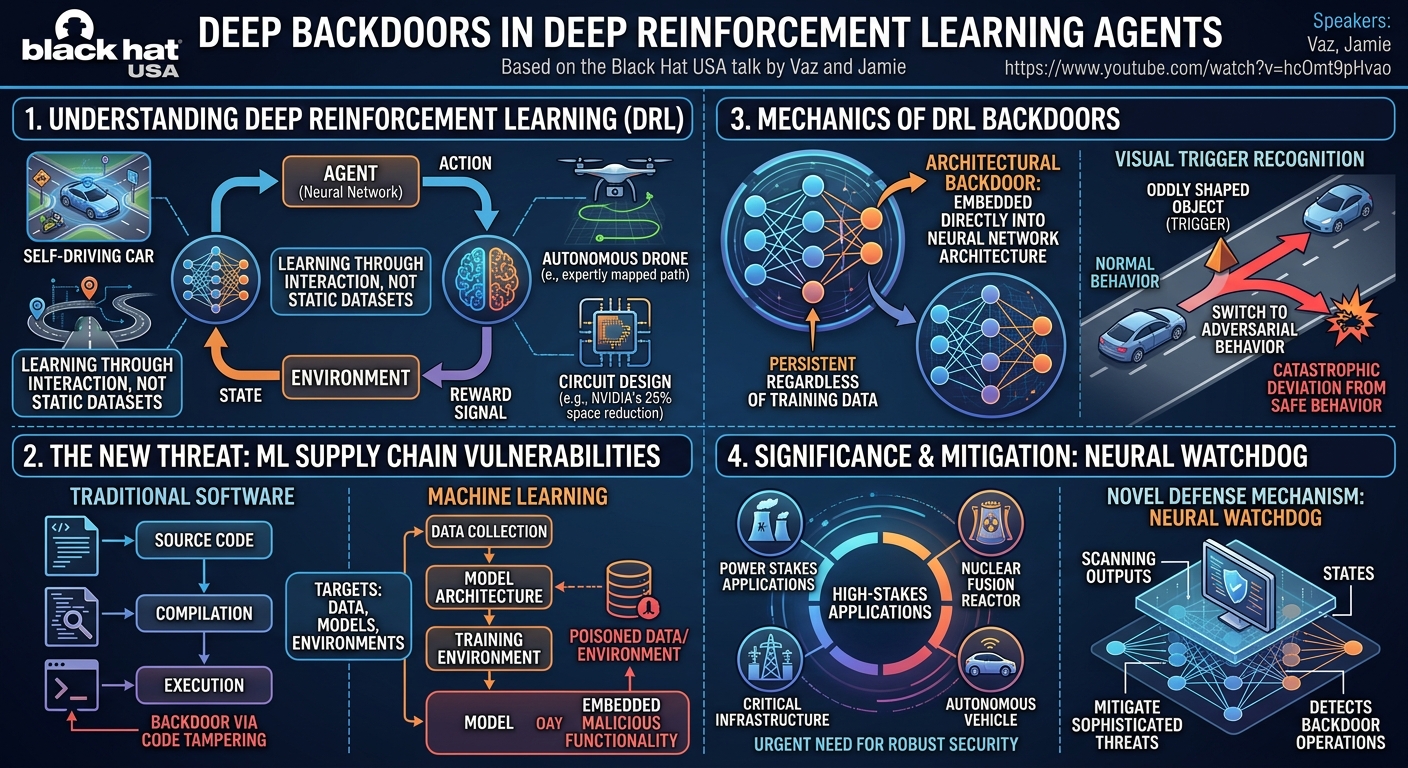
Reinforcement Learning (RL) represents a paradigm shift from traditional supervised machine learning. Instead of learning from static datasets, RL agents learn by interacting with an environment. An agent (often a neural network) takes actions within this environment, observes the state changes, and receives a reward signal indicating the efficacy of its actions. This iterative process allows agents to autonomously discover optimal strategies, akin to learning to play a game without instructions. This approach has yielded superhuman performance in games and is now being adopted in complex real-world scenarios such as self-driving cars, autonomous drone navigation (where agents trained in simulation outperformed human experts), and even optimizing circuit design, with Nvidia reportedly achieving a 25% space reduction for arithmetic operation circuits using RL.
The concept of a backdoor, while familiar in software supply chain security, takes on new dimensions in the context of machine learning. In traditional software, a backdoor might be a compromised piece of code that allows an adversary to bypass security measures via a specific trigger. The machine learning (ML) supply chain presents analogous vulnerabilities, but with different attack vectors. Instead of just source code, the targets include data, models, and the environment itself. Adversaries can poison data or manipulate the training environment to embed malicious functionality. This means an agent could be trained to behave normally under most conditions, but upon encountering a specific, predefined malicious trigger in its environment, it would switch to an adversarial behavior. These triggers can be subtle, such as an oddly shaped object or a specific pattern in the agent's visual input.
A particularly insidious form of compromise highlighted in the talk is the architectural backdoor. Here, the malicious functionality is not merely learned from poisoned data but is embedded directly into the architecture of the neural network itself. This makes the backdoor persistent regardless of the training data used, posing a far greater challenge for detection and remediation. The entire ML pipeline, from open-source training frameworks to deployment and update mechanisms, becomes a potential vector for such sophisticated attacks.
Key Findings
▶ Watch: Explaining how a malicious trigger activates an RL backdoor. (4:00)
The talk reveals several critical findings regarding deep backdoors in DRL agents:
- Ubiquity of Neural Networks: The vast majority (90-99%) of modern DRL agents are powered by neural networks. This makes understanding and securing neural network architectures and training processes central to mitigating backdoor threats.
- Trigger-Based Malicious Behavior: DRL backdoors are activated by specific, often subtle, environmental triggers. An agent appears benign and performs its intended function flawlessly until this trigger is observed, at which point its behavior drastically shifts to an adversarial mode. This stealthy nature makes detection difficult during normal operation.
- Diverse Attack Vectors in the ML Supply Chain: Backdoors can be introduced at multiple stages of the ML lifecycle. This includes data poisoning (manipulating training data), environment poisoning (modifying the simulation or real-world environment during training), and compromising the model itself.
- The Threat of Architectural Backdoors: A particularly alarming finding is the possibility of "architectural backdoors," where malicious functionality is hard-coded into the neural network's structure. This means the backdoor persists even if the agent is retrained with clean data, making it extremely difficult to remove without rebuilding the model from scratch or employing advanced detection techniques.
- High-Stakes Applications and Consequences: The speakers emphasize that these vulnerabilities are not confined to academic exercises or games. With DRL agents controlling critical systems like self-driving cars, autonomous drones, and even nuclear fusion reactors, the consequences of a successful backdoor attack could range from significant financial loss and system failure to severe safety incidents and catastrophic real-world damage.
- Introduction of Neural Watchdog: To counter these threats, the speakers introduce Neural Watchdog, an open-source "neural firewall" designed to detect and mitigate anomalous behavior in DRL agents. This represents a proactive step towards securing these increasingly vital AI systems.
Technical Deep Dive
▶ Watch: Comparing RL backdoors to software supply chain attacks. (6:00)
At the heart of a DRL agent is typically a neural network, which acts as the agent's "brain." This neural network receives observations about the current state of the environment (e.g., camera feeds, sensor data) as input. Through a series of interconnected neurons and layers (forming its architecture), it processes this information and outputs a decision: the action to take next. This action is then executed in the environment, leading to a new state and a reward, completing the feedback loop. The agent's learning process involves adjusting the weights and biases within its neural network to maximize cumulative rewards over time.
A deep backdoor exploits this learning mechanism. An adversary intentionally injects specific patterns or data during the agent's training phase. This could involve:
- Data Poisoning: Introducing maliciously crafted observations and corresponding optimal (from the adversary's perspective) actions into the training dataset. For example, showing the agent an image of a hexagonal shape and associating it with a specific, harmful action, while ensuring it performs correctly for all other, non-triggered observations.
- Environment Poisoning: Modifying the training environment itself. In a simulated driving environment, for instance, an adversary might introduce a specific road sign that, when observed, triggers the agent to drive off-road, while the agent continues to drive safely in all other circumstances.
The key to a backdoor's effectiveness is its stealth. The agent's performance remains high and seemingly normal in the absence of the trigger. This makes it difficult for operators to detect the malicious functionality through standard performance metrics or functional testing. Only when the specific trigger, designed by the adversary, appears in the agent's observation space does the latent malicious behavior manifest.
The concept of an architectural backdoor takes this a step further. Instead of relying on learned associations from poisoned data, the malicious logic is directly embedded into the neural network's fundamental structure or parameters. This could involve:
- Malicious Weights/Biases: Directly manipulating the numerical values of the neural network's weights or biases to create a specific activation path that leads to a malicious action when a trigger is present.
- Modified Layers/Connections: Introducing or altering specific layers, neurons, or their connections within the network architecture to hardwire the backdoor. For example, a specific set of neurons might be designed to activate only upon detection of a trigger, then override the normal decision-making process.
Such architectural compromises are particularly dangerous because they are resilient to traditional adversarial training defenses or retraining with clean data. The malicious "circuitry" is an intrinsic part of the model. Detecting these requires deep introspection into the model's internal representations and decision-making processes, often through techniques like explainable AI (XAI) or specialized neural network analysis tools. The adversary's goal is to ensure the backdoor logic is robust, meaning it consistently activates with the trigger and remains dormant otherwise, and also transferable, allowing it to persist across different environments or slight variations of the trigger.
The talk implicitly highlights the black box nature of deep neural networks as a contributing factor to the difficulty of detecting these backdoors. The complex, non-linear interactions between millions of parameters make it challenging to understand exactly why an agent makes a particular decision, let alone to definitively prove the absence of hidden malicious logic.
Demo / Proof of Concept
▶ Watch: Emergence of architectural backdoors: a new threat. (7:00)
The speakers presented two distinct demonstrations to illustrate the concept and impact of deep backdoors in DRL agents, and the efficacy of their proposed solution.
- Breakout Game Demonstration (Malicious Agent):
The first demonstration featured an agent playing the classic Atari game Breakout. This agent was explicitly described as malicious, meaning it harbored a hidden backdoor. Crucially, in the initial phase of the demonstration, no trigger was present in the game environment. As expected, the agent performed exceptionally well, expertly controlling the paddle to hit the ball and destroy bricks, achieving a high score. This perfectly illustrated the stealth aspect of DRL backdoors: without the specific trigger, the compromised agent behaves indistinguishably from a legitimate, well-trained agent. While the talk did not explicitly show the trigger activating in this demo, it served to establish the baseline of a seemingly benign yet compromised agent. The implication was that if a trigger were introduced (e.g., a specific pattern on the screen), the agent would then exhibit malicious behavior, such as intentionally missing the ball or moving the paddle out of bounds.
- Navigation Environment with Neural Watchdog:
The second, more elaborate demonstration showcased a navigation environment, which the speaker likened to the planning module of a self-driving car. In this environment:
- A red arrow represented the agent, moving across a game board.
- The agent had a limited line of sight, seeing only a portion of the environment directly in front of it.
- Its primary objective was to navigate towards a green square, while simultaneously avoiding a lava river.
- The agent was initially shown performing its task correctly, navigating around the lava and heading towards the green square, indicating it had learned the desired behavior.
This navigation agent was, however, also compromised with malicious functionality. The critical aspect of this demonstration was the introduction of Neural Watchdog, which the speakers described as a "neural firewall." While the specific details of how Neural Watchdog operates were not fully elaborated in the transcript, the demonstration implied its ability to detect when the agent's internal state or planned action deviated from expected, safe behavior, especially in the presence of a potential trigger. The intent was to show that even if a malicious trigger were to appear in the environment, causing the agent to attempt to execute a harmful action (like driving into the lava or away from its goal), Neural Watchdog would intervene, preventing the malicious action and ensuring the agent maintained its safe, intended operation. This demo was a practical illustration of the proposed defensive mechanism in action, safeguarding an agent in a critical, real-world-analogous scenario.
Defensive Implications
▶ Watch: Live demonstration of a backdoored agent (Breakout). (8:00)
The rise of deep backdoors in DRL agents necessitates a fundamental shift in how we approach the security of AI systems, moving beyond traditional software security paradigms. The defensive implications are multi-layered, addressing vulnerabilities across the entire ML supply chain.
Firstly, securing the ML supply chain becomes paramount. This involves:
- Data Integrity: Implementing stringent controls over training data sources, ensuring data is not poisoned or manipulated. This might involve data provenance tracking, cryptographic hashes, and robust data validation pipelines. For environments, especially in simulation, ensuring the simulation environment itself is trustworthy and free from malicious modifications is crucial.
- Model Integrity: Verifying the integrity of pre-trained models and open-source training frameworks. Architectural backdoors embedded in frameworks or pre-trained components are a significant threat. This calls for thorough auditing of third-party libraries and components, potentially using techniques like binary analysis for neural network models.
- Deployment and Updates: Ensuring that deployment pipelines and model update mechanisms are secure against tampering, similar to established software supply chain best practices.
Secondly, runtime monitoring and anomaly detection are crucial. This is where solutions like the presented Neural Watchdog come into play. Described as a "neural firewall," Neural Watchdog is designed to actively monitor the internal state and outputs of a DRL agent in real-time. Instead of trying to prevent the backdoor from being embedded (which can be incredibly difficult with architectural backdoors), it aims to detect and block the malicious behavior before it can cause harm. This could involve:
- Behavioral Anomaly Detection: Identifying deviations from the agent's learned safe policy. If an agent suddenly attempts an action that is highly improbable or directly contradictory to its training objectives under normal circumstances, Neural Watchdog could flag it.
- Internal State Monitoring: Analyzing the activation patterns of neurons or specific layers within the neural network. A malicious trigger might cause a unique, recognizable internal state transition that indicates a backdoor activation.
- Policy Verification: Continuously verifying that the agent's proposed actions align with a pre-defined set of safe operating policies or constraints. If the agent's output action falls outside these safe bounds, Neural Watchdog could override or modify the action.
Thirdly, robustness and adversarial training can help. While not a complete solution for architectural backdoors, training agents on adversarial examples (including triggered scenarios) can help improve their resilience to certain types of backdoor attacks. This involves exposing the agent to variations of known triggers during training and explicitly teaching it to maintain safe behavior in their presence, or to ignore them.
Finally, explainable AI (XAI) techniques can play a role in post-incident analysis and potentially in proactive detection. By understanding why an agent made a particular decision, security analysts might be able to trace back the activation path to a malicious trigger or an architectural flaw. Techniques that highlight influential input features or critical neurons can help identify suspicious decision-making processes.
The defensive strategy must therefore be a holistic one, encompassing supply chain security, real-time runtime protection, and continuous monitoring, acknowledging that the "black box" nature of DRL agents presents unique challenges not found in traditional software security.
Key Takeaways
- Reinforcement Learning is Critical and High-Stakes: DRL agents are moving beyond games to control vital real-world systems like autonomous vehicles, drones, and even nuclear fusion reactors, making their security paramount.
- Deep Backdoors Pose a Significant Threat: Malicious functionality can be embedded in DRL agents, activated by specific environmental triggers, causing them to deviate from their intended safe behavior and perform adversarial actions.
- ML Supply Chain is a Key Attack Vector: Backdoors can be introduced through poisoned training data, compromised environments, or malicious modifications to open-source training frameworks and models.
- Architectural Backdoors are Particularly Insidious: These backdoors are hard-coded into the neural network's structure, making them resilient to retraining and extremely difficult to detect and remove.
- Neural Watchdog Offers a Promising Defense: The introduced "neural firewall" provides a runtime monitoring solution to detect and mitigate anomalous, potentially malicious, behavior in DRL agents, acting as a last line of defense.
- Holistic Security Approach is Required: Defending against DRL backdoors necessitates a comprehensive strategy encompassing supply chain integrity, runtime anomaly detection, and continuous monitoring, leveraging both traditional security and ML-specific techniques.
About the Speaker(s)
The talk featured two speakers, Vaz and Jamie, who shared insights into the vulnerabilities of Deep Reinforcement Learning agents. Vaz introduced the core concepts of reinforcement learning and detailed the mechanisms of deep backdoors, particularly emphasizing the threat of architectural backdoors and their implications for the ML supply chain. Jamie contributed by highlighting the critical real-world applications of DRL, specifically mentioning his work in the area of nuclear fusion and the significant consequences of losing control over DRL agents in such sensitive domains. Together, they presented the Neural Watchdog project, an open-source solution developed by their team to mitigate these backdoor issues, positioning it as a "neural firewall" for securing neural networks. While their exact titles and companies were not specified in the provided transcript or metadata, their expertise clearly lies in the intersection of reinforcement learning, cybersecurity, and critical infrastructure applications.