Driving Forces Behind Industry 4.0 and Digital Transformation for Critical Infrastructure
Unknown
Black Hat USA 2024 · Day 1 · Briefing
Overview
Emma Stewart, Chief Power Grid Scientist at Idaho National Lab, delivered a compelling talk at Black Hat USA, dissecting the profound digital transformation currently reshaping the energy delivery sector, particularly the electric grid. Her presentation, "Driving Forces Behind Industry 4.0 and Digital Transformation for Critical Infrastructure," illuminated the intricate dance between evolving energy demands, technological advancements, and the often-overlooked imperative of cybersecurity. Stewart, drawing on her extensive background from utility field work to advanced research, emphasized that the traditional, centralized model of power delivery is giving way to a far more complex, interconnected, and vulnerable system.
Key moments
- 0:00 Introduction and key drivers for energy delivery transformation
- 2:00 Defining core themes: decentralization, digitalization, decarbonization
- 2:20 Emerging grid trends: robotics, big data, control systems
- 3:10 Customer-owned resources and unique grid dependencies
- 4:00 Bridge analogy: customer trust and distributed security
- 4:40 "Data is queen": managing vast grid information
Driving Forces Behind Industry 4.0 and Digital Transformation for Critical Infrastructure
Speakers: Emma Stewart, Chief Power Grid Scientist, Idaho National Lab
Conference: Black Hat USA
YouTube: https://www.youtube.com/watch?v=ffsrRKE5j9s
Overview
Emma Stewart, Chief Power Grid Scientist at Idaho National Lab, delivered a compelling talk at Black Hat USA, dissecting the profound digital transformation currently reshaping the energy delivery sector, particularly the electric grid. Her presentation, "Driving Forces Behind Industry 4.0 and Digital Transformation for Critical Infrastructure," illuminated the intricate dance between evolving energy demands, technological advancements, and the often-overlooked imperative of cybersecurity. Stewart, drawing on her extensive background from utility field work to advanced research, emphasized that the traditional, centralized model of power delivery is giving way to a far more complex, interconnected, and vulnerable system.
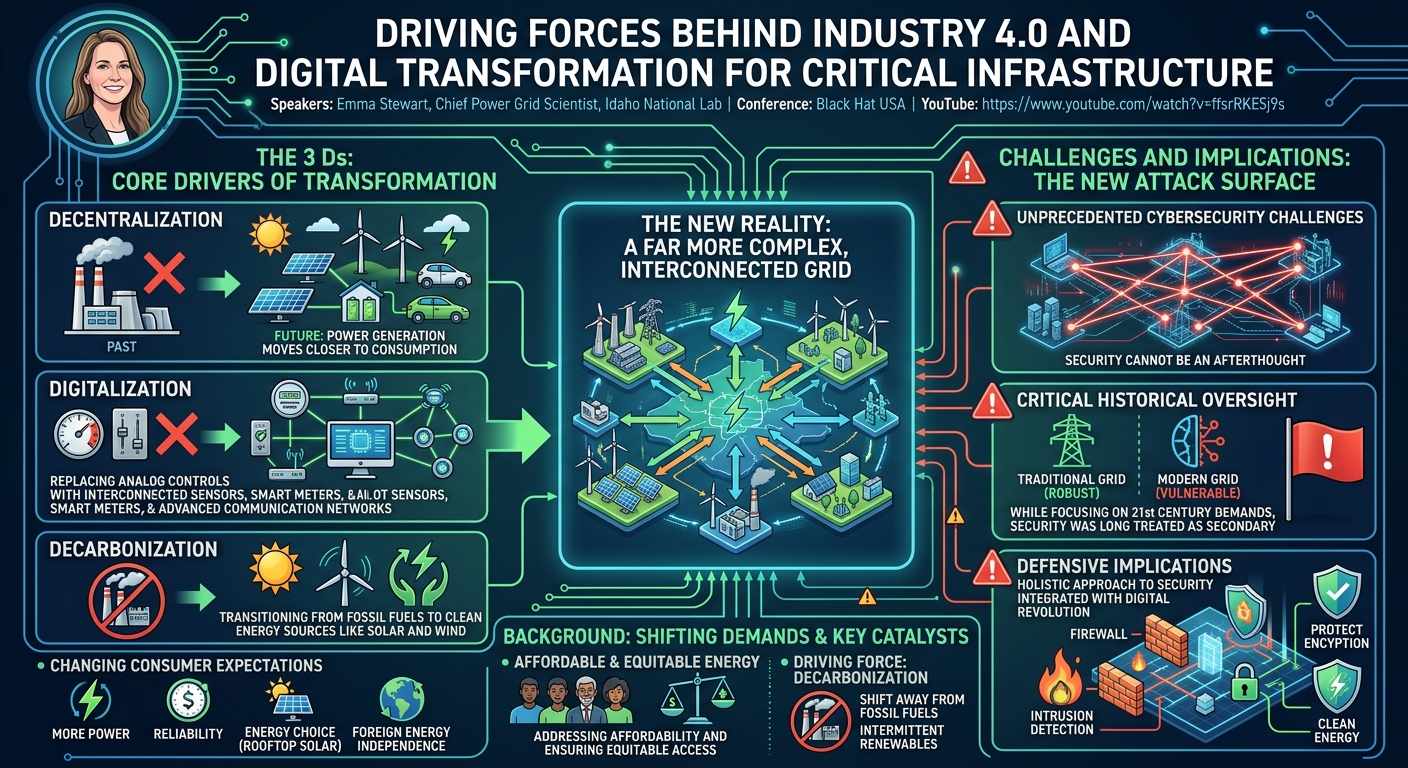
The core of Stewart's message revolved around three interconnected themes she termed the "3 Ds": decentralization, digitalization, and decarbonization. These forces are not merely technical shifts but fundamental drivers that are redefining how energy is generated, transmitted, and consumed. While these transformations promise a cleaner, more affordable, and resilient energy future, they simultaneously introduce unprecedented cybersecurity challenges. The talk critically highlighted that security, long treated as an afterthought in grid modernization efforts, must now be elevated to a foundational principle to safeguard this critical infrastructure against increasingly sophisticated threats.
This article delves into Stewart's insights, exploring the context of these changes, the key findings regarding the grid's evolving attack surface, and the critical defensive implications for utilities, policymakers, and even individual consumers. It underscores the urgent need for a holistic approach to security that integrates seamlessly with the ongoing digital revolution, ensuring the reliability and resilience of the nation's most vital energy systems.
Background
▶ Watch: Introduction and key drivers for energy delivery transformation (0:00)
For decades, the electric grid operated on a relatively straightforward model: large, centralized power generation facilities fed electricity to consumers through a hierarchical transmission and distribution network. This system, while robust for its time, is ill-suited for the demands of the 21st century. Emma Stewart highlighted that public expectations have dramatically shifted. Consumers now demand not only more power and reliability but also greater choice in their energy sources, such as installing rooftop solar, and independence from foreign adversaries through diversified energy portfolios. Furthermore, there's a pressing need to make energy both affordable and equitable, addressing the significant portion of the population that struggles to afford their power bills.
The transition towards a clean energy future, driven by the imperative of decarbonization, is a primary catalyst for this transformation. This shift away from fossil fuels necessitates the integration of intermittent renewable sources like solar and wind, which are often distributed rather than centralized. This leads directly to decentralization, where power generation moves closer to the point of consumption, involving millions of smaller, customer-owned resources like rooftop solar panels, battery storage systems, and electric vehicles. The sheer scale and distributed nature of these new components demand extensive digitalization, replacing analog controls with interconnected sensors, smart meters, and advanced communication networks to manage the complex flow of electrons.
Stewart pointed out a critical historical oversight: while the industry has focused on achieving clean, affordable, and reliable power, security has often been relegated to an afterthought. This approach is no longer tenable. The increasing interconnectedness and reliance on digital technologies mean that the attack surface of the electric grid has expanded exponentially. Unlike other critical sectors, the electric grid uniquely relies on human intervention from customers during emergencies. Stewart cited examples from Texas and California, where utilities resort to sending text messages asking customers to voluntarily increase their AC thermostat settings (e.g., from 69 to 83 degrees Fahrenheit) to prevent system collapse. This "greater good" appeal, she argued, is unsustainable and highlights a fundamental architectural vulnerability, as no other critical infrastructure sector (like water supply) depends on untrained public participation for its core stability.
Key Findings
▶ Watch: Emerging grid trends: robotics, big data, control systems (2:20)
Emma Stewart's talk illuminated several critical findings regarding the ongoing transformation of the electric grid:
- Security is no longer an afterthought but a paramount concern: The speaker repeatedly stressed that while the industry has historically focused on clean energy, affordability, and reliability, cybersecurity has lagged. With the grid's increasing complexity and digital footprint, security must now be prioritized as a foundational element, integrated from design to operation.
- The electric grid is undergoing unprecedented architectural decentralization: The shift from large, centralized generators to millions of distributed energy resources (DERs) like rooftop solar, home battery storage, and electric vehicles fundamentally changes the grid's topology. This decentralization introduces new points of interaction and potential vulnerabilities at the edge of the network.
- Massive digitalization creates both opportunity and risk: The proliferation of sensors, automation, big data analytics, and cloud computing provides unprecedented visibility and control over grid operations. However, this vast amount of data, much of it publicly accessible, and the reliance on interconnected digital systems, significantly expand the cyber-attack surface.
- Customer-owned resources are a unique dependency and security challenge: The electric sector is unique in its reliance on residential customers to manage their own energy resources and even to take voluntary actions (e.g., adjusting thermostats) to maintain grid stability during emergencies. This dependence on unmanaged, consumer-grade devices and human goodwill presents a significant and largely unaddressed security and reliability risk.
- Cloud adoption is essential but complex for utilities: While large utilities might maintain their own data centers, the vast majority of smaller utilities (approximately 900 out of 3,000 in the US) lack the resources to modernize without adopting cloud-based management systems. This introduces dependencies on third-party cloud providers, necessitating robust cloud security strategies tailored for critical infrastructure.
- Advanced technologies like AI and robotics are integrating into grid operations: From robot dogs inspecting substations to large language models (LLMs) interpreting field crew notes, AI and automation are becoming integral to grid maintenance and data management. While enhancing efficiency, these technologies also introduce new vectors for cyber threats and require their own security considerations.
- The "power systems" and "cybersecurity" domains remain largely siloed: Stewart highlighted that she attends both power systems and cybersecurity conferences, observing that the insights and professionals from these two critical fields often do not cross paths. This lack of interdisciplinary collaboration impedes a holistic understanding and mitigation of risks.
Technical Deep Dive
▶ Watch: Customer-owned resources and unique grid dependencies (3:10)
The digital transformation of critical infrastructure, particularly the electric grid, is characterized by the confluence of decentralization, digitalization, and decarbonization. These "3 Ds," as articulated by Emma Stewart, are driving profound technical shifts that demand a re-evaluation of traditional security paradigms.
Decentralization marks a radical departure from the traditional hub-and-spoke grid architecture. Historically, power flowed unidirectionally from large, centralized generators to consumers. Today, the grid is increasingly bidirectional, with electrons "flowing all over the place" due to the proliferation of Distributed Energy Resources (DERs). These include customer-owned assets such as rooftop solar panels, home battery storage systems, and electric vehicles (EVs) that can both consume and, in some cases, inject power back into the grid. The speaker underscored that managing these billions of devices requires "mass orchestration" through sophisticated Industrial Control Systems (ICS). The security implications are vast: each customer-owned device connected to the grid represents a potential new attack vector, often managed by individuals with little to no cybersecurity expertise. Stewart used a stark analogy: entrusting customers to secure grid-connected devices is akin to asking them to drive their car across a bridge to save a larger one for "one cent on the dollar," highlighting the inherent unreliability and insecurity of such a model.
Digitalization underpins the ability to manage this increasingly complex and decentralized system. This trend manifests in several key areas:
- Robotics and Automation: Stewart noted the emergence of technologies like "robot dogs" for inspecting substations. These autonomous systems improve efficiency and safety but also integrate advanced sensors and communication capabilities into critical physical infrastructure, creating new targets for cyber-physical attacks.
- Big Data and Analytics: "Data is queen," Stewart declared, emphasizing the sheer volume of information generated across the grid. This includes everything from publicly available geographical information system (GIS) data (e.g., Google Maps showing grid layouts, contrary to the misconception that this is hidden for security) to granular operational data. Examples include infrared scans of transformers to detect heat problems, and even "weird written notes from field crew" that are now being interpreted using Large Language Models (LLMs). While providing unprecedented situational awareness, this data deluge presents challenges in management, security, and ensuring the integrity of AI-driven interpretations. Securing the massive amount of information and, crucially, "securing the right part of the massive amount of information to keep the system going," is a significant undertaking.
- Cloud Adoption: Modernization efforts across the grid invariably involve cloud-based solutions. Stewart highlighted that "everyone who has a new type of equipment, a new type of management system, it's going to be cloud-based." For larger utilities, this might mean hybrid cloud environments, but for the approximately 900 very small utilities (out of 3,000 in the US), cloud services are "essential" for modernization, as they "can't build a data center." She cited an anecdote of a small utility losing its self-built data center to a tornado, underscoring the resilience benefits of cloud, but also the critical need for robust cloud security frameworks for operational technology (OT) data and controls.
Decarbonization acts as a primary driver for both decentralization and digitalization. The integration of renewable energy sources, often intermittent and geographically dispersed, necessitates advanced digital controls to balance supply and demand dynamically. This requires sophisticated communication networks and mass orchestration capabilities to manage billions of devices in real-time. The intertwining of these "3 Ds" means that cybersecurity can no longer be an isolated domain; it must be an integral part of every design decision, every new technology deployment, and every operational procedure within the evolving energy delivery ecosystem. Stewart alluded to a hypothetical attack scenario where an adversary could "brick the system" by manipulating a device, making it impossible to restart power without "cleaning up the device or setting it back to gold," potentially leading to "hours longer" or even "days if we need to get new equipment" to restore service. This illustrates the severe real-world consequences of inadequate security in a highly digitized and interconnected grid.
Demo / Proof of Concept
▶ Watch: Bridge analogy: customer trust and distributed security (4:00)
Emma Stewart's talk focused on the systemic challenges and transformational drivers within the critical infrastructure of the electric grid rather than demonstrating a specific exploit or proof of concept. There was no live demo of an attack or a defensive solution presented during her session.
However, the speaker did allude to the potential impact of a successful cyberattack on grid operations. She described a hypothetical scenario where, in the event of a system failure, an adversary could have manipulated a device such that attempting to restart the power without first "cleaning up the device or setting it back to gold" would effectively "brick the system." This action, rather than just causing a temporary outage, could lead to significantly prolonged recovery times, potentially "hours longer" or even "days if we need to get new equipment," thereby amplifying the disruption and cost. This anecdote, while not a demonstration, effectively served to illustrate the severe, cascading consequences that sophisticated cyber-physical attacks could have on the modernized, digitized electric grid.
Defensive Implications
▶ Watch: "Data is queen": managing vast grid information (4:40)
The sweeping changes described by Emma Stewart for the electric grid necessitate a fundamental rethinking of defensive strategies. Security can no longer be an afterthought but must be woven into the fabric of grid modernization.
- Integrate Security by Design: Utilities must adopt a "security by design" philosophy for all new equipment, systems, and processes. This means security considerations, threat modeling, and robust controls should be inherent from the initial planning stages, not bolted on later. This applies to hardware for substations, software for mass orchestration, and communication protocols.
- Secure the Edge and Distributed Energy Resources (DERs): With the proliferation of customer-owned DERs (solar, storage, EVs), the grid's attack surface extends directly into homes and businesses. Defenders need to develop and enforce rigorous security standards for these devices, potentially through certification programs, mandatory secure-by-default configurations, and secure communication protocols. Furthermore, utilities should explore mechanisms to remotely monitor and, if necessary, isolate compromised DERs without disrupting the entire system.
- Comprehensive Data Security and Governance: The "data is queen" reality means utilities are awash in information, much of which is publicly accessible or collected from disparate sources. Defenders must implement robust data governance policies, focusing on data classification, access control, encryption, and anomaly detection. The use of AI, particularly Large Language Models (LLMs), for interpreting field crew notes introduces a need to secure these AI systems themselves against adversarial inputs or data poisoning, ensuring the integrity of their insights.
- Robust Cloud Security Strategies: For the many utilities relying on cloud services for modernization, comprehensive cloud security is paramount. This includes secure configuration management, identity and access management (IAM), continuous monitoring, and incident response tailored for cloud environments. Contractual agreements with cloud providers must clearly define security responsibilities and service level agreements (SLAs) for critical infrastructure data and operations.
- Bridging the IT/OT and Power Systems Divide: Stewart's observation about the siloed nature of power systems and cybersecurity professionals is a critical vulnerability. Organizations must foster interdisciplinary collaboration through cross-training, joint exercises, and integrated teams. Power engineers need a deeper understanding of cyber threats, and cybersecurity professionals must grasp the unique operational constraints and physics of the electric grid.
- Supply Chain Risk Management: The integration of new technologies like robotics and advanced ICS components from a diverse range of vendors introduces significant supply chain risks. Utilities must implement stringent supply chain security programs, including vendor assessments, software bill of materials (SBOMs), and hardware assurance to mitigate the risk of compromised components or software.
- Reduce Reliance on Human Voluntary Action for Grid Stability: The current reliance on customers to voluntarily reduce load during emergencies is unsustainable and insecure. Future grid architectures must incorporate more automated, resilient, and cyber-secure demand-side management capabilities that do not depend on ad-hoc human responses for critical stability. This could involve secure, automated load shedding, intelligent grid-scale storage, or more robust microgrid capabilities.
- Enhanced Situational Awareness and Threat Intelligence: With billions of devices and vast data streams, maintaining comprehensive situational awareness is challenging. Defenders need advanced security information and event management (SIEM) systems, threat intelligence platforms, and behavioral analytics capable of detecting subtle anomalies indicative of sophisticated attacks across the converged IT/OT network.
By proactively addressing these defensive implications, the energy sector can build a more secure, resilient, and trustworthy critical infrastructure capable of supporting the demands of the future.
Key Takeaways
- The electric grid is undergoing a fundamental transformation driven by decentralization, digitalization, and decarbonization, moving from a simple, centralized model to a complex, interconnected one.
- Cybersecurity must evolve from an afterthought to a foundational principle, integrated into every aspect of grid design, operation, and modernization to protect against severe, cascading failures.
- The proliferation of Distributed Energy Resources (DERs) and customer-owned devices significantly expands the grid's attack surface, requiring new security standards and management paradigms for the edge.
- Massive data generation and the pervasive adoption of cloud computing introduce both unprecedented operational insights and critical security challenges, necessitating robust data governance and cloud security strategies, especially for smaller utilities.
- The electric sector's unique reliance on voluntary customer actions for grid stability during emergencies is an unsustainable and insecure model that needs to be addressed through more automated and resilient systems.
- Bridging the knowledge and operational gap between power systems engineers and cybersecurity professionals is crucial for developing holistic defenses against modern cyber-physical threats.
About the Speaker(s)
Emma Stewart is the Chief Power Grid Scientist at Idaho National Lab. Her background is uniquely suited to understanding the complexities of the evolving electric grid, blending hands-on practical experience with advanced scientific research. Stewart began her career "climbing wooden poles" for an electric utility, providing her with invaluable first-hand knowledge of grid infrastructure and operations. She has since advanced to hold a PhD, showcasing a deep academic and scientific understanding of power systems. Her current role focuses on the intersection of how the electric grid works and the critical role of cybersecurity within it, making her an authoritative voice on the digital transformation challenges facing critical energy infrastructure.