PyLingual: A Python Decompilation Framework for Evolving Python Versions
Unknown
Black Hat USA 2024 · Day 1 · Briefing
Overview
In the rapidly evolving landscape of cybersecurity, the ability to analyze and understand malicious software is paramount. Josh Wimer's Black Hat USA talk, "PyLingual: A Python Decompilation Framework for Evolving Python Versions," addresses a critical challenge in this domain: the difficulty of reliably decompiling Python bytecode, especially given the language's frequent updates. Python, celebrated as the world's most popular programming language, unfortunately also holds the dubious distinction of being a favored tool for malware authors, from basic Discord scams to sophisticated threat vectors. As Python malware proliferates, the need for robust decompilation tools becomes increasingly urgent for reverse engineers and security analysts.
Key moments
- 0:00 Introduction to Python decompilation challenges
- 1:15 Manual walkthrough of Python bytecode decompilation
- 3:00 Shortcomings of current Python decompilation tools
- 4:00 Python bytecode's rapid evolution hinders decompilers
- 5:20 Introducing PyLingual: A neural decompilation framework
- 6:00 PyLingual's bytecode segmentation using BERT
- 8:00 PyLingual's open-source availability plans
PyLingual: A Python Decompilation Framework for Evolving Python Versions
Speakers: Josh Wimer, Macellement fellow, University of Texas
Conference: Black Hat USA
YouTube: https://www.youtube.com/watch?v=TJ65LrInHxw
Overview
In the rapidly evolving landscape of cybersecurity, the ability to analyze and understand malicious software is paramount. Josh Wimer's Black Hat USA talk, "PyLingual: A Python Decompilation Framework for Evolving Python Versions," addresses a critical challenge in this domain: the difficulty of reliably decompiling Python bytecode, especially given the language's frequent updates. Python, celebrated as the world's most popular programming language, unfortunately also holds the dubious distinction of being a favored tool for malware authors, from basic Discord scams to sophisticated threat vectors. As Python malware proliferates, the need for robust decompilation tools becomes increasingly urgent for reverse engineers and security analysts.
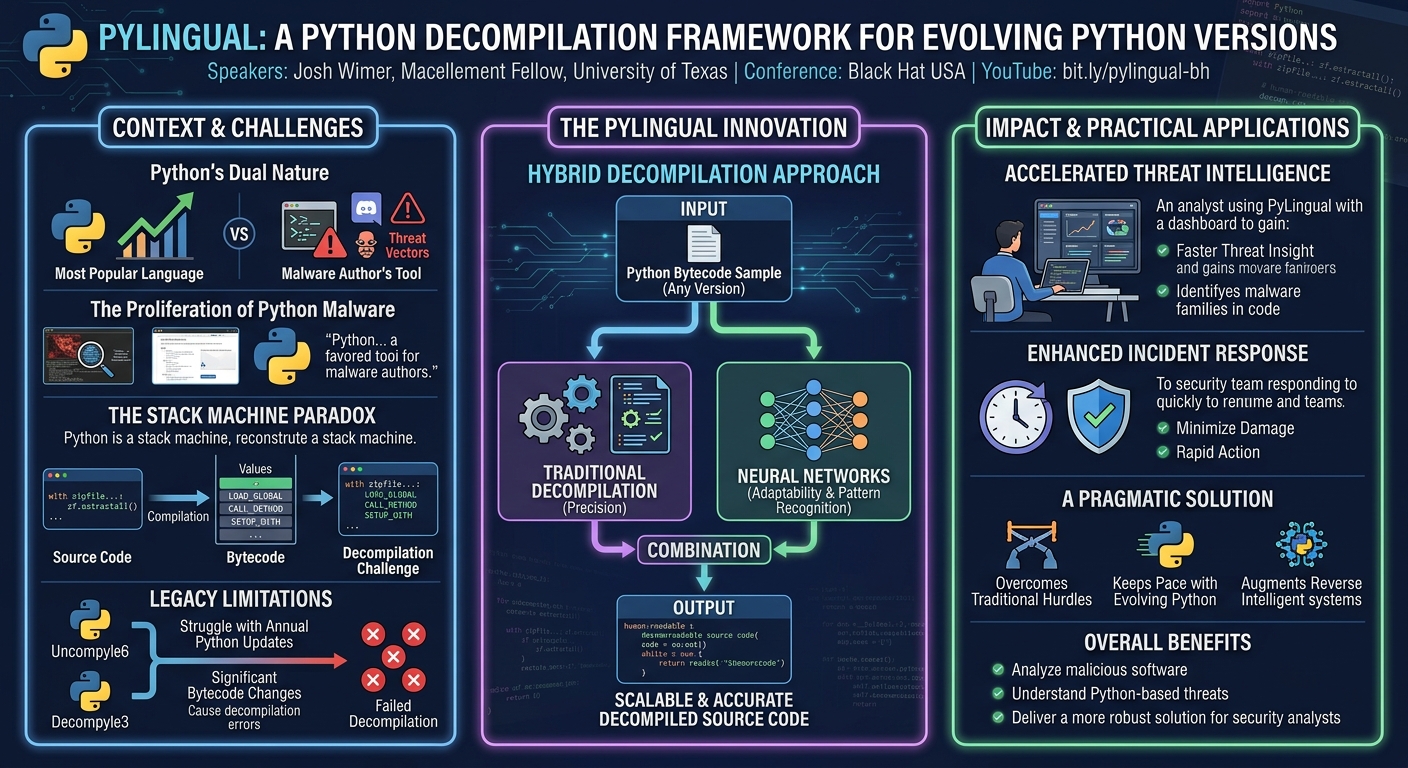
Wimer introduces PyLingual, a novel framework designed to overcome the limitations of traditional Python decompilers. These existing tools often struggle to keep pace with the annual release cycle and significant bytecode changes introduced with each new Python version. PyLingual distinguishes itself by adopting a hybrid approach, combining the precision and consistency of conventional decompilation techniques with the adaptability and pattern recognition capabilities of neural networks. This innovative methodology promises to deliver a more scalable and accurate solution for translating Python bytecode back into human-readable source code, even as the Python specification continues to evolve.
The significance of PyLingual extends beyond academic interest; it has direct implications for practical cybersecurity operations. By enabling analysts to effectively decompile Python samples compiled with the latest Python versions, PyLingual accelerates threat intelligence gathering, incident response, and the overall understanding of Python-based threats. This talk highlights a pragmatic solution to a persistent problem, offering a glimpse into how intelligent systems can augment traditional reverse engineering efforts to tackle modern, dynamic challenges.
Background
▶ Watch: Introduction to Python decompilation challenges (0:00)
Python's meteoric rise to become the most popular programming language, accounting for nearly 30% of programming tutorial searches, has inadvertently fueled a parallel surge in Python-based malware. From simple droppers that disable local defenses and download additional payloads to more complex, multi-stage attacks, Python's versatility and extensive libraries make it an attractive choice for adversaries. Analyzing these samples requires decompiling their bytecode back into source code, a task that has historically presented significant hurdles.
The Python interpreter is fundamentally a stack machine, executing operations by manipulating a stack of values. Decompiling Python bytecode involves reverse-engineering these stack operations into higher-level source code statements. A key challenge arises from the inherent differences between bytecode instructions and source code lines: a single source line might compile into multiple bytecode instructions, and conversely, a complex operation might span several source lines. The talk illustrates this with a manual walkthrough of a simple extract_zip function, demonstrating how individual bytecode operations like LOAD_GLOBAL, LOAD_ATTR, and CALL_METHOD combine to form recognizable Python statements. The SETUP_WITH opcode, for instance, implies the presence of a with block, requiring careful reconstruction of its implicit cleanup logic.
Existing Python decompilers, while foundational, have struggled to maintain comprehensive support across all Python versions. Uncompyle6 and Decompyle3 are widely respected names in the field, but as of the time of the talk, they did not yet fully support newer versions like Python 3.10. While efforts are underway by community contributors like Roki, the rapid pace of Python's development often leaves these tools playing catch-up. Another decompiler, Pycdc, aimed for broad version support but suffered from incomplete coverage of language features and opcodes, rendering it unable to decompile even the simple dropper used as an example in the presentation.
The root of this persistent problem lies in the dynamic nature of Python bytecode. Every new Python version introduces changes to its opcode specification – the set of available instructions. Historically, approximately 10% of the specification would change with each release. However, in recent years, these changes have become "dramatic," significantly hindering the scalability and maintainability of traditional decompilers. Compounding this issue is Python's annual release cycle, which places an immense burden on developers trying to keep decompilers up-to-date. Maintaining a decompiler that can flawlessly translate bytecode across all Python versions would almost require a dedicated, full-time reverse engineer.
The talk also briefly touches upon the limitations of generic large language models (LLMs) for this specific task. While LLMs excel at pattern recognition and filling in gaps, they "start making significant mistakes" on anything beyond toy examples. They are not purpose-built for the precise, consistent data transformations required for accurate decompilation. This insight forms the rationale behind PyLingual's hybrid approach, which seeks to leverage the strengths of both traditional, rigid program logic and flexible, pattern-matching AI.
Key Findings
▶ Watch: Shortcomings of current Python decompilation tools (3:00)
The central finding presented by Josh Wimer is that a novel, hybrid approach combining the strengths of traditional decompilation with the adaptability of machine learning can effectively address the persistent challenges posed by Python's rapidly evolving bytecode. This approach forms the foundation of PyLingual, a neural decompilation framework designed to provide scalable and accurate bytecode-to-source translation across diverse Python versions.
PyLingual's core contribution is its ability to naturally adapt to "superficial or surface level changes in the byte code specification" that frequently break traditional, rule-based decompilers. By segmenting the complex decompilation task into manageable, distinct components and applying the most suitable technology to each, the framework achieves a level of robustness and future-proofing that previous tools lacked. The recognition that traditional programs excel at "consistent data transformations that scale" while language models are "really good at pattern recognition and filling in the gaps" guides PyLingual's architectural design.
Specifically, the talk highlights that by leveraging debug symbols (like the line number table) in conjunction with controlled syntax tree transformations, it's possible to generate a high-quality dataset that reliably maps bytecode instructions to source code statements. This dataset then enables the training of a small, focused language model to accurately predict statement boundaries, a critical first step in the decompilation process. This intelligent segmentation, combined with subsequent translation and control flow reconstruction, represents a significant advancement in tackling the dynamic nature of Python's bytecode.
Technical Deep Dive
▶ Watch: Python bytecode's rapid evolution hinders decompilers (4:00)
PyLingual's architecture is meticulously designed to break down the complex task of Python decompilation into three distinct, manageable components: bytecode segmentation, statement translation, and control flow reconstruction. This modular approach allows for specialized techniques to be applied to each stage, optimizing for both precision and adaptability.
The first and arguably most critical component is bytecode segmentation. The objective here is to parse the raw Python bytecode into logical chunks that correspond directly to individual source-level statements. This is challenging because, as previously discussed, there isn't always a one-to-one mapping between bytecode instructions and source lines. To address this, PyLingual leverages the line number table, a debug symbol familiar to many developers. This table is typically used by the interpreter to localize exceptions, providing information like "error on line 23." While useful, the line number table alone is insufficient because source code lines do not always equate to statements (e.g., multiple statements on one line, or a single statement spread across multiple lines due to formatting). Furthermore, in real-world scenarios, especially with malicious code, the line number table can be arbitrarily manipulated or stripped, making it unreliable.
To overcome these limitations, PyLingual employs a clever strategy: in a controlled environment, it utilizes syntax tree transformations to ensure that every single statement in the source code is placed on its own unique line. This preprocessing step creates a consistent and reliable mapping between bytecode instructions and their corresponding source code statements. This meticulously curated association then forms a robust dataset, which is crucial for training the next phase of the segmentation process.
A small language model is trained on this dataset to predict statement boundaries within the bytecode. The talk mentions using a BERT architecture, a well-established neural network model, which in this context comprises "only about 100 million parameters." This is a relatively modest size compared to the billions of parameters found in larger, general-purpose LLMs, making it more efficient and focused on the specific task of bytecode segmentation. By learning the patterns associated with statement transitions in the bytecode, this model can accurately delineate where one source-level statement ends and another begins, even in the face of evolving opcode sets or varying code generation patterns. This is where PyLingual's neural component shines, adapting to changes that would typically break rigid, rule-based parsers.
The second component is statement translation. Once the bytecode has been segmented into individual statements, this stage is responsible for translating these bytecode fragments into their equivalent high-level Python source code. While the talk doesn't delve into the specific internal mechanisms of this translation phase, it's implied that this is where the language model's capabilities for "pattern recognition and filling in the gaps" are further utilized. For instance, a sequence of LOAD_CONST, LOAD_FAST, BINARY_ADD, STORE_FAST opcodes might be translated into result = a + b. The model would need to understand the semantic meaning of these opcode sequences and reconstruct the correct Python syntax, including variable names and operators. This is a complex task that likely involves mapping bytecode patterns to abstract syntax tree (AST) structures, which are then rendered as Python code. The adaptability of the neural network would be crucial here to handle variations in bytecode generated by different Python versions or even different compiler optimizations.
The final component is control flow reconstruction. After individual statements have been translated, the decompiler must accurately re-establish the logical flow of the program. This involves identifying and interpreting various control flow constructs such as if/else statements, for and while loops, function calls, exception handling blocks (like try/except and with statements), and jumps. For example, the SETUP_WITH opcode, briefly mentioned in the manual decompilation example, signifies a with block. Reconstructing this requires not only understanding the initial setup but also the implicit cleanup logic associated with such constructs. Similarly, conditional jump opcodes need to be translated into if/else or while statements, and loop constructs must be correctly identified and structured. This phase often involves building a control flow graph (CFG) from the bytecode and then transforming this graph into structured programming constructs. This component relies heavily on the precision of traditional decompilation logic, but its effectiveness is significantly enhanced by the accurate statement boundaries provided by the neural segmentation phase.
The Q&A session also brought up the applicability of this methodology to other languages, particularly lower-level or statically typed ones. Wimer noted that the main challenges would be the "comprehensiveness of the compiler optimizations" and the resulting impact on the segmentation step. Highly optimized compilers (like those for C) might extensively rearrange or inline code, making it difficult to find clear statement-level chunks. Additionally, for languages compiling to machine code (e.g., X86 assembly), accurately knowing "the compiler that was used to produce the original input binary" is critical for perfect decompilation. This is a much simpler problem in Python, where the C Python compiler is overwhelmingly dominant, providing a consistent target for PyLingual.
Demo / Proof of Concept
▶ Watch: PyLingual's bytecode segmentation using BERT (6:00)
While the talk did not feature a live, interactive demonstration, it effectively presented a proof of concept for PyLingual's capabilities. Josh Wimer began by manually walking the audience through the decompilation of a simple Python dropper's extract_zip function, illustrating how two lines of source code translate into a sequence of bytecode operations and how these can be manually reassembled into Python statements. This exercise, though tedious and time-consuming, served to build intuition.
Following this manual effort, Wimer explicitly stated the practical limitations of manual decompilation for larger programs: "Unfortunately the timer that the production crew is showing me says we don't have time for that. So let's use a decompiler." He then presented the output of PyLingual applied to the same simple dropper. The decompiled output displayed on screen was unequivocally "exactly like the code that we just... it is the exact same. It's correct in this case." This direct comparison served as the core demonstration, validating PyLingual's accuracy on a real-world, albeit simple, malware sample.
The presentation of PyLingual's correct output for the dropper, juxtaposed with the acknowledged shortcomings of existing tools like Uncompyle6, Decompyle3 (lacking Python 3.10+ support), and Pycdc (incomplete opcode coverage), effectively showcased the framework's ability to overcome current decompilation barriers. This visual confirmation, demonstrating PyLingual's ability to produce accurate, human-readable source code from bytecode that stumped other tools, served as compelling evidence of its effectiveness.
Defensive Implications
▶ Watch: PyLingual's open-source availability plans (8:00)
The advent of PyLingual carries significant implications for cybersecurity defenders and reverse engineers. Python's ubiquity and ease of use have made it a go-to language for malware development, leading to a proliferation of Python-based threats. However, the rapid evolution of Python versions has historically created a significant blind spot for security analysts, as existing decompilers struggle to keep pace. PyLingual directly addresses this challenge, empowering defenders with enhanced capabilities for malware analysis and threat intelligence.
Firstly, PyLingual allows for the rapid and accurate analysis of Python malware samples, irrespective of the Python version they were compiled with. This is particularly crucial for newer samples that might be leveraging Python 3.10 or later, which have proven problematic for older decompilers. By providing human-readable source code, PyLingual enables analysts to quickly understand the functionality, C2 communication, obfuscation techniques, and overall intent of Python-based threats. This accelerates incident response by reducing the time required to triage and contain new attacks.
Secondly, the framework's adaptability ensures that defensive tools relying on decompilation remain effective against future Python versions. As new Python releases introduce further bytecode changes, PyLingual's hybrid AI/traditional approach is designed to adapt, minimizing the need for constant, manual updates to decompiler logic. This contributes to the long-term sustainability and efficacy of Python malware analysis pipelines.
Furthermore, the potential for PyLingual to integrate with broader security intelligence efforts was explored during the Q&A. While not currently implemented, the speaker acknowledged the possibility of leveraging the framework to "classify patterns in code" or "quantify the security worth or security value of each of those byte code samples." Such capabilities could lead to automated threat detection, behavioral analysis of malware families, or even proactive identification of malicious code patterns based on their decompiled structure.
Finally, the commitment to open-sourcing PyLingual by the end of the year (as stated in the Q&A) is a critical defensive implication. Open-source security tools foster community collaboration, allowing for broader adoption, rigorous testing, and continuous improvement, ultimately strengthening the collective defense against Python-based cyber threats. The availability of PyLingual as a free web service also democratizes access to advanced Python decompilation capabilities.
Key Takeaways
- Python's Popularity Fuels Malware: Python is the most popular programming language globally, making it a common choice for malware authors, necessitating robust analysis tools.
- Decompiler Lag Behind Python Evolution: Traditional Python decompilers struggle to keep pace with the annual release cycle and significant (historically ~10%, recently "dramatic") bytecode changes in new Python versions.
- Hybrid Approach is Key: PyLingual introduces a novel hybrid framework combining the precision of traditional decompilation with the adaptability and pattern recognition of machine learning.
- Three Core Components: The framework operates in three stages: bytecode segmentation (using a BERT-based model), statement translation, and control flow reconstruction.
- Intelligent Segmentation: PyLingual leverages debug symbols and syntax tree transformations to create datasets for training a small language model (BERT, ~100M parameters) to accurately predict statement boundaries.
- Enhanced Malware Analysis: PyLingual enables security analysts to accurately decompile Python bytecode from newer versions, accelerating malware analysis, threat intelligence, and incident response.
About the Speaker(s)
Josh Wimer is a Macellement fellow at the University of Texas, currently entering his third year in the program. He presented PyLingual, a project developed as part of his research. Wimer also mentioned that a significant portion of his team consists of students graduating in the upcoming spring, actively seeking opportunities in the field.