Quantum Security: Myths, Facts, and Realities
Unknown
Black Hat USA 2024 · Day 1 · Briefing
Overview
This Black Hat USA forward-focus panel, "Quantum Security: Myths, Facts, and Realities," delves into the often-hyped world of quantum computing, aiming to demystify its true implications for cybersecurity. Moderated by Nathan Hammel, Senior Director of Research at Kecky Security and Black Hat review board member, the discussion features a panel of distinguished cryptographers and quantum security experts: JP, CEO and co-founder of Taurus; Tomasso, cryptographer and Quantum Security Initiative Lead at Kecky Security; and Mark, CTO of Quantum Village, a non-profit in the quantum space. The panel's primary objective is to cut through the pervasive hype surrounding quantum computers, distinguishing between revolutionary claims and the actual, tangible risks and opportunities they present for information security.
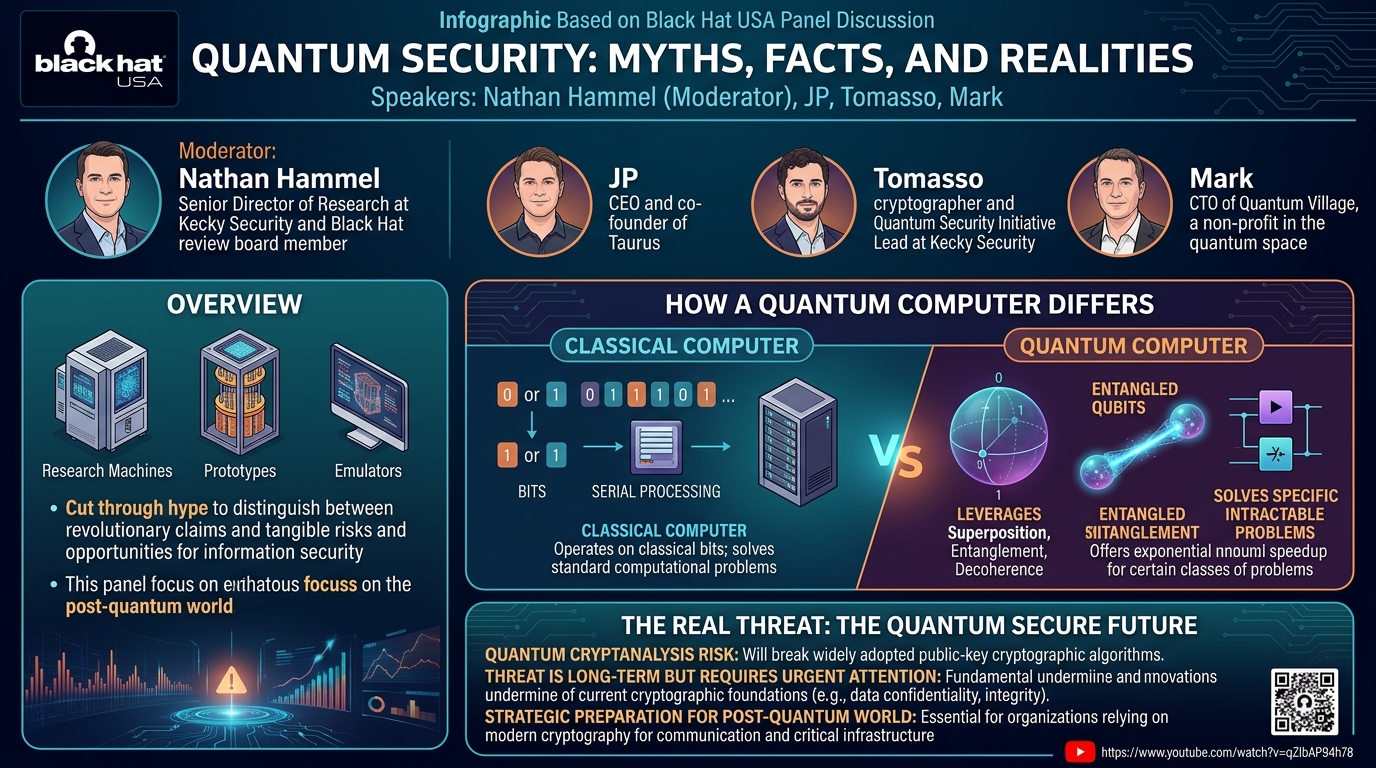
Quantum Security: Myths, Facts, and Realities
Speakers: Nathan Hammel (Moderator), JP, Tomasso, Mark
Conference: Black Hat USA
YouTube: https://www.youtube.com/watch?v=qZlbAP94h78
Overview
This Black Hat USA forward-focus panel, "Quantum Security: Myths, Facts, and Realities," delves into the often-hyped world of quantum computing, aiming to demystify its true implications for cybersecurity. Moderated by Nathan Hammel, Senior Director of Research at Kecky Security and Black Hat review board member, the discussion features a panel of distinguished cryptographers and quantum security experts: JP, CEO and co-founder of Taurus; Tomasso, cryptographer and Quantum Security Initiative Lead at Kecky Security; and Mark, CTO of Quantum Village, a non-profit in the quantum space. The panel's primary objective is to cut through the pervasive hype surrounding quantum computers, distinguishing between revolutionary claims and the actual, tangible risks and opportunities they present for information security.
The talk addresses the critical question of why quantum computers, which are still largely in prototype or emulator stages, generate such significant concern within the security community. Unlike other emerging technologies like generative AI, the threat from quantum computing is not immediate in its full form, yet its potential to fundamentally undermine current cryptographic foundations necessitates urgent attention. The conversation provides essential context for security professionals, highlighting that quantum computers are not merely faster versions of classical machines but operate on entirely different principles, capable of solving specific problems that are intractable for even the most powerful traditional supercomputers.
The core message underscores that the real threat lies in quantum computers' ability to break widely adopted public-key cryptographic algorithms, which form the bedrock of secure communication and data protection across the internet and critical infrastructure. This panel is particularly relevant for organizations that rely heavily on modern cryptography for data confidentiality and integrity, offering insights into the timelines, the specific risks, and the strategic steps required to prepare for a post-quantum world. By clarifying the "myths" and establishing the "facts," the speakers empower attendees with a realistic understanding of quantum security, urging proactive measures rather than succumbing to either undue alarm or complacency.
Background
The advent of quantum computing represents a paradigm shift in computational capabilities, but it is often shrouded in misconceptions and excessive hype. As moderator Nathan Hammel highlights, unlike technologies like generational AI that are already prevalent, fully functional, cryptographically capable quantum computers do not yet exist in a widespread, commercial sense. Instead, the current landscape is characterized by prototypes, emulators, and specialized research machines. This nascent stage, ironically, contributes to the hype, as the abstract nature of quantum mechanics makes it difficult for many to grasp its true potential and limitations.
At its core, a quantum computer differs fundamentally from a classical computer. As JP explains, it's not about doing the same things faster; rather, it's about doing completely different things at its own pace, which can even be slower for many tasks. The distinction lies in its use of qubits instead of classical bits. Qubits leverage phenomena from quantum mechanics such as superposition, entanglement, and decoherence. Superposition allows a qubit to exist in multiple states simultaneously, while entanglement links the states of two or more qubits, regardless of their physical separation. These properties enable quantum computers to explore vast computational spaces in parallel, offering exponential speedups for certain classes of problems.
The reason this emerging technology is a critical topic at a security conference stems from its unique ability to efficiently solve problems that underpin the security of most modern cryptographic schemes. Tomasso elaborates that while quantum computers are not universally faster, they excel at specific mathematical problems that are currently considered intractable for classical computers. It is "by bad luck," as he puts it, that these very problems are the "building blocks" of contemporary cryptography. Specifically, the security of widely used public-key cryptography, such as RSA and elliptic curve cryptography (ECC), relies on the computational difficulty of factoring large numbers or solving the discrete logarithm problem. These are precisely the types of problems that quantum algorithms like Shor's algorithm are designed to solve efficiently, thereby posing an existential threat to the current cryptographic infrastructure.
Key Findings
The central finding of this discussion is that while cryptographically relevant quantum computers are not yet a reality, their potential future existence poses a severe, systemic risk to global information security. This risk is primarily directed at the public-key cryptographic schemes that secure virtually all modern digital communications and data storage.
The panelists underscore that quantum computers are uniquely adept at solving certain mathematical problems that are currently intractable for classical computers. Specifically, these include the integer factorization problem (which underpins RSA) and the discrete logarithm problem (fundamental to Elliptic Curve Cryptography, or ECC, and Diffie-Hellman key exchange). If a "large enough, crypto-analytically capable quantum computer gets built," as Tomasso states, it could theoretically "break the foundations of most of the cryptographic schemes that we use in the real world." Given that cryptography serves as the "first line of defense" in information security, this represents a profound threat.
A critical distinction is drawn between the immediate risks to different types of cryptographic applications. The most pressing concern is the "harvest now, decrypt later" problem, which primarily affects encryption. Adversaries with sufficient resources could today collect vast amounts of encrypted data that is protected by current public-key algorithms. While this data is unreadable with classical computers, it could be stored and then decrypted at a later date once a powerful quantum computer becomes available. This implies that data with long-term confidentiality requirements (e.g., state secrets, medical records, financial data, intellectual property) is already at risk, even if the quantum computer doesn't exist yet.
Conversely, the panel notes that digital signatures generally face a less immediate "harvest now, decrypt later" threat. Signatures are typically used for authentication and integrity, and their validity is often time-sensitive. If a quantum computer were to break a signature algorithm in the future, it would primarily affect future signatures, as past signatures would likely have already served their purpose and their authenticity established. However, this does not negate the need for a transition to quantum-resistant signature schemes, as the integrity of new transactions and software updates remains paramount. The overall takeaway is a clear call for proactive planning and migration to Post-Quantum Cryptography (PQC), acknowledging the differing urgency for various cryptographic applications but emphasizing that all are eventually vulnerable.
Technical Deep Dive
The fundamental threat posed by quantum computers to modern cryptography stems from their ability to execute specific algorithms that exploit the principles of quantum mechanics to solve computationally hard problems with unprecedented efficiency. The core concepts enabling this are superposition and entanglement, which allow qubits to represent and process information in ways fundamentally different from classical bits.
A classical bit can be either 0 or 1. A qubit, however, can be 0, 1, or a superposition of both simultaneously. This means that a system of n qubits can represent 2^n states at once. When these qubits are also entangled, their fates are linked; measuring one qubit instantly influences the state of an entangled partner, even if physically separated. This collective behavior allows a quantum computer to explore multiple computational paths in parallel, leading to potential exponential speedups for certain algorithms.
The most famous and impactful quantum algorithm relevant to cryptography is Shor's algorithm. Developed by Peter Shor in 1994, this algorithm can efficiently factor large integers into their prime components and solve the discrete logarithm problem. These two problems are the mathematical bedrock for the security of most widely deployed public-key cryptographic systems:
- RSA (Rivest–Shamir–Adleman): The security of RSA relies on the computational difficulty of factoring large semiprime numbers (products of two large prime numbers). Shor's algorithm can factor these numbers in polynomial time, rendering RSA insecure.
- Elliptic Curve Cryptography (ECC): ECC's security is based on the difficulty of the elliptic curve discrete logarithm problem. Shor's algorithm can also solve this problem efficiently, thus breaking ECC.
- Diffie-Hellman Key Exchange: Similar to ECC, Diffie-Hellman relies on the discrete logarithm problem and would also be vulnerable to Shor's algorithm.
The impact of Shor's algorithm is profound because RSA, ECC, and Diffie-Hellman are ubiquitous, securing everything from TLS/SSL connections (HTTPS) to digital certificates, VPNs, and encrypted communications.
Another relevant quantum algorithm is Grover's algorithm. This algorithm provides a quadratic speedup for searching unsorted databases. In a cryptographic context, Grover's algorithm could theoretically be used to reduce the effective key length of symmetric encryption schemes (like AES) and hash functions. For example, a brute-force attack on a 128-bit AES key would typically require 2^128 operations. With Grover's algorithm, this could be reduced to approximately 2^64 operations. While significant, this is generally considered less catastrophic than Shor's algorithm because it can be mitigated by simply doubling the key length (e.g., moving from AES-128 to AES-256). The panel emphasizes that the primary concern remains the complete破壞 of public-key cryptography by Shor's algorithm rather than the weakening of symmetric schemes.
It's crucial to reiterate JP's point that quantum computers are "not necessarily faster than classical computers for any kind of problems." They are specialized machines designed for specific computational challenges. For the vast majority of tasks that classical computers perform daily, quantum computers offer no advantage and would, in fact, be slower or impractical. The threat is highly targeted to the mathematical structures underpinning current public-key cryptography.
Demo / Proof of Concept
This session was presented as a panel discussion, featuring multiple experts discussing the theoretical and practical implications of quantum security. As such, the format did not include a live demonstration or a proof of concept of a quantum computer breaking cryptographic algorithms. The discussion focused on elucidating the current state of quantum technology, its potential risks, and the strategic responses required, rather than showcasing a working exploit.
Defensive Implications
The defensive implications arising from the potential threat of quantum computers are significant and necessitate proactive strategic planning. The panel's insights highlight several crucial actions for organizations to undertake, even in the absence of fully capable quantum computers.
Firstly, understanding the "harvest now, decrypt later" threat is paramount. Organizations dealing with sensitive data that requires long-term confidentiality (e.g., government secrets, intellectual property, medical records, financial data) must recognize that encrypted communications and stored data protected by current public-key cryptography could be harvested today by adversaries and decrypted in the future once quantum computers become powerful enough. This means that merely waiting for quantum computers to emerge before acting is a critical mistake for such data.
Secondly, the distinction between the immediate vulnerability of encryption and the slightly deferred risk to signatures needs to inform prioritization. While signatures will eventually need to be quantum-resistant, the "harvest now, decrypt later" problem makes encryption migration the more urgent concern for long-lived sensitive data. Defenders should identify their assets that require confidentiality for decades and assess their current cryptographic protections against this specific threat model.
Thirdly, organizations must begin the process of Post-Quantum Cryptography (PQC) migration. This involves:
- Inventorying cryptographic assets: Identifying all instances where public-key cryptography is used, including TLS certificates, VPNs, code signing, data encryption at rest and in transit, and key exchange mechanisms.
- Assessing cryptographic agility: Evaluating how easily current systems and applications can update or swap out cryptographic algorithms. Systems with hardcoded algorithms or tightly coupled cryptographic libraries will be more challenging to migrate.
- Monitoring PQC standardization efforts: Primarily, tracking the National Institute of Standards and Technology (NIST) PQC standardization process. This process is actively selecting and standardizing quantum-resistant algorithms that will eventually replace current vulnerable schemes. Organizations should plan to adopt these standardized algorithms once they are finalized.
- Developing a migration roadmap: Creating a phased plan for transitioning to PQC, considering the complexity, cost, and interdependencies of various systems. This roadmap should prioritize high-risk assets and those with long data lifetimes.
- Implementing hybrid mode cryptography: As an interim step, some organizations may consider deploying hybrid cryptography, where both classical and quantum-resistant algorithms are used in parallel. This provides a "belt-and-suspenders" approach, offering protection against both classical and quantum threats until PQC is fully mature and widely adopted.
Finally, the panel implicitly advises against falling for quantum hype that overstates capabilities or understates timelines. While the threat is real, the focus should remain on pragmatic, risk-based planning and investment in PQC research and development, rather than being swayed by exaggerated claims. The goal is to achieve crypto-agility and ensure that systems can adapt to the evolving threat landscape, securing data against both present and future computational advancements.
Key Takeaways
- Quantum computers are fundamentally different, not just faster: They utilize qubits and quantum phenomena like superposition and entanglement to solve specific, complex mathematical problems, not to simply accelerate all classical computations.
- Current public-key cryptography is vulnerable to quantum attacks: Algorithms like RSA and ECC, which form the backbone of modern security, can be broken by quantum algorithms such as Shor's algorithm.
- The "harvest now, decrypt later" threat is real and immediate for sensitive data: Adversaries can collect currently encrypted data today and decrypt it in the future once powerful quantum computers become available, making long-term confidentiality a critical concern.
- Post-Quantum Cryptography (PQC) migration is essential and requires proactive planning: Organizations must inventory their cryptographic dependencies, assess crypto-agility, and begin preparing for the transition to quantum-resistant algorithms, guided by ongoing standardization efforts like those by NIST.
- Prioritize encryption migration for long-lived data: While digital signatures also require PQC, the "harvest now, decrypt later" scenario makes securing encrypted data with long-term confidentiality requirements the most urgent defensive task.
- Distinguish between quantum myths and realities: Avoid hype and focus on pragmatic, risk-based strategies for adopting PQC, understanding that quantum computers are specialized tools with specific, but profound, implications for cybersecurity.
About the Speaker(s)
The panel comprised a diverse group of experts, each contributing a unique perspective to the discussion on quantum security.
Nathan Hammel served as the moderator for the panel. He is the Senior Director of Research at Kecky Security, where he focuses on the security of emerging technologies, including quantum computing. Additionally, he holds a significant role on the Black Hat review board as the AI, Machine Learning, and Data Science track lead, demonstrating his broad expertise in cutting-edge technological security. His stated aversion to "hype" set the tone for a grounded and factual discussion.
JP is a seasoned cryptographer with 20 years of experience in the field. He is the CEO and co-founder of Taurus, a company involved in cryptographic solutions. While not directly working in quantum computing, his deep background in cryptography provides a crucial perspective on the implications of quantum advancements for existing security protocols.
Tomasso is a cryptographer at Kecky Security, where he leads the company's Quantum Security initiatives. His academic background is in mathematics, and he completed his PhD at the Technical University of Darmstadt, focusing on the intersection of quantum computing and cryptography. His specialized knowledge makes him a key voice in understanding the technical risks and solutions related to quantum threats.
Mark is the CTO of Quantum Village, a non-profit organization operating in the quantum space. Like Tomasso, his background is in mathematics, complemented by extensive experience in cybersecurity. His role at a non-profit suggests a commitment to advancing the broader understanding and preparedness for quantum technologies within the security community.