Reinforcement Learning for Autonomous Resilient Cyber Defense
Unknown
Black Hat USA 2024 · Day 1 · Briefing
Overview
This talk, presented by Sarah and Ian from Dstl, delves into the critical and rapidly evolving field of Autonomous Resilient Cyber Defense (ADR), particularly focusing on the application of Reinforcement Learning (RL). The core problem addressed is the severe shortage of human cyber responders, especially at the tactical edge of operations, such as in autonomous vehicles or forward-deployed military assets. This scarcity, coupled with the increasing sophistication and machine-speed operation of adversary attacks, creates a significant vulnerability that traditional human-centric defenses cannot adequately address.
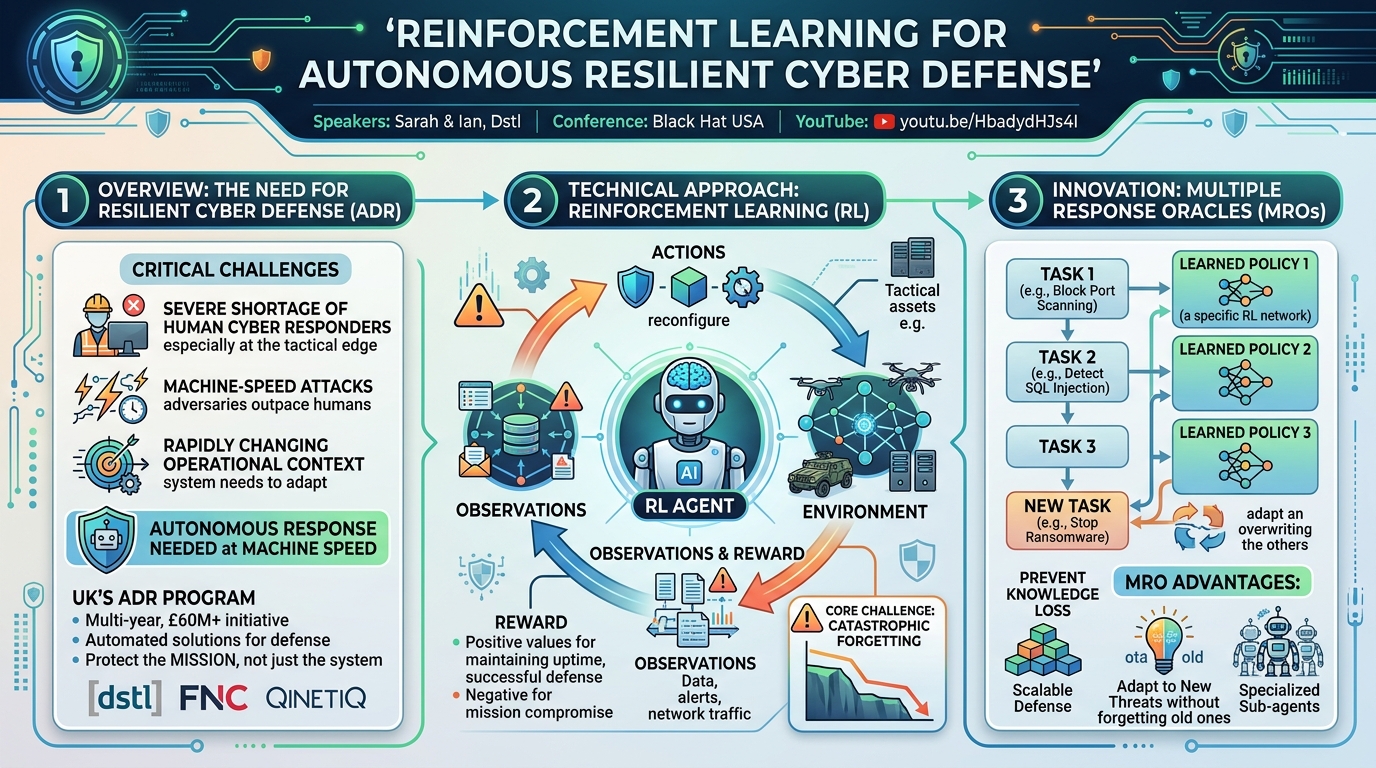
Reinforcement Learning for Autonomous Resilient Cyber Defense
Speakers: Sarah and Ian, Dstl
Conference: Black Hat USA
YouTube: https://www.youtube.com/watch?v=HbadydHJs4I
Overview
This talk, presented by Sarah and Ian from Dstl, delves into the critical and rapidly evolving field of Autonomous Resilient Cyber Defense (ADR), particularly focusing on the application of Reinforcement Learning (RL). The core problem addressed is the severe shortage of human cyber responders, especially at the tactical edge of operations, such as in autonomous vehicles or forward-deployed military assets. This scarcity, coupled with the increasing sophistication and machine-speed operation of adversary attacks, creates a significant vulnerability that traditional human-centric defenses cannot adequately address.
The speakers introduce the UK's ambitious ADR program, a multi-year, multi-million-pound initiative designed to develop automated solutions for cyber defense. The talk highlights the need for systems that can respond at machine speed to machine-speed attacks, adapt to rapidly changing operational contexts, and ultimately protect the mission rather than just the underlying system. Through their work, Dstl and its partners are pioneering novel approaches, including Multiple Response Oracles (MROs), to overcome inherent challenges in applying machine learning to cyber security, such as catastrophic forgetting.
This article explores the motivations, technical approaches, and implications of using reinforcement learning to build resilient cyber defense capabilities. It underscores a paradigm shift in thinking about cyber security for critical infrastructure and defense systems, moving towards proactive, autonomous responses that augment human capabilities and ensure mission continuity in hostile environments.
Background
The impetus behind the UK's Autonomous Resilient Cyber Defence (ADR) program stems from several pressing challenges facing modern defense and critical infrastructure. Firstly, there is a profound shortage of skilled cyber responders, a problem exacerbated in remote or tactical environments where personnel might be busy with primary operational duties or lack specialized cyber expertise. These "tactical edge" scenarios, such as autonomous vehicle deployments, demand immediate and localized cyber defense capabilities without constant human oversight.
Secondly, the threat landscape is evolving towards machine-speed attacks. Adversaries are increasingly leveraging automation, artificial intelligence, and sophisticated tooling to launch attacks at unprecedented speeds, volumes, and varieties. Such attacks are designed to overwhelm human teams, making traditional incident response models inadequate. The speakers emphasize the need to "respond at machine speed to machine speed attack," highlighting that human reaction times are simply insufficient.
A third, unique challenge for defense systems is the dynamic operational context. A system operating under normal conditions might suddenly find itself in a "hot zone," requiring a complete shift in its operational and defensive posture. Network configurations can change rapidly, and the overarching mission itself might evolve. This necessitates a defense strategy that is not merely about protecting the system's integrity but about ensuring the continuity and success of the mission it supports. This mission-centric approach implies a deeper understanding of system function and criticality under varying conditions.
To address these challenges, the UK government launched the ADR program, a significant investment of approximately £60 million over four years, encompassing over 100 different projects across dozens of organizations. Dstl (Defence Science and Technology Laboratory) leads the overall program, with key contributions from partners like Fraser Nash, who manages research concepts, and Genetec, responsible for test and evaluation, including the development of robust testing environments. Alan contributes at the lower Technology Readiness Levels (TRL 0-1), while the overall program aims to push solutions up to TRL 5 and beyond, working towards real-world deployment.
The program also fosters international collaboration, engaging with the Ministry of Defense, other UK government bodies, and international partners through the 5 Eyes alliance (Australia, New Zealand, America, Canada, and the UK). This includes participation in initiatives like the Cage Challenge and collaboration with the US equivalent project, "Castle."
Crucially, the ADR program's scope is specifically focused on the respond and recover phases of the NIST Cybersecurity Framework, acknowledging that cyber threat detection is handled by separate, complementary programs. The goal is to develop autonomous capabilities that can mitigate ongoing attacks and restore system functionality rapidly and effectively, even in challenging and dynamic environments. A notable outcome of this collaborative effort is the development of "unicorns" – cross-trained individuals who possess both cyber security and data science expertise, forming integrated teams essential for advancing AI-driven defense.
Key Findings
The primary finding of the ADR program and this talk is the demonstration of Reinforcement Learning (RL) as a viable and critical approach for achieving autonomous and resilient cyber defense, particularly in high-stakes, dynamic environments where human intervention is limited. The research underscores that RL agents can be trained to make optimal defensive decisions in real-time, offering a path to counter machine-speed attacks.
A significant contribution is the identification and proposed solution for catastrophic forgetting within RL models. In the context of cyber defense, catastrophic forgetting occurs when an RL agent, trained to defend against new threats, inadvertently loses its ability to defend against previously learned attack patterns. This is a critical vulnerability, as it could leave systems exposed to older, yet still prevalent, attack vectors. The development of Multiple Response Oracles (MROs) is presented as a novel technology to mitigate this issue, ensuring that defensive policies remain robust against a wide spectrum of threats over time.
Another key finding is the imperative for generalization in autonomous defense systems. For RL-based defenses to be practical, they must be capable of deploying onto unseen networks and effectively defending against a wide range of attackers without requiring extensive re-training for every new scenario. This demands that the learning algorithms develop highly adaptable and transferable policies, moving beyond context-specific solutions to truly resilient, broad-spectrum defense.
The concept of Cyber First Aid emerges as a pragmatic and immediately actionable application of autonomous defense. Instead of aiming for full autonomy in all complex recovery scenarios, the initial focus is on enabling RL agents to perform simple, autonomous tasks. These tasks are designed to buy critical time for human experts to intervene, assess the situation, and perform more complex recovery operations. This approach acknowledges the current limitations of AI while maximizing its immediate utility in alleviating pressure on human responders.
Finally, the talk highlights a fundamental shift in defensive strategy: moving beyond merely protecting the system to protecting the overarching mission. This means that autonomous defense systems must be context-aware, understanding how different system components contribute to mission objectives and prioritizing defensive actions accordingly, especially when operating in rapidly changing environments like a "hot zone." This mission-centric view ensures that resilience is measured not just by system uptime, but by the ability to continue critical operations.
Technical Deep Dive
The technical core of the ADR program lies in its innovative application of Reinforcement Learning (RL) to cyber defense. RL is a paradigm of machine learning where an agent learns to make decisions by performing actions in an environment to maximize a cumulative reward. In the context of cyber defense, the agent could be an autonomous defense system, the environment is the network infrastructure under attack, actions are defensive responses (e.g., reconfiguring a firewall, isolating a host, patching a vulnerability), and rewards are given for successfully mitigating threats or maintaining mission continuity, while penalties are incurred for failed defenses or mission disruption. The goal is for the RL agent to learn an optimal policy – a mapping from observed states of the network to the best defensive actions – through trial and error.
A significant challenge in applying RL to dynamic and adversarial environments like cyber defense is catastrophic forgetting. This phenomenon occurs when an artificial neural network, trained sequentially on new tasks or data, completely or partially forgets previously learned information. In cyber security, this means an RL agent that learns to defend against a new, sophisticated attack might "forget" how to counter older, simpler, but still prevalent, attack vectors. This is particularly problematic because the threat landscape is ever-evolving, and a robust defense must maintain proficiency against all known and emerging threats. If a defense system forgets how to counter a basic phishing attempt while learning to block an advanced persistent threat, it creates a critical vulnerability.
To address catastrophic forgetting, the ADR program has developed a novel technology called Multiple Response Oracles (MROs). While the talk specifies that detailed technical information is available in a supporting paper, the concept implies a mechanism that allows the RL agent to maintain and integrate multiple defensive policies or knowledge bases. Instead of overwriting old policies with new ones, MROs likely enable the system to consult various "oracles" or specialized sub-models, each potentially expert in defending against a specific class of attack or operating under certain conditions. This ensemble approach would allow the system to leverage a diverse set of learned responses, ensuring that it retains defenses against a broad spectrum of threats, thereby enhancing its overall resilience and adaptability.
The program also emphasizes the crucial need for generalization. An RL agent trained in a specific simulated network environment might perform well there, but real-world deployments involve diverse and constantly changing network architectures. The goal is to develop RL models that can be deployed onto unseen networks and still provide effective defense. This requires training methods that promote abstract understanding of network topologies and attack patterns, rather than memorization of specific configurations. Techniques like meta-learning, transfer learning, or training in highly diverse simulated environments are likely being explored to achieve this broad applicability, allowing the RL agent to defend against a wide range of attackers and attack methodologies without extensive, environment-specific retraining.
Furthermore, the work involves rigorous test and evaluation led by Genetec, focusing on building environments that accurately simulate complex operational scenarios. This includes modeling rapidly changing contexts, such as transitioning from normal operations to a "hot zone," and evaluating how the RL agent adapts its defensive posture to protect the mission. The program's engagement across different Technology Readiness Levels (TRLs), from fundamental research (TRL 0-1 by Alan) to applied development and integration (up to TRL 5 by Dstl), underscores a comprehensive approach to bringing these advanced concepts to practical realization.
Demo / Proof of Concept
While the talk did not feature a live, publicly detailed demonstration, Ian explicitly mentioned an "initial proof of concept" and elaborated on the Cyber First Aid project as a key practical application of their research. This project serves as the concrete manifestation of how their Reinforcement Learning (RL) based autonomous defense systems are designed to operate in real-world scenarios.
The primary objective of the Cyber First Aid project is to enable autonomous systems to perform simple tasks that can buy critical time for human experts. In a tactical edge environment, where specialized cyber personnel are scarce or engaged in other mission-critical duties, an automated "first responder" is invaluable. Imagine an autonomous vehicle or a remote military system under a machine-speed cyber attack. Instead of waiting for a human analyst to connect, diagnose, and initiate a response, the Cyber First Aid system, powered by an RL agent, would immediately initiate pre-learned or dynamically determined defensive actions.
These "simple tasks" could include:
- Automated isolation: Segmenting compromised network components to prevent lateral movement of an attacker.
- Service restart/reconfiguration: Restarting or reconfiguring a suspected compromised service to disrupt an attack.
- Temporary patching/mitigation: Applying immediate, temporary fixes or workarounds to known vulnerabilities being exploited.
- Data exfiltration prevention: Blocking specific outbound network flows associated with data theft attempts.
- Alerting and detailed logging: Generating enhanced alerts and diagnostic logs for human experts, providing a richer context for eventual manual intervention.
The emphasis is on rapid, pre-emptive, and low-risk actions that can slow down or disrupt an attacker's progress without requiring complex decision-making or potentially causing undue harm to the mission. By executing these tasks autonomously, the system creates a window for human experts to arrive, gain situational awareness, and then undertake the more intricate and nuanced recovery operations or strategic counter-attacks. This approach leverages the strengths of both AI (speed and consistency for defined tasks) and human intelligence (complex problem-solving, strategic thinking, ethical judgment).
The development of such proof-of-concepts also heavily relies on the work of partners like Genetec, who are responsible for building the robust testing and evaluation environments. These environments must accurately simulate the dynamic and often hostile conditions that defense systems face, allowing the RL agents to be trained and validated in scenarios that mirror real-world operational challenges, including rapidly changing network contexts and diverse attack vectors. This systematic testing ensures that the "Cyber First Aid" capabilities are reliable and effective when deployed.
Defensive Implications
The insights and developments from the ADR program have profound implications for defensive cyber security strategies, particularly for critical infrastructure and military systems.
- Embrace Machine-Speed Automation: The most significant implication is the undeniable necessity for defensive operations to match the speed and scale of adversarial attacks. Relying solely on human responders for detection, analysis, and response is increasingly untenable against automated, high-volume threats. Defenders must invest in and integrate Reinforcement Learning and other AI-driven automation into their security operations to achieve machine-speed response.
- Mission-Centric Defense: The paradigm shift from protecting the system to protecting the mission is crucial. Defenders need to understand the critical functions that underpin their organization's core objectives. Security measures should be prioritized and adapted based on their impact on mission continuity, especially in dynamic environments where operational context can change rapidly (e.g., normal operations to "hot zone"). This requires a deeper understanding of enterprise architecture and business processes beyond traditional IT security.
- Augmentation, Not Replacement: The "Cyber First Aid" concept highlights that AI's immediate role is to augment human defenders, not replace them entirely. Autonomous systems can handle the initial, time-sensitive, and repetitive tasks, buying valuable time for human experts to focus on complex analysis, strategic decision-making, and nuanced recovery. Defenders should plan for hybrid human-AI teams, leveraging the strengths of both.
- Resilience through Adaptability: Systems must be designed for inherent resilience and adaptability. The ability of RL agents to learn and adapt to unseen networks and diverse attackers means that defensive architectures should facilitate dynamic reconfiguration and policy updates. Static defenses are insufficient; systems must be able to change their posture and responses in real-time based on evolving threats and operational contexts.
- Address Catastrophic Forgetting: Any organization implementing AI/ML for cyber defense must actively address the problem of catastrophic forgetting. Solutions like Multiple Response Oracles (MROs) are vital to ensure that new defenses do not inadvertently compromise the ability to counter older, known threats. Continuous learning systems must be designed to retain and integrate knowledge across the entire threat landscape.
- Invest in Cross-Functional "Unicorn" Teams: The success of the ADR program is attributed partly to fostering "unicorns" – individuals with combined cyber security and data science expertise. Organizations looking to implement advanced AI/ML for defense must invest in training, hiring, and structuring teams that bridge these traditionally separate disciplines. Collaboration between security analysts, data scientists, and engineers is paramount.
- Participate in Research and Challenges: Engaging with initiatives like the Cage Challenge and collaborating with research programs such as ADR or Castle can provide valuable insights and accelerate the adoption of cutting-edge autonomous defense technologies. Staying abreast of and contributing to the latest research is critical for staying ahead of sophisticated adversaries.
Key Takeaways
- Autonomous cyber defense is essential: The increasing speed and sophistication of cyber attacks, coupled with a shortage of human responders at the tactical edge, necessitates the adoption of autonomous, machine-speed defense mechanisms.
- The UK's ADR program is a significant effort: A multi-year, multi-million-pound initiative, the ADR program is actively developing advanced solutions using Reinforcement Learning to address critical cyber defense challenges, focusing on the "respond and recover" phases.
- Reinforcement Learning offers promise but faces challenges: RL provides a powerful framework for learning optimal defensive policies, but issues like catastrophic forgetting must be mitigated through novel approaches such as Multiple Response Oracles (MROs) to ensure sustained effectiveness.
- "Cyber First Aid" is a pragmatic initial goal: Autonomous systems can perform simple, rapid defensive tasks to buy time for human experts to intervene, effectively augmenting human capabilities rather than fully replacing them.
- Mission protection is paramount: Defensive strategies must evolve from merely protecting system integrity to ensuring the continuity and success of the overarching mission, adapting to dynamic operational contexts.
- Cross-functional expertise is vital: Building "unicorn" teams that combine cyber security knowledge with data science and engineering skills is crucial for the successful development and deployment of AI-driven defense solutions.
About the Speaker(s)
The talk was presented by Sarah and Ian, who are key contributors from Dstl (the Defence Science and Technology Laboratory) in the UK. Dstl is an executive agency of the Ministry of Defence, focused on providing science and technology capabilities to support the UK's defense and security. Sarah and Ian are deeply involved in leading and contributing to the UK's Autonomous Resilient Cyber Defence (ADR) program. Their work focuses on pioneering the application of advanced machine learning techniques, specifically Reinforcement Learning, to address critical challenges in cyber defense for military and autonomous systems. They are instrumental in driving research and development efforts to enable autonomous, machine-speed responses to cyber threats, with a particular emphasis on ensuring resilience and mission continuity in dynamic operational environments.