Strengthen Cyber-security by Leveraging Cyber-Insurance
Unknown
Black Hat USA 2024 · Day 1 · Briefing
Overview
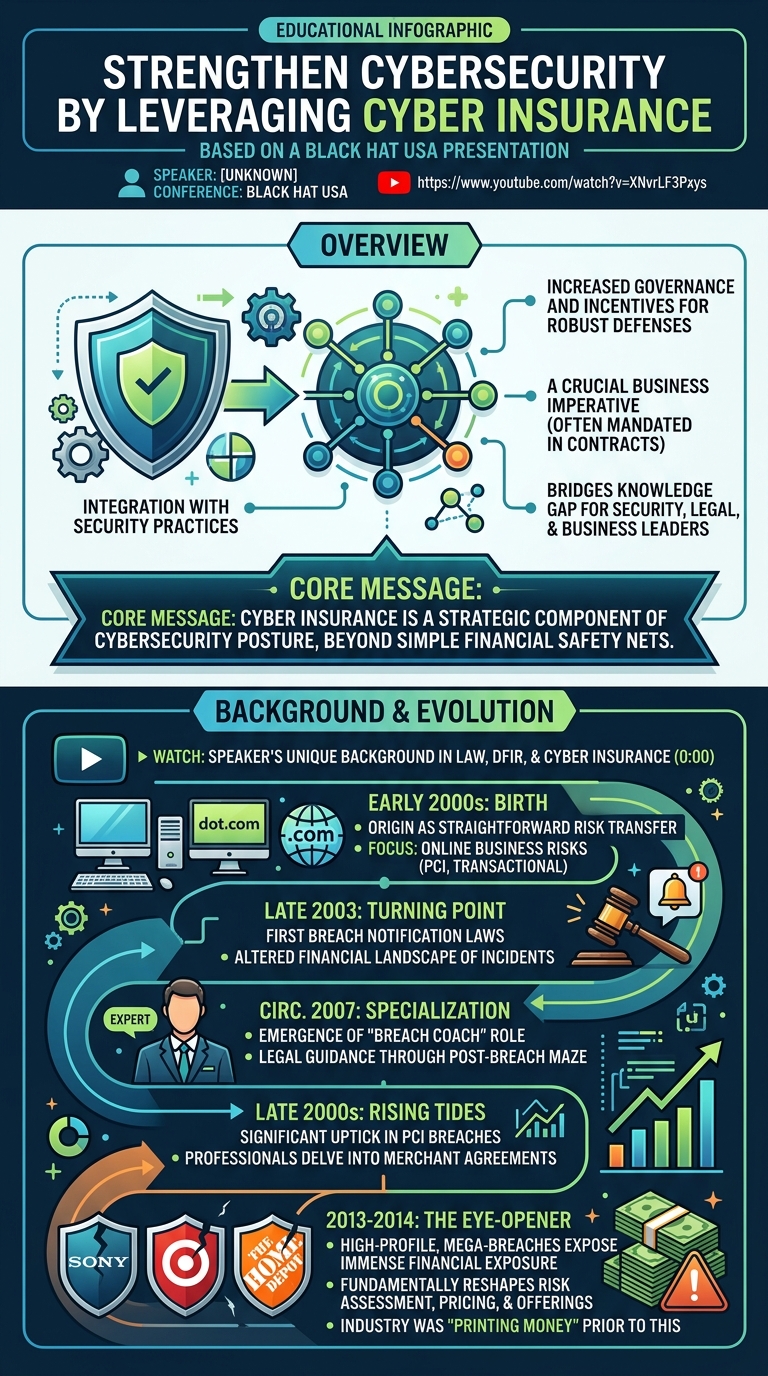
This Black Hat USA talk delves into the evolving landscape of cyber insurance, positioning it not merely as a financial safety net but as a crucial component for strengthening an organization's overall cybersecurity posture. The speaker, an experienced professional with a unique background spanning law, traditional insurance, incident response, and cybersecurity consulting, offers a compelling narrative on how the cyber insurance market has matured and how organizations can leverage it more effectively. The core message is that modern cyber insurance transcends simple risk transfer; it has transformed into an "active insurance" model that integrates with and incentivizes robust security practices and governance.
Key moments
- 0:00 Speaker's unique background in law, DFIR, and cyber insurance
- 2:00 Role as an insurance broker, advocating for clients
- 3:33 Early 2000s: Cyber insurance product comes to market
- 4:08 Breach notification laws: A turning point for the market
- 5:06 Major breaches (2013-14) reveal true cyber exposure
- 6:44 Why the insurance market pivoted to active insurance
Strengthen Cyber-security by Leveraging Cyber-Insurance
Speakers: Unknown
Conference: Black Hat USA
YouTube: https://www.youtube.com/watch?v=XNvrLF3Pxys
Overview
This Black Hat USA talk delves into the evolving landscape of cyber insurance, positioning it not merely as a financial safety net but as a crucial component for strengthening an organization's overall cybersecurity posture. The speaker, an experienced professional with a unique background spanning law, traditional insurance, incident response, and cybersecurity consulting, offers a compelling narrative on how the cyber insurance market has matured and how organizations can leverage it more effectively. The core message is that modern cyber insurance transcends simple risk transfer; it has transformed into an "active insurance" model that integrates with and incentivizes robust security practices and governance.
The talk is particularly relevant in today's threat landscape, where cyberattacks are increasingly sophisticated and costly. For many businesses, cyber insurance has become an imperative, often mandated in contracts for conducting business. However, understanding its genesis, its current capabilities, and how to optimize its benefits remains a challenge for many. This presentation aims to bridge that knowledge gap, providing insights for security professionals, legal teams, and business leaders on how to make cyber insurance work as a strategic asset rather than a reactive expense.
Background
▶ Watch: Speaker's unique background in law, DFIR, and cyber insurance (0:00)
The journey of cyber insurance began in the early 2000s, a period characterized by the rise of dot-com businesses and the burgeoning complexities of online transactions. Initially, the product was conceived as a straightforward risk transfer mechanism, akin to traditional insurance policies. Its primary focus was to address emerging risks associated with online business, particularly PCI risk (Payment Card Industry) and general transactional risks. Companies sought a financial buffer against the nascent threats of digital commerce, and insurers responded with policies designed to provide monetary compensation if something went wrong.
A pivotal moment arrived in late 2003 with the introduction of some of the first breach notification laws. This legislative development significantly altered the financial landscape of cyber incidents, as it mandated public disclosure of breaches, leading to substantial costs related to reputation management, legal fees, and regulatory fines. This marked a turning point, signaling the market's maturation beyond simple data loss and highlighting the increasing financial stakes involved. The industry further specialized around 2007 with the emergence of the "breach coach" role, a legal specialist dedicated to guiding organizations through the intricate post-breach legal and regulatory maze. This specialization underscored the growing complexity of incident response and the need for expert guidance.
The late 2000s saw a significant uptick in PCI breaches, forcing insurance professionals to delve deep into the intricacies of card brands and merchant agreements. However, the true "eye-opener" for the cyber insurance industry came between 2013 and 2014 with a series of high-profile, large-scale breaches involving major corporations such as Sony, Target, and Home Depot. Prior to these incidents, the cyber insurance market had been "printing money" due to relatively few claims compared to the premiums collected, allowing insurers to build significant reserves. These mega-breaches, however, exposed the immense financial exposure and the catastrophic potential of cyber incidents, fundamentally reshaping how insurers assessed risk, priced policies, and developed their offerings. The speaker, having been involved in claims for these very incidents, emphasizes their transformative impact on the industry's understanding of cyber risk.
Key Findings
▶ Watch: Early 2000s: Cyber insurance product comes to market (3:33)
The central finding of this talk is the evolution of cyber insurance from a passive risk transfer mechanism to an active insurance model. This shift is driven by the increasing frequency, sophistication, and financial impact of cyberattacks, coupled with the industry's deepening understanding of cybersecurity best practices. The speaker argues that the traditional model, where a policy was merely a piece of paper promising money in case of a breach, is no longer sufficient.
Instead, the modern cyber insurance market, as exemplified by the speaker's current role at Woodruff Sawyer, actively engages with an organization's security posture and governance. This means:
- Proactive Assessment: Insurers and brokers now seek to understand a client's specific vulnerabilities, existing security controls, and incident response capabilities before a policy is issued. This moves beyond basic questionnaires to a more in-depth analysis of an organization's cyber resilience.
- Integrated Support: Beyond financial payouts, active insurance involves providing access to a network of specialized resources during an incident. This includes DFIR (Digital Forensics and Incident Response) firms, legal counsel (breach coaches), public relations experts, and even assistance with complex tasks like procuring cryptocurrency for ransomware payments (where legally permissible) and reporting to Finsen (Financial Crimes Enforcement Network).
- Policy Customization and Advocacy: A key contribution of experienced brokers is the ability to draft policy language and negotiate with different carriers to ensure the insurance product truly aligns with the client's unique risk profile and operational needs. This transforms the insurer-insured relationship into a more collaborative partnership focused on resilience.
- Emphasis on GRC and Governance: For companies, especially those contemplating an IPO, robust Governance, Risk, and Compliance (GRC) frameworks, particularly in cyber, are becoming critical negotiating points for securing favorable insurance terms. The speaker's firm, Woodruff Sawyer, uniquely offers in-house attorneys specializing in GRC and governance to support clients.
In essence, the "gap" the speaker identifies and seeks to fill is the disconnect between the technical realities of cybersecurity and the financial and legal frameworks of insurance. By adopting an active approach, cyber insurance can become a powerful tool not just for recovery, but for incentivizing and supporting a stronger cybersecurity defense from the outset.
Technical Deep Dive
▶ Watch: Breach notification laws: A turning point for the market (4:08)
While the talk primarily addresses the business and legal facets of cyber insurance, it implicitly touches upon several technical and operational elements that underpin the modern cyber insurance market. The speaker's diverse career path highlights the intricate interplay between legal, financial, and technical domains in managing cyber risk.
Early cyber insurance products were designed to address specific technical risks such as PCI compliance and general transactional risk associated with online commerce. This required insurers to understand the technical standards and vulnerabilities inherent in payment processing and data handling. The shift in the late 2000s with the "uptick in PCI breaches" forced insurance claims professionals, including the speaker, to become intimately familiar with the technical details of card brands and merchant agreements, demonstrating a necessity for technical literacy within the insurance sector.
The speaker's experience as General Counsel at Kibu Consulting, a DFIR firm, provides a direct window into the technical and operational realities of incident response. In this role, the speaker was involved in:
- Procuring crypto: This refers to the complex process of acquiring and transferring cryptocurrency, often Bitcoin or Monero, to pay ransomware demands. This involves understanding cryptocurrency exchanges, wallets, transaction monitoring, and the inherent risks (e.g., fluctuating values, irreversibility of transactions). While the talk doesn't detail the technicalities of blockchain or specific crypto protocols, it highlights the operational necessity of engaging with these technologies under duress.
- Reporting to Finsen: The Financial Crimes Enforcement Network (Finsen) requires reporting of suspicious financial activities, which often includes ransomware payments or other cyber-related financial crimes. This involves understanding data reporting formats, compliance requirements, and the technical trails left by threat actors' financial transactions.
- Negotiating with threat actors: While largely a human-centric process, effective negotiation often requires understanding the technical scope of an attack, the data exfiltrated, and the capabilities of the threat group, which are derived from forensic analysis.
Furthermore, the speaker's tenure at Booz Allen involved advising large organizations on their cyber problems, specifically focusing on tabletop exercises and governance. Tabletop exercises are simulated incident response scenarios that test an organization's technical, operational, and communication capabilities. These exercises validate incident response plans, identify gaps in security controls, and ensure technical teams can effectively collaborate with legal, PR, and executive stakeholders. Cyber governance, on the other hand, involves establishing the policies, procedures, and organizational structures to manage and mitigate cyber risk. This includes technical standards, security architectures, data classification, access controls, and vulnerability management programs. For instance, robust governance ensures that critical systems are patched promptly, multi-factor authentication is enforced, and network segmentation is properly implemented – all technical safeguards that directly impact an organization's risk profile.
The "active insurance" model advocated by the speaker implicitly leverages these technical insights. When a broker like Woodruff Sawyer assesses a client's "security posture" and "governance," they are evaluating the effectiveness of their technical controls, their adherence to industry best practices, and their readiness to respond to incidents. This deep technical understanding allows for more accurate risk assessment, tailored policy language, and ultimately, more effective support when a breach occurs. The firm's focus on GRC for companies going public further emphasizes the need for a technically sound and well-documented security framework to meet regulatory and investor expectations.
Demo / Proof of Concept
▶ Watch: Major breaches (2013-14) reveal true cyber exposure (5:06)
The provided transcript does not include any description of a live demonstration or a technical proof of concept. The talk focuses on the historical evolution, current state, and strategic implications of cyber insurance within the broader cybersecurity landscape, rather than showcasing specific tools or attack vectors.
Defensive Implications
▶ Watch: Why the insurance market pivoted to active insurance (6:44)
The insights shared in this talk offer several critical defensive implications for organizations looking to bolster their cybersecurity posture and effectively manage risk:
- Shift Perception of Cyber Insurance: Organizations should view cyber insurance not merely as a payout mechanism for when things go wrong, but as a strategic asset for proactive defense. Engaging with an "active insurance" model means leveraging the insurer's or broker's expertise to identify gaps, improve governance, and access critical resources before an incident escalates.
- Invest in Governance, Risk, and Compliance (GRC): The speaker highlights GRC, particularly for cyber, as a "big negotiating issue" for insurance. Strong governance frameworks, well-defined policies, robust risk assessments, and adherence to compliance standards (like PCI DSS) are no longer optional. They are essential for demonstrating maturity to insurers, securing better policy terms, and reducing overall cyber risk.
- Prioritize Incident Response Preparedness: The speaker's background in DFIR underscores the importance of having a robust incident response plan. This includes conducting regular tabletop exercises to test response capabilities, establishing clear communication protocols, and understanding the legal and financial implications of a breach. Insurers are increasingly scrutinizing incident response readiness, and a well-practiced plan can significantly reduce the impact of an actual event.
- Understand Policy Language and Negotiate Effectively: Organizations should work with experienced brokers who can "draft policy language" and "negotiate with different carriers." This ensures that the policy truly covers their specific risks, aligns with their operational realities, and avoids unexpected exclusions. A deep understanding of policy nuances can be the difference between comprehensive coverage and significant out-of-pocket expenses.
- Leverage Broker Expertise for Security Posture Assessment: Engage brokers who possess a deep understanding of cybersecurity technology and governance, like Woodruff Sawyer with its in-house attorneys. These brokers can help organizations understand their existing security posture from an insurer's perspective, identifying areas for improvement that will not only enhance security but also lead to more favorable insurance rates and terms.
- Be Prepared for Regulatory Requirements (e.g., Finsen): The mention of "reporting to Finsen" highlights the complex regulatory landscape surrounding cyber incidents, especially those involving financial transactions like ransomware payments. Defenders need to be aware of and prepared for these reporting obligations, integrating them into their incident response and legal frameworks.
By adopting these defensive strategies, organizations can transform their relationship with cyber insurance, making it an integral part of their overall cybersecurity strategy, driving continuous improvement, and enhancing resilience against the ever-present threat of cybercrime.
Key Takeaways
- Cyber insurance has evolved from passive risk transfer to an "active insurance" model, emphasizing proactive engagement with security posture and governance.
- The market matured significantly following the first breach notification laws in late 2003 and the "eye-opener" mega-breaches of 2013-2014 (Sony, Target, Home Depot).
- Strong Governance, Risk, and Compliance (GRC) frameworks are crucial for securing favorable insurance terms and demonstrating cyber maturity, especially for companies seeking IPOs.
- Experienced brokers play a vital role in customizing policy language and negotiating with carriers, ensuring coverage aligns with an organization's unique risk profile.
- Incident response capabilities, including tabletop exercises and understanding complex processes like cryptocurrency procurement for ransomware, are key aspects evaluated by modern insurers.
- Organizations should view cyber insurance as a strategic tool to strengthen overall cybersecurity by incentivizing better practices and providing access to specialized incident response resources.
About the Speaker(s)
The speaker, whose name is not provided in the metadata or transcript, possesses a rich and varied professional background that offers a unique perspective on the intersection of law, cybersecurity, and insurance. They began their career as an attorney, practicing litigation in New York City for nine and a half years. This foundational legal experience provided a deep understanding of contractual obligations, liability, and dispute resolution.
Transitioning into the insurance industry, the speaker was involved in the nascent stages of developing "Cyber" insurance products. This experience provided firsthand insight into how insurers assess and price digital risks. However, recognizing a growing gap between insurance products and the rapidly evolving technological challenges faced by insureds, the speaker pivoted to cybersecurity consulting.
They served as General Counsel at Kibu Consulting, a DFIR (Digital Forensics and Incident Response) firm. In this pivotal role, the speaker was directly involved in the front lines of cyber incident response, including sensitive tasks such as procuring cryptocurrency for ransomware payments, navigating reporting requirements to agencies like Finsen, and negotiating with threat actors. This provided invaluable practical experience with the technical, operational, and legal complexities of managing cyber crises.
Following Kibu Consulting, the speaker joined Booz Allen, where they focused on assisting large, complex organizations with their cyber problems. This involved conducting tabletop exercises and developing robust governance frameworks, further broadening their perspective on enterprise-level cybersecurity challenges.
Currently, the speaker is an insurance broker at Woodruff Sawyer, a Silicon Valley-based firm specializing in tech. In this role, they leverage their comprehensive background to advocate for clients, helping them navigate the cyber insurance market by understanding their security posture and governance, drafting tailored policy language, and negotiating with carriers. Their journey reflects a continuous effort to bridge the gap between financial risk transfer and practical cybersecurity resilience.