Stop! Sandboxing Exploitable Functions and Modules Using In-Kernel Machine Learning
Unknown
Black Hat USA 2024 · Day 1 · Briefing
Overview
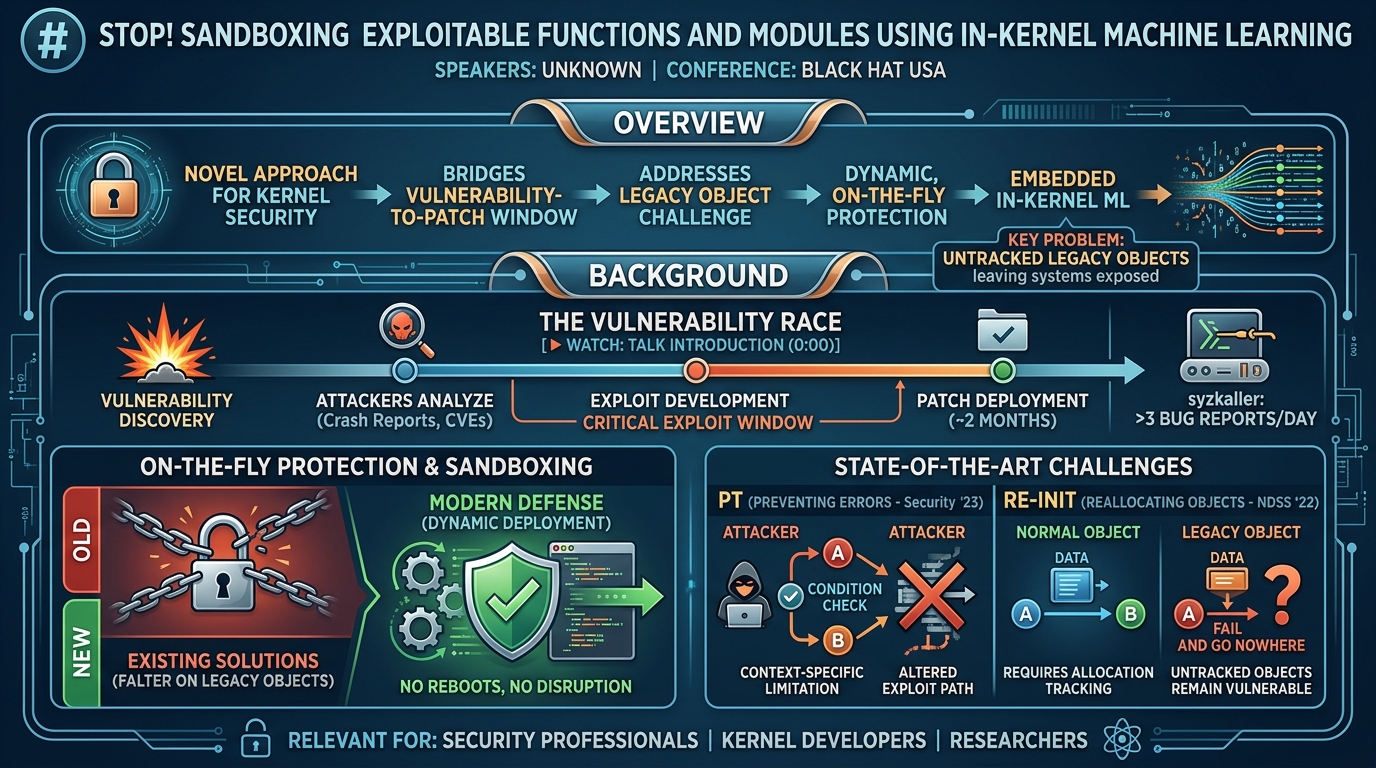
This talk introduces a novel approach to addressing a critical vulnerability window in kernel security: the period between a vulnerability's discovery and the deployment of an official patch. Focusing on the pervasive challenge of legacy objects in memory, the speakers propose an innovative solution that leverages in-kernel machine learning to provide on-the-fly protection. The core problem highlighted is the inability of current runtime sandboxing techniques to effectively monitor and protect objects that were allocated before the security solution itself was deployed, leaving a significant attack surface for sophisticated adversaries.
Key moments
- 0:00 Introduction, team, and talk structure overview
- 2:00 Motivation: The 2-month vulnerability discovery to patch gap
- 3:20 Existing sandboxes are disruptive, require on-the-fly solutions
- 4:10 Review of PT: prevents triggers, but context-specific and bypassable
- 5:20 Review of Seek: isolates objects, but vulnerable to legacy objects
- 6:40 Detailed explanation of the 'Legacy Object Problem' and its challenges
- 7:50 Implementation challenges: cannot track metadata for pre-existing objects
Stop! Sandboxing Exploitable Functions and Modules Using In-Kernel Machine Learning
Speakers: Unknown
Conference: Black Hat USA
YouTube: https://www.youtube.com/watch?v=e4UgGe_-hnc
Overview
This talk introduces a novel approach to addressing a critical vulnerability window in kernel security: the period between a vulnerability's discovery and the deployment of an official patch. Focusing on the pervasive challenge of legacy objects in memory, the speakers propose an innovative solution that leverages in-kernel machine learning to provide on-the-fly protection. The core problem highlighted is the inability of current runtime sandboxing techniques to effectively monitor and protect objects that were allocated before the security solution itself was deployed, leaving a significant attack surface for sophisticated adversaries.
The presentation underscores that traditional patching cycles often leave systems exposed for up to two months, a duration deemed ample for attackers to develop and deploy exploits. While existing on-the-fly protection mechanisms have made strides, they consistently falter when confronted with these untracked, long-lived legacy objects. By integrating machine learning directly into the kernel, the proposed system aims to dynamically identify, classify, and audit access to these elusive objects, thereby enabling proactive sandboxing and significantly narrowing the window of exploitability without requiring system reboots or service disruptions.
This work is particularly relevant for system and software security professionals, kernel developers, and researchers interested in advanced exploitation techniques and proactive defense strategies. It offers a fresh perspective on how machine learning, traditionally applied at higher layers of the stack, can be embedded at the kernel level to tackle fundamental memory safety challenges, particularly those associated with the dynamic and unpredictable nature of operating system memory management.
Background
▶ Watch: Introduction, team, and talk structure overview (0:00)
The landscape of kernel security is characterized by a relentless race between defenders and attackers. A central challenge highlighted in this talk is the significant time lag between the discovery of a vulnerability and the widespread deployment of official patches. This timeline, often spanning nearly two months, creates a critical "exploit window" during which systems remain vulnerable. Attackers, with sufficient time to analyze vulnerability disclosures (e.g., through crash reports or CVEs), can develop sophisticated exploits before patches become available, putting countless systems at risk. The scale of this problem is underscored by statistics from fuzzing tools like syzkaller, which generate an average of over three bug reports per day for the Linux kernel alone, illustrating the constant stream of newly discovered vulnerabilities.
Existing sandboxing solutions often fall short in addressing this dynamic threat. Many require system rebuilding or reboots for deployment, which is highly disruptive for production environments. Imagine having to reboot a system three times a day to integrate new protections – an unacceptable scenario for critical services. This necessitates on-the-fly protection – solutions that can be deployed at runtime without interrupting services.
The speakers review two notable state-of-the-art solutions:
- PT (presented at Security '23): This approach focuses on preventing the triggering of discovered errors. It works by constructing specific triggering conditions, monitoring for these conditions at runtime, and then preventing the trigger (e.g., by sending a
SIGKILLsignal to the offending process) if the conditions are met. However, PT has a significant limitation: it is context-specific. If an attacker alters their method of triggering the bug, perhaps by using a different execution path or a different memory access pattern, PT's predefined conditions may fail to detect and prevent the exploit.
- Seek: This solution adopts a more general strategy, focusing on preventing the launching of exploitation rather than just the triggering of bugs. Seek is particularly relevant for heap out-of-bounds (OOB) vulnerabilities, where an attacker might corrupt sensitive data structures or function pointers in memory. Seek's defense mechanism involves isolating different types of objects in separate memory regions, often employing guard pages between them. For objects of the same type, they are stored within the same "case" to prevent cross-case exploitation. While more robust than PT, Seek also has a critical limitation: it can be bypassed if the target exploit leverages legacy objects.
This brings us to the central problem addressed by the talk: the legacy object problem. Legacy objects are defined as memory objects that were allocated before a protection mechanism was deployed (at time T0) and were not deallocated after its deployment. For on-the-fly protection solutions, these objects pose a significant challenge because they were allocated without the protection system's knowledge or ability to instrument them. Consequently, vital auditing information, such as their start and end addresses or their precise type, remains untracked.
According to the speakers' statistics, a considerable number of such objects exist in typical kernel environments: over 10,000 objects were observed to have a lifetime exceeding 10 seconds, and these objects are frequently accessed, undergoing an average of 22 modifications during their lifetime. This combination of longevity and frequent modification makes them prime targets for exploitation. Crucially, because these legacy objects are untracked, they are not isolated by existing protection mechanisms like Seek and can be freely "mixed" with other objects in memory. This lack of isolation provides attackers with numerous opportunities to abuse them, making the auditing of access to these legacy objects a paramount concern for practical on-the-fly kernel protection.
Key Findings
▶ Watch: Existing sandboxes are disruptive, require on-the-fly solutions (3:20)
The primary finding of this research is the identification and articulation of the "legacy object problem" as a critical vulnerability gap in existing on-the-fly kernel protection mechanisms. While prior work like PT and Seek has advanced runtime defenses, the inability to effectively track, classify, and protect memory objects allocated before the defense was enabled leaves a significant and exploitable surface. The statistics presented—over 10,000 objects living longer than 10 seconds and experiencing an average of 22 modifications—underscore the ubiquity and exploitability of these untracked memory regions.
The key contribution and proposed solution is the demonstration that embedding machine learning directly into the kernel can effectively address this legacy object problem. By leveraging ML, the system aims to overcome the inherent challenge of determining the exact type and purpose of pre-existing, uninstrumented objects. This allows for dynamic auditing and sandboxing of access to these legacy objects, thereby making on-the-fly protection truly practical and comprehensive. The approach offers a temporal remediation, providing crucial defense during the vulnerable period before official patches are released, significantly narrowing the exploit window for newly discovered kernel vulnerabilities.
Technical Deep Dive
▶ Watch: Review of PT: prevents triggers, but context-specific and bypassable (4:10)
The core innovation proposed in this talk is the integration of machine learning (ML) capabilities directly into the operating system kernel to address the legacy object problem. While the transcript outlines the motivation and the problem in considerable detail, specific architectural components, algorithms, feature engineering, or implementation details of the in-kernel ML solution are not extensively provided. However, based on the problem statement, we can infer the theoretical requirements and challenges of such a system.
The fundamental challenge with legacy objects is the lack of metadata—information like their allocated type, intended purpose, and valid access patterns—which is crucial for effective security auditing. When a protection mechanism is deployed at T0, it cannot retroactively instrument or track objects that already exist in memory. This means traditional methods of memory object isolation or access control, which rely on compile-time or allocation-time tagging, are ineffective.
An in-kernel machine learning system designed to solve this would likely involve several conceptual stages:
- Data Collection and Feature Extraction:
- The kernel would need to monitor memory access patterns to legacy objects. This could involve using hardware features (like Memory Management Unit (MMU) page protections) or software instrumentation (e.g., hooks on memory access functions, though this is difficult for pre-existing objects without overhead).
- Features extracted might include:
- Access Type: Read, Write, Execute.
- Access Frequency: How often an object is accessed.
- Accessing Process/Module: Which kernel module or user process is performing the access.
- Access Offset: The specific byte offset within the object being accessed.
- Call Stack Information: The sequence of function calls leading to the access.
- Object Size and Alignment: Inferred properties of the legacy object.
- Contextual Information: System calls, interrupts, and other kernel events occurring around the access.
- The goal is to gather enough runtime information to build a "behavioral profile" for each untracked legacy object.
- Object Classification and Type Inference:
- The ML model's primary task would be to infer the type and expected behavior of legacy objects. This is critical because the exact type (e.g.,
struct task_struct,struct file,struct socket) dictates its legitimate access patterns. - A classification model (e.g., a Support Vector Machine, Random Forest, or a neural network) could be trained on known, tracked objects to learn correlations between access patterns and object types. This pre-trained model would then be deployed in the kernel.
- When applied to a legacy object, the model would analyze its observed access patterns and attempt to classify it into one of the known object types or flag it as an "unknown" or "anomalous" type.
- This inference might be probabilistic, with the system assigning a confidence score to its type prediction.
- Anomaly Detection and Sandboxing:
- Once a legacy object's type is inferred, the system can establish a baseline of expected legitimate access patterns.
- Any deviation from this baseline would be considered an anomaly. For example, if an object inferred to be a
struct file(which primarily involves read/write operations) suddenly exhibits execution attempts, it would trigger an alert. - The in-kernel ML system could then enforce sandboxing policies based on the inferred type and detected anomalies. This could involve:
- Restricting access: Applying more stringent memory protections (e.g., making a page read-only or non-executable).
- Alerting: Notifying security administrators of suspicious activity.
- Process Quarantine/Termination: Forcing a malicious process that attempts to abuse a legacy object into quarantine or terminating it.
- Memory Isolation: Dynamically moving or remapping the legacy object to a guarded memory region, similar to Seek, but after the object has been identified and characterized by ML.
Challenges of In-Kernel ML:
- Performance Overhead: Running complex ML models directly in the kernel can introduce significant latency and CPU overhead, which is unacceptable for a high-performance operating system. This necessitates highly optimized, lightweight models and efficient feature extraction. The mention of "reduce overhead using PKS like hardware feature" in the future work section suggests an awareness of this challenge and a potential solution through hardware-assisted memory tagging or protection keys.
- Reliability and Accuracy: Kernel security demands near-perfect accuracy. False positives (legitimate activity flagged as malicious) can lead to system instability, while false negatives (missing real attacks) defeat the purpose. The speaker acknowledges this with the limitation: "machine model accuracy is not 100%."
- Data Scarcity and Training: Training robust ML models requires vast amounts of representative data, including examples of both benign and malicious kernel object interactions. Collecting this data from a live kernel, especially for rare or novel attack vectors, is difficult.
- Model Update and Deployment: How are ML models updated in a live kernel? Can they be retrained and deployed on-the-fly without requiring reboots? This is crucial for adapting to new attack techniques.
The "future work" mentions "mature the type implementation and the solution to current cases in the machine model," which implies ongoing refinement of the object typing and anomaly detection capabilities. While the technical specifics are sparse in the provided transcript, the conceptual framework points towards a sophisticated, adaptive security layer that leverages the power of machine learning to overcome a long-standing challenge in kernel security.
Demo / Proof of Concept
▶ Watch: Detailed explanation of the 'Legacy Object Problem' and its challenges (6:40)
The talk's introduction and subsequent structural outlines explicitly mention the intention to "use a video demo to show our approach case." However, the provided transcript does not contain any description or details of this demonstration. It is stated that a video demo was planned to illustrate the effectiveness of their solution in action. Given the nature of the problem—sandboxing exploitable functions and modules using in-kernel machine learning—a typical demonstration would likely involve:
- Setup: A vulnerable kernel environment with a known exploit targeting a legacy object (i.e., an object allocated before the ML-based protection was enabled).
- Attack Scenario: An attacker attempting to trigger the exploit, perhaps a heap out-of-bounds write or a use-after-free on an untracked object.
- Defense Activation: The on-the-fly deployment of the in-kernel ML protection system.
- Observation: The system dynamically inferring the type of the legacy object, detecting the anomalous access attempt by the exploit, and subsequently preventing it (e.g., by terminating the malicious process, modifying memory permissions, or quarantining the affected module).
- Comparison: Potentially showing the exploit succeeding when the ML protection is absent or bypassed, and failing when it is active, thus highlighting the value of their approach.
Without further details in the transcript, the exact specifics of the demo remain speculative, but its inclusion would have been crucial for visually validating the proposed solution's efficacy against the legacy object problem.
Defensive Implications
▶ Watch: Implementation challenges: cannot track metadata for pre-existing objects (7:50)
The work presented in this talk carries significant defensive implications for modern operating system security, particularly for high-availability systems where reboots are costly and unacceptable.
- Shrinking the Exploit Window: The most immediate and profound implication is the ability to drastically reduce the exploit window for newly discovered kernel vulnerabilities. By providing on-the-fly protection against exploits targeting unknown or unpatched bugs, defenders can mitigate threats during the critical two-month period before official patches are widely deployed. This shifts the paradigm from reactive patching to proactive, runtime mitigation.
- Addressing the Legacy Object Gap: The explicit focus on the legacy object problem directly addresses a critical blind spot in existing runtime protection schemes. By conceptualizing and demonstrating a path to audit and protect objects allocated prior to security deployment, this research closes a significant attack vector that sophisticated adversaries could otherwise exploit. This means that even long-running services with complex memory states can benefit from dynamic security enhancements without disruption.
- Paradigm Shift to In-Kernel Machine Learning: Embedding machine learning directly into the kernel represents a notable paradigm shift. Traditionally, ML for security operates at higher layers (e.g., network intrusion detection, malware analysis). Bringing it into the kernel space, particularly for tasks like object type inference and anomaly detection on memory access, opens new avenues for adaptive and intelligent defense. This could lead to more resilient systems that can dynamically learn and adapt to evolving threat landscapes without requiring constant manual updates or reconfigurations.
- Enhanced Memory Safety: While not a complete memory safety solution, the ability to infer object types and audit access patterns for untracked memory regions significantly enhances overall memory safety. This provides a dynamic layer of defense against common memory corruption vulnerabilities such as heap out-of-bounds, use-after-free, and type confusion, even when the underlying code is unpatched.
- Temporal Remediation: The solution is explicitly framed as a "temporal remediation," meaning it provides a crucial stop-gap measure. This allows organizations to maintain security posture while awaiting rigorous, officially tested patches. It buys valuable time, reducing the urgency and pressure on development teams to release emergency patches and enabling a more structured patch management process.
- Future Hardware Integration: The mention of future work involving PKS (Protection Keys for Supervisor-mode) or similar hardware features suggests a path toward highly efficient and performant in-kernel ML. Leveraging hardware-assisted memory tagging could drastically reduce the overhead associated with runtime monitoring and ML inference, making such advanced protections more viable for production systems.
In summary, this research empowers defenders with a robust, adaptive, and non-disruptive mechanism to protect critical kernel components against zero-day and n-day exploits, particularly those targeting the challenging domain of untracked legacy memory objects.
Key Takeaways
- Critical Exploit Window: There's a significant 2-month window between vulnerability discovery and patch deployment, which attackers actively exploit, necessitating on-the-fly protection.
- Limitations of Current Solutions: Existing on-the-fly kernel protection mechanisms like PT and Seek are limited by their context-specificity or their inability to handle legacy objects effectively.
- The "Legacy Object Problem": Memory objects allocated before a protection system is deployed and remaining active are untracked and uninstrumented, creating a significant and frequently abused attack surface (e.g., over 10,000 objects with >10s lifetime, ~22 modifications).
- In-Kernel Machine Learning as a Solution: Embedding machine learning directly into the kernel can effectively address the legacy object problem by dynamically inferring object types and auditing access patterns for untracked memory.
- On-the-Fly, Non-Disruptive Protection: The proposed solution offers a vital temporal remediation that provides protection at runtime without requiring system reboots or service interruptions.
- Future Directions: Ongoing work includes maturing type inference, addressing specific kernel use cases for ML models, and exploring hardware features like PKS to reduce overhead and enhance performance.
About the Speaker(s)
The primary presenter for this talk is a student researcher from the University of [unspecified], whose research focuses on system and software security, as well as exploitation development. This project represents their first presentation at Black Hat, indicating a promising start to their career in cybersecurity research.
The work is a collaborative effort involving a team of researchers. One key contributor is a colleague who recently received their PhD degree from [unspecified] University and is identified as the originator of the project's core ideas. Another student from the same university provided "medical assistance," likely a misspoken term for technical or research assistance. The team also includes a provisor at [unspecified] board specializing in system and software security, and an assistant professor at U [unspecified] whose research interests lie in reinforcement learning, data mining, and urban computing. This diverse team brings together expertise in various facets of security, systems, and machine learning, which is crucial for a project that integrates advanced ML techniques into kernel security.