The Fundamentals of Cyber-Insurance
Unknown
Black Hat USA 2024 · Day 1 · Briefing
Overview
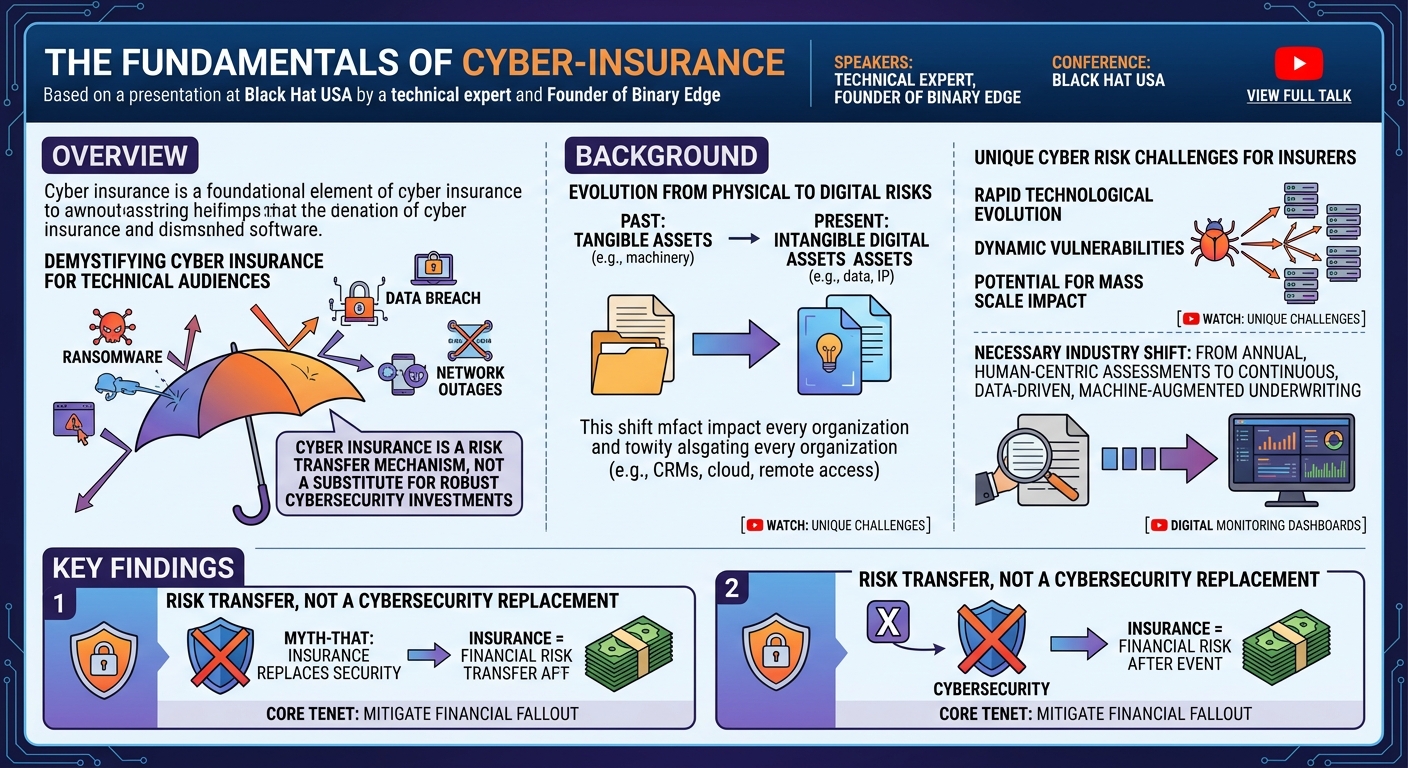
This talk delves into the often-misunderstood world of cyber insurance, providing a foundational understanding of its purpose, scope, and evolving role within the cybersecurity landscape. Presented by a speaker with a deep technical background—having founded Binary Edge, a company known for internet-wide scanning and large-scale data collection—the session aims to demystify cyber insurance for a technical audience. It highlights that while commonly associated with ransomware, cyber insurance policies cover a much broader array of incidents, from data breaches and network outages to physical theft of company assets. Crucially, the speaker emphasizes that cyber insurance is a risk transfer mechanism, not a substitute for robust cybersecurity investments, a common misconception the talk actively seeks to dispel.
Key moments
- 0:00 Introduction, speaker background, and talk objectives
- 0:40 Core coverage of cyber insurance explained
- 3:00 Unique challenges of cyber risk for insurance
- 4:45 Shift to machine-augmented, data-driven underwriting
- 5:55 How modern cyber insurers leverage technology and security
- 7:00 Step-by-step process of obtaining a cyber insurance policy
The Fundamentals of Cyber-Insurance
Speakers: Unknown (Technical Expert from a Cyber Insurance Provider, Founder of Binary Edge)
Conference: Black Hat USA
YouTube: https://www.youtube.com/watch?v=8FZUbcyEVpI
Overview
This talk delves into the often-misunderstood world of cyber insurance, providing a foundational understanding of its purpose, scope, and evolving role within the cybersecurity landscape. Presented by a speaker with a deep technical background—having founded Binary Edge, a company known for internet-wide scanning and large-scale data collection—the session aims to demystify cyber insurance for a technical audience. It highlights that while commonly associated with ransomware, cyber insurance policies cover a much broader array of incidents, from data breaches and network outages to physical theft of company assets. Crucially, the speaker emphasizes that cyber insurance is a risk transfer mechanism, not a substitute for robust cybersecurity investments, a common misconception the talk actively seeks to dispel.
The session underscores the unique challenges cyber risk presents to the traditional insurance industry. Unlike static physical assets, digital risks are characterized by rapid technological evolution, dynamic vulnerabilities, and the potential for a single flaw to impact thousands of organizations simultaneously. This inherent volatility has necessitated a profound shift in how insurance providers assess and manage cyber risk, moving towards data-driven, machine-augmented underwriting and continuous monitoring. The talk is particularly relevant for security professionals, business leaders, and anyone grappling with the financial implications of cyber risk in an increasingly digital world.
Background
▶ Watch: Introduction, speaker background, and talk objectives (0:00)
The evolution of business value from tangible, physical assets to intangible digital assets—such as data, intellectual property, and customer privacy—forms the bedrock of the need for cyber insurance. Historically, insurance models were built around well-defined physical assets, with risk assessment and distribution relying on established brick-and-mortar channels. However, the advent of the digital age has fundamentally altered this paradigm. Today, nearly every organization, from large corporations to local churches, relies on technology for core operations, creating a vast and interconnected attack surface. Customer Relationship Management (CRM) systems, remote access solutions, cloud applications, and even simple websites all represent potential points of exposure.
The unique characteristics of cybersecurity risk further complicate matters for traditional insurers. Technology evolves at an unprecedented pace, rendering security postures dynamic and volatile. A company deemed secure one day can become vulnerable the next due following the discovery of a new exploit or zero-day vulnerability. Furthermore, a single individual or a small group of attackers can leverage such vulnerabilities to compromise thousands of entities simultaneously, a scale of impact rarely seen in other insurance lines. The insurance industry, originally unprepared for the speed and amorphous nature of cyber threats, has had to undergo a significant learning curve, adapting its underwriting practices, risk models, and engagement strategies to address this new reality. This shift involves moving from annual, human-centric assessments to continuous, data-driven, and machine-augmented processes that mirror the dynamic nature of digital risk itself.
Key Findings
▶ Watch: Unique challenges of cyber risk for insurance (3:00)
The talk reveals several pivotal shifts and core tenets within the modern cyber insurance landscape:
- Cyber Insurance is a Risk Transfer, Not a Cybersecurity Replacement: This is the most critical myth debunked. Cyber insurance policies mandate a minimum set of security controls. Without fundamental protections like Multi-Factor Authentication (MFA) on email, obtaining coverage at a reasonable price is increasingly difficult, if not impossible.
- Modern Insurers Operate Like Tech Companies: Cutting-edge cyber insurance providers leverage sophisticated technical capabilities. They conduct internet-wide scans of prospective and current policyholders, collect granular security controls data through questionnaires and direct integrations, and continuously monitor for new exposures.
- Data-Driven, Machine-Augmented Underwriting: The complexity and scale of cyber risk necessitate a departure from manual underwriting. Modern providers utilize "trillions and trillions of data points"—including details on security controls, password policies, employee numbers, and internet-exposed assets—to accurately assess and price risk. This data-centric approach allows for a dynamic understanding of risk that continuously evolves.
- Insurers as Security Enforcers: Cyber insurance carriers possess a unique level of influence over organizational security. Due to contractual requirements for coverage, insurers can mandate specific security improvements, such as enforcing MFA across all web applications, removing Remote Desktop Protocol (RDP) from internet exposure, or isolating VPN admin panels. This influence can drive security uplift in ways that other cybersecurity initiatives often struggle to achieve.
- Varied Insurance Entities and Their Focus: The cyber insurance ecosystem comprises different players with distinct priorities. Managing General Agents (MGAs) and carriers typically focus on individual company incidents and claims. In contrast, reinsurance entities are concerned with "big things"—catastrophic events costing billions, such as the impacts seen with incidents affecting CDK Global or Change Healthcare, which represent systemic risks rather than isolated breaches. Understanding who you're speaking with in the insurance chain is crucial for effective engagement.
- Comprehensive Coverage Beyond Ransomware: While ransomware often dominates headlines, cyber insurance policies offer broad protection, encompassing data breaches, network outages, third-party security and privacy events, cybercrime, and even physical theft of company devices that could lead to data compromise.
Technical Deep Dive
▶ Watch: Shift to machine-augmented, data-driven underwriting (4:45)
The technical underpinnings of modern cyber insurance reveal a sophisticated, data-intensive approach to risk assessment and management. At its core, the transformation from traditional insurance to cyber insurance is driven by the dynamic and intangible nature of digital assets.
Modern cyber insurance providers leverage internet-wide scanning capabilities, akin to the work done by companies like Binary Edge, to gain an external, objective view of a prospective policyholder's digital footprint. These scans identify exposed services, open ports, known vulnerabilities, and misconfigurations that could represent attack vectors. This proactive scanning is not a one-time event but a continuous process, allowing insurers to monitor changes in a company's security posture and alert them to newly discovered exposures or vulnerabilities. For instance, if a company exposes an unpatched RDP instance to the internet or an insecure VPN admin panel, the insurer's scans will likely detect it, leading to a contingency requirement before policy binding or an alert during continuous risk maintenance.
Data-driven underwriting is another cornerstone. Instead of relying solely on self-reported questionnaires—though these still play a role—modern insurers ingest "trillions and trillions of data points." This includes automated telemetry from security tools, public internet scan data, industry benchmarks, and detailed information on an organization's internal security controls. Examples of data points include the enforcement of MFA on critical services like email and web applications, the strength of password policies, the number of employees, the types of assets exposed to the internet, and the overall technology stack heterogeneity. This holistic data collection allows for a much more accurate and granular assessment of risk than traditional methods.
The underwriting process itself has become highly automated and iterative. A typical quote lifecycle begins with basic inputs from a broker (company name, domain, industry, employee count, revenue, desired coverage limit). This data feeds into a risk selection phase, which can result in a clean quote, a quote with contingencies (specific security improvements required for coverage), or a decline. Once a policy is bound, the relationship enters a risk maintenance and reduction mode. In this phase, the insurer continuously monitors the policyholder and provides monthly notifications about new vulnerabilities, required patches, or recommended security control implementations. This continuous engagement ensures that security posture remains dynamic and responsive to the evolving threat landscape.
The speaker highlights specific security controls that are non-negotiable for modern cyber insurance coverage. MFA on email is cited as a baseline requirement, given the prevalence of phishing and credential theft in initial access attempts. Beyond email, MFA is increasingly expected across all web applications. Insurers also actively identify and require the remediation of common attack surfaces, such as publicly exposed RDP services or unisolated VPN admin panels, demonstrating their direct influence on improving a company's fundamental security hygiene. The ability for a single zero-day vulnerability to impact thousands of companies simultaneously underscores the need for this dynamic, data-driven approach, as traditional static risk models cannot account for such rapid, widespread shifts in exposure.
Demo / Proof of Concept
▶ Watch: How modern cyber insurers leverage technology and security (5:55)
The talk, "The Fundamentals of Cyber-Insurance," is primarily conceptual and educational in nature, focusing on explaining the principles, evolution, and practicalities of cyber insurance. As such, it did not include a live demonstration or a technical proof of concept. The content was delivered through analytical prose and illustrative examples to convey the intricate workings of modern cyber insurance providers.
Defensive Implications
▶ Watch: Step-by-step process of obtaining a cyber insurance policy (7:00)
For cybersecurity defenders, the insights from this talk offer crucial guidance and opportunities:
- Prioritize Fundamental Security Controls: Cyber insurance is a strong motivator for implementing baseline security. Defenders should ensure Multi-Factor Authentication (MFA) is deployed across all critical services, especially email and web applications. This is not just a best practice but an increasingly mandatory requirement for obtaining and maintaining affordable cyber insurance coverage.
- Proactive Vulnerability Management: Modern insurers perform continuous internet-wide scans. Organizations should adopt a similar proactive stance, regularly scanning their own external attack surface for exposed services, open ports, and known vulnerabilities (e.g., unpatched RDP, exposed VPN admin panels). Addressing these issues before an insurer flags them can lead to better policy terms and reduced risk.
- Leverage Insurer Guidance: View your cyber insurance provider as a partner in risk reduction. Modern insurers often employ security engineers and provide continuous alerts and recommendations. Defenders should actively engage with these resources to identify and remediate weaknesses, effectively gaining expert security advice as part of their policy.
- Understand Policy Requirements and Exclusions: Don't view cyber insurance as a "set it and forget it" solution. Defenders need to understand the specific security controls mandated by their policy and ensure continuous compliance. They should also be aware of what is covered, any sub-limits (e.g., for ransomware payouts), and how different types of incidents are handled.
- Communicate Internally About Risk Transfer: Educate internal stakeholders, particularly leadership, that cyber insurance is a risk transfer mechanism, not a replacement for cybersecurity investment. It mitigates financial impact but does not prevent incidents or eliminate the need for robust security programs. This helps align expectations and secure necessary budgets for ongoing security initiatives.
- Prepare for a Data-Driven Underwriting Process: Be ready to provide comprehensive data on your security posture, either through detailed questionnaires or direct integrations. Transparency and accuracy in reporting security controls will be critical for favorable underwriting and pricing.
Key Takeaways
- Cyber insurance is a risk transfer mechanism, not a replacement for cybersecurity investments. It financially safeguards against cyber incidents but does not negate the need for robust security controls.
- Modern cyber insurance providers operate like tech companies, using internet-wide scans and vast data points for dynamic, machine-augmented underwriting. This allows for continuous risk assessment and monitoring.
- Minimum security controls, such as Multi-Factor Authentication (MFA) on email and critical applications, are increasingly mandatory for obtaining and maintaining cyber insurance coverage at appropriate prices.
- Cyber insurance carriers wield significant influence, often mandating specific security improvements (e.g., removing RDP from the internet, enforcing MFA) as conditions for coverage, thereby driving overall security uplift.
- The unique, dynamic, and rapidly evolving nature of cyber risk (e.g., new vulnerabilities daily, single zero-days impacting thousands) required the insurance industry to fundamentally shift from traditional, tangible asset-based models to data-driven approaches for intangible assets.
- Understanding the different entities within the cyber insurance ecosystem (MGAs, carriers, reinsurance) is crucial, as their focus and scale of concern vary significantly, from individual company incidents to catastrophic, billion-dollar systemic events.
About the Speaker(s)
The speaker, whose name was not provided in the metadata or explicitly stated in the transcript, is identified as a highly technical individual working for a cyber insurance provider. They possess a strong background in cybersecurity, having founded Binary Edge, a company renowned for its capabilities in internet-wide scanning and large-scale data collection. The speaker also mentioned having built network and web application scanners, and continues to engage in such technical work on a day-to-day basis. Their expertise spans both the offensive and defensive aspects of cybersecurity, offering a unique and informed perspective on the intersection of technology and insurance. The transcript notes that the speaker was introduced by "Jeremiah," but their own name was not explicitly stated.