The Way to Android Root: Exploiting Your GPU on Smartphone
Unknown
Black Hat USA 2024 · Day 1 · Briefing
Overview
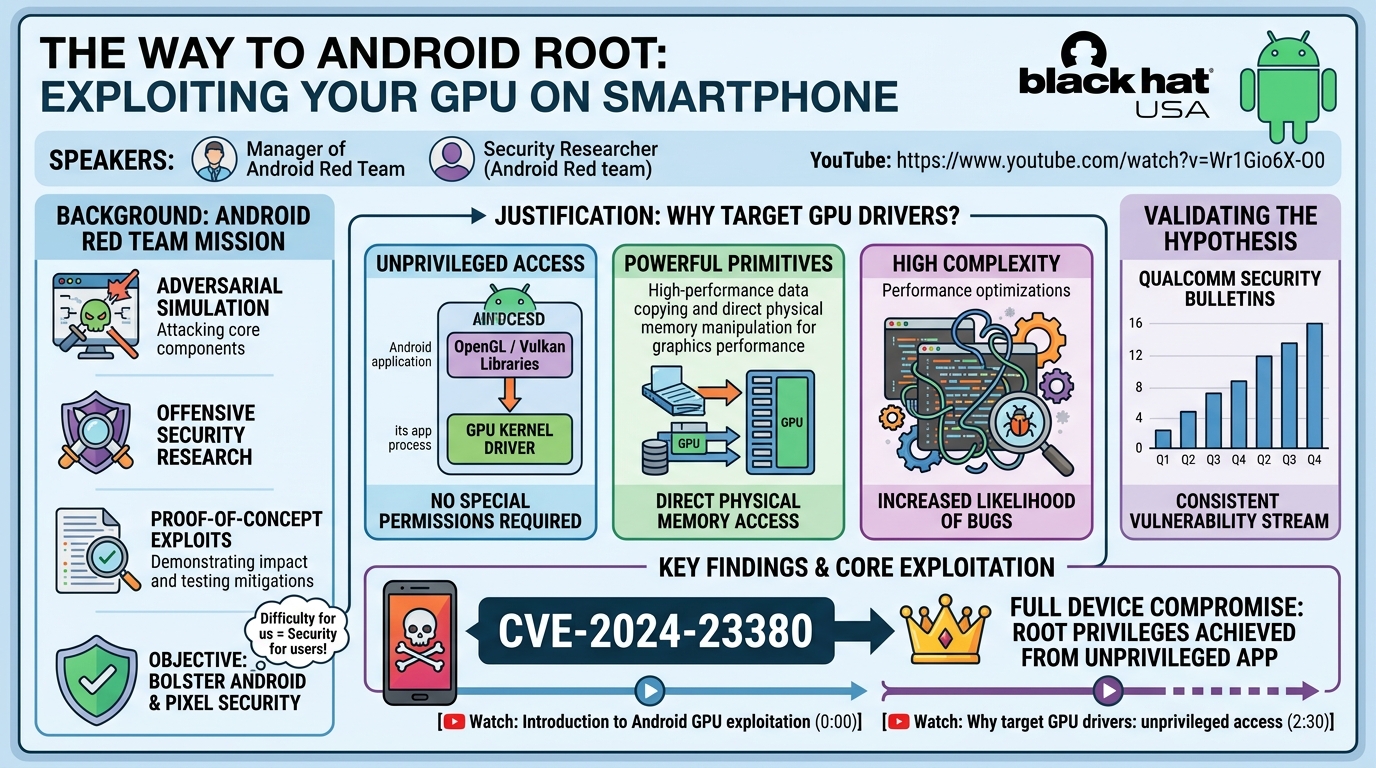
This talk, presented by members of the Android Red team, delves into the critical security implications of Qualcomm Adreno GPU drivers on Android smartphones. The speakers reveal their discovery and exploitation of CVE 2024-23380, a vulnerability that allowed them to achieve root privileges from an unprivileged Android application. The presentation highlights why GPU drivers are a prime target for attackers: their direct access by unprivileged applications, the necessity for direct physical memory manipulation for performance, and the inherent complexity that often leads to exploitable bugs.
Key moments
- 0:00 Introduction to Android GPU exploitation
- 1:00 Android Red Team's mission and approach
- 2:30 Why target GPU drivers: unprivileged access
- 4:50 Consistent GPU vulnerability rate in Qualcomm bulletins
- 8:00 Bug discovery methodology: manual patch analysis
- 9:50 Challenges encountered when fuzzing GPU drivers
The Way to Android Root: Exploiting Your GPU on Smartphone
Speakers: Manager of Android Red team, Security Researcher (Android Red team)
Conference: Black Hat USA
YouTube: https://www.youtube.com/watch?v=Wr1Gio6X-O0
Overview
This talk, presented by members of the Android Red team, delves into the critical security implications of Qualcomm Adreno GPU drivers on Android smartphones. The speakers reveal their discovery and exploitation of CVE 2024-23380, a vulnerability that allowed them to achieve root privileges from an unprivileged Android application. The presentation highlights why GPU drivers are a prime target for attackers: their direct access by unprivileged applications, the necessity for direct physical memory manipulation for performance, and the inherent complexity that often leads to exploitable bugs.
The Android Red team, tasked with enhancing Android and Pixel security through adversarial simulation, undertook this research to validate or break existing security assumptions. Their findings underscore a persistent challenge in mobile security, as GPU drivers continue to present a consistent stream of vulnerabilities. This work is highly significant for the Android ecosystem, demonstrating a clear path to device compromise through a component often overlooked by mainstream security research but critical for system performance and functionality.
Background
▶ Watch: Introduction to Android GPU exploitation (0:00)
The Android Red team operates with the mission of bolstering Android and Pixel security by proactively simulating sophisticated adversary attacks on key components and features. Their methodology encompasses offensive security research, rigorous design and implementation reviews, and the development of tools for continuous fuzzing and static analysis. A crucial aspect of their work involves developing proof-of-concept (PoC) exploits to demonstrate the real-world impact of discovered vulnerabilities and to assess the efficacy of existing security mitigations. The team emphasizes that the more difficulty they encounter in developing exploits, the more secure the end-user is.
Before embarking on this particular engagement, the team meticulously justified their focus on Android GPU drivers. Several compelling reasons converged to make GPU drivers a high-impact target. Firstly, and perhaps most critically, unprivileged Android applications do not require any special permissions to interact with the GPU driver. Applications communicate with the GPU through user-space libraries like OpenGL or Vulkan, which then directly interface with the kernel GPU driver within the app's process. This direct access from an unprivileged context creates a significant attack surface. Secondly, the demanding performance requirements of modern graphics processing necessitate that GPUs can copy vast amounts of data directly between user space and kernel space, often involving the manipulation of physical memory. This powerful primitive, if exposed or mismanaged, is highly coveted by attackers. Lastly, the pursuit of performance optimizations has led to incredibly high complexity in GPU driver codebases. This complexity invariably increases the likelihood of introducing subtle yet exploitable bugs, making bug-free code an elusive goal.
The team's analysis of Qualcomm's security bulletins further reinforced their decision, revealing a consistent, albeit single-digit, rate of security issues disclosed each quarter. This steady stream of vulnerabilities, without a clear downward trend, suggested that GPU drivers remained a fertile ground for discovering new security flaws. The speakers also acknowledged the invaluable contributions of other security researchers who have publicly disclosed high-profile GPU issues, providing a rich body of work for study and inspiration.
Key Findings
▶ Watch: Why target GPU drivers: unprivileged access (2:30)
The primary finding of this research is the successful identification and exploitation of CVE 2024-23380 within the Qualcomm Adreno GPU driver. This vulnerability proved to be critical, enabling the Android Red team to elevate privileges to root from an unprivileged application running on an Android smartphone. The core impact of this discovery lies in demonstrating a viable path for an attacker to gain full control over a device without requiring any special permissions from the user.
The exploitation of CVE 2024-23380 leveraged the powerful primitives inherent in GPU operations, specifically the ability to manipulate physical memory directly. While the detailed mechanics of the specific vulnerability were not elaborated in the provided transcript, the speakers emphasized that such issues often stem from the high complexity and performance-driven optimizations within GPU drivers. The successful exploitation to achieve root privilege from a trusted app highlights a significant security gap, where a component designed for performance can inadvertently become a conduit for system-wide compromise if not rigorously secured. This finding validates the Android Red team's hypothesis that GPU drivers represent a high-impact area for security research, capable of yielding severe vulnerabilities.
Technical Deep Dive
▶ Watch: Consistent GPU vulnerability rate in Qualcomm bulletins (4:50)
The technical focus of the talk centered on the intricacies of the Qualcomm Adreno GPU architecture and the general challenges in securing such a complex component. As previously noted, the specific technical details of how CVE 2024-23380 functions were not fully disclosed within the provided transcript. However, the speakers did outline the broader context and types of vulnerabilities often found in GPU drivers, which likely apply to CVE 2024-23380.
GPU drivers, particularly those from Qualcomm's Adreno series, are highly optimized for performance, requiring direct interaction with hardware and efficient data transfer. This often involves Memory Management Unit (MMU) operations that can directly map and unmap physical memory regions into user-space processes. A common class of vulnerabilities in this domain involves MMU misconfigurations, where the driver might incorrectly set up memory protections or mappings, allowing an attacker to access sensitive kernel memory or other processes' memory regions. Such misconfigurations might not immediately trigger a crash, making them difficult to detect with traditional crash-based fuzzing. Instead, they require careful analysis to identify when a misconfigured memory region is accessed by an attacker.
The high complexity of GPU drivers also makes them susceptible to concurrency issues. Modern GPUs execute many tasks in parallel, and their drivers must handle numerous simultaneous requests and state transitions. Race conditions or improper synchronization mechanisms can lead to memory corruption, use-after-free conditions, or other exploitable bugs. Given the direct physical memory manipulation capabilities required for GPU performance, any such bug can be leveraged for powerful arbitrary read/write primitives, which are often the foundation for achieving kernel-level control or root privileges. The speakers indicated that CVE 2024-23380, like many other high-profile GPU vulnerabilities, likely exploited one of these fundamental classes of issues stemming from the demanding performance requirements and intricate design of the Adreno architecture.
Demo / Proof of Concept
▶ Watch: Bug discovery methodology: manual patch analysis (8:00)
The Android Red team's methodology explicitly includes the development of Proof of Concept (PoC) exploits to demonstrate the real-world impact of discovered vulnerabilities. While the transcript mentions that a demo was presented ("that's the demo. Yeah, thank you."), the specific details of what was demonstrated for CVE 2024-23380 were not included in the provided text.
However, based on the talk's title and the speakers' statements, it is highly probable that the demonstration showcased the successful exploitation of CVE 2024-23380 to achieve root privileges on an Android smartphone. This would typically involve an unprivileged Android application launching the exploit, which then leverages the GPU driver vulnerability to escalate its privileges to the highest level, demonstrating full control over the device. Such a PoC serves as critical evidence to illustrate the severity of the vulnerability and its potential for malicious actors to compromise user devices without requiring explicit permissions.
Defensive Implications
▶ Watch: Challenges encountered when fuzzing GPU drivers (9:50)
The research into CVE 2024-23380 and the broader challenges in GPU driver security offer several critical defensive implications for vendors and developers. Firstly, the fundamental problem of unprivileged applications having direct access to GPU kernel drivers needs continuous scrutiny. While performance dictates this architecture, robust isolation, stringent input validation, and more aggressive sandboxing within the GPU driver itself are paramount. Any interface exposed to user space must be treated as untrusted.
For vulnerability discovery, the speakers highlighted the limitations of traditional fuzzing for GPU drivers and proposed advanced methodologies. To address hardware dependencies, solutions include simulating hardware functionalities or isolating hardware-dependent code to allow fuzzers to run at scale in cloud environments without physical devices. Detecting MMU misconfigurations requires moving beyond crash-based detection; fuzzers need to intelligently identify and attempt to access potentially misconfigured memory regions to confirm a vulnerability. For concurrency issues, the team is exploring deterministic race condition fuzzing and binary driver fuzzing techniques, as discussed at Offensive Con.
Furthermore, the effectiveness of patch analysis as a defensive and offensive tool was underscored. Vendors should not only apply patches but also scrutinize them for potential regressions or newly introduced vulnerabilities, as fixes for complex issues can inadvertently create new attack surfaces. This iterative process of patching and re-evaluating is essential for mature security development. The consistent rate of vulnerabilities in Qualcomm's bulletins suggests an ongoing need for increased investment in secure coding practices, architectural reviews, and advanced testing techniques for GPU drivers to break this cycle. Ultimately, defenders must recognize the GPU as a high-value target and allocate resources accordingly to harden this critical component of the mobile operating system.
Key Takeaways
- GPU drivers are high-impact targets: Unprivileged Android applications have direct access to GPU kernel drivers, and the need for direct physical memory manipulation for performance, combined with high code complexity, makes them a prime target for privilege escalation.
- Persistent vulnerability stream: Qualcomm Adreno GPU drivers exhibit a consistent, albeit single-digit, rate of security issues disclosed quarterly, indicating an ongoing challenge in securing these components.
- CVE 2024-23380 enables root: The Android Red team successfully exploited CVE 2024-23380 in a Qualcomm Adreno GPU driver to gain root privileges from an unprivileged Android application.
- Manual code review is effective: For complex targets like GPU drivers, manual code review, particularly patch analysis, is a highly effective methodology for discovering new vulnerabilities and understanding historical issues.
- Fuzzing GPU drivers is challenging but evolving: Traditional fuzzing struggles with hardware dependencies, MMU misconfigurations that don't cause crashes, and concurrency issues, but researchers are developing advanced techniques like hardware simulation and deterministic race condition fuzzing.
- Defensive vigilance is crucial: Vendors must enhance isolation, input validation, and sandboxing for GPU drivers, and adopt advanced testing methodologies to address the unique challenges presented by these complex, performance-critical components.
About the Speaker(s)
The talk was presented by a manager of the Android Red team and a security researcher from the same team. The security researcher was credited with performing the majority of the technical work involved in the research. Eugene Rodionov, a tech lead, also contributed significantly to the slides and demos presented. The Android Red team's overarching mission is to enhance the security of Android and Pixel devices by simulating real-world adversary attacks on key components and features. Their work involves offensive security research, reviewing designs and implementations, developing security tools like fuzzers and static analyzers, and creating proof-of-concept exploits to demonstrate the impact of vulnerabilities. They also assess the effectiveness of existing security mitigations through their exploitation efforts.