Tracing Origins: Navigating Content Authenticity in the Deepfake Era
Unknown
Black Hat USA 2024 · Day 1 · Briefing
Overview
In an era increasingly plagued by sophisticated digital forgeries, Peleus Uhley, a Principal Scientist at Adobe and co-chair of the Threats and Harms Working Group for the Coalition for Content Provenance and Authenticity (C2PA), presented a critical talk at Black Hat USA on the urgent need for verifiable content authenticity. This presentation delved into the multifaceted challenges posed by deepfakes and manipulated media, particularly in high-stakes contexts such as global elections and public health. Uhley underscored that the problem extends beyond mere detection, advocating for a robust system of content provenance as a foundational solution.
Key moments
- 0:00 Speaker introduction and overview of C2PA's mission
- 0:30 Real-world examples of deepfakes impacting global elections
- 2:00 How politicians use deepfakes positively for communication
- 3:00 Deepfakes undermine institutional credibility and news consumption
- 3:25 Tech companies unite to combat deceptive AI use
- 3:50 Deceased doctor Michael Mosley used in deepfake medical scams
- 7:40 AI hallucination of Pentagon attack caused stock market dip
Tracing Origins: Navigating Content Authenticity in the Deepfake Era
Speakers: Peleus Uhley, Principal Scientist, Adobe
Conference: Black Hat USA
YouTube: https://www.youtube.com/watch?v=zvDxZZ8IqTc
Overview
In an era increasingly plagued by sophisticated digital forgeries, Peleus Uhley, a Principal Scientist at Adobe and co-chair of the Threats and Harms Working Group for the Coalition for Content Provenance and Authenticity (C2PA), presented a critical talk at Black Hat USA on the urgent need for verifiable content authenticity. This presentation delved into the multifaceted challenges posed by deepfakes and manipulated media, particularly in high-stakes contexts such as global elections and public health. Uhley underscored that the problem extends beyond mere detection, advocating for a robust system of content provenance as a foundational solution.
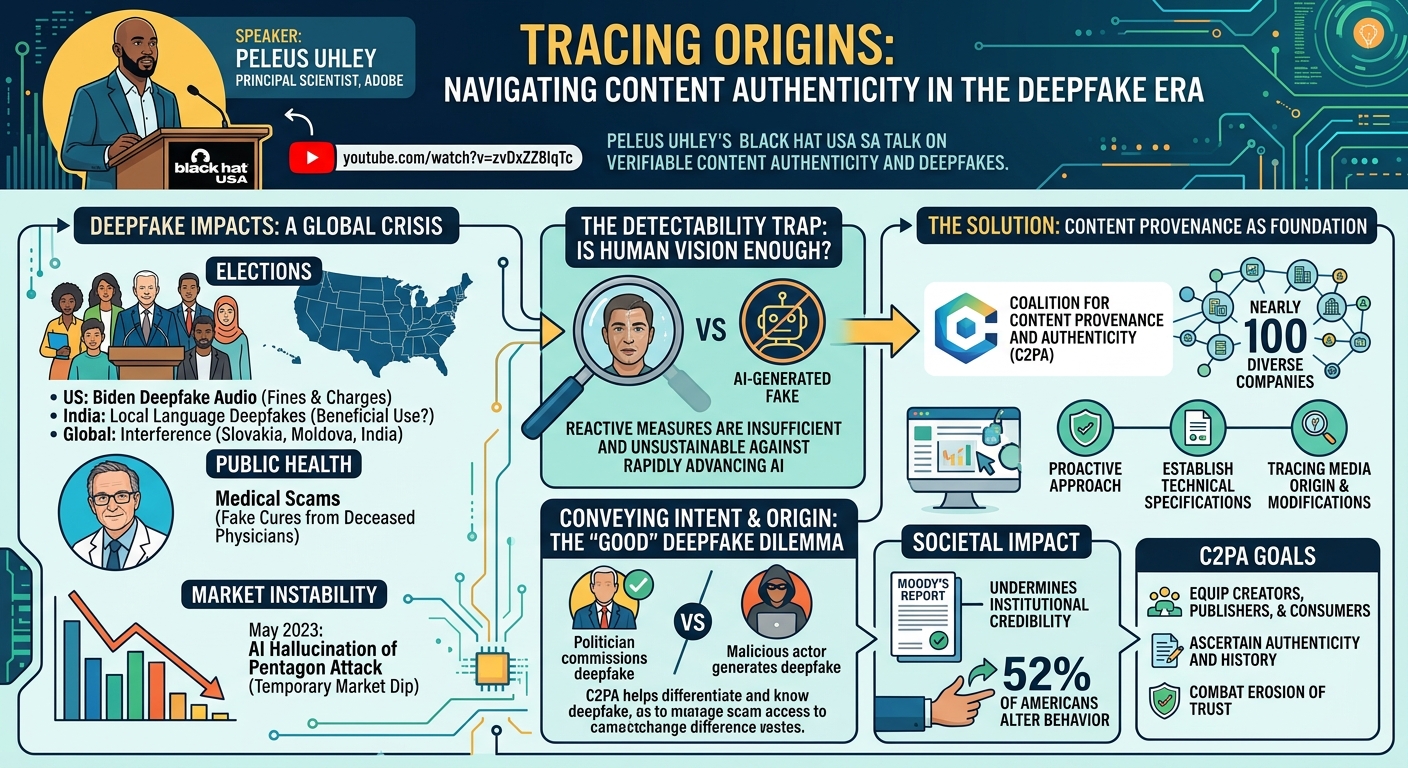
The talk highlighted the pervasive impact of deepfakes, citing examples from the US election cycle, where manipulated audio of President Biden led to criminal charges and similar content involving Kamala Harris circulated widely. Globally, with 64 countries (representing 49% of the world's population) heading to the polls in 2024, the threat of electoral interference through deepfakes is immense, as demonstrated by incidents in Slovakia, Moldova, and India. Beyond politics, deepfakes are being exploited for medical scams, with deceased trusted physicians like Michael Mosley being impersonated to promote fake cures, and even for causing market instability, such as the May 2023 AI hallucination of a Pentagon attack that temporarily dipped the stock market.
Uhley's presentation argued that current reactive measures—relying on human ability to spot anomalies—are insufficient and unsustainable against rapidly advancing AI technology. The C2PA, a collaborative initiative involving nearly 100 diverse companies, is working to establish technical specifications for tracing media origin and modifications. This proactive approach aims to equip creators, publishers, and consumers with the tools to ascertain the authenticity and history of digital content, thereby combating the erosion of trust in information and institutions.
Background
▶ Watch: Speaker introduction and overview of C2PA's mission (0:00)
The proliferation of deepfakes and other forms of manipulated media represents a profound challenge to information integrity and societal trust. As Uhley articulated, this is not a futuristic problem but a present crisis, with tangible impacts on elections, public health, and even financial markets. The 2024 election year, with its unprecedented global scale of democratic exercises, serves as a stark backdrop for the urgency of this issue. Examples include a deepfake of President Biden's voice that led to a $6 million fine and 26 criminal charges for its perpetrator, and more recent deepfakes targeting Kamala Harris. The problem is global, affecting countries like Slovakia, Moldova, and India, where deepfakes have been used to interfere with electoral processes, leading to arrests.
Beyond malicious intent, the speaker highlighted a nuanced aspect of deepfake usage: their intentional, non-malicious application. In India, for instance, national politicians have commissioned deepfakes of themselves speaking in local languages like Punjabi to better reach diverse electorates. This beneficial use, however, creates a complex dilemma: how do politicians communicate to the public which deepfakes are legitimate and which are malicious? This "good deepfake vs. bad deepfake" paradox underscores the inadequacy of mere detection and the need for a mechanism to convey intent and origin.
The broader societal impact is significant. A Moody's report indicated that deepfake political content undermines the credibility of US institutions. Public behavior is also changing dramatically: 52% of Americans have altered their social media usage, and 43% have reduced their overall news intake due to frustration with rampant fake news and disinformation. A Pew Research study further revealed that US adults under 30 now trust information from social media as much as from national news outlets, highlighting a critical shift in information consumption and trust.
Traditional methods of deepfake detection—such as looking for inconsistencies like too many fingers in an image or unnatural breathing patterns in audio—are rapidly becoming obsolete. While a 2022 study suggested over 50% of people felt they could reliably spot deepfake videos, and preliminary data from Henry Farid at UC Berkeley found over 60% could identify deepfake audio, these methods are easily circumvented. Uhley drew an analogy to computer-generated drum tracks, which sound "too perfect" until artificial errors are introduced to make them sound more realistic. Similarly, deepfake creators can easily introduce "imperfections" to bypass current detection techniques. This rapid evolution means that reliance on current detection capabilities is a losing battle; the focus must shift to future-proof solutions.
Existing efforts by entities like the FCC, Meta, and Google are described as "inconsistent" and lacking a "great way" to identify deepfakes at scale. While a "Tech Accord" was formed earlier this year by various companies to combat deceptive AI use in the 2024 elections, these efforts often remain fragmented or reactive. This landscape underscores the critical need for a standardized, industry-wide, and proactive approach to content authenticity, which is precisely the void the C2PA aims to fill. The Coalition, a project of the Linux Foundation Joint Development Foundation, was formed by merging the Content Authenticity Initiative and Project Origin, bringing together their collective expertise to tackle this global challenge.
Key Findings
▶ Watch: How politicians use deepfakes positively for communication (2:00)
The central finding presented by Peleus Uhley is the undeniable and urgent need to shift from a reactive deepfake detection paradigm to a proactive content provenance and authenticity framework. The talk elucidated several critical insights that underscore this shift:
Firstly, deepfakes are not exclusively malicious. The speaker's example of Indian politicians commissioning deepfakes to deliver messages in local languages illustrates a legitimate, even beneficial, use case. However, this introduces a significant challenge: distinguishing intentionally created, authentic deepfakes from malicious, deceptive ones. This nuance proves that simple detection of manipulation is insufficient; the public requires a clear understanding of the content's origin and intent.
Secondly, public trust in traditional news sources is eroding, particularly among younger demographics. A Pew Research study found that US adults under 30 now accord the same level of trust to social media as they do to national news outlets. This fundamental shift in information consumption habits, coupled with widespread disinformation, leads to public frustration, with 52% of Americans changing their social media usage and 43% reducing their overall news intake. This environment makes societies more vulnerable to manipulation and undermines the credibility of institutions, as reported by Moody's regarding deepfake political content.
Thirdly, current deepfake detection methods, whether manual (like counting fingers in images) or auditory (listening for speaking errors or unnatural enunciation), are inherently limited and easily overcome by the rapid advancements in AI technology. As Uhley noted, deepfakes "are going to be better tomorrow" than they are today. This technological arms race highlights the futility of relying solely on detection and necessitates a more robust, systemic solution that tracks content from its point of creation.
Fourthly, the solution lies in verifiable content provenance, which involves developing technical specifications to trace the origin and modification history of media. This approach, championed by the C2PA, aims to provide an auditable and trustworthy record for all forms of digital content. Instead of trying to spot fakes after they've been created, the C2PA seeks to provide a mechanism to verify what is real and how it has evolved.
Finally, addressing this complex global problem requires a multi-stakeholder, collaborative effort. The C2PA's membership, comprising nearly 100 companies from diverse sectors—including Big Tech (Microsoft, Google, Adobe), chipset manufacturers (Intel, ARM, Qualcomm), camera manufacturers (Leica, Nikon, Canon, Fujifilm), news and media organizations (BBC, CBC, France TV, WDR), certificate authorities (DigiCert), AI groups (OpenAI, Eleven Labs), and nonprofits (Witness, Partnership on AI, Society Library)—demonstrates a recognition that no single entity can solve this alone. This broad coalition is critical for developing and implementing a scalable, interoperable standard. The current C2PA specification, at version 2.X and approximately 200 pages, is designed to cover multiple media types, including images, videos, audio files, and PDFs, ensuring a comprehensive approach.
Technical Deep Dive
▶ Watch: Deepfakes undermine institutional credibility and news consumption (3:00)
The core technical contribution discussed in this talk revolves around the Coalition for Content Provenance and Authenticity (C2PA) and its efforts to establish robust technical specifications for content provenance and authenticity at scale. The C2PA's mission is explicit: "to develop technical specifications that can establish content provenance and authenticity at scale to give publishers, creators and consumers the ability to trace the origin of media." This is a fundamental shift from trying to detect deepfakes after the fact to embedding verifiable information about a piece of media from its inception.
At the heart of the C2PA framework is the concept of a content credential. This credential is a secure, tamper-evident record that travels with the content, documenting its creation and any subsequent modifications. When a piece of media is captured or created—whether it's an image from a camera, a video from a smartphone, or an audio recording—the device or software can embed initial provenance data. This data typically includes information about the creator, the device used, the date and time of creation, and potentially geographical metadata. Crucially, this information is cryptographically signed, making it highly resistant to tampering.
As the content undergoes modifications—for instance, an image being edited in Adobe Photoshop, a video being cut in a professional editing suite, or an audio file being remixed—each significant change triggers an update to the content credential. The editing software or platform would add a new "step" to the provenance chain, detailing the nature of the modification, the tools used, and the identity of the editor. This updated credential is then also cryptographically signed and attached to the content. This continuous chain of cryptographically linked records forms an immutable audit trail, allowing anyone to inspect the history of the content.
The C2PA specification, currently in version 2.X and spanning approximately 200 pages, is designed to be comprehensive and media-agnostic. It supports a wide array of media types, including images, videos, audio files, and PDFs. This broad coverage is essential because deepfakes and manipulated content can manifest in any of these forms. The specification defines the structure and format of the content credentials, the cryptographic mechanisms for signing, and the protocols for embedding and extracting this metadata.
Interoperability and standardization are critical components of the C2PA's technical strategy. The Coalition actively liaises with major international standards organizations such as the International Standards Organization (ISO), the International Press Telecommunications Council (IPTC), the European Telecommunications Standards Institute (ETSI), and the PDF Association. This collaboration ensures that the C2PA specifications are aligned with existing industry standards and can be seamlessly integrated into various workflows and technologies, from camera firmware to social media platforms and digital asset management systems. The goal is to make content provenance a ubiquitous feature, much like how digital certificates secure web traffic.
The technical implementation often involves embedding provenance data directly into the media file headers or alongside the content in a way that is compatible with existing file formats. While the speaker alluded to demonstrating this with "hex editors," implying a low-level view of how this data is physically embedded and secured within files, the core principle is the creation of a verifiable digital signature and a chain of custody for the content. This allows a user, or an automated system, to query the content's provenance, see who created it, what changes were made, and by whom, and verify that the content has not been tampered with since its last authenticated state.
The Threats and Harms Working Group, co-chaired by Uhley, plays a crucial role in shaping these technical specifications. By analyzing the evolving landscape of deepfake threats and their societal impacts, this group informs the C2PA's technical development, ensuring that the standards are robust enough to counteract current and future forms of content manipulation. This includes considering how to handle both malicious and intentionally created deepfakes, providing mechanisms for creators to declare their intent and for consumers to understand the context. The collaborative nature of the C2PA, bringing together diverse technical expertise from software developers, hardware manufacturers, and identity providers, is fundamental to building a truly scalable and effective solution.
Demo / Proof of Concept
▶ Watch: Deceased doctor Michael Mosley used in deepfake medical scams (3:50)
While the speaker, Peleus Uhley, explicitly mentioned early in the talk his intention to "go down to the point where I show you hex editors," implying a detailed technical demonstration of content provenance embedding, the provided transcript does not contain the specifics of such a demonstration. The transcript focuses heavily on the problem statement, the societal impact of deepfakes, and the collaborative efforts of the C2PA to develop technical specifications.
Had a demo been detailed, it would likely have showcased the practical application of C2PA standards. This would typically involve:
- Content Creation and Initial Credentialing: Demonstrating how a piece of media (e.g., an image taken with a C2PA-compliant camera or created in an application like Adobe Photoshop) automatically receives its initial content credential, including metadata about the creator, device, and timestamp, all cryptographically signed.
- Modification and Credential Update: Showing how editing the content in a compliant application (e.g., cropping an image, adding a filter, or altering an audio track) triggers an update to the content credential, adding a new entry to the provenance chain that details the modification and the identity of the editor, again with cryptographic signatures.
- Verification and Display: Presenting a tool or interface (perhaps a browser plugin or a dedicated C2PA viewer) that can read the embedded content credentials. This tool would then display the full provenance history to the user in an easily understandable format, indicating the origin, modifications, and any potential tampering.
- Tampering Detection: Potentially demonstrating how attempts to alter the content without updating the credential would be flagged by the verification tool, indicating a break in the provenance chain and thus potential unauthorized manipulation.
- Hex Editor View (Implied): The mention of hex editors suggests a low-level view of the actual bytes within a media file, illustrating where and how the C2PA metadata blocks are embedded, the cryptographic signatures, and how these resist casual alteration. This would underscore the technical robustness of the solution.
Although the specifics are absent from the transcript, the talk's emphasis on "tracing origins" and "content provenance" strongly implies that such a demonstration would visually articulate the journey of a piece of media from creation to consumption, with its verifiable history intact. This would serve to highlight the C2PA's capability to provide a transparent and trustworthy record of digital content, contrasting it with the opacity of unverified deepfakes.
Defensive Implications
▶ Watch: AI hallucination of Pentagon attack caused stock market dip (7:40)
The work of the C2PA and the principles articulated by Peleus Uhley offer crucial defensive strategies against the pervasive threat of deepfakes and manipulated media. These implications span creators, platforms, consumers, and policymakers, advocating for a holistic shift in how digital content is produced, distributed, and consumed.
For content creators and publishers, adopting C2PA standards is paramount. This means integrating C2PA-compliant tools and workflows that automatically embed and maintain content credentials from the point of capture or creation. By signing their content, creators can establish a verifiable record of its origin and any subsequent modifications. This not only protects their intellectual property but also provides a clear mechanism to distinguish their legitimate work, including intentionally created deepfakes (e.g., for translation), from malicious forgeries. For news organizations, this provides a powerful tool to reinforce journalistic integrity and combat disinformation by offering transparent provenance for their reporting.
Digital platforms—social media networks, news aggregators, and content hosting services—have a critical role in integrating C2PA verification capabilities. Platforms should develop and deploy tools that can read and interpret content credentials, providing users with clear indicators of a piece of media's provenance. This could manifest as a visible badge, a clickable link to a detailed provenance history, or an alert for content lacking verifiable credentials. By doing so, platforms can empower their users to make informed decisions about the trustworthiness of the content they encounter, thereby mitigating the spread of disinformation and enhancing the overall information ecosystem. The current "inconsistent" efforts of Meta and Google can evolve into a standardized, interoperable approach.
For consumers, the defensive implication is to cultivate a new form of digital literacy: learning to look for and understand provenance indicators. Just as users learn to identify secure websites by HTTPS, they will need to recognize C2PA-verified content. This involves being inherently skeptical of content that lacks verifiable origin, particularly in sensitive domains like political news, health information, or financial alerts. Educational campaigns will be essential to inform the public about the meaning of content credentials and how to utilize tools that display them.
Hardware manufacturers, especially those producing cameras, smartphones, and audio recording devices, are foundational to this defense. Integrating C2PA functionality directly into hardware firmware ensures that provenance data is captured at the earliest possible stage, making it more robust and harder to tamper with. Chipset manufacturers like Intel, ARM, and Qualcomm, along with camera manufacturers such as Leica, Nikon, Canon, and Fujifilm, are already part of this coalition, indicating a commitment to embedding this capability at the source.
Finally, policymakers and regulators must consider C2PA standards as a framework for future legislation. As demonstrated by the EU's recent AI laws and US bills protecting voices from misuse, governments are increasingly concerned with regulating AI and deepfakes. Integrating C2PA's open technical specifications into these regulations can provide a consistent, technology-agnostic mechanism for accountability and transparency across jurisdictions. This would move beyond punitive measures to establish a proactive standard for content integrity. By fostering a legal and technical environment that supports provenance, policymakers can help restore public trust in digital information and safeguard democratic processes and public well-being.
In essence, the defensive strategy is to create a digital environment where the authenticity of content is a default expectation, rather than a constant struggle for verification. This shift from reactive detection to proactive provenance, enabled by cross-industry collaboration and standardized technical specifications, is the most robust defense against the escalating threat of deepfakes.
Key Takeaways
- Deepfakes are an escalating, multifaceted threat: They impact global elections (64 countries/49% of world population in 2024), public health (scam medical cures promoted by deepfakes of trusted physicians like Michael Mosley), and financial stability (e.g., May 2023 AI hallucination of Pentagon attack causing stock market dip). They can also be used intentionally for legitimate purposes, complicating detection.
- Traditional detection methods are insufficient: Relying on human ability to spot anomalies (e.g., counting fingers, identifying speaking errors) is increasingly ineffective against rapidly advancing AI, which can easily introduce "realistic" imperfections to bypass detection.
- Content provenance is the core solution: The Coalition for Content Provenance and Authenticity (C2PA) is developing open technical specifications (version 2.X, ~200 pages) to establish a verifiable, tamper-evident record of a piece of media's origin and modification history across images, videos, audio, and PDFs.
- Collaboration is critical for scale: Combating deepfakes requires a broad, multi-industry effort, as demonstrated by the C2PA's nearly 100 member companies, including tech giants (Microsoft, Google, Adobe), hardware manufacturers (Intel, Nikon, Canon), news organizations (BBC, CBC), certificate authorities (DigiCert), and AI groups (OpenAI, Eleven Labs).
- Public trust is eroding, demanding transparency: With US adults under 30 trusting social media as much as national news, and significant portions of the public reducing news intake due to disinformation, transparent content provenance is essential to restore confidence in information sources and institutions.
- Proactive defense over reactive detection: The C2PA's approach shifts the focus from attempting to detect deepfakes after they are created to providing a robust, verifiable chain of custody for all digital content, enabling users to ascertain authenticity from the source.
About the Speaker(s)
Peleus Uhley is a Principal Scientist at Adobe, a company deeply involved in digital content creation and authenticity initiatives. In addition to his role at Adobe, Uhley serves as the co-chair of the Threats and Harms Working Group for the Coalition for Content Provenance and Authenticity (C2PA). In this capacity, he plays a crucial role in analyzing and understanding the evolving landscape of malicious AI and deepfake threats, informing the technical specifications developed by the C2PA. His work helps ensure that the coalition's standards are robust and effective in combating current and future forms of content manipulation. Uhley describes himself as the "scary person" in the working group, focusing on the threats, while his co-chair, Hacobo Castianos from Witness, addresses the harms.