TuDoor Attack: Systematically Exploring and Exploiting Logic Vulnerabilities
Unknown
Black Hat USA 2024 · Day 1 · Briefing
Overview
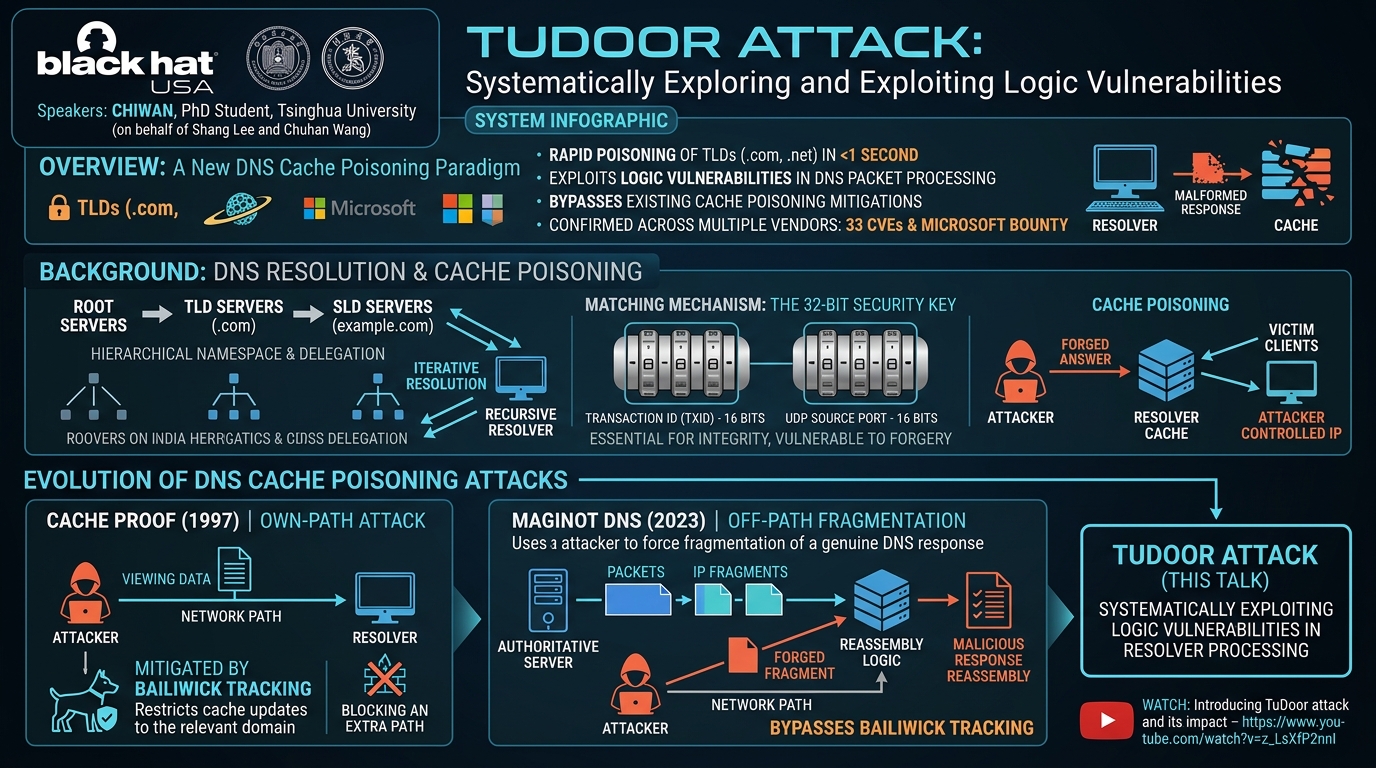
The "TuDoor Attack" presentation at Black Hat USA unveiled a novel class of DNS cache poisoning attacks that systematically exploit logic vulnerabilities in how DNS resolvers process malformed packets. Presented by Chiwan from Tsinghua University on behalf of his colleagues Shang Lee and Chuhan Wang, the talk detailed a new set of DNS-based attacks, collectively termed TuDoor, capable of rapidly poisoning arbitrary top-level domains like .com and .net within a mere second. This discovery represents a significant leap in the ongoing cat-and-mouse game between DNS defenders and attackers, highlighting critical oversights in current DNS response processing logic.
Key moments
- 0:00 Introducing TuDoor attack and its impact
- 1:00 DNS fundamentals and cache poisoning explanation
- 4:00 Retrospect: On-path Cache Proof attack and bailiwick tracking
- 5:30 Retrospect: Off-path Kaminsky attack and source port randomization
- 6:40 Retrospect: Fragmentation-based attacks and mitigations
- 8:00 TuDoor's novel mechanism: CNAME chains for fragmentation
- 8:15 TuDoor attack impact, CVEs, and vendor recognition
TuDoor Attack: Systematically Exploring and Exploiting Logic Vulnerabilities
Speakers: Chiwan, PhD Student, Tsinghua University (on behalf of Shang Lee and Chuhan Wang)
Conference: Black Hat USA
YouTube: https://www.youtube.com/watch?v=z_LsXfP2nnI
Overview
The "TuDoor Attack" presentation at Black Hat USA unveiled a novel class of DNS cache poisoning attacks that systematically exploit logic vulnerabilities in how DNS resolvers process malformed packets. Presented by Chiwan from Tsinghua University on behalf of his colleagues Shang Lee and Chuhan Wang, the talk detailed a new set of DNS-based attacks, collectively termed TuDoor, capable of rapidly poisoning arbitrary top-level domains like .com and .net within a mere second. This discovery represents a significant leap in the ongoing cat-and-mouse game between DNS defenders and attackers, highlighting critical oversights in current DNS response processing logic.
The talk emphasized that despite decades of research and mitigation efforts against DNS cache poisoning, fundamental weaknesses persist. TuDoor leverages specific malformations within DNS responses, particularly those designed to force IP fragmentation, to bypass established security mechanisms. The research has led to the confirmation of vulnerabilities across various affected software vendors, resulting in the publication of 33 CVE IDs and a bounty award from Microsoft, underscoring the severity and widespread impact of these findings. This work not only introduces a potent new attack vector but also calls for a fundamental re-evaluation and standardization of DNS response processing to account for complex, "corner processing cases" that attackers can exploit.
Background
▶ Watch: Introducing TuDoor attack and its impact (0:00)
The Domain Name System (DNS) serves as the internet's foundational directory, translating human-readable domain names into machine-readable IP addresses. This critical function underpins virtually all internet communications, from web browsing to content delivery networks (CDNs). DNS operates on a hierarchical namespace, with root servers delegating authority to Top-Level Domains (TLDs) like .com and .net, which in turn delegate to Second-Level Domains (SLDs). Resolution typically involves a client sending a query to a configured forwarder or recursive resolver, which then performs an iterative process, querying various authoritative servers until a valid response is obtained. These responses are subsequently cached by all intermediate resolvers to expedite future queries.
The integrity of DNS resolution relies heavily on matching queries to their corresponding responses. This matching is primarily performed using two fields within the DNS packet: the 16-bit Transaction ID (TXID) and the 16-bit source port. Combined, these fields offer a 32-bit identification space for each unique query. However, the UDP-based nature of DNS makes it inherently susceptible to cache poisoning attacks, where attackers inject forged answers into a resolver's cache. Once poisoned, subsequent queries for the affected domain will resolve to an IP address controlled by the attacker, enabling various forms of hijacking.
Historically, DNS cache poisoning has evolved through several significant attack waves and subsequent mitigations:
- Cache Proof (1997): An early own-path attack where an attacker, positioned on the network path between the resolver and the authoritative server, could observe the TXID and source port to inject forged responses. This was mitigated by bailiwick tracking, which restricts resolvers to only accept answers from the same domain as the requested name, preventing unrelated records from being cached.
- Maginot DNS (2023): Decades after Cache Proof, Maginot DNS demonstrated that bailiwick tracking could be circumvented. By forcing IP fragmentation on the authoritative server, attackers could send forged fragments that would bypass bailiwick checks, illustrating that even long-standing mitigations can be broken by novel techniques.
- Kaminsky Attack (2008): A prominent off-path attack that leveraged the birthday paradox to guess the TXID. Attackers would send numerous forged responses with different TXIDs for various subdomains before the legitimate response arrived. The limited 16-bit TXID space made this attack feasible. The primary mitigation was source port randomization, which, when combined with TXID randomization, expanded the guessing space to 32 bits (over 4 billion possibilities), making brute-forcing impractical for off-path attackers.
- Fragmentation-Based Attacks (Post-2008): Even with source port randomization, attackers discovered ways to exploit IP fragmentation. When a large DNS packet is fragmented, the second and subsequent fragments often lack the original validation fields (source port, TXID) present in the first fragment. Attackers could inject forged second fragments, exploiting this lack of validation. This was addressed by IPID randomization and fragmentation restriction implemented in OS kernels, aiming to make it harder for attackers to predict or inject fragments.
However, the research leading to TuDoor identified a critical flaw in these fragmentation mitigations. The Tsinghua University lab found that by increasing the packet size with CNAME chains, fragmentation-based attacks could still be made to work. While triggering fragmentation for normal responses is difficult, an attacker controlling a domain can craft responses with excessively long CNAME chains, forcing the DNS packet to exceed the Maximum Transmission Unit (MTU) and thus necessitating fragmentation. This insight forms the foundational precursor to the TuDoor attack, demonstrating that the problem of fragment exploitation was not fully resolved.
Key Findings
▶ Watch: Retrospect: On-path Cache Proof attack and bailiwick tracking (4:00)
The core discovery presented in the TuDoor talk is a new class of DNS cache poisoning attacks that systematically identifies and exploits logic vulnerabilities within DNS resolvers' response processing mechanisms. These vulnerabilities are triggered by malformed packets, specifically crafted to bypass existing security checks and leverage "corner processing cases" that have historically been overlooked.
The key findings can be summarized as follows:
- Novel Attack Vector: TuDoor represents a distinct and powerful set of DNS-based attacks that exploit flaws in the logic of how resolvers handle unusual, yet structurally plausible, DNS responses. This moves beyond simple brute-force guessing or direct observation of network traffic.
- Rapid and Widespread Poisoning: The attack demonstrates unprecedented efficiency, capable of poisoning arbitrary top-level domains, such as
.comand.net, within a mere one second. This rapid execution highlights the profound impact and potential for large-scale internet disruption. - Systematic Vulnerability Exploration: The research wasn't a discovery of a singular, isolated bug but rather a systematic approach to explore and identify a range of logic vulnerabilities. This implies a methodology that could potentially uncover similar flaws in other complex network protocols.
- Leveraging Malformed Packets: TuDoor's efficacy stems from its ability to craft "malformed packets" that, while not necessarily violating strict protocol syntax, trigger unexpected and exploitable behavior in resolver logic. The talk specifically identified the use of CNAME chains as a key mechanism to increase packet size and force IP fragmentation, circumventing existing fragmentation restrictions.
- Confirmed by Vendors and Significant Impact: The findings were confirmed by all affected vendors, leading to the issuance of 33 distinct CVE IDs. Microsoft notably awarded a bounty for the disclosure, underscoring the critical nature and broad applicability of these vulnerabilities across various DNS resolver implementations.
- Call for Standardization: A crucial takeaway from the research is the need to standardize DNS response processing logic. The existing implementations often lack a unified, robust approach to handling complex and unusual scenarios, leaving gaps that attackers like TuDoor can exploit via side channels.
In essence, TuDoor reveals that even with advanced mitigations like source port randomization and IPID randomization in place, the intricate logic governing DNS response parsing and validation remains a fertile ground for sophisticated attackers. By focusing on how resolvers interpret and process responses, rather than just how they authenticate them, TuDoor bypasses a generation of defensive measures.
Technical Deep Dive
▶ Watch: Retrospect: Off-path Kaminsky attack and source port randomization (5:30)
The technical ingenuity of the TuDoor attack lies in its systematic exploitation of subtle logic vulnerabilities within DNS resolvers, primarily by manipulating DNS packet structures to induce specific, exploitable conditions. While the transcript does not delve into the exact byte-level malformations beyond the high-level concept, it firmly establishes the foundational technique: leveraging CNAME chains to force IP fragmentation and then exploiting the subsequent processing of these fragments.
At its core, TuDoor builds upon the previously acknowledged, yet incompletely mitigated, threat of fragmentation-based attacks. Earlier mitigations, such as IPID randomization and fragmentation restrictions in OS kernels, aimed to make it exceedingly difficult for off-path attackers to inject valid fragments. However, the TuDoor research identified a critical bypass: an attacker can force fragmentation. This is achieved by controlling an authoritative DNS server and crafting a response that contains an unusually long or complex CNAME chain. A CNAME (Canonical Name) record maps one domain name to another, and legitimate responses can contain multiple CNAMEs. By chaining many CNAME records, the overall size of the DNS response packet can be inflated.
When a DNS response packet exceeds the Maximum Transmission Unit (MTU) of the network path, the IP layer is forced to fragment it into smaller pieces. This is where the crucial logic vulnerability comes into play. As noted in the background, previous fragmentation attacks exploited the fact that the second and subsequent fragments often lack the full validation headers (like source port and TXID) present in the initial fragment. While IPID randomization was intended to prevent an attacker from guessing the correct IP Identification field for these fragments, forcing fragmentation from a controlled authoritative server changes the attack surface. The legitimate resolver expects these fragments, and the attacker's goal is to subtly alter one of these fragments to introduce malicious data after the initial validation has occurred or within a context where validation is incomplete.
The "logic vulnerabilities" themselves are not explicitly detailed in the provided transcript, but they can be inferred as flaws in the resolver's state machine or parsing routines. For instance, a resolver might:
- Perform initial validation (source port, TXID) on the first fragment.
- Reassemble subsequent fragments without re-validating the entire DNS message structure or its contents against the original query's expectations.
- Have specific code paths for handling CNAME chains that introduce unexpected side effects when combined with fragmentation.
- Fail to correctly handle "corner processing cases" where the malformed packet, while syntactically acceptable in isolation, leads to an exploitable condition when reassembled or processed in a specific sequence.
The mention of a "side channel" further suggests that the malformed packets might not directly inject malicious data but rather manipulate the resolver's internal state or behavior in a way that leaks information or allows for indirect control over the cache. For example, a malformed fragment might trigger an error condition that causes the resolver to accept a subsequent, otherwise invalid, response, or it might alter the domain name being processed in a way that circumvents bailiwick checks.
Crucially, TuDoor effectively bypasses the 32-bit guessing space (TXID + source port randomization) that was a primary defense against off-path Kaminsky-style attacks. By forcing fragmentation from a controlled domain, the attacker doesn't need to guess these values for a random legitimate query. Instead, they initiate a query for their own domain, receive the fragmented response, and then exploit the resolver's processing of those specific fragments. The attack transitions from a guessing game to a precise manipulation of the resolver's internal logic upon reassembly and parsing of the intentionally oversized, fragmented response. This sophisticated manipulation of legitimate protocol mechanisms to trigger underlying logic flaws is what makes TuDoor a formidable new threat.
Demo / Proof of Concept
▶ Watch: TuDoor's novel mechanism: CNAME chains for fragmentation (8:00)
While the presentation transcript does not detail a specific step-by-step demonstration segment, the impact and effectiveness of the TuDoor attack were clearly demonstrated and quantified. The speaker confidently stated that "our TuDoor attack could poison arbitrary domains like .com and .net within just one second." This bold claim serves as the de facto proof of concept, highlighting the attack's speed, efficiency, and broad applicability.
The underlying mechanism for this rapid poisoning would involve an attacker performing the following sequence:
- Attacker-Controlled Domain Setup: The attacker registers a domain (e.g.,
attacker.com) and sets up an authoritative DNS server for it. - Forced Fragmentation: The attacker configures their authoritative server to respond to queries for
attacker.comwith an intentionally oversized DNS response. This response is meticulously crafted to include a long chain of CNAME records, ensuring that the packet size exceeds the typical MTU and is forced to fragment at the IP layer. - Initiating a Query: The attacker or a confederate sends a DNS query to the target recursive resolver for a subdomain under
attacker.com(e.g.,www.attacker.com). - Exploiting Logic Vulnerabilities: As the target recursive resolver attempts to resolve
www.attacker.com, it queries the attacker's authoritative server. The attacker's server then sends the fragmented, CNAME-chain-laden response. During the reassembly and processing of these fragments, the pre-identified logic vulnerabilities in the resolver are triggered. - Cache Poisoning: The logic vulnerability allows the attacker to inject malicious records into the resolver's cache. This might involve an unexpected interaction between the CNAME chain and the fragmentation, leading to the resolver caching an
Arecord for a target domain (e.g.,example.comor even.comitself) that points to an IP address controlled by the attacker. - Arbitrary Domain Impact: The "arbitrary domains" aspect implies that the logic vulnerability, once triggered, allows for a broad scope of cache manipulation, potentially affecting any domain the attacker chooses, including critical TLDs. The "one second" timeframe suggests that the entire process, from query initiation to cache poisoning, is nearly instantaneous, indicating a highly efficient and non-brute-force exploitation.
The successful exploitation leading to 33 CVEs and a Microsoft bounty further validates the practical demonstration of this attack, confirming its real-world feasibility and significant security implications across a range of DNS resolver implementations. While the specific network traffic or code snippets of the PoC were not detailed in the transcript, the stated impact is a clear testament to its successful implementation.
Defensive Implications
▶ Watch: TuDoor attack impact, CVEs, and vendor recognition (8:15)
The discovery of the TuDoor attack necessitates a critical re-evaluation of DNS resolver security and highlights several urgent defensive implications for network operators, software developers, and security professionals:
- Standardize DNS Response Processing Logic: The most significant implication, explicitly stressed by the speakers, is the need to standardize DNS response processing logic to rigorously consider "corner processing cases." Current implementations often feature divergent and complex logic for handling unusual or malformed responses, leading to exploitable inconsistencies. A unified, robust standard, perhaps involving formal verification or extensive fuzz testing against a broad range of malformed packets, is essential to eliminate these logic vulnerabilities.
- Enhanced Validation of Fragmented DNS Responses: Despite previous mitigations, TuDoor demonstrates that fragmentation-based attacks are still viable. Defenders must ensure that their DNS resolvers implement highly robust validation not only for the initial fragment (TXID, source port) but also for the reassembled DNS message as a whole. This includes strict checks on the consistency and integrity of all records within a reassembled message, particularly when CNAME chains are involved, and ensuring that no part of the message can bypass bailiwick or other contextual checks.
- Scrutiny of CNAME Chains and Packet Size: Resolvers should implement stricter policies regarding the maximum length and complexity of CNAME chains, especially when originating from newly delegated or untrusted authoritative servers. While CNAME chains are a legitimate part of DNS, excessively long chains that force fragmentation could be flagged for additional scrutiny or rate-limiting. Operators might consider setting stricter limits on the maximum size of accepted DNS responses to mitigate forced fragmentation.
- Regular Software Updates and Patching: Given the 33 CVEs published as a result of TuDoor, it is paramount for organizations to prioritize and promptly apply updates and patches released by their DNS resolver vendors. These patches will address the specific logic vulnerabilities identified by the research.
- Deep Code Review and Fuzzing: DNS resolver developers must conduct deep architectural and code reviews, focusing on the parsing, reassembly, and validation logic for complex DNS responses, especially those involving fragmentation, CNAMEs, and other rarely encountered configurations. Extensive fuzz testing with purposefully malformed and oversized DNS packets, specifically targeting known "corner cases," should become a standard part of the development lifecycle.
- Monitoring for Anomalous DNS Traffic: Network defenders should monitor DNS traffic for unusual patterns, such as an excessive number of fragmented DNS responses, unusually large DNS responses, or responses with highly complex CNAME chains, particularly those originating from new or suspicious authoritative servers. While not a direct prevention, such monitoring can aid in early detection of ongoing attacks.
- Consider DNS-over-TLS/HTTPS (DoT/DoH): While not a direct mitigation for logic vulnerabilities within resolvers, the use of encrypted DNS protocols like DoT or DoH can prevent on-path attackers from observing or injecting forged fragments at the network level. However, if the attack originates from a compromised authoritative server, encryption alone will not prevent the resolver from processing a malformed, fragmented response.
The TuDoor attack underscores that the security of foundational internet protocols like DNS is an ongoing challenge. Continuous vigilance, rigorous protocol adherence, and robust implementation validation are crucial to protect against sophisticated, logic-based attacks.
Key Takeaways
- TuDoor is a novel class of DNS cache poisoning attacks that systematically exploits logic vulnerabilities in DNS resolvers' response processing.
- The attack achieves rapid and widespread impact, capable of poisoning arbitrary top-level domains like
.comand.netwithin a single second. - TuDoor primarily leverages malformed packets, specifically by using excessively long CNAME chains to force IP fragmentation, bypassing existing fragmentation restrictions and source port randomization.
- The research led to the disclosure of 33 CVE IDs and a bounty from Microsoft, confirming the critical nature and broad applicability of these vulnerabilities across various DNS resolver implementations.
- A fundamental defensive implication is the urgent need to standardize DNS response processing logic to account for complex "corner processing cases" and ensure robust validation of all parts of DNS responses, especially fragmented ones.
- Defenders must prioritize software updates, conduct deep code reviews, and employ extensive fuzz testing to mitigate these sophisticated logic-based vulnerabilities.
About the Speaker(s)
The presentation was delivered by Chiwan, a PhD student from Tsinghua University. He presented the research on behalf of his colleagues, Shang Lee and Chuhan Wang, who are also credited with the work. Shang Lee is specifically mentioned as the first author of the detailed research. Their work from Tsinghua University focuses on identifying and exploiting deep-seated vulnerabilities within critical internet infrastructure like the DNS.